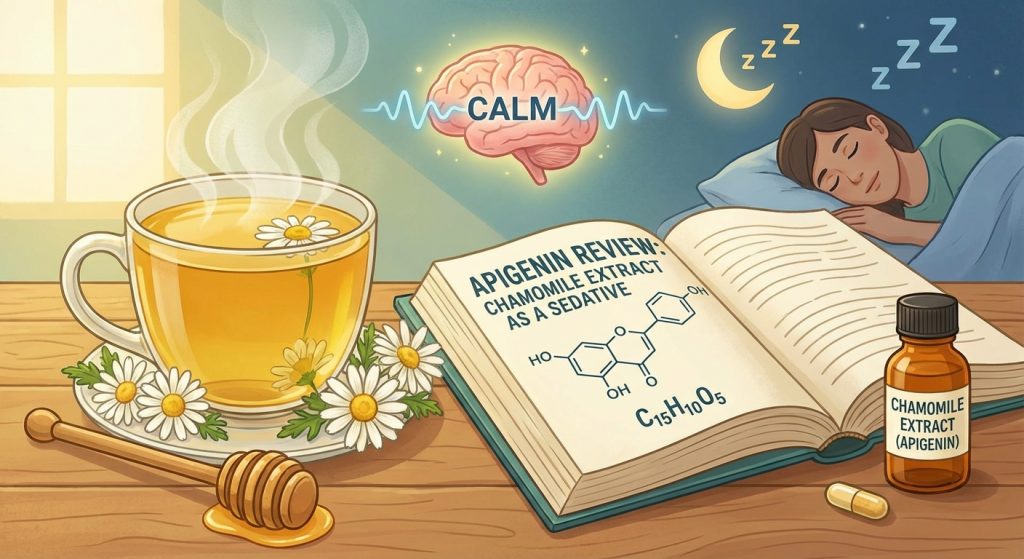
You have likely heard of drinking Chamomile tea for sleep. It’s an ancient remedy. But recently, biohackers and neuroscientists like Andrew Huberman have been advocating for something stronger: isolated Apigenin.
Apigenin is the bioactive flavonoid found in chamomile that actually makes you sleepy. By extracting it and taking it in higher doses (50mg), proponents claim you can turn off the “racing mind” and induce relaxation similar to weak benzodiazepines, but without the addiction risk.
In this review, we will analyze the science behind apigenin benefits, investigate why the source material matters (Greek vs. Generic chamomile), and I (Alex) will share my high rating for this supplement in my nightly stack.
The Source: Why Chamomile Tea Often Fails
Most people have tried supermarket chamomile tea and found it underwhelming.
- The Dosage Problem: A standard tea bag might contain 1% to 2% apigenin by weight. To get a therapeutic dose of 50mg, you would need to drink liters of tea right before bed, which would cause you to wake up to pee (Nocturia).
- The Quality Problem: Not all chamomile is created equal. Is chamomile the same as apigenin? Yes, apigenin is the active ingredient, but the concentration varies wildly depending on the soil and climate.
Alex’s Experience with Raw Sourcing:
I have personally tested chamomile tea brought directly from the mountains of Crete (Greece). It was potent and induced sleep almost immediately. Compare this to generic Eastern European chamomile tea bags found in grocery stores, which felt like drinking hot water. The terroir matters. If you buy an Apigenin supplement, you are essentially buying a concentrated version of that high-quality Cretan tea, bypassing the need to drink a gallon of fluid.
The Science: How Apigenin Works on the Brain
What does apigenin do to the brain?
Apigenin is unique because it crosses the blood-brain barrier and binds to benzodiazepine receptors (specifically the GABA-A receptor sites).
- GABA: This is the brain’s primary inhibitory neurotransmitter. It calms nerve activity.
- The Mechanism: Instead of chemically forcing these channels open to induce heavy sedation, Apigenin acts as a modulator. It increases the calming effect of GABA that is already present. This turns down the volume of your internal monologue.
Does apigenin increase dopamine?
Some studies suggest it may also inhibit CD38 and increase NAD+ levels, which can indirectly support dopamine and testosterone, but its primary effect for sleep is via GABA.
Is apigenin an estrogen blocker?
There is some evidence in vitro (test tubes) that apigenin can bind to estrogen receptors, but at the 50mg dosage used for sleep, this is generally considered negligible for most people. However, those with hormone-sensitive conditions should consult a doctor.
Reddit & Community Consensus
What do real users say on r/HubermanLab and r/Supplements?
The Good:
- “The Off-Switch”: The most common report is that Apigenin excels at stopping “ruminating thoughts.” If you lay in bed planning tomorrow’s meeting, Apigenin is the specific tool for that.
- “Stacking Synergy”: Users often report it works best when combined with Magnesium L-Threonate. The magnesium relaxes the body, while apigenin relaxes the mind.
- “No Hangover”: Unlike melatonin or antihistamines, few people report grogginess the next day.
The Bad:
- “Stomach Issues”: Some users report mild gastrointestinal upset if taken on an empty stomach.
- “Tolerance?”: Can I take apigenin every night? Most users do without issue, but some report cycling it (5 days on, 2 days off) keeps it effective.
- “Weak Effect”: For people with severe, chronic insomnia, Apigenin alone is rarely enough. It is a nudger, not a hammer.
Alex’s Personal Review
The following is based on my personal logs.
I was skeptical. I thought it was just “tea in a pill.” I was wrong.
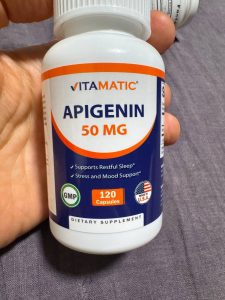
I tested three different brands of Apigenin. Two were mediocre. One (Itamatic) was excellent.
My Experience:
- I take 50mg of Apigenin roughly 60 minutes before bed.
- The sensation is distinct. It is not a heavy sedation. It feels like a “mental exhale.” The urgency of my thoughts fades. If I combine this with a small cup of my imported Greek chamomile tea, the effect is profound—I am asleep within 15 minutes.
My Rating: 9/10
This is one of the few supplements I notice immediately if I miss a dose. It is reliable. It doesn’t knock me out, but it opens the door to sleep. It is a permanent fixture in my stack alongside Magnesium.
Where to Buy:
I personally use Itamatic Apigenin because it consistently works for me. Quality control with herbal extracts is notoriously difficult, so once you find a brand that works, stick to it.
Dosage and Safety
How much apigenin for sleep?
The standard researched dose (and the Huberman recommendation) is 50mg. Some people go up to 100mg or 200mg, but higher doses can actually be less effective or cause grogginess. Start low.
Is apigenin hard on the liver?
Generally, no. It is a flavonoid found in parsley, celery, and chamomile. However, like grapefruit juice, it can affect liver enzymes (CYP2C9), which might slow the breakdown of other medications. If you are on blood thinners or other prescription drugs, check with your doctor.
Can you take apigenin with magnesium?
Yes. In fact, you should. They work on different pathways to achieve the same goal: relaxation.
Update for December 2025
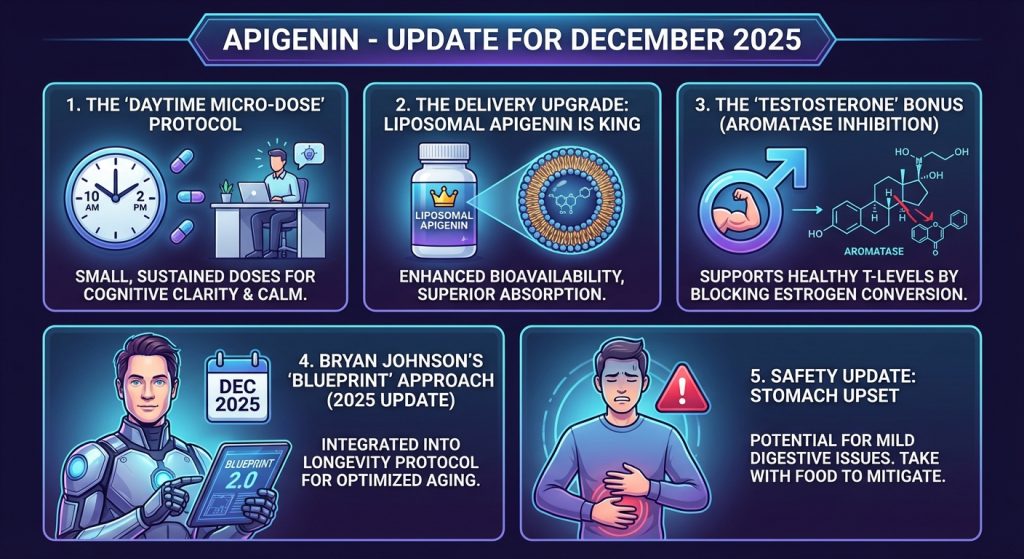
Since I first published this review, Apigenin has graduated from a simple “sleep aid” to a cornerstone of the longevity community. The conversation has shifted from “does it make me sleepy?” to “how does it affect cellular aging?”
Here is the critical new information for late 2025, analyzed through the lens of current biohacking protocols.
1. The “Daytime Micro-Dose” Protocol
In 2025, many biohackers have stopped taking Apigenin exclusively at night.
The Problem: Some users found 50mg at night caused morning grogginess or vivid dreams.
The Fix: Taking 10mg-25mg with morning coffee.
The Benefit: At low doses, Apigenin calms the “jittery” side effects of caffeine without causing sleepiness. It acts as an anxiolytic buffer, smoothing out your productivity curve.
2. The Delivery Upgrade: Liposomal is King
My original review discussed standard powder. In 2025, Liposomal Apigenin has become the gold standard.
Why: Standard apigenin has notoriously poor bioavailability. Liposomal encapsulation protects it from stomach acid.
The Math: A 25mg Liposomal dose is often functionally equivalent to 100mg of standard powder. If you switch to a high-tech brand (like Renue by Science or Quicksilver), cut your dose in half initially.
3. The “Testosterone” Bonus (Aromatase Inhibition)
A massive topic in men’s health forums in late 2025 is Apigenin’s role as a mild Aromatase Inhibitor.
The Science: Studies suggest Apigenin can inhibit the enzyme CYP19 (aromatase), which converts testosterone into estrogen.
The Biohack: Natural bodybuilders and men on TRT are adding Apigenin to their stack not just for sleep, but to keep estrogen levels in check naturally. It aligns perfectly with the goal of optimizing hormonal health while fixing sleep.
4. Bryan Johnson’s “Blueprint” Approach (2025 Update)
As of late 2025, tech biohacker Bryan Johnson continues to use Apigenin, but his focus has sharpened on the CD38 pathway.
The Longevity Link: Apigenin inhibits CD38, an enzyme that degrades NAD+ (essential for cellular energy). By blocking CD38, Apigenin indirectly boosts NAD+ levels during sleep.
The Protocol: He uses it as part of a “Cellular Repair” evening stack, rather than just a sedative.
5. Safety Update: Stomach Upset
A recurring report from long-term users in 2025 involves mild gastrointestinal discomfort with high doses (>100mg).
The Fix: Always take Apigenin with a small amount of fat (like almond butter or yogurt), as it is fat-soluble. This significantly reduces nausea and improves absorption.
Summary
Apigenin is the biohacker’s upgrade to chamomile tea. It solves the problem of dosage and nocturia (peeing at night) while delivering potent anxiety relief.
- Who is it for? People with “racing minds” or anxiety-induced insomnia.
- Who is it NOT for? People expecting a pharmaceutical-grade knockout punch.
If you want natural sedation that mimics the best quality tea from the Greek mountains without the bathroom trips, 50mg of Apigenin is the answer.

By: Alex Warenstein.
Bio: Alex Warenstein is a sleep biohacker and founder of Night Time Comfort. After battling chronic insomnia and circadian disruption, he now helps others optimize their sleep using data-driven protocols. Read full story.
Disclaimer: Alex is not a doctor. This content is for educational purposes only. Always consult a specialist.