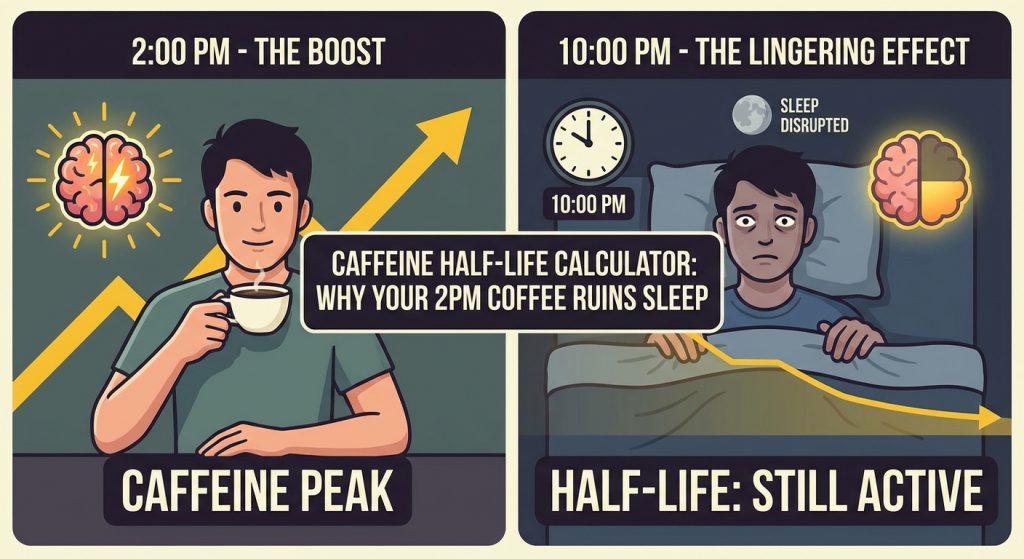
You drink a coffee at 4:00 PM to power through the end of the workday. You fall asleep at 11:00 PM without any issues. You wake up the next morning feeling groggy, so you reach for another coffee.
If you can fall asleep after late coffee, it’s easy to assume caffeine isn’t affecting you. But falling asleep isn’t the same thing as getting fully restorative sleep.
Caffeine is the world’s most widely used stimulant—and it’s easy to underestimate how long it can linger. Falling asleep doesn’t automatically mean your sleep is as deep and restorative as it could be. This guide explains the practical math of caffeine half-life, how caffeine blocks adenosine receptors, and why an afternoon espresso can still make sleep lighter for many people.
The Mechanism: How Caffeine Blocks Sleepiness
To understand caffeine, you must first understand why you feel tired.
Adenosine is a chemical byproduct of cellular energy. From the moment you wake up, adenosine builds up in your brain like sand in an hourglass. This is called “Sleep Pressure.” As adenosine accumulates, it binds to specific receptors in the brain, signaling that it is time to rest.
The Blockade:
Caffeine is a chemical imposter. Its molecular structure is nearly identical to adenosine. When you drink coffee, caffeine enters the brain and parks itself in the adenosine receptors. It doesn’t activate them; it just sits there, blocking the real adenosine from entering.
The Result: You don’t feel tired because your brain cannot sense the sleep pressure building up. The “sand” is still piling up, but the sensor is taped over.
The Crash:
When the caffeine finally wears off, it detaches from the receptors. As receptors become available again, your brain can “notice” the built-up sleep pressure more strongly, which is why the crash can feel sudden. This causes the massive wave of exhaustion known as the “caffeine crash.”
The Mathematics: Caffeine Half-Life Calculator
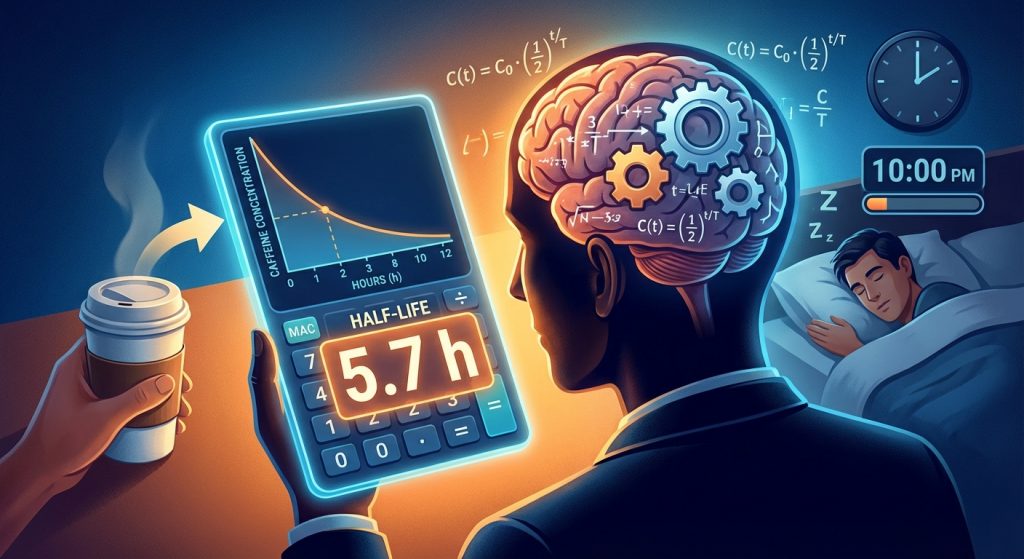
The most critical concept to grasp is caffeine’s half-life. This is the time it takes for your body to eliminate 50% of the caffeine in your system.
The Average:
In healthy adults, caffeine’s half-life is often around ~5 hours, but it can vary widely (roughly ~1.5 to 9.5 hours) depending on CYP1A2 genetics, smoking status, pregnancy, medications, and liver function (NCBI Bookshelf).
For context, the FDA cites 400 mg per day as an amount not generally associated with negative effects for most adults—though sensitivity and clearance speed vary a lot from person to person.
The Math (The 2 PM Mistake):
Let’s do the math on a “Double Shot” standard coffee (approx. 200mg of caffeine) consumed at 4:00 PM.
- 4:00 PM: 200mg in your system (Peak alertness).
- 9:00 PM (5 hours later): 100mg still in your system.
- 2:00 AM (10 hours later): 50mg still in your system.
The Reality:
When you go to bed at 11:00 PM, you may still have a meaningful amount of caffeine on board (the exact number depends on your personal half-life). That can be comparable to having caffeine close to bedtime—enough to make sleep lighter even if you fall asleep quickly.
Deep Sleep Destruction
This is where the distinction between “falling asleep” and “sleeping” matters.
Deep Sleep (NREM3) is a key restoration phase, and slow-wave sleep is linked to the brain’s glymphatic “clean-up” of metabolic waste (Nature Communications). (Read more in How Much Deep Sleep Do You Need?).
Caffeine can reduce deep (slow-wave) sleep and shift sleep toward lighter stages—especially when the dose is higher or the timing is later in the day.
The Effect: You sleep for 8 hours, but your sleep is shallow. You wake up unrefreshed. You drink more coffee to fix it. The cycle repeats.
Hidden Sources: It’s Not Just Coffee
You might skip the espresso, but are you eating your caffeine?
- 1. Painkillers (Paracetamol/Acetaminophen with Caffeine)
Some headache medicines add caffeine because it can enhance pain relief and, for some painkillers, speed early absorption. In some products, a standard dose can add a non-trivial amount of caffeine—sometimes comparable to a cup of coffee. - 2. Dark Chocolate
As discussed in The Anti-Sleep Diet, dark chocolate contains Theobromine and small amounts of caffeine. While less potent, eating a whole bar at night adds to the load. - 3. Decaf Coffee
“Decaf” does not mean “caffeine-free.” It means “decaffeinated,” so small residual amounts can still remain. For very caffeine-sensitive sleepers, even that small amount can matter—especially in the evening. - 4. Soda and “Energy” Water
Many sodas (Cola, Mountain Dew) and even some sparkling waters contain added caffeine. Check the label. - 5. “Sugar-Free” Coffee Candies
Coffee-flavored candies often use real coffee extract. Sucking on five of these is a micro-dose of caffeine right before bed.
The 2 PM Rule (or 10-Hour Rule)
To protect your sleep architecture, you need a strict cutoff. One controlled study in the Journal of Clinical Sleep Medicine found that caffeine taken even 6 hours before bedtime still measurably disrupted sleep.
The Huberman Rule:
Neuroscientist Andrew Huberman suggests waiting 90–120 minutes after waking before the first caffeine, and keeping caffeine earlier in the day so it’s less likely to overlap with bedtime.
The Calculation:
If you plan to sleep at 10:00 PM, counting back 10 hours puts your deadline at 12:00 PM (Noon).
- Standard Advice: Stop at 2:00 PM.
- Sensitive Advice: Stop at 12:00 PM.
Decaf Coffee vs. Regular: Does it Matter?
If you switch to Decaf, does it fix the problem?
- Yes, mostly. The trace amounts of caffeine in decaf are usually negligible for the average person, provided you don’t drink a gallon of it.
- The Placebo: The smell and taste of coffee can trigger psychological alertness, but for many people, decaf’s trace caffeine is small enough not to noticeably affect sleep—especially if it’s not consumed late in the evening.
Should You Quit Completely?
Is caffeine inherently evil? No.
Coffee is a complex beverage, and people tolerate it differently. The goal is not to demonize coffee, but to respect its potency and align timing with your sleep goals.
The “Caffeine Reset”:
If you suspect caffeine sleep issues, try a 7-day reset.
- 1. Day 1-3: Reduce intake by 50%. (Expect headaches).
- 2. Day 4-7: Switch to Decaf or herbal tea.
- 3. Assess: Do you wake up feeling more refreshed? If yes, your previous timing or dose was likely affecting your sleep quality.
Genetic Variance: The “Fast Metabolizers”
You will always hear someone say: “My grandpa drank coffee at dinner and lived to 90.”
- The Gene: CYP1A2.
- Fast Metabolizers: These people clear caffeine in 2-3 hours. They can drink coffee late.
- Slow Metabolizers: These people (likely you, if you are reading this) take 8-10 hours.
- The Test: You can take a genetic test (like 23andMe) to find out, or simply listen to your body. If you have insomnia, assume you are a slow metabolizer.
Update for December 2025
Since I first published this guide on the half-life of caffeine, the scientific community has moved deeper. We are no longer just looking at caffeine; we are looking at its breakdown products and safer alternatives that provide focus without the sleep penalty.
Here is the essential new information for late 2025.
1. Why “Half-Life” Doesn’t Mean “Gone”
Half-life tells you when ~50% is gone—not when caffeine is “out of your system.” If you’re sensitive, the remaining fraction can still be enough to make sleep a bit lighter.
The Math: It takes roughly 4 half-lives (20-24 hours) to eliminate 94% of the drug.
The Implication: This explains why “one cup a day” drinkers still sometimes struggle. Even 25mg remaining in the system (the quarter-life amount) is enough to blunt the sharpest edge of NREM3 sleep in sensitive individuals.
2. Paraxanthine: The “Sleep-Safe” Caffeine?
A massive trend in 2025 biohacking is the shift from Caffeine to Paraxanthine.
What is it? Paraxanthine is the primary metabolite of caffeine. It is what your liver turns caffeine into.
Early human research suggests paraxanthine may deliver alertness with a shorter half-life than caffeine (SpringerLink). That shorter clearance window is why some people consider it for earlier-afternoon use, although it has a much smaller evidence base than caffeine overall.
3. The “Nap-Latte” (Science Validation)
The “Nappuccino” (coffee + a short nap) is a counterintuitive but practical alertness trick that’s been widely discussed in sleep coverage; timing is key (National Geographic).
Avoid doing this late afternoon: for many people it pushes stimulation too close to bedtime.
4. Genetic Testing (Accessible)
Direct-to-consumer genetic testing can sometimes indicate whether you tend to clear caffeine faster or slower. If you learn you’re on the slower end, the practical takeaway is simple: move your caffeine cutoff earlier than “standard” advice.
Summary
You cannot cheat chemistry. If you drink caffeine late in the day, you are stealing happiness from tomorrow.
Your Action Plan:
- 1. The Cutoff: Strict deadline at 2:00 PM. No exceptions.
- 2. The Delay: Wait 90 minutes after waking before the first cup to prevent the afternoon crash.
- 3. The Hidden Sources: Check your headache pills and afternoon chocolate.
- 4. The Test: If you wake up tired despite sleeping 8 hours, try a 14-day zero-caffeine trial.
Sleep is the foundation. Coffee is a tool. Don’t use the tool to destroy the foundation.
Read Next:
Best Bedtime Snacks for Deep Sleep: What to Eat & When |
How Much Deep Sleep Do You Need? Age Chart & Norms 2026

By: Alex Warenstein.
Bio: Alex Warenstein is a sleep biohacker and founder of Night Time Comfort. After battling chronic insomnia and circadian disruption, he now helps others optimize their sleep using data-driven protocols. Read full story.
Disclaimer: Alex is not a doctor. This content is for educational purposes only. Always consult a specialist.