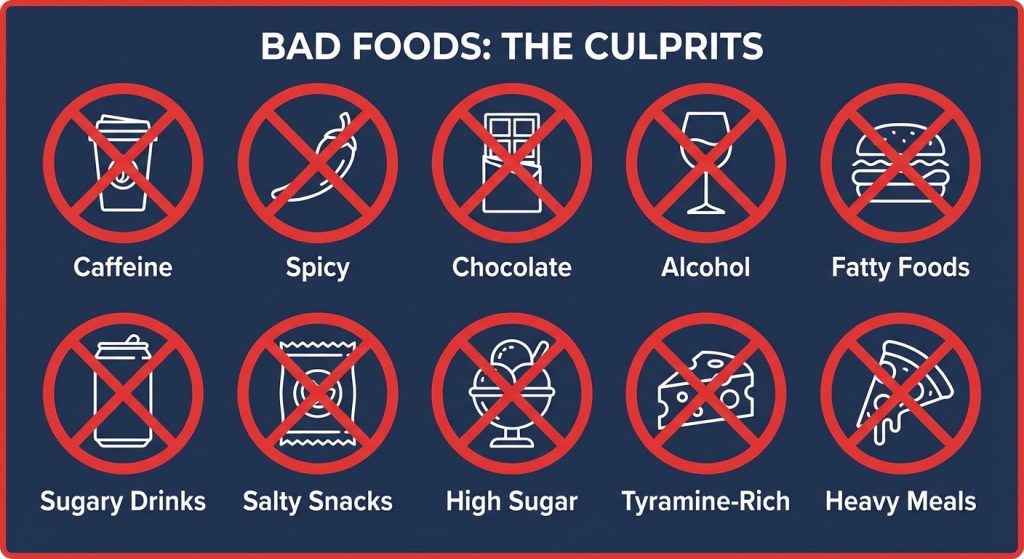
You treat your bedroom like a sanctuary. You have the blackout curtains, the expensive mattress, and the perfect temperature. You follow a strict wind-down routine. Yet, you find yourself staring at the ceiling at 2:00 AM, heart racing, or waking up feeling like you went ten rounds in a boxing match.
The culprit is often hiding in plain sight: your dinner plate.
We often think of diet in terms of weight loss or heart health, but we rarely connect it to sleep quality. The “Anti-Sleep Diet” idea is simple: certain compounds in everyday foods—like tyramine, theobromine, capsaicin, and histamines—can nudge the body toward alertness, warmth, reflux, or nighttime bathroom trips in people who are sensitive to them.
This guide is a practical deep dive into foods that commonly degrade sleep quality. We will rank the top offenders, explore stealth triggers like “sugar-free” snacks, and translate the underlying biology into plain English—grounded in mainstream sleep physiology and reputable medical sources—so you can test what matters for you.
The Mechanism: How Food Wrecks Sleep
Before we list the foods, we must understand how they attack your rest. It is rarely as simple as “indigestion.” The damage happens on three specific physiological battlegrounds:
- 1. Neurochemical Stimulation
Certain foods contain amino acids or compounds that stimulate the central nervous system. They increase the production of norepinephrine (adrenaline) and dopamine. If you eat these dietary triggers, you are essentially taking a mild stimulant pill before bed. - 2. Thermoregulation Disruption
As you fall asleep, your core body temperature naturally drifts downward, and staying cooler tends to support deeper sleep. Heavy meals and spicy foods can increase metabolic heat and digestive discomfort, which may make it harder to settle into sustained deep sleep.
- 3. Silent Reflux and Micro-Awakenings
You might not feel classic heartburn, but reflux can still flare when you lie flat and subtly disturb sleep. When stomach contents move upward, the irritation can trigger brief arousals or lighter sleep—even if you don’t fully wake up. For a clear overview of reflux basics (and why it often worsens when lying down), see the NIH’s NIDDK.
The Top 5 “Sleep Killers” (Ranked)
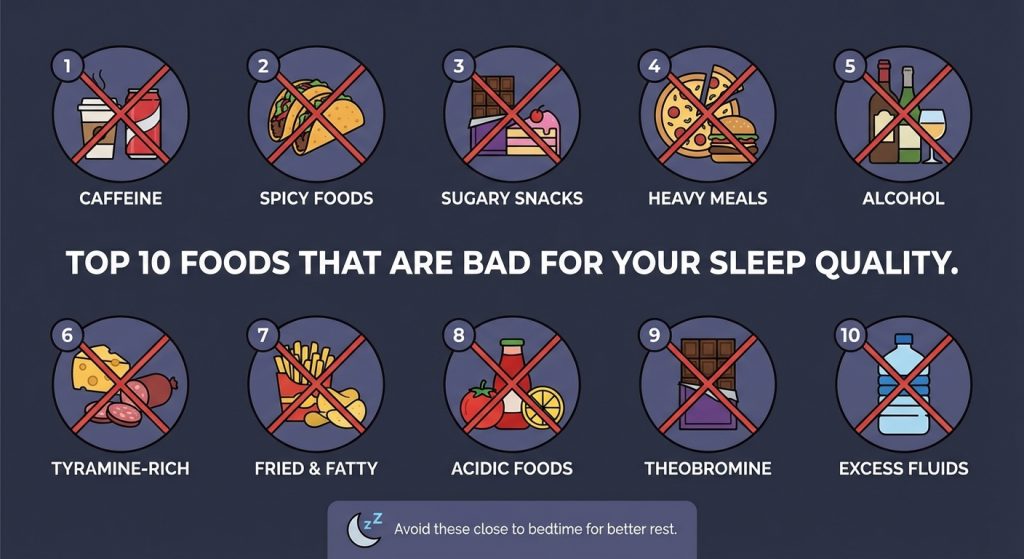
For many people, these are the foods most likely to backfire if eaten within roughly 3–4 hours of bedtime.
1. Alcohol: The Great Deceiver
Alcohol is one of the most consistent sleep disruptors in research and real life, even though it can feel like it “helps” at first. The Sleep Foundation has an accessible overview.
The Trap: Alcohol is a sedative. It does help you lose consciousness (sleep onset) quicker.
The Rebound: As alcohol is metabolized, the sedating effect fades and sleep often becomes lighter and more fragmented in the second half of the night—commonly described as a “rebound” effect in sleep research. A classic review in PubMed Central discusses this pattern.
The Result: Some people wake up in the middle of the night feeling hot, restless, or wide awake. Alcohol also tends to disrupt normal sleep architecture—often suppressing REM earlier in the night and increasing awakenings later—so even a “full” night can feel mentally foggy the next day.
2. Aged Cheese & Cured Meats (The Tyramine Trap)
Have you ever heard that eating cheese before bed gives you nightmares? There is a chemical truth to this old wives’ tale.
The Compound: Tyramine.
The Science: Tyramine is an amino acid found in fermented, cured, and aged foods. It stimulates the adrenal glands to release norepinephrine (adrenaline).
The Foods: Aged Cheddar, Blue Cheese, Parmesan, Gouda, Salami, Pepperoni, Smoked Salmon, and Soy Sauce.
The Effect: Eating a charcuterie board at 8 PM is signaling your brain to go into “fight or flight” mode. It increases heart rate and alertness, making it chemically difficult to drift off. This is a primary driver of aged cheese insomnia.
3. Spicy Foods (The Thermogenic Spike)
Hot sauce, curry, and chili peppers contain Capsaicin.
Thermoregulation: Capsaicin significantly raises core body temperature. As we established, you need to cool down to sleep. Eating spicy food is metabolically equivalent to turning up the thermostat in your body right when you are trying to cool it down.
Reflux: Spicy foods are the leading cause of gastroesophageal reflux. When you lie down, gravity no longer keeps acid in the stomach. The acid creeps up, causing micro-arousals that fragment your sleep architecture.
Result: You may fall asleep, but you will spend most of the night in light sleep (N1/N2) and wake up unrefreshed.
4. Dark Chocolate (The “Healthy” Stimulant)
Many health-conscious individuals eat a square of 85% or 90% dark chocolate as a dessert.
The Compound: Theobromine (and Caffeine).
The Science: Cocoa contains two stimulants—caffeine and theobromine—and the balance depends on how dark the chocolate is. The USDA summarizes measured caffeine/theobromine levels across chocolate products; for some people, that stimulant “tail” is enough to keep heart rate a bit higher and delay wind-down.
The Dosage: The darker the chocolate, the higher the concentration of stimulants. White chocolate contains none; milk chocolate contains very little; dark chocolate is potent.
The Effect: It prevents your resting heart rate from dropping to its sleeping baseline (dip), keeping your body in a state of low-level arousal.
5. Salty Snacks (The Dehydration Loop)
Dehydration & The Thirst/Bathroom Loop: A salty snack can make you noticeably thirstier, which often leads to late fluids and a higher chance of a middle-of-the-night bathroom trip. Separately, higher sodium intake is well known to raise blood pressure in many people; the American Heart Association summarizes the sodium–blood-pressure relationship and practical limits.
Secondary Triggers: The “Stealth” Destroyers
The Top 5 are obvious to some, but these secondary triggers catch almost everyone off guard.
1. Sugar-Free Candy & Gum (Polyols)
You might think you are doing the right thing by skipping dessert and having a sugar-free mint or gummy bear.
The Culprit: Sorbitol, Mannitol, Xylitol, Maltitol.
The Problem: These sugar alcohols are osmotic laxatives. They pull fluid into your intestines. More importantly, they are known to be bladder irritants.
The Problem: These sugar alcohols can pull water into the gut and commonly cause bloating, gas, or urgency—especially in larger amounts—which is an easy way to fragment sleep even if you don’t label it “pain.” Cleveland Clinic breaks down why polyols like xylitol and sorbitol can do this.
The Result: They can trigger Nocturia (the need to pee at night) even if your bladder isn’t full. The chemicals irritate the bladder lining, sending a false “full” signal to the brain, waking you up.
Reference: For more on this mechanism, read our guide Stop Waking Up to Pee: Nocturia.
2. Acidic Foods (Tomatoes & Citrus)
Tomato sauce (pizza/pasta) and citrus fruits (oranges/grapefruit) are highly acidic.
The Problem: Even without spicy heat, high acidity triggers the bladder. Similar to Polyols, acidic urine is more irritating to the bladder wall, increasing the frequency of wake-ups.
Silent Reflux: Tomato-based meals are a leading cause of silent reflux, where acid vapor irritates the throat without the classic “burning” chest sensation, causing coughing or shallow sleep.
3. Fatty & Fried Foods
A burger or fried chicken takes significantly longer to digest than proteins or carbs.
The Problem: Digestion is a metabolically active process. It requires blood flow and energy.
The Effect: If you eat a heavy, fatty meal late at night, your digestive system is working overtime while your brain is trying to shut down. This conflict keeps the body in a semi-active state, preventing the paralysis required for REM sleep and reducing Deep Sleep duration.
4. High Water Content Foods
Celery, Watermelon, and Cucumbers.
The Problem: These are natural diuretics. While healthy during the day, eating them within 3 hours of bed guarantees a bathroom trip. It is a simple volume issue.
The Glucose Connection: Hidden Sugars
While this article focuses on specific food compounds, we cannot ignore the impact of blood sugar.
Eating simple carbohydrates (white rice, pasta, sugary cereal) or even high-glycemic fruit (grapes, bananas) before bed leads to the Insulin Rollercoaster.
- 1. Blood sugar spikes.
- 2. Insulin floods the system.
- 3. Blood sugar crashes (Hypoglycemia) 4 hours later.
- 4. Cortisol spikes to release stored sugar.
- 5. You wake up.
If you suspect this is your issue, or you wake up hungry, read our specific guides on Sugar & Fruit Before Bed: Why Insulin Spikes Wake You Up and Nocturnal Hypoglycemia. We also recommend using a Freestyle Libre 3 sensor to see exactly how your dinner is affecting your overnight glucose stability.
Community Consensus: Real World Experiences
We analyzed threads on r/Insomnia, r/Biohackers, and sleep forums to see what real patients report as their biggest dietary triggers.
1. The “MSG Dreams”
Many users report vivid, disturbing dreams and restlessness after eating heavily processed savory snacks or takeout.
Monosodium glutamate (MSG) is a common flavor enhancer, and while many people tolerate it well, some report vivid dreams or restlessness after very salty, heavily processed meals—so it’s worth testing MSG as a personal trigger rather than treating it as a universal trigger.
2. The “Pizza Hangover”
Pizza is frequently cited as the “Final Boss” of anti-sleep foods because it combines almost every trigger:
Tyramine: From the cheese and pepperoni.
Acidity: From the tomato sauce.
Reflux: From the high fat content and dough.
Glucose Spike: From the refined white flour crust.
Verdict: If you eat pizza, do it at lunch. Never at dinner.
3. The “Healthy” Salad Trap
Users who switch to big salads for dinner often report waking up to pee. This is due to the high water content of lettuce and raw vegetables, plus the acidity of vinegar-based dressings. Cooked vegetables are often better for evening sleep hygiene.
What Should You Eat?
This article focuses on what not to eat, but you are likely wondering what is left.
The goal is to eat foods that are:
- Rich in Tryptophan (Turkey, Chicken, Pumpkin Seeds).
- Rich in Magnesium (Almonds, Spinach).
- Slow-digesting but not heavy.
For a complete list of safe options, read our guide on Best Bedtime Snacks for Deep Sleep: What to Eat & When.
Summary
The Anti-Sleep Diet is not about starving yourself; it is about timing and chemistry.
If you eat a meal heavy in Tyramine (cheese board), Theobromine (chocolate dessert), or Capsaicin (spicy curry) within 4 hours of bed, you may be stacking several “sleep-friction” triggers at once—stimulation, heat, reflux risk, or thirst. For some people, that combination is enough to turn a normal night into lighter, more fragmented sleep even if they still “sleep through” on paper.
The Action Plan:
- 1. The 4-Hour Rule: Aim to finish heavy meals about 4 hours before bed (adjust if you digest fast/slow).
- 2. The 2-Hour Rule: If nighttime bathroom trips are an issue, taper fluids in the last 1–2 hours and front-load hydration earlier.
- 3. The Elimination: Cut the Top 5 Sleep Killers from your dinner menu for one week.
- 4. The Test: If you still wake up, consider tracking patterns (meal timing, key triggers, and—if you already use one—overnight glucose with a Freestyle Libre 3) or reviewing Nocturia triggers.
Sleep is a biological process, and food is the fuel. Do not put diesel in a gasoline engine and expect a smooth ride.

By: Alex Warenstein.
Bio: Alex Warenstein is a sleep biohacker and founder of Night Time Comfort. After battling chronic insomnia and circadian disruption, he now helps others optimize their sleep using data-driven protocols. Read full story.
Disclaimer: Alex is not a doctor. This content is for educational purposes only. Always consult a specialist.