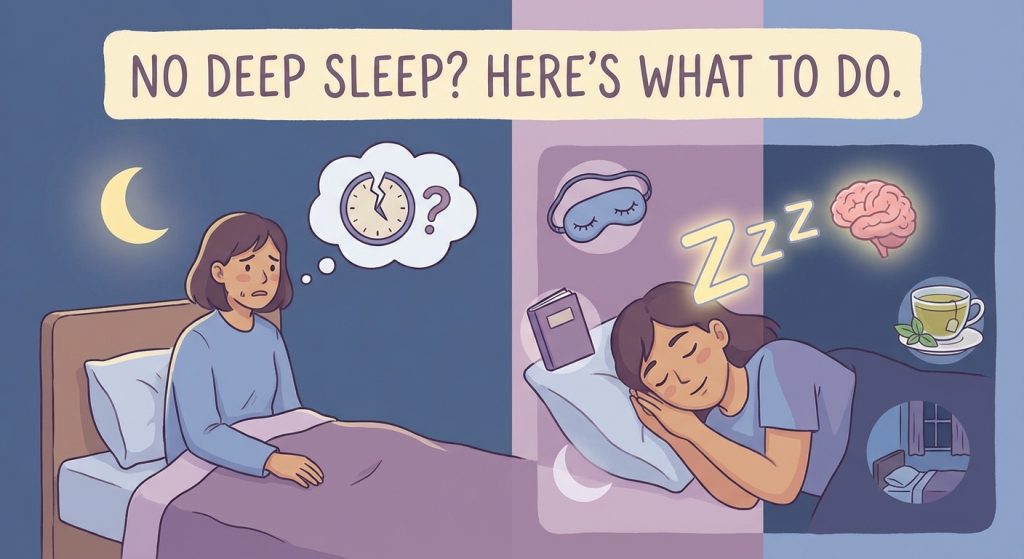
You wake up, check your smart watch, and panic. The screen says: “Deep Sleep: 18 minutes.”
According to the internet, you should be getting hours of deep restorative sleep. You feel tired, sure, but are you dying? Is your brain deteriorating? This phenomenon is so common it has a name: Orthosomnia — the anxiety caused by sleep tracking data.
Before you spiral into worry or buy expensive gadgets, you need to understand the biological reality. Deep sleep (NREM3) is not a flat number; it is a moving target that changes drastically as you age. A healthy 20-year-old and a healthy 60-year-old have completely different deep sleep norms.
This guide offers a practical deep sleep age chart, a reality check on how accurate popular trackers are, and a few sensible next steps if your numbers stay low across many nights.
Understanding Sleep Architecture: What is NREM3?
Sleep isn’t a monolith. It’s a repeating cycle (often around 90–120 minutes) made of stages that are defined and scored in sleep labs using standardized rules from the American Academy of Sleep Medicine. To understand how much NREM3 you need, you must understand what it does.
The Stages
- 1. Light Sleep (NREM1 & NREM2): The transition phase. This makes up the bulk of your night (approx. 50-60%). It is not “junk” sleep; it is essential for processing information.
- 2. Deep Sleep (NREM3 / Slow Wave Sleep): Often described as the “physical restoration” phase. Brain activity shifts to slower delta waves; heart rate and breathing typically slow. Deep NREM is also linked to recovery processes and the brain’s housekeeping pathways, but the exact health impact can vary by person. Growth hormone secretion tends to peak early in the night, alongside the deepest NREM.
- 3. REM (Rapid Eye Movement): This is the mental restoration phase. It is essential for emotional regulation, memory consolidation, and creativity.
The Key Difference: Deep sleep is front-loaded after sleep onset; REM becomes more common later. In practice, the biggest factor is a shortened or fragmented sleep window—when your night gets cut short, one of the stages gets squeezed, and the pattern can vary by age and by person.
The Data: Deep Sleep Age Chart

There is no single “magic number.” Deep sleep is a moving target across the lifespan, and individual variation is large. Below is a pragmatic deep sleep age chart informed by sleep-lab research and broad overviews; as a rough adult benchmark, many people spend about 10%–20% of the night in deep sleep (Sleep Foundation).
Percentage of Total Sleep Time (NREM3)
| Age Group | Deep Sleep Norm (%) | Average Duration (Hours) |
| Young Adults (18-25) |
20% – 25% | 1.5 – 2.0 hours |
| Adults (26-35) |
16% – 20% | 1.2 – 1.6 hours |
| Middle Age (35-50) |
15% – 18% | 1.0 – 1.5 hours |
| Older Adults (50-60) |
10% – 15% | 45 min – 1.2 hours |
| Seniors (60+) |
5% – 10% | 30 min – 60 min |
| Elderly (75+) |
0% – 5% | 0 min – 30 min |
*** Based on a standard 7-8 hour sleep opportunity.
Interpreting the Sleep Norms by Age
- At Age 30: Many people land somewhere around ~60–100 minutes on a full night. If you’re consistently far below that and feel unrefreshed, the common culprits are sleep time, alcohol, and late caffeine.
- At Age 50: It is biologically normal for deep sleep to decrease. Seeing 45 to 60 minutes on your tracker is not a sign of failure; it is consistent with the aging brain’s reduction in delta wave amplitude.
- At Age 60+: Many seniors experience a drastic reduction in NREM3. Some healthy seniors get almost zero detectable deep sleep but compensate with lighter NREM2 sleep.
The Danger Zone: Analyzing Low Deep Sleep Durations

If your tracker says you are low, how scared should you be? Here is a breakdown of what different durations imply.
Less than 10 Minutes
If this repeats across many nights (not just one) and matches how you feel, treat it as a signal to investigate the “why” rather than a single-night emergency.
- Symptoms: Marked exhaustion, poor exercise recovery, muscle aches, and persistent “brain fog.”
- Causes: Sleep-disordered breathing, pain-related awakenings, or heavy alcohol use are common culprits.
- Action: A sleep clinician can help confirm whether a breathing issue (like sleep apnea) or another disruptor is fragmenting your deep sleep.
20 Minutes of Deep Sleep
- Context: This is the most common complaint on sleep forums (and reddit).
- The Reality: For a 30-year-old, this is low. For a 60-year-old, it might be slightly below average but acceptable.
- Likely Culprit: If you feel fine physically but the data says 20 minutes, it is likely a tracker error (see the Accuracy section below).
30 to 40 Minutes
The Verdict: This is often “good enough” for modern adults dealing with stress and age (40+). While not optimal, it is sufficient to maintain basic physical health if REM sleep is adequate.
1 to 1.5 Hours
The Verdict: This is the Gold Standard. If you hit this, your body is effectively repairing tissues and clearing metabolic waste.
The Accuracy Reality Check: Watch vs. EEG
Before you diagnose yourself with a disorder based on 20 minutes of deep sleep, you must understand the technology.
Wearables (Apple Watch, Oura Ring 4, Whoop 4.0)
These devices do not measure sleep. They measure *proxies* for sleep: movement (actigraphy) and heart rate variability (PPG).
- The Algorithm: They guess you are in deep sleep when you stop moving completely and your heart rate lowers and stabilizes.
- The Flaw: If you lie very still but are awake, the watch might think you are asleep. Conversely, if you have a naturally variable heart rate, it might miss your deep sleep entirely. In validation studies, consumer trackers show only moderate agreement with polysomnography for sleep staging, and performance varies by device and person (PubMed Central).
Home EEG (Brainwave Sensing)
The only way to accurately measure sleep stages is via EEG (electroencephalography), which measures the electrical activity of the brain. Until recently, this was only possible in a clinic.
Several home devices (like the Dreem 2 headband, now defunct, or the Muse S Gen 3 Athena Headband) attempt this.
- My Experience with the Muse S Athena (Gen 3): I purchased a Muse S Athena hoping for clinical-grade data to confirm my Apple Watch’s low readings. The device promised to track real delta waves.
- The Failure: The data was terrifying—it often showed 0 to 5 minutes of deep sleep. However, this turned out to be a hardware flaw, not a biological one. The Muse S relies on fabric sensors pressing against the forehead. If you move, sweat, or have hair in the way, the contact breaks. The algorithm interprets “bad signal” as “light sleep” or “awake.”
- The Lesson:
Even “advanced” home EEG is prone to user error and contact issues. Unless you are glued up with medical conductive paste in a lab, take *all* data with a grain of salt.
REM Sleep: The Other Half of the Equation
While Deep Sleep is physical, REM is mental.
REM Sleep Norms
- Requirement: Adults generally need 20-25% of their total sleep to be REM (approx. 90-120 minutes).
- Infants: Spend 50% of sleep in REM (essential for brain development).
- Seniors: REM remains relatively stable with age, unlike Deep Sleep.
The Apnea/UARS Connection
Obstructive Sleep Apnea (OSA) and Upper Airway Resistance Syndrome (UARS) destroy sleep architecture.
Why: During REM sleep, your muscles undergo atonia (paralysis). This includes the muscles keeping your airway open. Therefore, apnea events are often most severe during REM.
The Result: When the airway repeatedly narrows or collapses, the brain may trigger brief arousals that break up REM. If your REM looks chronically low and you also have symptoms (unrefreshing sleep, morning headaches, daytime sleepiness), it can be a clue to discuss sleep-disordered breathing with a clinician (European Respiratory Society).
Causes of Low Deep Sleep
Why are you missing out on those restorative delta waves?
- 1. Diet and Timing
What you eat impacts your sleep architecture. High sugar intake or eating immediately before bed can cause insulin spikes. This raises body temperature and cortisol, physically preventing the body from entering the cool, relaxed state required for NREM3.
*** See our guide: The Anti-Sleep Diet: 5 Foods That Destroy Sleep Quality. - 2. The Caffeine Half-Life
Caffeine blocks adenosine receptors. Adenosine is the chemical pressure that pushes you into deep sleep. Even if you can fall asleep, caffeine in your system reduces the *amplitude* (depth) of deep sleep waves.
*** See our guide: Caffeine Half-Life Calculator. - 3. Temperature
Deep sleep requires a core body temperature drop. A room warmer than 70°F (21°C) can inhibit this process. - 4. Alcohol
The “Nightcap” is a myth. Alcohol is a sedative, not a sleep aid. It fragments sleep and dramatically suppresses REM, while also often reducing deep sleep in the second half of the night via the “rebound effect” as the alcohol wears off.
What Happens If You Get Zero Deep or REM Sleep?
Zero Deep Sleep (NREM3)
True near-zero deep sleep across a formal sleep study is uncommon; near-zero on a consumer tracker is often a measurement artifact.
- Physical: The body cannot repair tissue. Muscle atrophy accelerates.
- Pain: Pain thresholds drop significantly. You become hypersensitive to touch.
- Metabolic: Chronic sleep disruption can worsen insulin sensitivity over time, which can make weight management harder.
Zero REM Sleep
- Emotional: Severe irritability, inability to read social cues, and increased anxiety.
- Memory: Inability to consolidate new skills learned during the day.
- Long-term: While some antidepressants suppress REM with manageable side effects, total deprivation is linked to severe cognitive decline.
How to Increase Deep Sleep: Protocols & Supplements
If your deep sleep norms are truly low (and not just a tracker error), you can intervene.
Behavioral Protocols
- Heat to Cool: Take a hot shower or use a sauna 90 minutes before bed. The rebound cooling effect triggers deep sleep.
- Exercise: Heavy resistance training or cardio during the day increases the body’s demand for physical repair (NREM3).
- The 3:2:1 Rule: Stop eating 3 hours before bed, stop working 2 hours before bed, stop screens 1 hour before bed.
Supplements for Sleep Architecture
- 1. Magnesium L-Threonate or Glycinate: Some people report better sleep continuity and a calmer evening routine; objective changes in “deep sleep minutes” are inconsistent.
- 2. L-Glycine: In small studies, glycine may support sleep quality and body-temperature regulation; effects on NREM3 vary.
- 3. Apigenin: A plant compound studied for relaxation; evidence for measurable stage changes is limited.
- 4. Melatonin (dose & timing matter): Higher doses can increase vivid dreams for some and don’t reliably improve sleep architecture.
FAQ: Common Deep Sleep Questions
How do Navy Seals fall asleep so quickly?
They use a technique involving progressive muscle relaxation and visualization (the “Winter” method). However, falling asleep quickly does not guarantee deep sleep. In fact, falling asleep the second your head hits the pillow (latency < 5 mins) is a sign of pathological sleep deprivation.
What are signs of poor core sleep?
If you wake up with a headache, sore muscles, or feel “heavy” behind the eyes, your core sleep (NREM3) was likely interrupted.
Is 40 minutes of deep sleep enough?
For a person over 45, yes, 40 minutes is likely within the functional range, provided it is continuous and not fragmented.
Update for December 2025
Here is the essential new information for late 2025.
Pink Noise & Acoustic Stimulation (Acoustic Entrainment)
For years, white noise was mainly used to mask sound. More recently, researchers have tested timed sound pulses (often discussed as acoustic stimulation, sometimes using pink-noise-like tones) to nudge slow-wave activity in controlled settings.
What the evidence says: A 2025 systematic review of acoustic stimulation trials reported meaningful improvements in insomnia severity, while effects on sleep efficiency and total sleep time were mixed (Frontiers in Neuroscience).
Practical take: If you’re curious, treat it as an add-on experiment—not a replacement for basics like sleep time, light exposure, and alcohol/caffeine timing.
2. The Glymphatic Posture: Side vs. Back
Body position may influence how efficiently cerebrospinal fluid moves through the brain’s clearance pathways, but most of the hard data comes from animal research.
The Finding: In controlled experiments, glymphatic transport looked more efficient in a lateral (side) position than supine (back) (Journal of Neuroscience).
The Conflict: Back-sleeping can feel better for some people’s neck/back alignment, while side-sleeping may reduce snoring for some and can be friendlier for airflow.
The Verdict: If you wake up groggy despite a decent sleep duration, it’s reasonable to experiment with side-sleeping for a week and see how you feel—just don’t treat posture as a substitute for addressing breathing issues or chronic sleep restriction.
Conclusion
If your tracker says you are getting 20 minutes of deep sleep, do not panic. First, look at the deep sleep age chart – if you are older, a decrease is normal. Second, acknowledge that wrist-based trackers are estimates, not diagnoses. I learned this the hard way with the Muse S—chasing data often causes more insomnia than the sleep loss itself.
However, if you feel physically broken every morning, look at your sleep hygiene. Cut the sugar, cool the room, and consider if Sleep Apnea or UARS might be stealing your restoration.
*** Read Next:
Suspect a breathing issue? O2Ring Data Analysis: Estimating Your Apnea/UARS Probability.

By: Alex Warenstein.
Bio: Alex Warenstein is a sleep biohacker and founder of Night Time Comfort. After battling chronic insomnia and circadian disruption, he now helps others optimize their sleep using data-driven protocols. Read full story.
Disclaimer: Alex is not a doctor. This content is for educational purposes only. Always consult a specialist.