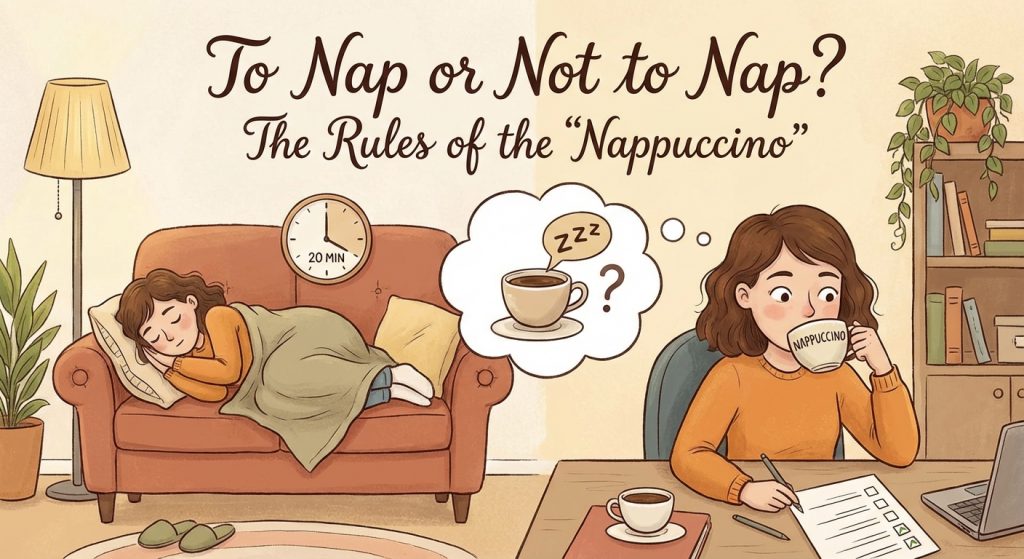
It usually happens around 2:00 PM. You’ve had lunch. You’ve answered the morning emails. And suddenly, it feels like someone pulled the plug on your battery. Your eyelids get heavy, your focus dissolves into a grey fog, and the concept of “productivity” becomes a cruel joke.
If you are like the old version of me—before I understood my biology—you probably reach for a double espresso and power through, only to crash harder later. Or, perhaps you surrender to the couch, wake up two hours later with a headache, realizing you have just destroyed your ability to fall asleep tonight.
This is the dilemma of the nap. For a person with a healthy sleep system, a nap is a luxury. For us—people battling insomnia, UARS, or just trying to optimize recovery—a nap is a loaded weapon. Used correctly, it is the ultimate performance hack. Used incorrectly, it is a guarantee that you will be staring at the ceiling at 3:00 AM, regretting everything.
I have spent years testing protocols. I have analyzed my Apple Watch data after 15-minute dozes and 90-minute marathons. I have scoured the latest 2025 research from the American Medical Association and the trenches of Reddit biohacking communities.
Here is the truth about the “Nappuccino,” adenosine buildup, and how to fix the afternoon slump without sabotaging your night.
The Biological Crash: Why You Fade at 2 PM
First, stop blaming your lunch. While a heavy carb load can make you sleepy (thanks to an insulin spike), the mid-afternoon energy dip is primarily circadian.
Your body is governed by two opposing forces. Scientists call this the “Two-Process Model”:
- 1. Process C (Circadian Drive): This is your internal clock, managed by the Suprachiasmatic Nucleus (SCN). It sends a signal to keep you awake during the day. However, there is a natural dip in this alerting signal in the early afternoon, usually between 1:00 PM and 3:00 PM.
- 2. Process S (Sleep Drive): This is the accumulation of adenosine pressure.
Understanding Adenosine Pressure
Think of adenosine like chemical exhaust fumes. Every minute you are awake, your neurons are firing and burning energy (ATP). The byproduct of this energy burn is adenosine. It builds up in your brain throughout the day, latching onto receptors that tell your system: “You are tired. Slow down.”
By 2:00 PM, your adenosine buildup is high enough to make you feel drowsy, exactly at the moment your Circadian Drive takes a dip. This collision creates the afternoon slump fix requirement.
If you have insomnia, this pressure is your best friend. It is the fuel that will knock you out at night. If you nap too long, you open the pressure valve. You release the steam. You wake up feeling great, but when bedtime arrives at 11:00 PM, your “tank” is empty. You have no sleep pressure left to initiate unconsciousness.
So, how do we cheat the system? We use the “Nappuccino.”
The “Nappuccino” Technique: Science and Protocol
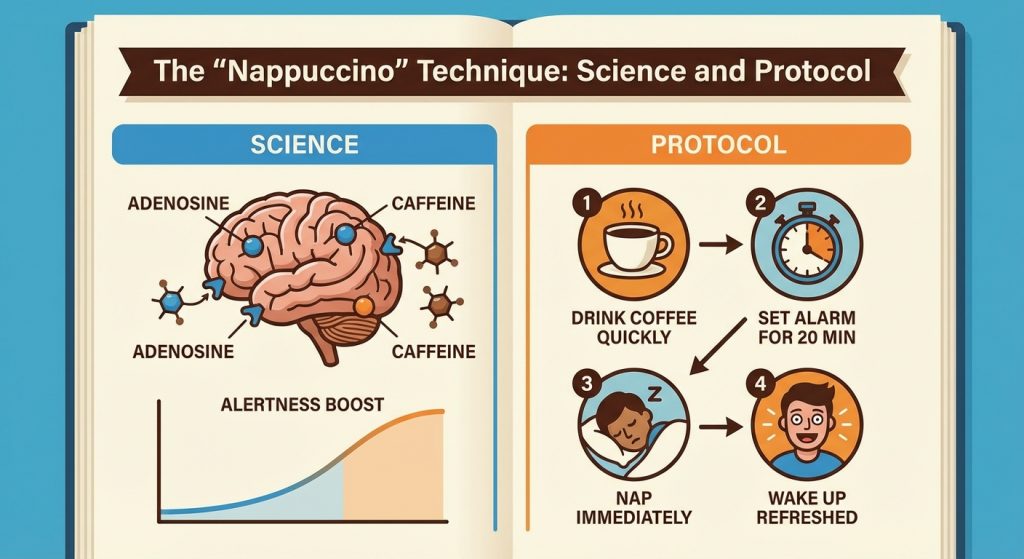
The term sounds like a marketing gimmick, but the pharmacology behind the “Coffee Nap” is solid. It leverages the interaction between caffeine and adenosine receptors to bypass sleep inertia.
How It Works
Caffeine does not give you energy. I cannot stress this enough. Caffeine is an adenosine blocker. It looks exactly like adenosine on a molecular level. It slides into the adenosine receptors in your brain and parks there, preventing the real adenosine from signaling fatigue.
However, caffeine takes time to metabolize. If you drink a cup of coffee, it takes about 20 to 30 minutes to reach peak levels in your bloodstream and start blocking those receptors effectively.
The Nappuccino capitalizes on this delay.
- 1. You drink the caffeine. It hasn’t kicked in yet.
- 2. You sleep immediately. During light sleep, your brain naturally clears out some of the adenosine (the “exhaust fumes”).
- 3. You wake up 20 minutes later. Two things happen simultaneously: you have naturally reduced your sleep pressure slightly (just enough to feel refreshed), and the caffeine arrives at the brain to block whatever adenosine is left.
The result is a double-stacked boost in alertness that neither napping nor coffee can achieve alone.
My Personal Nappuccino Protocol
This is the exact sequence I use. Precision is key here. If you drift for too long, the strategy fails.
- 1. The Time Window: I only do this between 12:30 PM and 2:30 PM. Never later.
- 2. The Intake: I brew a double espresso or take a quick shot of cold brew. It must be consumed quickly—don’t sip it over 20 minutes. You need the bolus to hit your system at once.
- 3. The Setup: I lie down immediately. I use my Loop Quiet 2 earplugs and a blackout mask. Darkness is non-negotiable to signal safety to the brain.
- 4. The Alarm: I set a timer for 20 minutes. Not 25. Not 30.
- 5. The Reboot: When the alarm goes off, I get up immediately. No snoozing. I expose my eyes to light (ideally daylight, or my Beurer TL45 if I’m in a dark office) to re-anchor my circadian rhythm.
The 20-Minute Rule: Avoiding the “Zombie” Zone
Why 20 minutes? Why not 40?
This comes down to sleep stages. A normal sleep cycle lasts roughly 90 minutes. It transitions from NREM1 (light sleep) to NREM2, then plunges into NREM3 (Deep Sleep), and finally REM.
- 0–20 Minutes (NREM1 & NREM2): This is light sleep. Your brain cools down, muscles relax, but you are easily awakened. Waking up from this stage is easy. You feel refreshed.
- 20–60 Minutes (NREM3 – Deep Sleep): This is the danger zone for napping. If you enter deep sleep, your brain creates high-voltage delta waves. It is doing heavy maintenance work. If your alarm rips you out of deep sleep, you will experience severe sleep inertia.
Sleep Inertia Explained
We have all felt it. You wake up from a nap not knowing what year it is. Your limbs feel like lead. You are groggy, irritable, and cognitively slower than before you slept. This is sleep inertia—a state of temporary cognitive impairment caused by waking up during Slow Wave Sleep (SWS).
According to 2025 reviews on sleep inertia, recovery from deep sleep inertia can take anywhere from 30 minutes to 2 hours. If you nap for 45 minutes at 3:00 PM, you might spend the rest of your workday in a “zombie mode,” functioning worse than if you hadn’t slept at all.
This is why the 20-minute limit is a hard biological wall. You must wake up before the slide into NREM3 begins.
The Insomnia Paradox: Is Napping Forbidden?
If you are reading this site, you likely have trouble sleeping at night. This brings us to the most controversial question: Should an insomniac nap?
Traditional Cognitive Behavioral Therapy for Insomnia (CBT-I) – the gold standard for treatment—says NO.
The logic of Sleep Restriction Therapy is simple: You need to be starving for sleep by bedtime. If you snack on sleep during the day, you spoil your dinner. If you have “Sleep Maintenance Insomnia” (waking up at 4 AM), a nap reduces the homeostatic pressure needed to bridge that early morning gap.
The 2025 Nuance: “Authorized Napping”
However, recent data suggests the strict “no nap” rule might be outdated for everyone. A pilot study published in the Journal of Sleep Research (late 2024) explored “authorized napping” during CBT-I. They found that short, sanctioned naps did not necessarily ruin the treatment outcomes (like sleep efficiency) and actually helped patients cope with the misery of sleep deprivation during the restriction phase.
This aligns with what I see on forums like SleepHQ and Reddit. There is a psychological component. If you are terrified of the day because you are exhausted, your cortisol stays high. A 15-minute reset can lower that anxiety, paradoxically helping you sleep better at night because you aren’t entering the evening in a state of hyperarousal.
Alex’s Rule for Insomniacs
Based on my experience and the consensus of the biohacking community:
- 1. If you have Sleep Onset Insomnia (Can’t fall asleep): Do NOT nap. You need every ounce of adenosine to get you under. Push through the afternoon slump fix with movement or cold water.
- 2. If you have Maintenance Insomnia (Wake up too early) or UARS: You can experiment with a strict 15-20 minute nap before 2:00 PM. If you find your Oura Ring Gen 4 sleep scores dropping or your 4 AM wake-ups getting worse, stop immediately.
The “Death Zone”: Why Sleeping Past 3 PM is Fatal
If there is one hill I will die on, it is this: No sleeping after 3:00 PM.
The American Medical Association and chronobiologists agree that late afternoon naps are the primary disruptor of the circadian rhythms.
When you sleep late in the day:
- 1. You shift your clock: You signal to your body that “night” has happened. This pushes your biological bedtime back. If you usually sleep at 11:00 PM, a 5:00 PM nap might shift your sleep onset ability to 1:00 AM.
- 2. You crush your Adenosine: You clear the pressure too close to the finish line. It’s like emptying your gas tank 10 miles before you need to drive across the country.
This leads to a vicious cycle. You nap at 5 PM -> You can’t sleep until 2 AM -> You wake up exhausted -> You nap at 5 PM again. This is often misdiagnosed as “insomnia” when it is actually just a chaotic schedule.
Community Consensus: What Actually Works?
I spend hours every week on r/sleep, r/Biohackers, and the ApneaBoard forums. Clinical trials are great, but user reports show the reality of implementation. Here is the hierarchy of effectiveness based on thousands of user reports in 2025.
Tier 1: The “Caffeine Nap” (Nappuccino)
- Success Rate: High.
- User Consensus: Most effective for clearing brain fog and returning to high-focus work.
- Common Pitfall: “Timer Anxiety.” Many users report that worrying about falling asleep within the 20-minute window keeps them awake.
- Alex’s Tip: Don’t try to sleep. Just try to “rest your eyes.” Even NREM1 (dozing) works for the Nappuccino. If you stress about sleeping, you won’t sleep.
Tier 2: The “Micro-Nap” (10-15 mins)
- Success Rate: Moderate/High.
- User Consensus: Safer than 20 minutes for those prone to deep sleep inertia.
- Common Pitfall: Not feeling “rested” enough emotionally.
- Alex’s Tip: Combine this with 4-7-8 breathing technique to drop your heart rate fast.
Tier 3: The Full Cycle (90 minutes)
- Success Rate: Risky.
- User Consensus: Only recommended for shift workers or those with zero sleep debt issues.
- Common Pitfall: Waking up in the middle of the cycle (at 60 mins) results in catastrophic grogginess.
- Alex’s Tip: Avoid this unless you are sick or have pulled an all-nighter. It takes too big a bite out of your nightly sleep hygiene checklist.
Tier 4: The Unstructured Couch Crash
- Success Rate: Zero.
- User Consensus: “I woke up at 7 PM, ate dinner, and stared at the wall until 4 AM.”
- Alex’s Tip: Never nap on the couch. Never nap without an alarm.
Biohacking the Nap: Gadgets and Supplements
You don’t need gear to nap, but if you are tracking data, here is what to look for.
- Continuous Glucose Monitors (CGM): If you are using a Freestyle Libre 3, check your glucose during the slump. If you see a crash right before you get sleepy, your issue isn’t adenosine—it’s your lunch. A nap won’t fix a metabolic crash; stabilizing blood sugar will.
- The Apple Watch / Whoop 4 Debate: Most trackers are terrible at detecting short naps. Don’t stress if your Whoop 4.0 doesn’t register the nap. Trust how you feel.
- L-Theanine: If the coffee makes you too jittery to nap, stacking 200mg of L-Theanine with your espresso can smooth out the buzz, allowing for that transition into light sleep.
What If You Can’t Nap? (NSDR and Yoga Nidra)
I often hear from people: “Alex, I just can’t nap. My brain won’t shut off.” Or, maybe you are at the office and can’t curl up under a desk.
The alternative is NSDR (Non-Sleep Deep Rest) or Yoga Nidra.
Popularized by Dr. Andrew Huberman, NSDR is a protocol of guided relaxation that mimics the brain wave patterns of sleep without actual sleep. You lie down (or sit back), listen to a guided audio script, and systematically relax your body.
Why it wins:
- 1. No Sleep Inertia: Since you don’t fully lose consciousness, you don’t get groggy.
- 2. Dopamine Recovery: Research suggests NSDR can help replenish dopamine in the basal ganglia, restoring motivation.
- 3. Anxiety Reduction: It is a manual brake for the sympathetic nervous system.
If I miss my 2:00 PM window and feel tired at 4:00 PM, I never nap. I do 10 minutes of NSDR. It recharges the battery without stealing from the night’s adenosine bank.
Summary
The nap is a tool, not a treat. If you are suffering from chronic insomnia, avoiding naps is still the safest bet to ensure high sleep pressure at night. But if you must function, or if you are optimizing for performance, the rules are rigid:
- 1. The Window: Only between 12:00 PM and 3:00 PM.
- 2. The Method: The Nappuccino (Caffeine + Sleep) is superior to sleep alone for alertness.
- 3. The Duration: Set an alarm for 20 minutes. Do not rely on your internal clock.
- 4. The Exit: Get light in your eyes immediately upon waking.
Sleep is a rhythm. Napping is jazz—it can be a beautiful improvisation, or it can be a chaotic mess. Follow the rhythm, respect the adenosine, and you might just survive the afternoon without becoming a zombie.
Related Articles to Explore:
Sleep Hygiene Checklist: The 5 Non-Negotiables Before Biohacking

By: Alex Warenstein.
Bio: Alex Warenstein is a sleep biohacker and founder of Night Time Comfort. After battling chronic insomnia and circadian disruption, he now helps others optimize their sleep using data-driven protocols. Read full story.
Disclaimer: Alex is not a doctor. This content is for educational purposes only. Always consult a specialist.