 You are lying in bed. It is completely silent. Suddenly, a car drives by, or the floorboards creak. Your eyes snap open.
We often assume that silence is the gold standard for sleep. But for the human brain, total silence can be a trap. In the absence of sound, your brain becomes hypersensitive, treating every tiny noise as a potential threat. This is why a dripping faucet can sound like a gunshot at 2:00 AM.
This is where colored noise comes in.
You’ve heard of white noise. In recent years, more people have been experimenting with Pink Noise and Brown Noise, and researchers are actively studying whether certain sound patterns can do more than mask disturbances—especially when they’re delivered in carefully timed pulses during deep sleep.
This guide explains whether pink noise is actually better for sleep than white noise, what pink noise does to the brain (masking vs. slow-wave entrainment), and how to use it in practice—volume targets, timers, and the best apps and machines. Where I reference research, I’m leaning on peer-reviewed evidence syntheses, including systematic reviews in the Journal of Clinical Sleep Medicine.
The Science: Sound Masking vs. Brain Entrainment
To understand why noise helps, we must distinguish between two mechanisms.
- 1. Sound Masking (The “Shield”)
This is the traditional role of White Noise. It creates a “wall of sound” that covers up sudden spikes in volume (like a barking dog).By raising the ambient noise floor, the difference between the background and the disturbance is minimized, making brief, sharp noises less likely to stand out and trigger a full awakening (Sleep Foundation).
- 2. Brain Entrainment (The “Sync”)
This is the new frontier for Pink Noise.
Work from Northwestern University has shown that pink-noise bursts synced to ongoing slow waves can enhance slow-wave activity under lab conditions, particularly in older adults.
The Result: It doesn’t just block noise; in some studies, timed stimulation modestly increases slow-wave activity (a hallmark of deep sleep), though outcomes can vary outside the lab.
(Read more on How Much Deep Sleep Do You Need?).
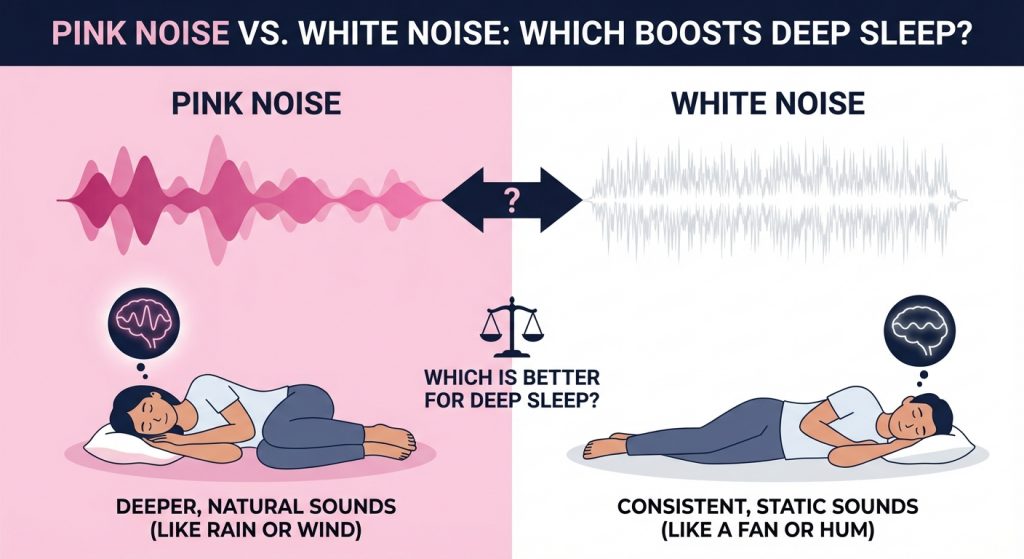
White Noise: The Static Shield
What is White Noise?
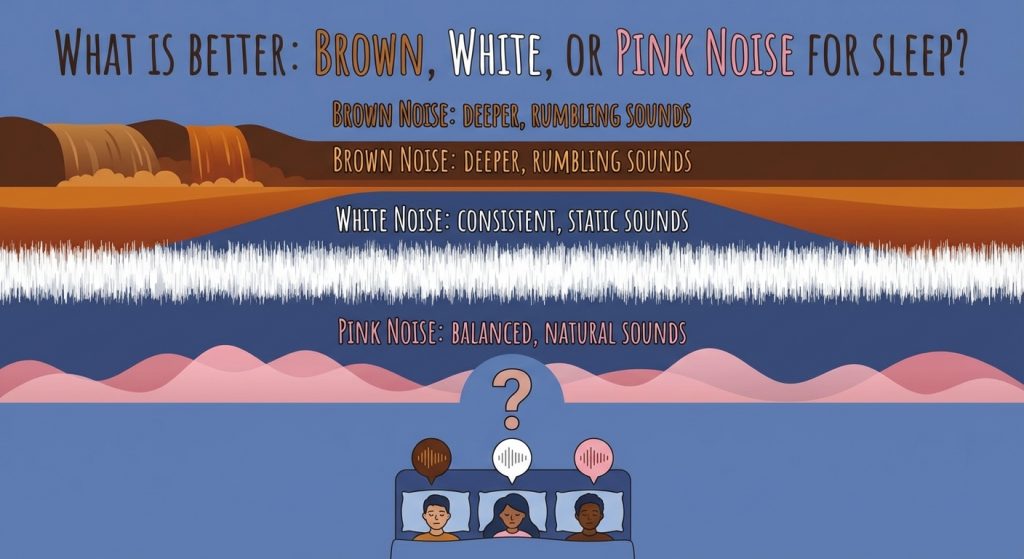
It acts like white light—it contains all audible frequencies played at the same intensity. It sounds like a radio tuned to a dead station, a vacuum cleaner, or a high-pitched fan.
Is it good to sleep with white noise?
Pros: It is the most effective at blocking noise. If you live in a loud city or have noisy neighbors, White Noise is the supreme masker because it covers high-pitched sounds (sirens, screeching brakes).
Cons: Why shouldn’t you leave white noise on all night?
For some people, the high-frequency “hiss” feels stimulating or simply annoying over hours, which can lead to lighter sleep or more wake-ups; if that’s you, Pink or Brown noise is often easier to tolerate. If you wake up with ringing ears or a headache, White Noise is too harsh for you.
Pink Noise: The Deep Sleep Booster
What does Pink Noise do to your brain?
Pink noise lowers the intensity of higher frequencies. It is deeper and more balanced. It sounds like steady rain, wind rustling through trees, or a steady river.
Which is better for sleep, pink or white noise?
The Verdict: For many people, Pink Noise is a comfortable default—especially if White Noise feels too sharp—but the best choice still depends on your room’s noise profile and your own sensitivity.
The Science: Because pink noise follows a 1/f power spectrum (an inverse-frequency profile), it mimics patterns found in nature and biological rhythms (like your heartbeat). This makes it inherently soothing to the human nervous system.
Many people use Pink Noise as a calming bedtime backdrop; the strongest evidence is still about sleep stability and masking, not specific mental-health outcomes.
Brown Noise: The Deep Rumble
Is brown noise better than white noise?
Brown (or Red) noise lowers the high frequencies even more than Pink. It is all bass. It sounds like a distant thunderstorm, a low roar of a waterfall, or the hum of an airplane cabin.
Who is it for?
Brown noise has exploded on TikTok and Reddit (r/ADHD) as a focus and sleep tool for neurodivergent brains. It creates a “cognitive blanket” that quiets internal thoughts. If Pink Noise still sounds too “hissy” to you, Brown Noise is the answer.
How to Generate It: Apps & Machines
You do not need to buy a $100 machine immediately. Your phone is a powerful sound generator.
The Best Free Apps (iPhone/Android)
Based on user reviews from r/Sleep and r/Biohackers, these are the leaders:
- 1. BetterSleep (formerly Relax Melodies):
Why: You can mix sounds. You can overlay a “Pink Noise” base with a “Rain on Roof” sound. It allows you to create a custom soundscape.
Cost: Free version is robust; Premium has guided meditations.
- 2. White Noise Lite (TMSoft):
Why: Pure simplicity. It generates mathematically perfect Brown, Pink, and White noise. No loops (so your brain doesn’t catch a repeating pattern).
Feature: Background audio allows it to run while you use other apps.
- 3. myNoise (by Dr. Irène Stéphane):
The Audiophile Choice: This app allows you to adjust the EQ sliders. You can manually lower the high hiss (White) and boost the low rumble (Brown) to create your perfect “colored noise.”
The Hardware Leader: The LectroFan
If you don’t want your phone in the bedroom (good sleep hygiene!), the LectroFan is the Reddit gold standard.
Why: It uses non-looping algorithms to generate noise, not recordings. It creates a true, random noise field that never repeats.
Potential Downsides: Is It Safe?
What are the downsides of pink noise or white noise?
- 1. Volume Dependency: Keep it roughly in the 40–55 dB range (quiet shower/soft rainfall); hearing-risk thresholds are typically discussed around ~85 dBA for an 8-hour workday, so there’s no upside to running a sleep sound loud all night (CDC/NIOSH).
- 2. Addiction: You may find it difficult to sleep in total silence (e.g., during a power outage or camping).
- 3. Will my phone overheat if I play white noise all night? Generally, no, but keeping it plugged in and running audio for 8 hours can degrade battery health over years. A dedicated machine is better long-term.
Update for January 2026
Since I first published this guide, the most important shift has been this: “pink noise” is no longer just a background sound—newer research and devices are increasingly about timing, context (like traffic noise), and automation.
Here are the key updates through late January 2026.
1. Alex’s New Experiment: soundcore Sleep A30 (Pillow-Friendly + Local Audio)
I (Alex) have ordered the soundcore Sleep A30, positioned as the next step up from the Sleep A20.
Why I am testing them: they’re designed for side-sleeping comfort, and the platform now leans into sleep-specific features like auto-switching to local audio after you fall asleep, auto-shutoff, and a large in-app sound library (Soundcore).
What I care about most for this article: whether their built-in noise + masking features help me keep Pink Noise low and steady without waking me up later in the night.
2. January 2026: Pink Noise as “Traffic-Noise Armor” (Small Cross-Over Pilot)
A January 10, 2026 crossover pilot study tested traffic-noise nights vs. pink-noise nights and found that continuous low-volume pink noise helped blunt the sleep-fragmentation effect of discrete traffic events, with signals also appearing in next-morning blood metabolomic measures (Nature: Communications Medicine).
Plain-English takeaway: if your main problem is sudden outside noise (cars, trains, neighbors), Pink Noise may be most useful as a masker—not a magic “deep sleep booster.”
3. Late 2025: The “Timing Matters” Upgrade (Best Practices Are Getting Sharper)
A late-2025 methods paper highlights why results vary so much between studies: closed-loop stimulation works best when bursts are aligned with the up-phase of slow waves, and the details of automation (detection, delays, protocols) strongly influence outcomes (Sleep Advances).
Consumer takeaway: playing generic Pink Noise all night is not the same thing as “closed-loop” stimulation; they’re two different tools.
4. November 2025: At-Home Closed-Loop Stimulation Looks Promising—But Not Guaranteed
A November 12, 2025 study in a more ecological (real-life) setting found that closed-loop auditory stimulation can enhance slow oscillation amplitude, but it did not reliably improve next-day memory performance (PubMed).
Translation: the brain-synchronization story is real enough to study seriously, but the practical “so what” can depend on who you are, how the sound is timed, and how you measure outcomes.
5. September 2025: A Notable At-Home RCT Preprint in Chronic Insomnia
A September 2025 randomized, placebo-controlled preprint tested an at-home phase-locked auditory stimulation system in chronic insomnia and reported increases in slow-wave/theta activity and longer time in NREM3/4 and REM in the stimulation group (Research Square).
Practical takeaway: the “next wave” of pink-noise sleep tech is wearable + closed-loop—not just a playlist.
6. December 2025: New Mechanism Proposal (Why Pink Noise Might Support Memory)
A December 26, 2025 perspective paper proposes a mechanistic pathway for how pink-noise stimulation could support sleep-dependent memory consolidation via coordination between slow oscillations, spindles, and hippocampal ripple activity (PubMed Central).
Translation: the science is moving from “it seems to help” toward “here’s a plausible wiring diagram”—but it’s still a hypothesis, not a universal promise.
Summary
Silence is not the goal; stability is.
- Use White Noise if: You need to block out sirens, barking dogs, or erratic loud noises.
- Use Pink Noise if: You want to improve Deep Sleep, reduce fragmentation, and prefer natural sounds like rain.
- Use Brown Noise if: You have ADHD, a racing mind, or find high-pitched sounds irritating.
The Action Plan:
- 1. Download BetterSleep or myNoise tonight.
- 2. Test Pink Noise first.
- 3. Set a timer for 30 minutes. If you are still awake, switch to Brown Noise.
- 4. Once you find your “color,” consider buying a LectroFan to keep your phone out of the room.

By: Alex Warenstein.
Bio: Alex Warenstein is a sleep biohacker and founder of Night Time Comfort. After battling chronic insomnia and circadian disruption, he now helps others optimize their sleep using data-driven protocols. Read full story.
Disclaimer: Alex is not a doctor. This content is for educational purposes only. Always consult a specialist.