You have the perfect mattress. You take magnesium. You go to bed at 10 PM. Yet, you wake up at 7 AM with a dull, throbbing headache, dry eyes, and a feeling of “heaviness” that takes two cups of coffee to shake off.
You might be poisoning yourself every night. Not with chemicals, but with your own breath.
Bedroom CO2 levels (Carbon Dioxide) are the single most overlooked factor in sleep hygiene. When you sleep in a sealed room with the door and windows closed, CO2 levels can spike to toxic concentrations within hours. This leads to micro-awakenings, increased heart rate, and that dreaded “stuffy room headache.”
This guide explains the science of air quality, how to monitor it cheaply, and why an air purifier is not enough to fix the problem.
The Science: Why CO2 Destroys Sleep
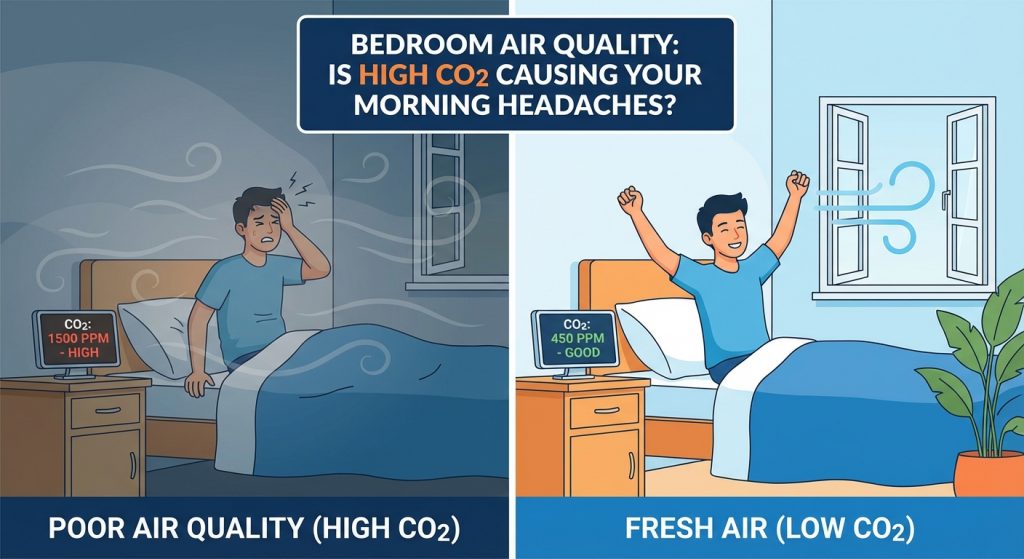
Every time you exhale, you release Carbon Dioxide (CO2). In a well-ventilated house, this disperses. In a small, closed bedroom, it accumulates.
The Thresholds (Parts Per Million – PPM):
- 400 ppm: Fresh outdoor air.
- 600-800 ppm: Excellent indoor air quality.
- 1,000 ppm: The threshold for drowsiness and poor concentration.
- 1,500 – 2,500+ ppm: Common levels in a closed bedroom. Causes headaches, increased heart rate, and restless sleep.
- 5,000 ppm: Toxic limit for workplace exposure (8 hours).
How does CO2 affect your sleep?
Research shows that as CO2 rises, your blood oxygen saturation can drop slightly, but more importantly, your autonomic nervous system perceives the “stale air” as a threat.
- 1. Hypercapnia (Mild): Your body works harder to breathe to flush out the CO2.
- 2. Arousal: Your brain pulls you out of Deep Sleep into Light Sleep to increase respiration rate.
- 3. Acidosis: High CO2 turns blood slightly acidic, leading to the “morning hangover” headache caused by vasodilation in the brain.
The Invisible Dust: PM2.5 and Allergens
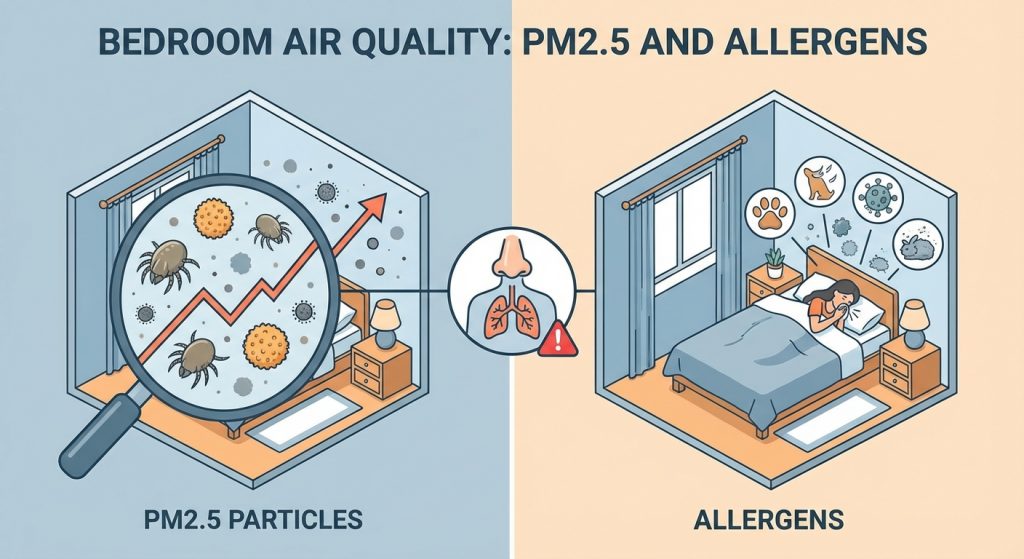
While CO2 makes you groggy, Particulate Matter (PM) makes you inflamed.
- PM2.5: Microscopic dust/smoke particles that enter the bloodstream. High levels are linked to sleep apnea and inflammation.
- PM10: Pollen, mold spores, and dust mites. These trigger nasal congestion.
- The Result: If your nose is blocked by allergies (PM10), you mouth breathe. Mouth breathing leads to snoring, dry mouth, and worse oxygenation. (See The Sleep Triage Test for UARS symptoms).
Monitoring: How to See the Invisible
You cannot fix what you cannot measure. You do not need a $300 professional sensor.
The Budget Solution:
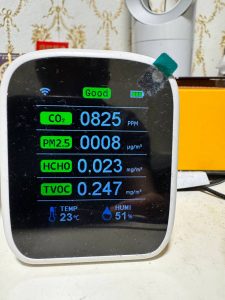
Look for “8-in-1 Air Quality Monitors” on Amazon or AliExpress (often powered by the Tuya Smart Life app).
Key Sensors to look for: NDIR (Non-Dispersive Infrared) for CO2. Warning: Cheap “eCO2” sensors just guess CO2 based on VOCs. Ensure it says NDIR.
Cost: $30 – $60.
What it tracks: CO2, PM2.5, Temperature, Humidity, and TVOC (Volatile Organic Compounds).
The Action Plan:
Place the monitor on your nightstand. Check the history graph in the morning.
- Did CO2 spike above 1,500 ppm?
- Did temperature rise above 72°F (22°C)?
- Did humidity drop below 30% (causing dry throat)?
Solutions: Ventilation vs. Purification
This is the most common mistake: “I bought a HEPA filter, so my air is clean.”
WRONG.
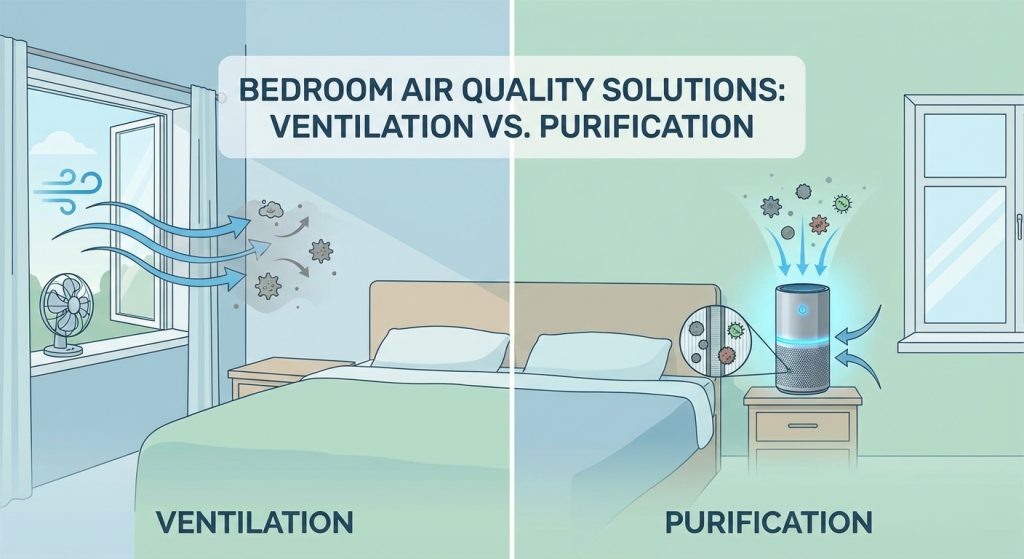
Air Purifiers: Remove dust, pollen, and smoke (PM2.5). They DO NOT remove CO2.
Ventilation: Removes CO2 and replaces it with oxygen.
1. The “Crack the Door” Rule
Does opening a window reduce CO2? Yes, instantly.
Experiment: Sleep with your bedroom door open 3 inches tonight. Your CO2 levels will likely drop from 2,000 ppm to 800 ppm.
If you need privacy: Install a vent in the door or use a “door catch” to keep it slightly ajar.
2. The Fresh Air Hack
If you live in a noisy city or cold climate where opening a window isn’t an option:
Vent the room before bed: Open everything for 10 minutes to “flush” the room down to 400 ppm before you sleep.
Plants: While snake plants produce oxygen at night, you would need a jungle (hundreds of plants) to offset one human’s breathing. Do not rely on plants alone.
3. ERV/HRV Systems (The Gold Standard)
If you own your home, consider an Energy Recovery Ventilator (ERV).
What it does: It sucks stale, high-CO2 air out of the room and pumps fresh, filtered outdoor air in. It transfers the heat/coolness so you don’t lose energy.
Why: Unlike an AC (which just recirculates the same stale air), an ERV actually changes the air.
Temperature and Humidity: The Supporting Actors
Air quality isn’t just about chemicals; it’s about comfort.
Humidity:
- Too Low (<30%): Dries out nasal turbinates, causing congestion and mouth breathing.
- Too High (>60%): Promotes mold growth and dust mites.
- Target: 40-50%. Use a humidifier if necessary, but clean it daily to avoid pumping mold into the air.
Temperature:
As discussed in Sleep Hygiene Checklist, high temps destroy Deep Sleep. High CO2 often correlates with high heat (stuffy room). Keeping the air fresh usually keeps it cool.
Reddit & Community Consensus
On r/Biohackers and r/Sleep, users report drastic changes after buying CO2 monitors.
- “The 2,500 PPM Shock”: Many users found their small bedrooms hit 3,000 ppm by 4 AM. Simply opening the door resolved their “chronic fatigue” and morning headaches instantly.
- “AC is a Trap”: Users noted that Split-System AC units do not bring in fresh air. You can freeze in a room that is toxic with CO2.
- “Mouth Taping + Air Quality”: If you use mouth tape, you must ensure your nasal passages are clear. High PM2.5 (dust) will block your nose, making mouth taping dangerous or impossible.
Update for December 2025: The “Aranet4” Standard & The Mold Sensor Revolution
Since I first warned about the dangers of bedroom CO2, the market for home air monitoring has exploded. We have moved from cheap sensors to lab-grade diagnostics that fit in your pocket.
Here is the essential new information for late 2025.
1. The “Aranet4” Standard (The Biohacker’s Choice)
In 2025, the Aranet4 Home has become the undisputed gold standard for portable CO2 monitoring.
Why? Unlike the cheaper Tuya sensors I previously recommended (which drift), Aranet uses a high-precision NDIR sensor with e-ink display (saving battery for months).
The Feature: Its app provides detailed 7-day graphs that clearly show the “CO2 Curve” of your sleep. Seeing the line spike to 2,500ppm at 4:00 AM is the visual proof most people need to finally invest in ventilation.
2. The Mold Sensor Breakthrough (Mycometer Tech)
We used to rely on “PM2.5” as a proxy for mold. In late 2025, consumer-grade Mycotoxin Sensors are finally hitting the market.
The Tech: Devices like the AirThings Plus Gen 3 now include specific “Risk Indexes” for mold growth based on humidity duration, not just current humidity.
The Takeaway: If your room smells “musty” but your PM2.5 is low, your sensor was blind. The new generation detects the conditions that breed mold before the spores become airborne.
3. “Positive Pressure” Ventilation (The DIY ERV)
A massive DIY trend on Reddit/r/AirQuality in 2025 is the “Positive Pressure” Bedroom.
The Hack: Instead of just opening a window (which lets in noise/pollen), biohackers are installing small intake fans with HEPA filters in the window.
The Result: This pushes filtered fresh air into the room, forcing stale, high-CO2 air out under the door gaps. It lowers CO2 to outdoor levels (<500ppm) while keeping the room ultra-clean from dust.
4. Safety Update: “Ionizer” Ozone Warning
Many “Sleep Air Purifiers” marketed in 2025 include Ionizers.
The Warning: Be extremely careful. Ionizers can generate Ozone, a lung irritant that is arguably worse for sleep than CO2.
The Rule: Always buy mechanical HEPA filters. Avoid “Plasma,” “Ionic,” or “UV” add-ons unless they are CARB-certified zero-ozone.
Summary
If you wake up with a headache or brain fog, your bedroom is likely a CO2 trap.
Your Action Plan:
- 1. Buy: A cheap NDIR CO2 monitor ($40).
- 2. Test: Measure your baseline tonight with the door closed.
- 3. Fix: If CO2 > 1,000 ppm, open the door or window.
- 4. Purify: Add a HEPA filter for dust/allergens, but know that it does not fix the CO2 problem.
Sleep requires oxygen. Don’t starve your brain while you rest.
Read Next:
Sleep Hygiene Checklist: The 5 Non-Negotiables
The Sleep Triage Test: Do You Have Insomnia, Apnea, or UARS?

By: Alex Warenstein.
Bio: Alex Warenstein is a sleep biohacker and founder of Night Time Comfort. After battling chronic insomnia and circadian disruption, he now helps others optimize their sleep using data-driven protocols. Read full story.
Disclaimer: Alex is not a doctor. This content is for educational purposes only. Always consult a specialist.