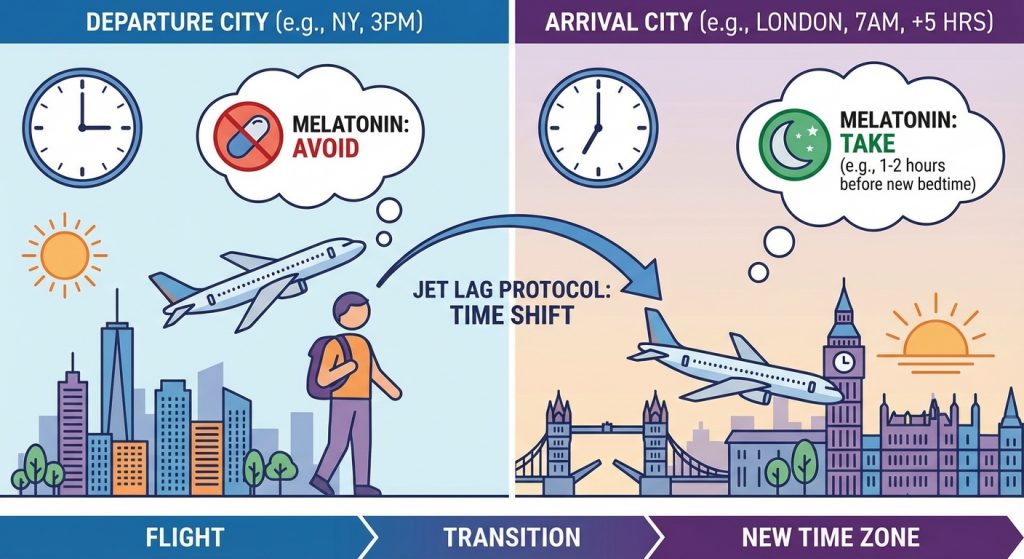
You land in London at 8:00 AM. Your body thinks it is 2:00 AM. You have a meeting in four hours, but your brain feels like it is filled with wet cement. You power through the day, crash at 7:00 PM, and wake up wide awake at 3:00 AM staring at the ceiling.
This is jet lag: a temporary mismatch between your internal clock and the local light–dark cycle (CDC Yellow Book).
While most people use melatonin as a generic sleeping pill, its true power is as a chronobiotic—a tool to shift your circadian rhythm. However, most people use it wrong. They take too much, too late.
This guide explains the most effective time to take melatonin for travel, how late is too late, and how to avoid the dreaded next-day grogginess while resetting your clock.
The Core Concept: It’s a Timer, Not a Tranquilizer
To understand the protocol, you must answer this common question: Does melatonin make you fall asleep or sleep longer?
- The Answer: Melatonin is primarily a timing signal (a “darkness message”), not a knockout sedative; it helps your brain interpret when “night” is happening (NCBI Bookshelf).
- The Nuance: While it lowers body temperature, which helps you fall asleep, it does not force you unconscious like a prescription hypnotic. If you take it at the wrong time, you won’t sleep longer; you will just confuse your biological clock, potentially making jet lag worse.
The Protocol: Flying East (Phase Advance)
Scenario: New York (EST) to Paris (CET). You lose hours. You need to fall asleep earlier.
This is the hardest direction for the human body. You need to pull your sleep window forward (“Phase Advance”).
- 1. Pre-Flight Preparation
What is the most effective time to take melatonin before you travel?A. Start 3 days before your trip.
B. Take a micro-dose (0.5mg) 5 hours before your current bedtime.
C. Why? This tricks your brain into thinking the sun has set early, shifting your fatigue window earlier for the next night.
- 2. On The Flight
A. Set your watch to destination time immediately.B. Take 1-3mg of melatonin when it is 10:00 PM at your destination.
C. How long does it take for melatonin to put you to sleep? Roughly 30-60 minutes. Plan accordingly and wear an eye mask.
- 3. Arrival (The “Too Late” Rule)
You arrive. It’s afternoon. You are exhausted.How late is too late for melatonin?
A. If you arrive and it is 2:00 PM, taking melatonin now is a disaster. It will likely push your clock the wrong way (Phase Delay) or leave you groggy for dinner.
B. The Strategy: Wait. Fight the sleepiness.
C. Take a small dose (0.5mg – 1mg) at 7:00 PM local time. This is earlier than normal bedtime, but it starts the “wind down” sequence so you can sleep by 10:00 PM.
The Protocol: Flying West (Phase Delay)
Scenario: London (GMT) to New York (EST). You gain hours. You need to stay awake later.
This is easier, but the danger is waking up at 4:00 AM.
1. On The Flight
Do not take melatonin. Use caffeine (if it’s before 2 PM EST) or light exposure to stay awake.
2. Arrival
When should you not take melatonin? Do not take it in the evening (e.g., 7 PM or 8 PM). You want to delay sleepiness.
Wait until 11:00 PM local time. Take it only to help sustain sleep through the night.
Dosage Warning: The “More is Better” Trap
How much melatonin is safe to take daily? And is 10 mg of melatonin too much?
In the US, supplements are often sold in large doses (1mg–10mg). For jet lag, starting low is usually the better trade-off: doses around 0.5mg–1mg can be enough for many people, while higher doses are more likely to cause next-day grogginess (Mayo Clinic).
- The Problem: Higher doses can keep melatonin effects “spilling” into the morning, especially if you take it late.
- The Consequence: Does melatonin make you groggy the next day? Yes—especially if you take 10 mg. You will wake up with “brain fog” because your brain is still bathed in the “it’s dark” hormone even though the sun is up.
- The Protocol: Buy 1mg or 3mg pills and break them. You only need 0.3mg to 1mg to trigger the circadian shift.
The Safety Check: Side Effects
What are melatonin side effects?
While generally safe, for travel purposes, watch for:
- 1. Vivid Dreams: More common at higher doses or when your sleep is already fragmented.
- 2. Grogginess: As mentioned, caused by overdosing.
- 3. Feeling Cold: Melatonin can slightly lower core body temperature, so on a cold plane you may feel chillier than expected—bring a blanket.
Is melatonin addictive or habit-forming?
Melatonin isn’t considered physically addictive, but it works best here as a short, targeted tool—not a nightly habit. If you take prescription meds (especially blood thinners) or have epilepsy, it’s worth checking with your clinician before using it.
Interaction and Effectiveness
What interacts negatively with melatonin?
Caffeine: Caffeine can suppress melatonin production. Do not take them together.
Alcohol: Alcohol destroys sleep quality and can interfere with melatonin’s signaling. The free wine on the plane is not your friend.
How long does melatonin last before it wears off?
Fast-release melatonin typically peaks around ~1 hour; time-release (XR) lasts longer.
For jet lag, fast-release is usually the better fit for shifting your clock, while slow/extended-release can be less effective for the phase shift itself (Cochrane).
Reddit & Community Hacks
- 1. The “Sunrise” Anchor:
Users emphasize that melatonin is useless without light. You must get morning sunlight exposure the next day to “lock in” the shift caused by melatonin. (See Morning Sunlight: The Huberman Protocol). - 2. The “Pre-Flight Fast”:
Some biohackers stop eating 16 hours before the first breakfast at the destination. This resets the “peripheral clock” (gut), while melatonin resets the “central clock” (brain).
Update for January 2026:
The big theme of late-2025 → Jan-2026 is simple: melatonin works best when it’s paired with smart light and meal timing. Here are the most useful updates in plain language.
- 1. A clearer “eastbound rule” for melatonin (and why it works):
If you fly east, consider melatonin 30–60 minutes before the NEW local bedtime for the first couple of nights, and treat morning sunlight + evening light-avoidance as non-negotiable (Stanford Lifestyle Medicine). - 2. Jet lag is increasingly framed as a “whole-body clock” issue (not just sleep):
Late-2025 public-health messaging emphasizes resetting your sleep + light + meal timing together; melatonin is a helper, but the heavy lifting still comes from what your eyes and schedule tell your brain (ABC listen). - 3. Screens before bed: small changes can move sleep timing (useful for jet lag nights):
A 2025 crossover study found that partial blue-light-blocking glasses worn for ~3 hours before bed nudged sleep timing earlier; for jet lag, this can help your evening melatonin dose “push” in the same direction as your light environment (PLOS ONE). - 4. “Gut jet lag” got louder in the research conversation:
A 2025 review highlights that irregular and late-night eating is one of the strongest ways to keep the gut clock out of sync; consistent meal timing (especially “breakfast in the new time zone”) supports faster adaptation alongside melatonin (Frontiers in Nutrition). - 5. Why this matters more after 35 (practical, not scary):
An October-2025 American Heart Association statement ties frequent circadian disruption (late-night light, irregular sleep/meal timing—jet lag is the extreme version) to higher cardiometabolic risk over time—another reason to prioritize fast realignment (light + timing) and to keep melatonin as a short-course tool (American Heart Association).
Summary
Jet lag is manageable if you treat Melatonin as a clock-setter, not a sedative.
- 1. Flying East: Take it early (5 hours before bed pre-flight; 7 PM local time post-flight).
- 2. Flying West: Take it late (bedtime only).
- 3. Dosage: Keep it under 3mg to avoid the hangover.
- 4. Avoid: Taking it at 2 AM or 2 PM, which will confuse your rhythm further.

By: Alex Warenstein.
Bio: Alex Warenstein is a sleep biohacker and founder of Night Time Comfort. After battling chronic insomnia and circadian disruption, he now helps others optimize their sleep using data-driven protocols. Read full story.
Disclaimer: Alex is not a doctor. This content is for educational purposes only. Always consult a specialist.