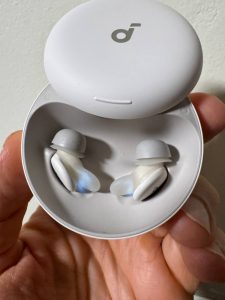
I have a drawer in my nightstand that I call the “Graveyard of Hope.” inside, you will find foam earplugs that hurt my ear canals, wax balls that got stuck in my hair, and bulky noise-canceling headphones that are impossible to wear while sleeping on my side.
If you are reading this, you probably have a similar drawer. You are likely here because your bedroom environment is hostile to your sleep. Maybe it’s a snoring partner (the number one cause of “sleep divorce”), maybe it’s street traffic, or maybe it’s just the deafening silence that makes your tinnitus or racing thoughts louder.
I bought the Soundcore Sleep A30 (the successor to the A10 and A20) with my own money here in Europe about 10 days ago. I needed to know if Anker finally cracked the code: a tiny earbud with actual Active Noise Cancellation (ANC) that lasts all night.
I have tested them for over a week, comparing them against my Apple Watch sleep tracking, and the gold standard of silence—simple foam plugs. Here is the honest truth about whether these can save your sleep or if they are just expensive digital earplugs.
The Problem: Why Regular Headphones Fail
Before we dive into the specs, we need to establish why you can’t just wear your AirPods Pro 2/3 to bed.
- 1. Pressure Pain: If you are a side sleeper like me, putting a standard earbud against a pillow creates immediate pressure on the ear canal. After 30 minutes, it’s annoying. After 4 hours, it’s agony.
- 2. Battery Life: Most ANC headphones last 6 hours max. If you wake up at 4 AM because the battery died and the “low battery” chime screamed in your ear, the device has failed its purpose.
- 3. The “Sticking Out” Factor: Standard earbuds protrude. When you roll over, the pillow knocks them out.
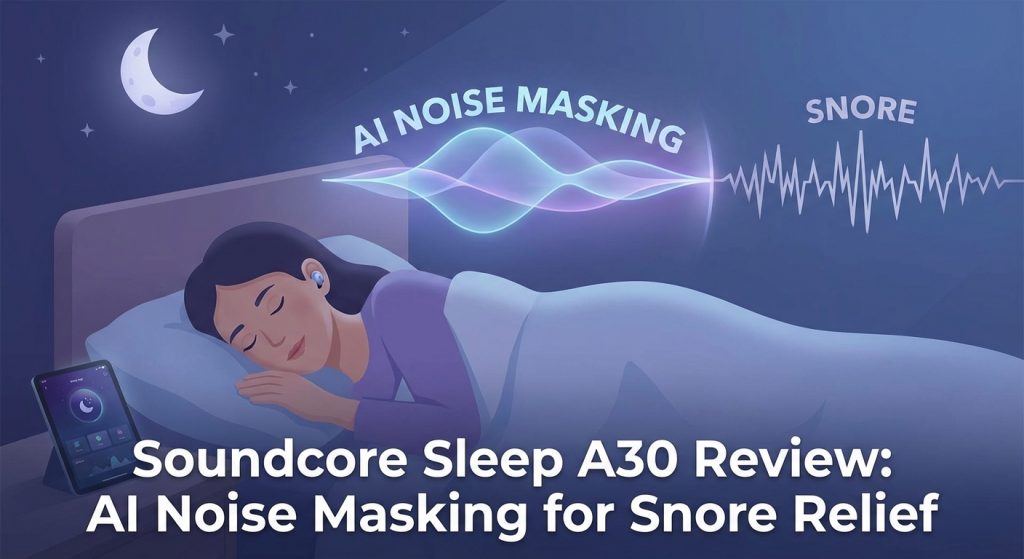
The Soundcore Sleep A30 promises to solve all three. They claim to be “imperceptible” in the ear, offer AI-driven noise masking that adapts to your environment, and track your sleep stages.
Let’s see if they deliver.
Design & Comfort: The “Invisible” Earbud
When I unboxed the A30s, the first thing that struck me was the size. They are laughably small. They make my AirPods 3 Pro look massive.
The design philosophy here is “flush fit.” The body of the earbud is thin enough that when inserted, it sits entirely inside the concha (the bowl of the ear). This is critical for side sleeping.
The “Twin Seal” System
Soundcore uses a two-part system to keep them in place and block noise:
- 1. Ear Wings: These soft silicone fins tuck under the ridge of your ear to lock the bud in place. They come in multiple sizes.
- 2. Ear Tips: The actual plug that goes into the canal.
Alex’s Experience:
My Rating: 7/10
Out of the box, I struggled with the silicone tips. They felt slippery and didn’t create that vacuum seal I need to block out the world. However, Anker includes foam tips in the box. I switched to the medium foam tips immediately.
The result? Near perfection in terms of comfort.
I lay down on my Tempur Sonata pillow, pressed my ear firmly into the memory foam, and… nothing. No sharp pain. No pressure point. I could feel them, sure, but it wasn’t the stabbing sensation of an AirPod stem. For side sleepers, the form factor is a 10/10. They stayed in my ears for the entire night, every night for 10 days.
The Big Question: Is the ANC Good?
This is the main selling point of the A30 over previous generations. The box proudly claims Active Noise Cancellation.
Let me be extremely clear so you don’t waste your money: The ANC is very, very weak.
If you are expecting the “cone of silence” you get from Apple AirPods Pro 3 or Bose QC Ultra, you will be disappointed. When I toggle the ANC on and off without playing any sound, the difference is subtle. It cuts out the low-end hum of my bedroom air purifier and perhaps the very distant rumble of a car outside.
However, it does not silence voices, a TV playing in the next room, or a loud snore next to you on its own.
Passive Isolation vs. Active Cancellation
The magic here isn’t the software; it’s the hardware. With the foam tips expanded in my ears, the passive noise isolation is doing 80% of the heavy lifting. It acts like a high-end earplug. The ANC just polishes off the remaining low-frequency hum.
Consensus from the Community:
I checked the latest threads on r/sleepheadphones and SleepHQ, and the verdict matches mine. Users are noting that while the A30 is better than the A20, the ANC is “light.” It’s designed to lower the noise floor, not eliminate it. Do not buy these solely for the ANC.
Features & Modes: How I Use Them
The Sleep A30 operates in two distinct modes, and understanding this is key to battery life and sleep hygiene.
1. Bluetooth Mode (Streaming)
In this mode, they act like normal headphones. You can stream Spotify, YouTube, or podcasts from your phone.
- Pros: limitless content.
- Cons: Higher battery drain (approx. 6 hours). If you lose connection, the audio stops. Blue light exposure from fiddling with your phone.
2. Local Mode (Sleep Mode) — The Winner
This is where the device shines. You can upload sounds from the Soundcore app directly onto the earbuds’ internal memory. Once the sound is transferred, you don’t need your phone. You can turn off Bluetooth on your phone, put it in another room, and just tap the earbud to play the sound.
My Protocol:
I found Bluetooth mode draining. I switched to Local Mode.
I browsed their library—which is surprisingly extensive and free (no subscription needed). They have:
- Nature: Rain, wind, forest, stream, Niagara Falls (heavy water noise).
- Colors of Noise: White, Pink, Brown, Green.
- Binaural Beats: Brainwave entrainment tracks.
I uploaded Pink Noise. Pink noise is deeper than white noise; it has reduced higher frequencies which I find less harsh for the brain.
In Local Mode, the battery lasts significantly longer—easily covering my 8-hour sleep window.
The “Smart” Features: Masking & Detection
Smart Volume Control (Masking)
The A30s have a feature where they can listen to the environment and automatically increase the volume of your masking sound (the Pink Noise) if the external noise (snoring) gets louder.
Does it work? Technically, yes. But I turned it off. I found the fluctuating volume to be more disturbing than a constant steady stream of sound. I prefer setting the Pink Noise to a consistent 40% volume. It creates a “sound blanket” that smoothes over the spikes of external noise.
Sleep Detection
The earbuds claim to detect when you fall asleep. You can set them to:
- 1. Play sound all night.
- 2. Turn off the sound once you fall asleep.
My Experience: I set them to play all night. Why? Because if the sound stops, the snoring might wake me up at 3 AM. However, for those who just need help with Sleep Onset Latency (falling asleep) but stay asleep fine, the auto-off feature works well. It usually detected my sleep onset within 20 minutes of me actually drifting off.
Sleep Tracking: The Disappointment
The Soundcore app offers a “Sleep Health” section. It gives you a hypnogram showing Awake, Light, Deep, and REM sleep.
Alex’s Verdict: Ignore this data.
I compared the A30 data against my Apple Watch Ultra 2 (which is validated against polysomnography to be relatively accurate for a wearable) and my subjective feeling.
The A30 data is, frankly, a hallucination.
- Deep Sleep Inflation: The A30 consistently told me I was getting 2 to 3 hours of deep sleep. My Apple Watch and O2Ring usually place me around 40-50 minutes (which is normal for my age).
- Inaccuracy: The A30 relies on head movement (accelerometers) to guess your sleep stage. It does not measure Heart Rate (HR) or Heart Rate Variability (HRV). Without HR data, accurate staging is impossible.
Community Check: Top reviewers like The Quantified Scientist have shown that movement-based sleep staging is rarely better than a random guess. On Reddit, users jokingly call it “Sleep Entertainment” rather than Sleep Tracking.
Takeaway: Use the A30 to help you get to sleep. Use your Apple Watch or Oura Ring 4 to track the sleep. Do not look at the Soundcore app for medical insights.
The App & Ecosystem
The Soundcore app is actually quite good. It’s stable, connects quickly, and allows for deep customization of the controls.
You can customize what a “double tap” or “triple tap” on the earbud does. I set my left ear to toggle “Quiet Mode” (ANC only) vs. “Play Mode” (Pink Noise).
Note: The tap controls are sensor-based, not touch-based. You have to tap the earbud firmly. It takes some getting used to, but it prevents accidental touches against the pillow.
Comparison: A30 vs. The Competition
vs. Loop Quiet 2 (Earplugs)
- Loop: Purely passive silicone. Costs ~$25.
- A30: Active masking + passive foam. Costs ~$150.
- Winner: If you just need to dim the lights on noise, get the Loops. But the Loops create an “occlusion effect”—you hear your own heartbeat and breathing very loudly. The A30’s audio masking (Pink Noise) covers up your internal body sounds, which I find essential for relaxation.
vs. Ozlo Sleepbuds (Ex-Bose)
- The Bose Sleepbuds II were legendary but discontinued. The team formed Ozlo.
- Comparison: The Ozlos are focused purely on masking (no ANC). The A30 offers ANC + Masking + Bluetooth Streaming. The A30 is also significantly cheaper. Unless you are a die-hard Bose fan, the A30 is the better value proposition in 2025.
vs. Standard ANC Earbuds (AirPods/Sony)
Winner: A30 purely for side-sleeping comfort. You cannot sleep on your side with AirPods without pain.
Summary
The Soundcore Sleep A30 is a tool, not a miracle cure. It will not silence a chainsaw-level snorer into oblivion. However, by combining a secure foam seal, mild ANC, and a localized sound curtain (Pink Noise), it pushes the noise floor down enough for your brain to ignore the environment.
What I Liked:
- Comfort: The foam tips and tiny profile are perfect for side sleepers. Zero pain after 10 days.
- Local Mode: Playing sounds without a phone connection saves battery and reduces blue light/radiation anxiety.
- The Library: Huge selection of free masking sounds (Pink, Brown, Green noise, Binaural beats).
- Battery: In Local mode, they easily last the whole night.
What I Disliked:
- Weak ANC: Don’t expect Apple-level silence. It’s subtle.
- Sleep Tracking: Inaccurate and prone to wild overestimations of Deep Sleep.
- Case Fiddle: The earbuds are tiny and magnetic; sometimes it’s hard to get them seated perfectly in the charging case in the dark.
Should You Buy Them?
- Buy them only if you are a side sleeper who specifically needs sound masking (rain, white noise, etc.) to drift off. If you rely on audio to distract your racing mind or cover tinnitus, these are the best comfortable option on the market.
- Do NOT buy them if you just want absolute silence and hate listening to white noise. You are better off with high-quality custom molded earplugs.
For me, they have earned a spot on my nightstand, acting as my “Pink Noise delivery system” and a backup for travel when I can’t control the hotel environment. They aren’t perfect, but they fit in my ear, and right now, that’s half the battle.

By: Alex Warenstein.
Bio: Alex Warenstein is a sleep biohacker and founder of Night Time Comfort. After battling chronic insomnia and circadian disruption, he now helps others optimize their sleep using data-driven protocols. Read full story.
Disclaimer: Alex is not a doctor. This content is for educational purposes only. Always consult a specialist.