When Shoulder Pain Wakes You at Night: A Practical Guide to Rotator Cuff-Related Shoulder Pain, Impingement, and Broken Sleep
For many people, shoulder pain does not begin as a dramatic daytime injury. It starts as something much easier to underestimate: a slight catching sensation with rotation, a mild pinch when the arm turns the wrong way, or a vague front-of-shoulder discomfort that is barely noticeable during the day. Then sleep begins to fall apart. The person wakes at 1 a.m., then 3 a.m., then 4:30 a.m. They turn from one side to the other, drift off again, then wake a little later for the same reason. Eventually, what looks like “insomnia” turns out to be a mechanical shoulder problem that keeps re-triggering the nervous system through the night. Current shoulder research supports this pattern: rotator cuff-related shoulder pain can be painful during sleep or rest, poor sleep is common in rotator cuff disease, and sleep quality often worsens well before people realize how much the shoulder is driving their awakenings.
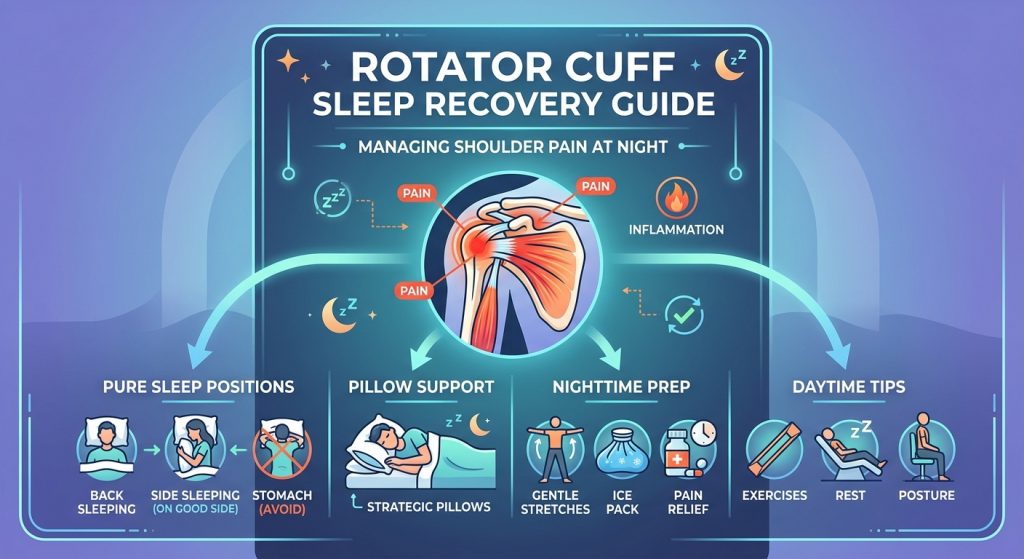
That is exactly the kind of case this article is about. Think of a middle-aged side sleeper whose left shoulder has become the real problem, especially because he usually sleeps on that side. The left shoulder does not hurt much during the day. It may only feel slightly “not right” with turning or rotational movements. But at night, the pattern changes completely. The shoulder becomes sensitive when he rolls from one side to the other, and there is an additional pressure pain from lying directly on the shoulder. The right shoulder can also become sore when he lies on the right side, but much less. In the daytime, the right side feels essentially normal. This split between daytime function and nighttime suffering is not unusual in rotator cuff-related shoulder pain and subacromial pain syndrome. Research has repeatedly shown that night pain and sleep disturbance are among the most common complaints in rotator cuff disorders, and the severity of structural findings on imaging does not neatly predict how bad sleep will be.
That last point matters. Many people wrongly assume that if the shoulder is “not that bad” during the day, it cannot be the real reason they keep waking at night. But shoulder literature says otherwise. In a large cohort of patients with rotator cuff disease, nocturnal pain was reported by 91% of participants, and worse sleep quality was associated with pain and related factors rather than simply with how severe the rotator cuff pathology looked. Another systematic review found that nighttime pain and sleep disruption are extremely common in rotator cuff injuries and tend to improve when the underlying shoulder problem is treated. In other words, you do not need catastrophic daytime pain for the shoulder to become a powerful driver of sleep fragmentation.
Why this pattern is so easy to misread?
People often search for why you wake up at 3am, sleep maintenance insomnia, or early morning awakening, and sometimes those are the right frameworks. But there is another pattern that looks similar from the outside and is very different underneath: pain-related awakenings caused by an irritated shoulder that becomes more symptomatic under sustained compression, awkward rotation, or repeated turning in bed. In shoulder research, nocturnal pain is described as a major symptom in rotator cuff disorders and shoulder impingement, and prospective data show that more severe nocturnal pain is linked to greater disability.
This is why some people wake in a repeating sequence across the night. They fall asleep. The shoulder is tolerable. After one or two sleep cycles, enough time has passed in one position for local irritation, compression, or stiffness to build. They turn. The turn itself hurts. The nervous system wakes up fully enough to break sleep, even if the person does not rate the pain as extreme. Then the same thing happens again two hours later. That is not just “bad sleep hygiene.” It is a classic example of sleep fragmentation driven by a musculoskeletal trigger. The shoulder studies on sleep quality and nocturnal pain, together with clinical guidelines that explicitly recognize pain during sleep or rest in more irritable rotator cuff presentations, fit this pattern very well.
Another reason this is misread is that shoulder pain at night does not always feel sharp. Sometimes it is an ache. Sometimes it is a pressure discomfort. Sometimes it is a brief pinch during rolling over. Sometimes it is a feeling that the shoulder is “not happy” when compressed. But sleep is sensitive. Repeated low-grade mechanical irritation can be enough to wake a person again and again, especially in the second half of the night when sleep is lighter. That is why people with rotator cuff-related night pain often describe a puzzling pattern: they are not in agony, yet they keep waking anyway. The shoulder-sleep literature strongly supports that poor sleep is common in shoulder disorders, that nocturnal pain is a central complaint, and that sleep disturbance is one of the most burdensome consequences of these conditions.
What rotator cuff-related shoulder pain and “impingement” usually mean in real life
The terminology around this problem has evolved. Many clinicians now prefer broader terms such as rotator cuff-related shoulder pain or subacromial pain syndrome rather than using “impingement” as the only explanation. The reason is simple: shoulder pain in this region is usually not caused by one single thing. It is more often a blend of load intolerance in the rotator cuff tendons, pain sensitivity, altered shoulder-blade mechanics, reduced trunk or thoracic contribution, and movement patterns that increase stress in an already irritable system. Modern guidelines recommend treating it as a functional, load-related shoulder disorder rather than as a pure “bone pinching tendon” story.
That said, the older word impingement still describes what many patients feel. The subacromial space is the region where the rotator cuff tendons and nearby soft tissues move under the top of the shoulder. If the shoulder blade is not moving well, the humeral head is not being controlled well, the tissues are already irritable, or the shoulder is repeatedly compressed in awkward positions, symptoms can show up as a pinch, catch, ache, or painful arc. The rotator cuff muscles help center the ball of the shoulder in the socket during movement, and the scapular muscles help position the shoulder blade so the shoulder has better mechanics. When that system is off, night symptoms become much more plausible.
This is also where the attached physiotherapy referral makes clinical sense. Stripped of all personal identifiers, the referral emphasizes reducing secondary impingement, restoring shoulder-girdle dynamics, releasing periscapular tension, doing individualized kinesiotherapy, correcting movement stereotypes, stabilizing the joint, relaxing hypertonic muscles, strengthening weak muscles, using soft-tissue techniques, adding joint mobilization, and teaching self-therapy. That is not a random list. It is almost a plain-language map of what modern conservative care for this problem is trying to achieve.
Why side sleepers get hit especially hard
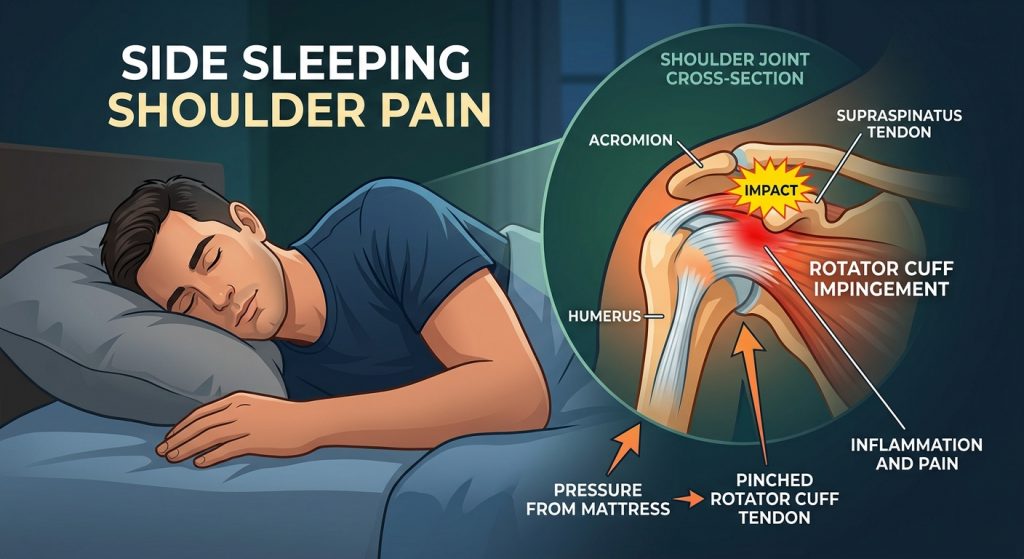
This problem often becomes brutal in people who sleep almost exclusively on their side. Not because side sleeping is automatically wrong, but because side sleeping places direct load on one shoulder for long periods, and when one shoulder starts to hurt, the person switches sides more often, which can then irritate the other side too. Experimental work has shown that subacromial pressures are lower in people sleeping supine than in people sleeping on the side or prone. More recent work has also suggested a relationship between preference for side sleeping and rotator cuff tears, although not every study agrees on posture as a direct cause. What is clear is that lying on the affected shoulder commonly worsens symptoms, and many patients report being awakened by the combination of pressure and rolling movements.
That matches the real-world pattern extremely well. A person lies on the left shoulder because that is his normal position. After enough time, compression builds irritation. He rolls away from it, and the turn itself provokes pain, especially if the shoulder has to internally or externally rotate under load. He then lands on the right side. The right shoulder is healthier, but now it is taking more compression than usual, so after some time it also begins to complain. This creates a miserable “pain rotisserie” through the night, where neither side feels sustainable. It is a surprisingly common description in patient communities, and it lines up with what shoulder biomechanics and night-pain studies would predict.
For the left shoulder in particular, the details matter. Front-of-shoulder pain, discomfort near the armpit, sensitivity during rotational testing, and pain triggered by rolling can fit with an anteriorly irritable rotator cuff pattern, including subscapularis involvement in some cases. A 2022 prospective study found that nocturnal pain severity in rotator cuff-related shoulder pain was related to disability, and the presence of subscapularis tendinosis appeared to predict more severe nocturnal pain. That does not mean every person with front-shoulder night pain has the same structure involved, but it does underline something important: night pain is a real clinical signal, not an imaginary side effect of bad sleep.
What current evidence says actually helps
The broad answer is clear: physiotherapy is first-line treatment, and the center of that treatment is an active rehabilitation program built around education, activity modification, rotator cuff loading, scapular control, and gradual strengthening. The 2025 JOSPT clinical practice guideline recommends active rehabilitation exercise as an initial treatment modality for adults with rotator cuff tendinopathy. The same guideline says education should include advice on exercise supervision, goal setting, activity modification, and pain management. The 2025 British Elbow and Shoulder Society pathway also states that physiotherapy or non-surgical treatment should be first-line management for subacromial pain, and that most symptoms respond within about three months.
The best new practical data are encouraging. In a 2025 prospective cohort of 143 adults with rotator cuff-related shoulder pain, a 12-week criteria-based physiotherapy program led to significant reductions in pain at rest, at night, and with activity within six weeks, with continued improvement through 26 weeks. Range of motion and strength improved, and clinically important quality-of-life gains appeared within 12 weeks. Participants were taught a structured three-phase program, completed home exercise at least four times per week, and were specifically coached to work “to but not through” pain. That is about as close as current literature gets to a realistic picture of how non-surgical recovery often happens in the real world.
There is also strong support for targeting the scapula. A 2024 systematic review and meta-analysis of randomized trials found that scapular stabilization exercises improved pain and function more than conventional physiotherapy alone in subacromial pain syndrome. The review also explains why this makes sense: patients with this problem often show reduced upward rotation and posterior tilt of the scapula, along with underuse of the serratus anterior and lower-to-middle trapezius and overuse of the upper trapezius. In simpler words, the shoulder blade often stops doing its share of the job, and that leaves the shoulder itself working in a worse position.
Manual therapy is not the main engine of long-term recovery, but it can be genuinely useful, especially early on. The JOSPT guideline says spinal or upper-limb manual therapy, including soft-tissue work and joint mobilization, may reduce pain in the short term. The 2025 BESS pathway similarly notes a favorable short-term effect of manual therapy. A 2024 randomized trial also found that adding myofascial release to supervised exercise improved pain with activity, function, external rotation, abduction, and the balance between upper trapezius and serratus anterior activation more than exercise alone. This matters because when the shoulder is waking someone at night, short-term symptom relief is not trivial. It can create the window needed to actually perform the exercises that drive durable improvement.
The evidence on taping is more modest. Taping may help reduce pain in the short term, especially as part of an active rehab program, but it is not a stand-alone fix and the evidence remains mixed. The 2025 guideline notes that taping is believed to improve posture and shoulder kinematics and may reduce pain, especially early in rehabilitation, yet the evidence is not strong enough to treat it as a major long-term solution. That is the right way to think about it: tape can be useful, but exercise is the foundation.
One more point is worth making because it changes expectations. Not every person needs endless supervised therapy sessions. The GRASP trial found that a more elaborate progressive exercise program was not superior over 12 months to a well-delivered best-practice advice session with a physiotherapist, and corticosteroid injection offered no long-term benefit. Combined with guideline statements that supervised exercise is not clearly superior to home-based exercise for pain and disability, the lesson is straightforward: consistency and progression matter more than collecting a high number of clinic visits.
A practical non-surgical recovery plan for the side sleeper whose shoulder keeps breaking sleep

The following plan is the kind of structure that fits both the referral logic and the current evidence. It is not a rigid formula. The exact exercise mix should be individualized by the physiotherapist after examining which movements trigger pain, which muscles are underperforming, and how the shoulder blade moves. But for the common pattern described here, this is the right framework.
Phase 1: Calm the irritated shoulder and stop feeding the night-pain loop
The early goal is not to “smash the weakness.” It is to reduce irritability, restore tolerable motion, and make the shoulder safer to turn with in bed. This is the phase where people often make the mistake of either doing nothing or doing too much.
A good opening block usually includes gentle pendulum work, supported range-of-motion drills, isometric rotator cuff work, very basic scapular setting, and thoracic mobility. HSS’s patient-facing guidance for shoulder impingement highlights isometric internal and external rotation as a useful starting point, along with side-lying external rotation and scaption. NHS-style shoulder impingement leaflets make the same general point from another angle: the most important part of treatment is the home exercise program, done regularly, while avoiding activities that obviously aggravate the pain.
In practical terms, the first exercises often make sense in this order. First, gentle pendulum swings or supported arm circles to reduce guarding and restore trust in movement. Second, isometric internal and external rotation with the elbow by the side and a towel roll under the arm. These are useful because they let the rotator cuff work without large painful movement. Third, low-load scapular awareness work: gentle shoulder-blade setting without shrugging, or a light scapular retraction drill. Fourth, thoracic extension or “open-book” style mobility to make the trunk contribute better. Fifth, if tolerated, a light posterior-shoulder stretch or cross-body stretch, because posterior capsule stiffness and pectoralis minor tightness are repeatedly mentioned as contributors to abnormal scapular position and subacromial pain.
Why these first? Because the shoulder that wakes someone at night is often both irritable and poorly controlled. Isometrics give the cuff a job without forcing big ranges. Gentle mobility prevents the shoulder from becoming more guarded. Scapular drills begin restoring the shoulder-blade position that helps create cleaner arm movement. Thoracic work matters because the shoulder blade does not float in space; it rides on the rib cage. If the upper back is stiff and the shoulder sits habitually forward, the cuff has less help. Current guidelines and scapular-focused evidence fit this strategy well.
A reasonable rhythm in this phase is daily gentle mobility, with low-load strengthening most days of the week, keeping intensity in a tolerable range. The 2025 cohort study used home exercise at least four times per week, and NHS educational material emphasizes regular home exercise as the most important part of recovery. The best pain rule is the one used in the 2025 physiotherapy cohort: work to but not through pain. In plain English, discomfort is acceptable; sharp pain and obvious nighttime flare are not the target.
Phase 2: Restore control of the rotator cuff and shoulder blade
Once the shoulder is a bit less reactive, the next job is improving control. This is where many people start to notice that daytime movement feels easier, but the real prize is that rolling in bed becomes less provocative and the sleep window starts to lengthen.
This phase usually expands from basic isometrics into side-lying external rotation, banded external rotation, scaption, and scapular stabilization drills such as wall slides, scapular retraction, and serratus-focused work. HSS specifically highlights side-lying external rotation and scaption as practical home exercises. The 2024 scapular-stabilization meta-analysis lists examples such as wall slides, wall push-up variations, lawnmower patterns, and scapular-retraction exercises. Those are not random internet moves; they map onto the exact muscle pattern that often underperforms in subacromial pain: serratus anterior and lower-to-middle trapezius need to do more, while upper-trapezius over-dominance needs to calm down.
The rotator cuff part matters because the cuff is not just a “lifting” system. Its deeper job is to help center the humeral head during arm movement. When cuff strength and endurance are poor, the shoulder can feel unstable, overloaded, or pinchy in very ordinary tasks. The shoulder-blade part matters because the scapula needs to upwardly rotate and posteriorly tilt well enough to give the arm a clean platform. Current evidence suggests scapular stabilization improves pain and function, even if range of motion itself is not always dramatically different. That is clinically important: many patients do not primarily need more loose range. They need cleaner mechanics under load.
This is also the stage where scaption becomes especially useful. HSS includes it among its core patient exercises. It is a practical way to strengthen the shoulder in a plane that is often better tolerated than pure side lifting. If the movement can be done with control and without provoking the classic pinch, it helps bridge the gap between rehab drills and real life. A light load is enough at first. The point is not bodybuilding. The point is restoring load tolerance.
Phase 3: Build resilience so the shoulder stays quiet at night
By this point, the goal is no longer only “less pain.” It is enough strength, endurance, and movement quality that the shoulder does not become reactive after a few hours of side sleeping or after repeated turns in bed.
This phase tends to progress rows, scaption, external rotation work, serratus drills, and functional reaching patterns. For some people, this includes incline push-up plus work, stronger banded cuff exercises, and more demanding scapular control. The 2025 progressive physiotherapy cohort found that pain dropped first, then strength gains became more apparent between 6 and 12 weeks, with continued improvement later. That sequence makes sense in practice. Better sleep often starts before the shoulder feels “strong,” but the longer-term protection comes from continuing to build the system.
This phase is also where adherence separates people who truly recover from people who only improve temporarily. The 2025 cohort, the GRASP trial, NHS-style leaflets, and modern guidelines all point in the same direction: home program quality matters enormously. Good technique, tolerable dosing, and gradual progression beat random intensity. The shoulder that keeps waking a side sleeper usually does not need heroics. It needs repetition, progression, and enough time for tissues and motor patterns to adapt.
What specific exercises make sense, and why?
For a case like this, the most useful exercises are the ones that solve actual problems rather than just adding “more movement.”
Isometric internal and external rotation help because they activate the rotator cuff with minimal joint motion. Early in the process, that often makes them the most sleep-friendly strengthening option. HSS recommends them specifically for shoulder impingement, using a towel under the arm to improve position and reduce compensation.
Side-lying external rotation is a classic rotator cuff exercise because it loads the external rotators in a controlled, simple way. It is especially useful once the shoulder tolerates movement better and needs true strength rather than just symptom calming. HSS includes it as one of its three simple home exercises.
Scaption helps bridge rehab and function. It trains lifting in a shoulder-friendly plane and can improve confidence with reaching and arm elevation. Again, HSS includes it in basic patient programming.
Wall slides and scapular retraction drills matter because shoulder pain is frequently not just a tendon problem; it is also a shoulder-blade control problem. The 2024 meta-analysis on scapular stabilization gives wall slides and scapular-retraction patterns as examples and supports their use for improving pain and function.
Thoracic mobility work matters because a stiff upper back makes it harder for the shoulder blade to move well. Better thoracic contribution helps the scapula upwardly rotate and posteriorly tilt rather than living in a more forward, crowded position. Current scapular rehabilitation literature repeatedly ties thoracic and scapular mechanics together.
Posterior-shoulder and pectoral mobility can matter because posterior capsule stiffness and pectoralis minor tightness are associated with abnormal scapular position and subacromial pain mechanics. This is one reason some people feel a little better when they are less rounded forward and worse when they are chronically protracted.
How taping fits into the plan
Taping should be viewed as an adjunct, not the cure. The strongest guideline-based way to use it is simple: use it if it reduces pain enough to make movement and exercise easier, especially early in rehab, but do not mistake that for the thing that fixes the problem. The 2025 rotator cuff guideline notes that taping around the scapulothoracic and glenohumeral regions is intended to improve posture and shoulder kinematics and decrease pain, and that clinicians may use it in addition to active rehabilitation to reduce pain in the short term. At the same time, the evidence remains uncertain and conflicting for long-term benefit.
For the kind of shoulder pain discussed here, taping is usually applied in one of three ways. One approach is a scapular cueing application, intended to reduce excessive forward shoulder posture and remind the shoulder blade to sit and move a bit better. Another is a posterior shoulder / deltoid / cuff-support application, intended to reduce pain with movement. A third is a decompression-style kinesiology tape pattern over the more symptomatic region, often around the front or top-lateral shoulder depending on the presentation. The exact pattern is less important than the effect. The first application should ideally be done by a physiotherapist who can test whether the tape actually changes pain during arm rotation, elevation, or the rolling movement that reproduces symptoms at night. Guideline language and clinical practice both support this practical, response-based use.
So how can tape help a side sleeper specifically? Mainly by making the shoulder slightly less reactive during the evening and during the first painful turns in bed. If the tape reduces movement pain, the shoulder is less likely to spike the nervous system during rolling. But the effect is usually temporary. If the cuff remains weak, the scapula remains poorly controlled, and the shoulder remains compressively sensitive, the night-waking pattern returns. Tape buys time. Exercise changes the system.
What real patients keep reporting in forums and Reddit
Scientific evidence should drive treatment decisions, but practical patient communities are often very good at revealing patterns that clinicians also see in practice. Across Reddit threads and German-language forums, the same themes recur again and again. People describe being mostly functional during the day but miserable at night. They describe sleeping on one side until that shoulder fails, then switching, then waking again because the second shoulder starts to ache. They describe getting the best relief not from one miracle stretch, but from a combination of good physiotherapy, gradual external-rotation and scapular work, thoracic mobility, and sometimes manual therapy or soft-tissue release from a therapist who understood the mechanics.
That is worth taking seriously because it matches the better-quality evidence. Patients on forums often end up rediscovering the same principles the literature supports: build cuff strength, improve scapular control, progress gradually, and do not expect surgery to be the default answer. The details vary, but the pattern is surprisingly consistent. A German forum example specifically describes meaningful improvement after manual therapy combined with exercises, while Reddit discussions repeatedly point to band external rotations, floor or wall slide work, and time spent on consistent rehab as the things that changed the trajectory.
What helped temporarily in this case: reishi before bed
In the case behind this article, KAAPA reishi tincture before bed, two pipettes, seemed to increase total sleep time somewhat and slightly reduce the number of awakenings. That is useful as a practical observation, but it does not change the core diagnosis of the sleep problem. At most, it looked like a temporary layer of symptom management. The mechanical driver remained the shoulder itself, especially the left side under compression and during turning. So this kind of support may soften the sleep problem for a while, but it does not replace physiotherapy. In a case like this, rehab is not optional background work. It is the main treatment.
How long improvement usually takes
For people with this pattern, one of the most demoralizing things is that sleep often deteriorates faster than the shoulder improves. The good news is that the recovery timeline is more favorable than many people assume. Patient-facing NHS materials say improvement should often start within the first four weeks of physiotherapy exercises, with greater gains in the first 12 weeks. The 2025 cohort in rotator cuff-related shoulder pain showed significant reductions in night pain within six weeks and clinically important overall improvement within 12 weeks. BESS guidance similarly expects meaningful improvement from specific physiotherapy programs by around three months in many patients.
That does not mean every side sleeper is fixed in a month. Some cases take longer, especially when symptoms have been present for a while, the person keeps re-aggravating the shoulder during sleep, or both shoulders become involved. But a realistic expectation is this: the first sign of progress is often fewer wake-ups during turning, not perfect daytime comfort. Then the person notices that the left shoulder is still the weak link, but the night is less broken. Then the early-morning awakenings become less frequent. Then the right shoulder stops getting dragged into the problem as much. Over time, sleep blocks get longer because the mechanical trigger is less active. The literature on non-operative rehab aligns well with that staged pattern.
Why surgery is not the focus here
For the kind of shoulder problem discussed in this article, surgery is not the default answer, and the modern evidence base has moved strongly in that direction. The BESS 2025 pathway states that physiotherapy should be first-line treatment and that arthroscopic subacromial decompression does not provide significant benefit over sham surgery for pain, function, or quality of life in adults with subacromial pain. The FIMPACT long-term follow-up similarly found that decompression offered no benefit over placebo surgery or exercise therapy at 10 years. That does not mean surgery is never used, but it does mean that for non-catastrophic shoulder pain with this sleep-disturbance pattern, structured rehabilitation is the place to begin and usually the place to stay unless the case clearly fails to respond.
Trusted Shoulder Exercise Guides for Patients with Night Pain
If your sleep is being disrupted by rotator cuff-related shoulder pain, it can be helpful to follow a structured home program from a recognized orthopaedic or physiotherapy provider. The resources below are patient-facing exercise guides from established institutions and fit well with the conservative, physiotherapy-first approach discussed in this article. The AAOS resource is a broad shoulder conditioning program with stretching and strengthening guidance, intended to run for 4 to 6 weeks. The Ashford and St Peter’s leaflet uses a graded loading model with pain-monitoring advice and progressive exercise levels. The Berkshire Healthcare leaflet is a shorter NHS guide that includes staged exercises and practical self-management advice, including the fact that symptoms are often provoked by sleeping on the affected side.
Recommended resources:
- American Academy of Orthopaedic Surgeons (AAOS): Rotator Cuff and Shoulder Conditioning Program.
- Ashford and St Peter’s Hospitals NHS Foundation Trust: Rotator Cuff Related Shoulder Pain (PDF).
- Berkshire Healthcare NHS Foundation Trust: Rotator Cuff Related Shoulder Pain (PDF).
These handouts are useful because they give patients a practical bridge between diagnosis and day-to-day recovery: how to start loading the shoulder safely, how to progress exercises gradually, and how to stay active without repeatedly flaring the joint. For readers whose main problem is repeated night waking, these programs are especially relevant because they reinforce the key message of this article: long-term improvement usually comes from restoring rotator cuff strength, scapular control, and load tolerance — not from trying to “sleep through” an untreated shoulder problem.
The bottom line
A shoulder that hurts mainly at night can absolutely be the real reason a person keeps waking at 1, 2, 3, 4, 5, or 6 a.m. It does not need to be dramatic during the day. It does not need to look catastrophic on MRI. In side sleepers especially, rotator cuff-related shoulder pain and subacromial pain syndrome can become a quiet but relentless driver of frequent night awakenings, sleep fragmentation, and early morning waking. The current evidence says the same thing clinicians see in practice: active physiotherapy works, home exercise matters, scapular stabilization matters, manual therapy can help in the short term, taping may help as an adjunct, and meaningful improvement in night pain often begins within the first several weeks if the plan is consistent.
For the side sleeper with a mostly nighttime left shoulder problem, the path forward is not mysterious. Reduce irritability. Retrain shoulder-blade mechanics. Strengthen the rotator cuff. Use manual therapy and taping only as support tools. Progress gradually. Stay consistent long enough for the shoulder to stop behaving like a nightly alarm clock. That is how the sleep problem improves: by treating the shoulder as the real source of the awakenings, not as a minor side issue.

By: Alex Warenstein.
Bio: Alex Warenstein is a sleep biohacker and founder of Night Time Comfort. After battling chronic insomnia and circadian disruption, he now helps others optimize their sleep using data-driven protocols. Read full story.
Disclaimer: Alex is not a doctor. This content is for educational purposes only. Always consult a specialist.