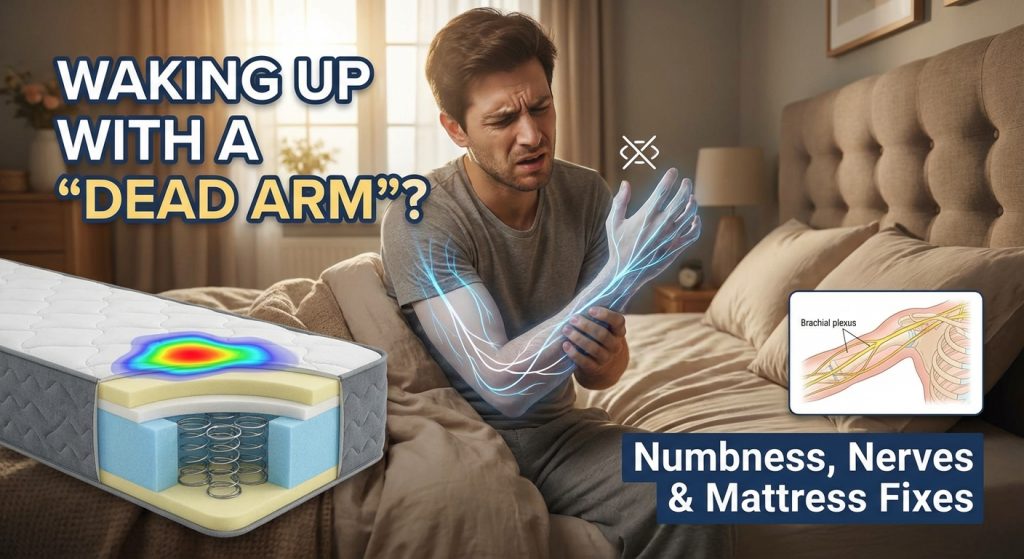
It starts as a dream. In the dream, you are trying to lift a heavy box, but your left arm is missing. You look down, and it’s just gone. Then, you jolt awake.
You try to move your arm to check your phone, but nothing happens. A terrifying, cold, dead weight is lying across your chest. For a split second, your lizard brain thinks, “I’ve had a stroke.” You grab the limb with your working hand—it feels like a piece of foreign meat, cold and heavy. You shake it. And then, the fire starts. A rush of “pins and needles” (paresthesia) floods from your shoulder to your fingertips, an electric buzzing so intense it’s almost painful.
I know this feeling. I spent six months waking up at 3:00 AM, shaking my left hand like a Polaroid picture, trying to get the blood—or so I thought—flowing again.
If you are reading this, you are likely tired of waking up with a “dead arm.” You are worried about nerve damage. You are wondering if you need surgery, a new mattress, or just a new sleeping position.
Here is the reality I discovered after diving into the medical literature of late 2025 and spending hundreds of hours on sleep forums: usually, it is not a stroke. It is rarely a permanent vascular issue. It is almost always a mechanical conflict between your anatomy and your sleep environment.
This is my deep dive into why we get arm numbness while sleeping, how to distinguish a pinched nerve in the elbow (ulnar nerve entrapment) from a problem in your neck (cervical radiculopathy), and why your expensive mattress might be the silent culprit.
The Physiology of the “Dead Arm”
First, let’s kill a myth. When you wake up with a numb arm, your first thought is usually, “I cut off the circulation.” We imagine a tourniquet stopping blood flow.
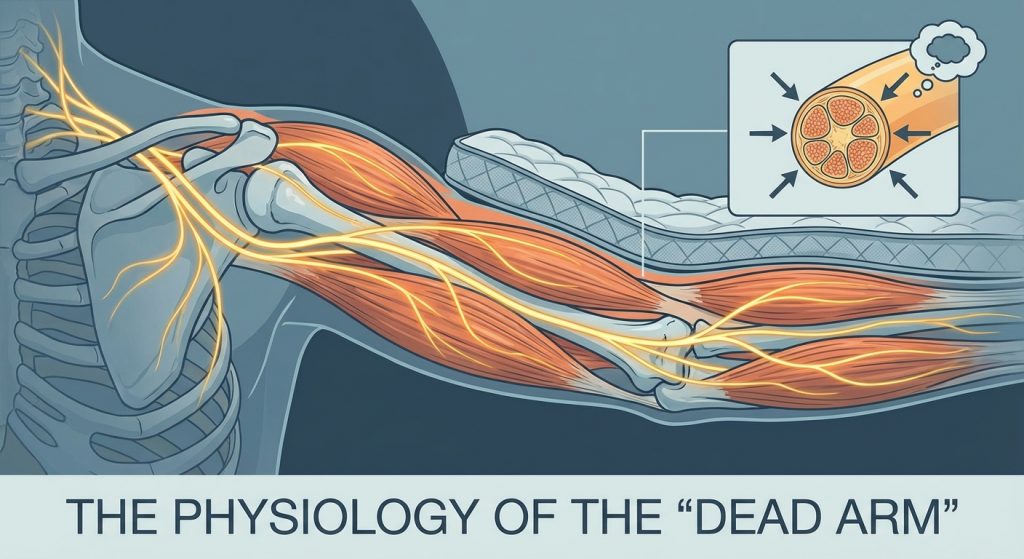
While “circulation cutoff sleep” is possible (if you lay directly on a major artery), in 90% of cases, blood flow is fine. The issue is neurological, not vascular. You have compressed a nerve.
Nerves are like fiber-optic cables. They carry signals from the brain to the fingers. If you step on a garden hose, the water stops. If you compress a nerve—either by bending a joint too tightly or crushing it against a mattress—the signal stops. Your brain loses contact with the limb. That’s the numbness. When you release the pressure, the signal rushes back. That’s the “pins and needles.”
The three main suspects are:
- 1. The Ulnar Nerve (The Funny Bone).
- 2. The Cervical Spine (The Neck).
- 3. The Brachial Plexus (The Thoracic Outlet).
And the accomplices helping them commit the crime are your mattress firmness and your pillow height.
Part 1: The Triage – Is it Your Elbow, Neck, or Bed?
Before you buy a cubital tunnel brace or a new bed, we need to figure out where the signal is getting blocked. By early 2026, orthopedic guidelines and patient reports have solidified a few “self-checks” you can do at home.
The “Pinky Test”: Is it the Ulnar Nerve?
The ulnar nerve runs from your neck, down the inside of your arm, through the “cubital tunnel” (the funny bone groove in your elbow), and into your hand. It is the most exposed nerve in the body.
The Symptoms:
- You wake up with numbness specifically in your pinky and ring fingers.
- The thumb and index finger usually feel fine.
- You often sleep in the “T-Rex” position: curled up on your side, hands tucked under your chin, elbows bent at an acute angle.
The Mechanism:
Sleep studies and orthopedic literature confirm that when you bend your elbow past 90 degrees for hours, the pressure inside the cubital tunnel skyrockets. You are essentially strangling the nerve with your own anatomy. This is ulnar nerve entrapment sleep. If shaking your hand and straightening your arm resolves the feeling within minutes, this is your likely culprit.
The “Spurling” Concept: Is it Cervical Radiculopathy?
If the blockage is higher up—in the spine—it’s called cervical radiculopathy. This means a disc or inflammation in your neck is pinching the nerve root before it even leaves the shoulder.
The Symptoms:
- The numbness isn’t just in the hand; you might feel a dull ache or “radiating” pain shooting from your neck down into the shoulder blade (scapula) or arm.
- Stiff neck: You wake up unable to turn your head easily.
- The dermatome map: If the numbness is in your thumb and index finger (C6 nerve root) or your middle finger (C7 nerve root), the problem is likely in your neck, not your elbow.
The Check:
Clinicians use the “Spurling Test.” While you shouldn’t self-diagnose, the logic is simple: if tilting your head back and to the side reproduces the tingling in your arm, the problem is likely cervical (neck), not local (arm).
The “Pressure Point”: Is it Your Mattress?
If you are a side sleeper, your entire body weight is concentrated on two points: the hip (trochanter) and the shoulder.
The Symptoms:
- Shoulder pain (Side Sleeper Syndrome): You wake up with a deep ache in the deltoid or the shoulder joint itself.
- The numbness is diffuse—the whole arm feels heavy or dead, not just specific fingers.
- You toss and turn all night, flipping from side to side because your shoulder starts to hurt.
- The Sofa Test: This is the most telling clue. If you fall asleep on a softer couch or in a hotel bed and don’t get the numbness, your mattress at home is too firm.
Part 2: The Equipment Fixes
I have analyzed threads on Mattress Underground and Reddit dating up to late 2025. A distinct pattern emerges: people spend thousands on doctors for “nerve damage,” only to cure themselves by buying a $200 piece of foam.
The Mattress: The “Too Firm” Epidemic
We have been brainwashed to believe that “firm is better for your back.” For a back sleeper, maybe. For a side sleeper, a firm mattress is a torture device for the brachial plexus.
When you lie on a board-like mattress, your shoulder cannot sink in. It gets jammed upward toward your ear. This crunches the neck (causing cervical radiculopathy vs pillow issues) and crushes the nerves running through the shoulder.
The Fix:
You need pressure relief.
- 1. The Topper Test: Before replacing a mattress, buy a soft, 3-inch memory foam or latex mattress topper. This acts as a diagnostic tool. If the arm numbness while sleeping disappears after adding the topper, you know the cause was mechanical compression from a surface that was too hard.
- 2. Zone Support: In 2026, the best mattresses for side sleepers use “zoned” coils or foam—softer under the shoulders to allow sinkage, firmer under the hips to keep the spine straight.
Refer to the Mattress Firmness Selector guide on our site to find your exact firmness match based on body weight.
The Pillow: The “Loft” Trap
This was my personal downfall. I was sleeping on a pillow that was too low (too thin).
When your pillow is too low, gravity pulls your head down toward the mattress. To compensate, your body subconsciously does something dangerous: it shoves your arm under the pillow to prop your head up.
Now you have the weight of your head (approx. 5kg) crushing your arm against the mattress for 7 hours. Of course, you wake up with a dead arm.
The Fix:
You need a pillow with the correct “loft” (height).
- The Gap Rule: Lie on your side. Measure the distance from the tip of your shoulder to the side of your neck. Your pillow must fill this gap exactly.
- Adjustability: This is why I reviewed the Cloudpilo. It allows you to add or remove fill. You need to engineer the pillow so that your neck is dead straight, removing the need to use your arm as a prop.
- The Shape: A curved pillow, like the Tempur Sonata, can also prevent you from creeping your arm up, as it cradles the neck/shoulder curve naturally.
Check the Pillow Height Guide for a step-by-step measurement protocol.
Part 3: Behavioral Fixes & The “T-Rex” Cure
If your gear is perfect but you still wake up with paresthesia at night, the problem is your posture.
The “T-Rex” Arms (Cubital Tunnel)
If you sleep with your elbows bent tight against your chest, you are stretching the ulnar nerve to its limit.
The “Towel Splint” Hack:
You can buy a rigid medical cubital tunnel brace, but they are uncomfortable and often disrupt sleep quality. The Reddit community has a better, cheaper fix:
- 1. Take a standard bath towel.
- 2. Fold it and wrap it loosely around your elbow.
- 3. Secure it with tape or an Ace bandage (not too tight!).
- 4. The bulk of the towel mechanically prevents you from bending your elbow past 45 degrees, but is soft enough to sleep in.
I used this method for two weeks. It retrained my brain. Now, I naturally sleep with my arms more open, “hugging” the bed rather than curling into myself.
The “Hug Pillow” Protocol
For side sleepers, the best way to prevent the shoulder from collapsing forward (which compresses the thoracic outlet) is to hug a pillow (Tempur Ombracio in my case).
- Place a thick, firm pillow (or a body pillow) against your chest.
- Drape your top arm over it.
- This keeps the shoulder joint open, the wrist neutral, and prevents the “dead arm” roll.
Part 4: Managing the Panic (The Mental Game)
Waking up with a numb arm is terrifying. It triggers a massive spike in cortisol. You lie there, heart pounding, convinced you have permanent nerve damage. This anxiety creates a feedback loop—you become hyper-aware of every tingle, leading to Hyperarousal (or “Tired but Wired” syndrome).
The Re-Entry Protocol:
When you wake up with numbness:
- 1. Don’t Panic: Remind yourself: “This is mechanical. My nerve is just compressed. It will pass.”
- 2. Reposition: Straighten the arm. Shake it gently (don’t thrash). Let gravity help blood flow, just in case.
- 3. Down-Regulate: Your sympathetic nervous system is screaming. You need to manually shut it off.
Technique A: The Physiological Sigh
Popularized by neurobiologists like Andrew Huberman, this is the fastest way to offload carbon dioxide and lower heart rate.
- Inhale deeply through the nose.
- At the top of the inhale, take a second, shorter sip of air (fully expanding the alveoli).
- Exhale slowly and fully through the mouth.
- Repeat 3 times.
Technique B: 4-7-8 Breathing
- Inhale quietly through the nose for 4 seconds.
- Hold the breath for 7 seconds.
- Exhale forcefully through the mouth for 8 seconds (making a whoosh sound).
- This forces the body into a parasympathetic (rest) state.
If you struggle with anxiety spikes at night, read the article on Tired But Wired Syndrome.
Real Stories from the Trenches (2025-2026)
I spend hours every week on r/Mattress, r/Sleep, and specialized forums. Here are the patterns that keep repeating in late 2025.
The “Gym Rat” Pattern
A user on Reddit shared a common story. After increasing muscle mass in the shoulders and chest, he started waking up with numb hands. Why? Muscle is dense. The added bulk in his deltoids and pecs was compressing the brachial plexus against his mattress, which used to be soft enough but was now too firm for his new weight distribution.
The Fix: He didn’t stop lifting. He bought a 3-inch Talalay Latex topper to increase pressure relief for his broader shoulders.
The “Phone Scroller”
A thread on a specialized sleep forum highlighted “Smartphone Elbow.” People who scroll on their phones in bed for an hour before sleep often hold their elbows in a static, bent position. They turn off the light and go to sleep, but the ulnar nerve is already irritated.
The Fix: Blue Light Blocking Glasses and a strict “no phone in bed” rule. The inflammation subsided within a week.
The “Secret” Stomach Sleeper
Many people think they are side sleepers, but actually roll onto their stomachs (half-prone) during deep sleep. This forces the neck to twist and the arms to go under the pillow (the “surrender” position). This is a nightmare for thoracic outlet syndrome sleep.
The Fix: Using a barrier pillow (or the “tennis ball trick”) to prevent rolling onto the stomach.
What Is “Nerve Flossing” and Should You Do It?
In 2026, “Nerve Gliding” or “Flossing” has become a buzzword in biohacking circles for fixing pins and needles in hand.
The theory: Nerves can get “stuck” in their sheaths due to inflammation or scar tissue. Flossing exercises gently pull the nerve back and forth to ensure it slides freely.
*** Warning: Do not do this aggressively. Nerves hate being stretched.
A simple Ulnar Nerve Glide involves making an “OK” sign with your hand, flipping your hand upside down around your eye (like a mask), and gently moving the elbow.
My advice: Don’t try to learn this from text. Find a licensed physical therapist on YouTube (look for channels like “Bob & Brad” or specialized physios) and follow the latest 2026 protocols. If it hurts, stop.
The 7-Day “Dead Arm” Elimination Protocol
If you are tired of waking up in pain, follow this triage plan.
Nights 1-2: The Positional Fix (Free)
- Objective: Rule out the “T-Rex” and “Arm-Under-Head” habits.
- Action: Use the “Towel Splint” on your affected arm. Hug a second pillow against your chest. Ensure your sleeping pillow is high enough that you don’t need your arm under it.
- Result: If numbness stops, it was your posture. You don’t need a new bed.
Nights 3-4: The Surface Fix (Softening)
- Objective: Test for pressure points.
- Action: If you have a spare guest bed that is softer, sleep there. If not, try sleeping on a thick comforter folded over your mattress to simulate a topper.
- Result: If shoulder pain and waking up with dead arm cease, your mattress is too firm. Invest in a high-quality Topper.
Nights 5-7: The Neck Fix
- Objective: Rule out Cervical Radiculopathy.
- Action: Focus on a neutral spine. Use a contoured pillow. Perform gentle neck mobility exercises before bed (not static stretching, but gentle rotations).
- Result: If the shooting pain persists despite position and surface changes, it is time to see a specialist for an MRI.
Summary
Waking up with a numb arm is a signal. It is your body telling you that your sleep architecture is physically crushing your nervous system.
For me, the solution was a combination: I stopped the “T-Rex” curl, upgraded to a Tempur Sonata pillow that actually fit my shoulder width, and accepted that as a side sleeper, I needed a softer mattress surface than I thought.
Don’t ignore the tingling. Chronic compression can lead to permanent nerve damage (neuropathy) over years. But also, don’t panic. You likely don’t have a disease. You just have a mechanical conflict.
Fix the gear. Straighten the arm. And finally, get a good night’s sleep without the pins and needles.
Read Next: Sleeping Positions for Back Pain & Sciatica: The Pillow Prop Method.

By: Alex Warenstein.
Bio: Alex Warenstein is a sleep biohacker and founder of Night Time Comfort. After battling chronic insomnia and circadian disruption, he now helps others optimize their sleep using data-driven protocols. Read full story.
Disclaimer: Alex is not a doctor. This content is for educational purposes only. Always consult a specialist.