Short answer to the question in the title: yes, you can sleep on a Freestyle Libre sensor. It won’t break. The adhesive is designed for it, and I’ve slept on mine hundreds of nights.
The real question — the one that brought most of you here — is why does my sensor scream “LOW” at 2 AM when I feel completely fine? That’s a different problem, it has a name, and once you understand it, overnight CGM data becomes genuinely useful instead of terrifying.
The short version:
- Sleeping on the sensor is safe for the sensor. The issue is data artifacts, not damage.
- A sudden dramatic drop while you’re lying still is usually a compression low — a false reading caused by pressure, not real hypoglycemia.
- Sensor placement (back of the upper arm, on the side you don’t sleep on) fixes most of it.
- A real nocturnal low usually looks different: gradual, with a slow recovery, and often accompanied by symptoms.
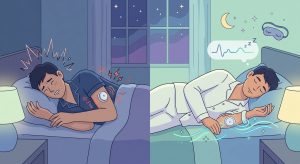
Compression lows: the thing nobody warns you about
When you lie on a CGM sensor, you compress the tissue around the filament. That reduces local interstitial fluid flow, and the sensor reads a glucose value that’s lower than what’s actually in your blood. The trace looks alarming — a sudden, nearvertical plunge — and then, when you roll over, it recovers just as abruptly. The University of Michigan’s research support team has documented this clearly for study participants, describing exactly how pressure on the sensor produces spurious low values and false alarms.
I lost a few nights of sleep to this before I understood it. The alarm goes off, you’re groggy and frightened, you eat something to “correct” it, and now you’ve actually spiked your glucose — which, ironically, can set up a genuine reactive dip later. That’s the trap.
How to tell a compression low from a real one:
A compression low typically drops fast and vertically, happens while you’re lying still, recovers within minutes of you changing position, and doesn’t come with symptoms. A real nocturnal low tends to descend more gradually, sits at the bottom longer, recovers slowly, and often does come with something you can feel — sweating, a pounding heart, waking up abruptly. If you’re diabetic and the reading is low, confirm with a finger stick rather than guessing. If you’re not diabetic and you’re wearing a CGM out of curiosity like I was, a single overnight artifact means very little; look for the pattern across weeks.
Where to put the sensor (this solves most of it)
Placement matters more than anything else. Both major systems are worn on the back of the upper arm, and there’s good reason for that: a Dexcom G7 study involving 316 participants and nearly 78,000 paired readings found the upperarm position performed as well as or better than the abdomen, with an overall MARD of 8.2% for the arm versus 9.1% for the abdomen. The arm position also reduces the risk of compression artifacts, because you’re less likely to lie directly on it than on an abdominal site.
Practical rules I follow:
- Wear it on your nondominant side, and specifically on the arm you sleep on least. If you’re a committed leftside sleeper, put the sensor on the right arm.
- Position it toward the back of the upper arm rather than the outer edge — that keeps it out of the pressure zone even if you roll.
- If you’re a diehard side sleeper who rotates all night, a pillow between your arm and mattress genuinely helps. So does a body pillow, which changes your whole pressure distribution.
If you’re also managing shoulder or arm pressure at night, this connects to a broader problem I’ve written about in dead arm numbness nerves — the same positional issues that compress a nerve will compress a sensor.
Libre 3 Plus vs Dexcom G7 for sleepers
The 2026 landscape has shifted, so here’s what actually matters for overnight use.
Accuracy is close enough that it shouldn’t be your deciding factor. In lab conditions, Dexcom G7 posts a MARD around 8.2% and the Libre 3 sits around 9.2% — both comfortably within acceptable ranges, and realworld performance varies more by individual physiology and placement than by brand.
The differences that matter at night:
- Alerts. This is the big one. Dexcom G7 transmits automatically every few minutes and pushes realtime alerts — it will wake you for a genuine low. The older Libre models required scanning, which meant you could be low for a long stretch without knowing. The Libre 3 line closed that gap with automatic readings, but Dexcom still has a reputation among users for the tighter realtime alert performance during rapid drops.
- Wear time. Both product lines pushed to longer wear in 2026 — Libre 3 Plus runs 15 days, and Dexcom introduced a 15day G7. Fewer sensor changes means fewer “first night on a new sensor” nights, which in my experience are the noisiest.
- Sensor profile. The Libre 3 is famously tiny — roughly the size of two stacked pennies. A lower profile means less to press on. Several users have hoped the smaller sensors would reduce compression lows, and anecdotally lowerprofile sensors do seem to help, but no sensor is immune.
- Cost. Libre is meaningfully cheaper per year than Dexcom. If you’re a nondiabetic biohacker paying out of pocket, that’s not a small consideration.
My take: if you’re using a CGM specifically to hunt down nocturnal lows and you want to be woken by a real event, the Dexcom alerting is the stronger tool. If you’re doing metabolic selfexperimentation and want the most data per dollar with the smallest sensor, Libre 3 Plus is excellent. I go deeper on the Abbott side in my freestyle libre 3 review.
One more note worth knowing: Abbott issued a medical device correction for certain Libre 3 and Libre 3 Plus sensor batches in late 2025 due to a manufacturing issue. If you’re using Libre, it’s worth checking whether your lot numbers were affected.
What a real overnight glucose curve looks like
This is where a CGM stops being a diabetes device and becomes a sleep instrument.
A healthy overnight trace is boring: a gentle, flat line with a mild drift, maybe a small rise toward morning as your dawn cortisol and glucose come up together. What you’re looking for as a sleep biohacker is the unboring stuff:
- A lateevening spike followed by a hard crash — usually a carbheavy dinner or dessert. The crash is the part that wakes you. I wrote about the mechanism in sugar insomnia.
- A slow drift downward through the early morning, sometimes bottoming out between 2 and 4 AM. This is the pattern I was chasing, and it’s covered in low blood sugar at night.
- A morning rise that’s just your normal circadian cortisol curve doing its job, not a problem.
The reason a glucose dip can wake you is genuinely welldocumented physiology. When blood sugar falls, your body launches a counterregulatory hormone response — primarily epinephrine (adrenaline). A study in PLOS Medicine that induced controlled overnight hypoglycemia found that in every participant who woke up, the epinephrine surge preceded the polysomnographic signs of waking by around seven and a half minutes on average. Read that again: the adrenaline comes first, then you wake up. That’s why you snap awake already wired, heart going, before your brain has any idea why.
That single finding reframed how I think about 3 AM wakeups, and it’s why I’d rather have a night of CGM data than another sleephygiene lecture.
What the community says
The CGM communities are where the practical wisdom lives, and the consensus across r/Freestylelibre, r/dexcom, r/diabetes, and the T1D Exchange forums is remarkably consistent:
- Compression lows are nearuniversal and people learn to recognize them. The recurring description is a sudden, drastic drop that appears when you roll onto the sensor. A very common experienceduser response is: don’t correct it, check your position first. Several users describe exactly the trap I fell into — waking in a sleepy panic, eating to correct, then launching into a high.
- Placement is the #1 fix people recommend. “Wear it on the arm you don’t sleep on” comes up constantly, and users switching from abdominal to upperarm placement report far fewer compression events.
- Overpatches are the #2 fix — adhesive covers keep the sensor secure through a night of rolling, though they don’t stop compression itself.
- Nondiabetic biohackers in r/Biohackers and quantifiedself circles increasingly use CGMs exactly as I do: as a sleep diagnostic rather than a glucose management tool. The most common finding people report is discovering their late dinner or evening alcohol wrecks their overnight curve — which lines up with what I found in alcohol and sleep.
- A recurring frustration is nighttime false alarms causing more sleep disruption than the lows they’re warning about. Several users tune their lowalert threshold for overnight specifically. If you’re diabetic, that’s a conversation for your care team, not a DIY adjustment.
Forum consensus isn’t evidence. But when thousands of people independently report the same artifact and the same fix, it’s a signal worth acting on.
How I use a CGM as a sleep tool
For transparency: I’m not diabetic. I wore a CGM in blocks of two weeks at a time, correlating the overnight glucose trace against my sleep data — first with a wearable, later against actual EEG from a hypnodyne zmax, which is the only way to know whether a glucose dip actually coincided with a real awakening rather than a suspected one.
What I learned: my 3 AM wakeups clustered around nights with a specific pattern — a big evening glucose excursion followed by a hard fall. Changing what I ate before bed changed the pattern more than any supplement I’ve tried. I covered what actually worked in bedtime snacks for deep sleep.
Also worth saying: a CGM ruled things out for me, which was just as valuable. Some of my wakeups had nothing to do with glucose. That’s when I went looking at breathing instead, and if your overnight glucose looks perfectly flat but you’re still waking, that’s your cue to investigate
obstructive sleep apnea osa or uars instead of chasing metabolism.
When to talk to a doctor
Please take this seriously:
- If you have diabetes and are experiencing frequent or severe nocturnal lows, that’s a treatment adjustment conversation with your care team — urgently, not eventually.
- If you’re not diabetic but your CGM shows repeated genuine overnight lows, that warrants medical investigation rather than selfexperimentation. Reactive and fasting hypoglycemia in nondiabetics can have underlying causes worth identifying.
- If you wake with a pounding heart, sweating, or gasping and your glucose trace is normal, get evaluated for a breathing disorder. A home sleep apnea test is a reasonable first step.
- Never adjust insulin or medication based on CGM readings without your doctor’s guidance.
FAQ
Which arm should I put my CGM on if I sleep on my side?
The arm you sleep on least — so a leftside sleeper wears it on the right. Position it toward the back of the upper arm, not the outer edge.
Do compression lows damage the sensor?
No. They’re a temporary data artifact caused by pressure reducing local fluid flow. The sensor recovers once the pressure is removed.
Is Libre 3 or Dexcom G7 better for catching nighttime lows?
Dexcom G7 has the stronger realtime alert reputation and slightly better lab MARD. Libre 3 Plus offers the smallest sensor, 15day wear, and lower cost. Both are accurate enough that placement matters more than brand.
Can a CGM detect nocturnal hypoglycemia?
It can reveal patterns you’d otherwise never see, which is exactly why it’s valuable. But CGM readings measure interstitial fluid, not blood, and can be thrown off by compression. Confirm meaningful lows with a finger stick if you’re diabetic.
Can I wear a CGM if I’m not diabetic, just for sleep tracking?
Many biohackers do, and I did. Availability and prescription requirements vary by country. Just be aware you’ll see artifacts and normal variation that can look alarming without clinical context.
*** I update this guide as CGM hardware and my own data evolve. If a new sensor genuinely reduces compression lows, you’ll read it here.

By: Alex Warenstein.
Bio: Alex Warenstein is a sleep biohacker and founder of Night Time Comfort. After battling chronic insomnia and circadian disruption, he now helps others optimize their sleep using data-driven protocols. Read full story.
Disclaimer: Alex is not a doctor. This content is for educational purposes only. Always consult a specialist.