You cannot out-supplement a bad lifestyle.
This is the hard truth that most people ignore. They spend hundreds of dollars on magnesium, specialized pillows, and sleep trackers, yet they watch Netflix until midnight and drink coffee at 3 PM. If your foundation is cracked, no amount of expensive “biohacking” paint will fix the house.
Before you buy a new Mattress, before you order an Oura ring 4, and before you experiment with dietary supplements, you must master the sleep optimization basics.
This article is a practical sleep hygiene checklist, aligned with widely used public guidance from the National Heart, Lung, and Blood Institute (NHLBI) and Mayo Clinic, plus mainstream circadian research. It aggregates clinical guidelines, military protocols (4-7-8, Navy SEALs), and the latest 2024-2025-2026 data on circadian biology.
We will cover the “Big 5” non-negotiables that often remove a large share of common sleep-onset friction, followed by advanced behavioral protocols.
What Is Sleep Hygiene and Is It Actually Effective?
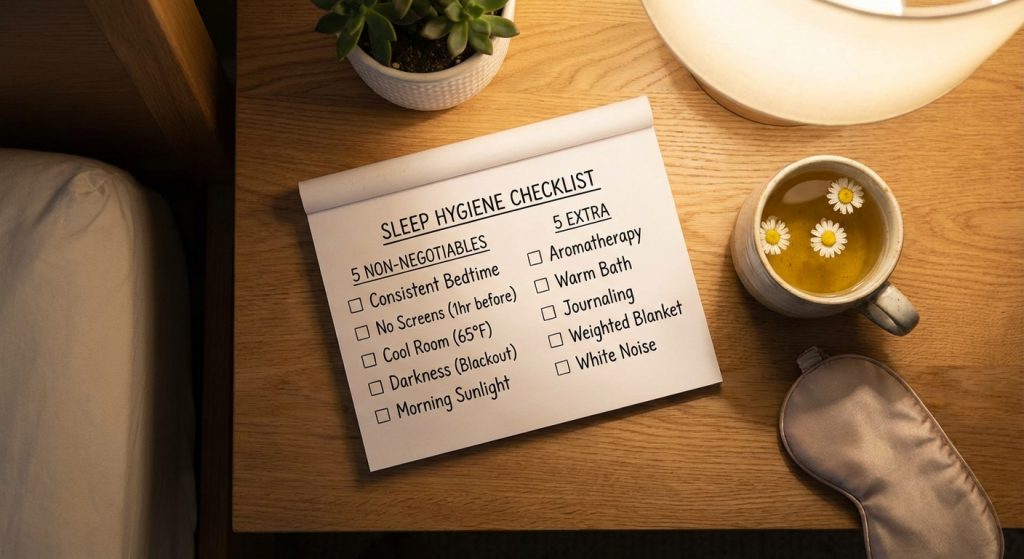
“Sleep Hygiene” is a clinical term referring to the behavioral and environmental practices that precede sleep.
Critics often argue: “Is sleep hygiene actually effective? I tried going to bed early and it didn’t work.”
The answer is nuanced. For chronic, severe insomnia—or if you suspect a breathing-related issue like sleep apnea or UARS – sleep hygiene alone rarely fixes everything. However, habit friction is a very common reason problems persist, so cleaning up the basics is still step one—and it’s also the foundation for evidence-based approaches like CBT-I.
Alcohol close to bedtime can fragment sleep, and late-night scrolling tends to keep the brain alert and delay your wind-down.
Think of sleep hygiene not as the cure-all, but as the prerequisite for any other treatment to work. You must fix sleep hygiene to get a baseline reading of your true sleep problems.
The 5 Non-Negotiables of Sleep
These are the “Big Rocks.” If you are not doing these five things, you do not have a right to complain about poor sleep yet.
1. Light: The Circadian Anchor (Morning & Evening)
Your body clock (circadian rhythm) is not run by a watch; it is run by light.
The Morning Sunlight Protocol: This is the single most important signal for your brain. You must view bright light (ideally sunlight) within 30-60 minutes of waking. This anchors your circadian clock early and (for many people) makes it easier for sleepiness to show up at a predictable hour later that night.
The Rule: 10 minutes on clear days, 20-30 minutes on cloudy days. Do not wear sunglasses.
The Evening Blackout: In the evening, the reverse must happen. Bright evening light—especially from screens held close to your face—can suppress melatonin and delay circadian timing, compared with reading printed material (as shown in controlled lab work published in PNAS).
The Protocol: After sunset, dim overhead lights. Use floor lamps with warm (red/orange) bulbs. If you must use screens, use “Night Shift” modes or blue-light blocking glasses, though total avoidance is better.
2. Temperature: The Thermal Dump
To initiate sleep, your core temperature naturally trends downward; a room that’s cool and not stuffy makes that drop easier.
The “Cool Side of Comfortable”: Many people do well in a cooler bedroom (often roughly 60–67°F / 16–19°C), but the best setting is the one that feels cool without making you tense or shiver.
Thermoregulation: Your body dumps heat through your hands and feet to lower your core temperature. If your room is stuffy or hot, this heat exchange fails.
Actionable Tip: If you cannot control the AC, take a warm shower 1-2 hours before bed. When you step out, the rapid cooling of your skin signals your body that it is time to sleep. This is why active cooling mattresses (like Eight Sleep) are becoming so popular—they mechanically force this temperature drop.
3. The 10-3-2-1 Rule: Chemical & Digestive Timing
This is a popular framework often cited in productivity and biohacking circles to structure your intake before bed. It creates a buffer zone between your active day and your sleep.
- 10 Hours Before Bed: No Caffeine.
Caffeine clearance is individual, but a common rule of thumb is that it can take about 5–6 hours to clear roughly half of a dose—so a 4 PM coffee may still interfere with sleepiness at 10 PM. Harvard Health Publishing explains this simply, and a Journal of Clinical Sleep Medicine study found measurable sleep disruption even when caffeine was taken 6 hours before bedtime.
- 3 Hours Before Bed: No Food.
Digestion is a metabolically active process that raises body temperature. Late heavy meals (and especially sugary or spicy ones) can raise core temperature, worsen reflux, and increase the odds of middle-of-the-night wakeups for some people. (See our guide on the anti-sleep diet). - 2 Hours Before Bed: No Work.
Stop checking emails. You need a psychological buffer to switch from “executive mode” to “rest mode.”
- 1 Hour Before Bed: No Screens.
This protects against blue light and dopamine loops from social media.
4. Regularity: The “Social Jetlag” Killer
You cannot “catch up” on sleep on the weekend. The brain craves predictability.
- The Consistency Rule: Go to bed and wake up at the same time, every single day, plus or minus 30 minutes.
- Social Jetlag: If you wake up at 7 AM on weekdays but 11 AM on weekends, you are shifting your time zone by 4 hours every week. This can leave you fatigued, and it can also nudge appetite regulation in an unhelpful direction—more cravings, worse decisions, and a harder Monday reset.
- The Anchor: If you had a bad night, still wake up at your target time. Do not sleep in. This builds “sleep pressure” for the following night, helping you reset.
5. The Bedroom Environment: Stimulus Control
Your brain is an association machine. If you work, argue, eat, and watch TV in bed, your brain associates the mattress with activity and stress.
- The Single Most Important Bedtime Habit: Use the bed only for sleep and sex.
Stimulus Control Therapy: If you cannot sleep after 20 minutes, get out of bed. Go to another room and read a boring book under dim light. Only return when you are sleepy. - Does lying in bed awake count as sleep? No. It counts as “conditioned arousal.” Staying in bed while frustrated trains your brain to be anxious in bed.
- Air Quality: High bedroom CO2 levels (due to closed doors and windows) can cause micro-awakenings and morning headaches. Ventilate your room.
Advanced Behavioral Protocols
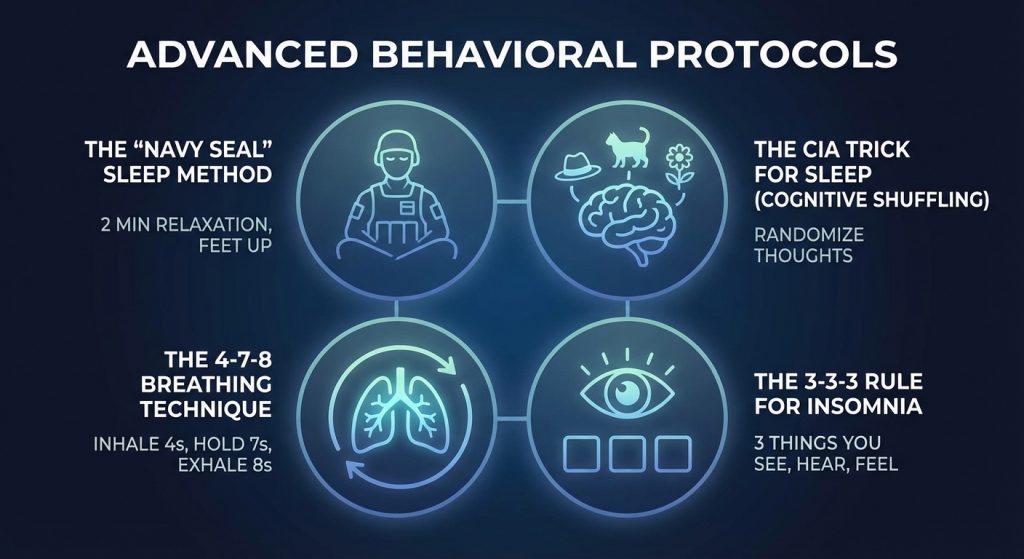
Once the “Big 5” are handled, you can utilize specific cognitive and physical techniques to speed up sleep onset.
The “Navy SEAL” Sleep Method
Popularized online as a “military-style” relaxation routine, this technique is essentially a step-by-step full-body downshift; the “2 minutes” claim is best treated as a motivational tagline, not a guarantee.
- 1. Relax the Face: Close your eyes, then consciously relax your forehead, cheeks, and jaw. Let your tongue fall from the roof of your mouth.
- 2. Drop the Shoulders: Let them sink as low as possible. Relax your arms, one side at a time.
- 3. Exhale: Breathe out, relaxing your chest.
- 4. Legs: Relax thighs, then calves.
- 5. Clear the Mind: For 10 seconds, repeat “Don’t think, don’t think” or visualize a canoe on a calm lake.
Cognitive Shuffling (sometimes mislabeled online as a “CIA trick”)
This is an anti-anxiety technique widely shared online; you may also see it described as “cognitive shuffling” or “Serial Diverse Imagining.”
- The Problem: You can’t sleep because your brain is planning, analyzing, or worrying (hyper-rational thought).
- The Fix: You must force your brain into “micro-dreams” or random associations.
- How to do it: Pick a letter (e.g., “B”). Visualize a word starting with “B” (Bear). Visualize the bear for a few seconds. Then move to another word (Ball).
- Then another (Boat). When you run out, pick a new letter.
- Why it works: It mimics the fragmented, visual nature of sleep onset (hypnagogia), tricking the brain into thinking it is safe to sleep.
The 4-7-8 Breathing Technique
Developed by Dr. Andrew Weil, this is a rhythmic breathing pattern that acts as a manual brake for your nervous system (Vagus Nerve activation).
- Inhale quietly through the nose for 4 seconds.
- Hold the breath for 7 seconds.
- Exhale forcefully through the mouth (making a whoosh sound) for 8 seconds.
- Repeat 4 times.
The 3-3-3 Rule for Insomnia
A grounding technique useful if you wake up in the middle of the night with anxiety.
- Name 3 things you see (e.g., the clock, the shadow, the blanket).
- Identify 3 sounds you hear (e.g., fan, breathing, traffic).
- Move 3 parts of your body (e.g., fingers, toes, an ankle).
- Goal: This pulls you out of your racing thoughts and back into the physical present.
Signs of Poor Sleep Hygiene (The Audit)
How do you know if hygiene is your problem? Look for these signs:
- 1. Variable Bedtimes: You sleep at 10 PM one night and 2 AM the next.
- 2. The “Nightcap”: You rely on alcohol to induce sleepiness (this destroys REM sleep).
- 3. The Snooze Button: You consistently need multiple alarms to wake up.
- 4. Bedtime Procrastination: You feel tired but force yourself to stay awake to scroll social media.
- 5. Environmental Failure: Your room is not pitch black (you can see your hand in front of your face) or there are LED lights from electronics glowing.
Secondary Factors: The Details That Matter
While not “Non-Negotiables,” these factors (the “Sand” that fills the jar) can significantly impact quality.
Bedding and Psychology
Clean Sheets: Many people genuinely sleep better on freshly laundered sheets. In the National Sleep Foundation’s Bedroom Poll, about 71% of respondents said a fresh-sheet scent makes for a more comfortable night—so if you’re stuck, “change the sheets” is a surprisingly high-leverage move.
Materials: Natural fibers (cotton, bamboo, linen) breathe better than synthetics, aiding in thermoregulation.
Soundscaping
Pink Noise vs. White Noise: While white noise (static) covers all frequencies, pink noise (like rain or a waterfall) has been shown in some studies to enhance deep sleep because its frequency mimics natural biological rhythms.
Sleep Position
While hygiene is about behavior, physical comfort matters. If you have neck or back pain, hygiene won’t fix a bad pillow. Ensure your spine is aligned. (See our guide on pillow height).
Jan-2026 Updates
Since September 2025, a few “extra credit” ideas have sharpened in research and in the sleep community. Treat the next items as optional experiments: they may help some people, but they’re not replacements for the Big 5.
1. The “Warm Feet, Cool Core” Paradox (Thermal Gradients)
The idea got more practical in late-2025 discussions: you don’t always want an aggressively cold bed surface if it makes your feet clamp down. Keeping feet comfortably warm (socks/booties) while the core can cool is often the sweet spot—and recent syntheses on foot-warming protocols have kept this on the radar (see PubMed Central).
2. NSDR / Yoga Nidra as the “Rescue Button”
NSDR (often delivered as Yoga Nidra) is still best treated as a recovery tool—not ‘sleep,’ but a structured downshift many people find helpful when they’re wired at night. A 2025 systematic review of RCTs suggests Yoga Nidra shows promise for sleep outcomes, while also highlighting that better trials are still needed (PubMed).
3. Mouth Taping: Trendy, Still Not a Universal “Basic” (new late-2025 data)
Mouth taping went from ‘viral’ to ‘narrowly useful’ in the best interpretation: a Dec-2025 randomized crossover study found that, in CPAP users with OSA who mouth-breathe, hypoallergenic mouth tape improved CPAP adherence and some symptoms—while also reporting adverse effects (PubMed). Practical takeaway: treat it as an optional, individual trial, and prioritize fixing nasal obstruction and evaluating suspected sleep apnea.
4. The “Spectral Diet” Update: It’s Not Only Blue—Dark Nights Matter
The newer framing is less about obsessing over ‘blue’ and more about protecting dark nights. A large 2025 cohort analysis linked higher personal night light exposure with higher incidence of several cardiovascular outcomes in adults over 40 (JAMA Network Open). The hygiene-level action is simple: kill LEDs, avoid bright screens in bed, and consider a sleep mask if your room can’t be made truly dark.
5. The “Next Step” After Hygiene: CBT-I (including digital) is getting more scalable
If you’ve nailed the Big 5 and sleep is still bad, late-2025 guidance and trials kept pointing to CBT-I as the next lever. The VA/DoD guideline emphasizes behavioral treatments for chronic insomnia, and a nationwide randomized trial found a fully automated digital CBT-I program (SleepioRx) outperformed online sleep hygiene education on insomnia outcomes (VA/DoD Clinical Practice Guideline; JMIR Mental Health).
6. Biohacker + forum reality check: ‘Build your life around sleep’ beats gadgets
One of the most repeated ‘sleep community’ takeaways since late-2025 is basically anti-biohacking: stop adding gadgets until the boring basics are automatic. Even Bryan Johnson has been repeating a ‘sleep first’ framing as a foundational habit (Bryan Johnson).
Conclusion: The 80/20 Rule for Sleep
You do not need to be a robot. The 80/20 rule for sleep suggests that if you hit your metrics 80% of the time, you will see massive benefits. You can have a late night out occasionally. You can have a slice of cake at a birthday party.
But the 5 Non-Negotiables—Light, Temperature, Regularity, Chemical Timing, and Bedroom Association—are the sleep foundation.
Buying a Zenowell Vagus stimulator or an Oura Ring feels like proactive progress. But supplements and gadgets are multipliers, not creators.
If you multiply zero by ten, you still get zero.
If your sleep hygiene is zero—if you drink coffee at 5 PM, stare at your phone until midnight, and sleep in a warm room, Magnesium L-Threonate (or any other supplement) is unlikely to compensate for missing the basics.

By: Alex Warenstein.
Bio: Alex Warenstein is a sleep biohacker and founder of Night Time Comfort. After battling chronic insomnia and circadian disruption, he now helps others optimize their sleep using data-driven protocols. Read full story.
Disclaimer: Alex is not a doctor. This content is for educational purposes only. Always consult a specialist.