You know the feeling. The alarm hasn’t gone off yet—it’s maybe 5:00 AM—but you are wide awake. It isn’t a noise that woke you, and it isn’t your bladder. It’s that dull, grinding ache in your lower back. You try to roll over, and a sharp jolt shoots down your leg. You are tired, your eyes are burning, but your body simply refuses to stay horizontal any longer.
I have been there. Before I fixed my sleep architecture, I spent months battling a nagging pain in my lumbar region and right hip. I thought I needed a harder mattress. Then I thought I needed a softer one. I blamed my gym routine. I blamed my age (47 isn’t old, but it isn’t 20).
The reality was much simpler: I was sleeping in a way that torque-twisted my spine for seven hours straight.
If you are reading this, you are likely looking for sleeping positions for back pain that don’t involve buying a $5,000 adjustable bed. You want relief now, tonight. This article is about the “Pillow Prop Method”—the strategic use of pillows to mechanically force your spine into neutrality.
Whether you have general stiffness, a herniated disc, or sciatica, the principle is the same: better alignment often reduces strain and can make symptoms easier to tolerate—and if pain is severe, worsening, or accompanied by red flags like progressive weakness, numbness around the genitals, or new bladder/bowel control problems, follow NHS guidance to seek prompt evaluation.
The Mechanics of Misalignment

To understand why you hurt, you have to visualize your skeleton. When you stand upright with good posture, your spine has a natural S-curve, and your hips are level.
When you lie down, gravity takes over.
If you are a side sleeper (like me), your top leg inevitably slides forward and down toward the mattress. This act pulls your top hip forward, rotating your pelvis. Since your shoulders remain perpendicular to the mattress, your lumbar spine is forced into a twist. Imagine wringing out a wet towel; that is essentially what is happening to your lower back discs all night.
If you sleep on your back, your legs extend straight out. This pulls on the psoas muscle (hip flexor), which in turn pulls the lumbar spine forward, exaggerating the arch in your lower back and compressing the facet joints.
This is where the concept of hip alignment sleep comes in. It isn’t about comfort; it is about geometry. We need to fill the gaps and support the limbs to stop gravity from distorting your skeletal alignment.
For the Side Sleeper: The “Pillow Between Knees” Protocol
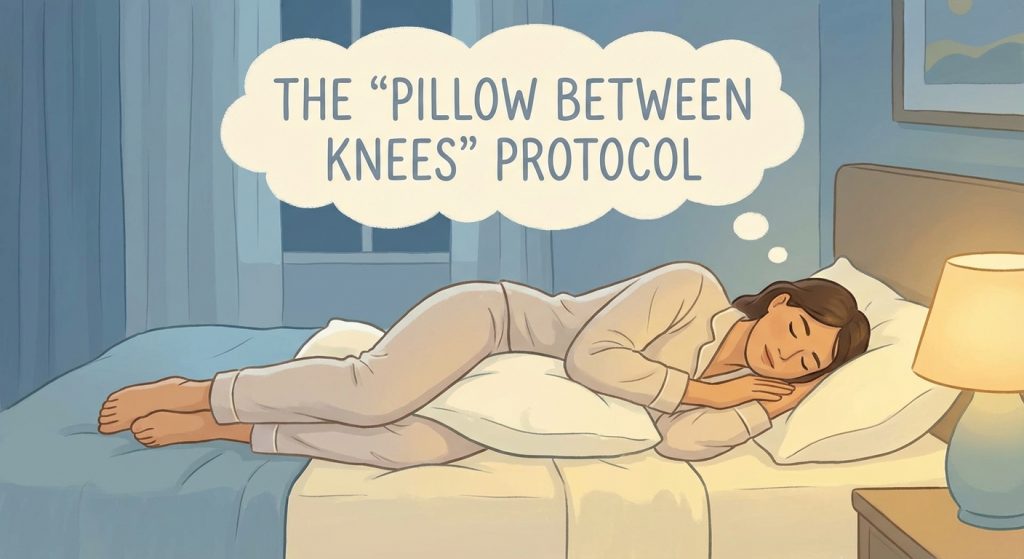
This is a strong baseline for many people. Mayo Clinic recommends side sleeping with support (including a pillow between the knees) as a practical way to reduce back strain during sleep. Without support, it’s a recipe for torsion.
The Technique
- 1. Lie on your side: Choose the side that feels most natural, though later we will discuss which side is better for sciatica.
- 2. Bend your knees: Bring them up slightly towards your chest. You don’t need a full fetal ball, but a slight bend unlocks the facet joints in the spine.
- 3. Insert the prop: Take a firm pillow and place it between your knees.
- 4. The Critical Detail: The pillow must support both the knees and the ankles. If your feet touch but your knees are separated, you are creating torque at the hip. Your thigh bones (femurs) should be parallel to one another.
Why It Works
Placing a pillow between the knees prevents the top leg from dropping across your body. This keeps your hips stacked vertically, one directly over the other. When the hips are stacked, the lumbar spine remains neutral. This reduces pressure on the intervertebral discs and prevents the sacroiliac (SI) joint from jamming.
Alex’s Personal Adjustment
I am a dedicated side sleeper. However, I found that a standard pillow was too bulky—a struggle that actually inspired me to write the Pillow Height Guide.
My solution evolved. I now use a specific contour leg pillow (made of memory foam) that has a strap. I picked this tip up from a Reddit discussion on r/Sciatica where users complained about losing the pillow halfway through the night. The strap keeps it attached to my thigh.
Furthermore, I realized that even with the knee pillow, I tended to roll slightly forward. To counter this, I use a small, heavy buckwheat pillow wedged behind my back. It acts as a “bumper.” It allows me to lean back slightly—relieving pressure on my bottom shoulder—without rolling onto my back. It’s a hybrid 3/4 position that has saved my sleep quality.
If you have a distinct waist (where your hips and shoulders are wider than your midsection), you might also have a gap between your waist and the mattress. Gravity will pull your spine down into this gap. Rolling up a small towel or using a thin lumbar pillow here can help fill that gap and may reduce spinal tension.
For the Back Sleeper: The “Under-Knee” Bolster
Sleeping on your back (supine) is often cited as the best pose for herniated disc issues because it distributes weight evenly across the widest surface area of your body. However, as mentioned, fully extended legs can cause the lower back to arch excessively (lordosis).
The Technique
- 1. Lie flat on your back: Ensure your head pillow isn’t too high; you don’t want your chin forced into your chest, as that can compromise your airway (and if you suspect issues there, look into my guide on the O2Ring Data Analysis).
- 2. The Prop: Place a cylindrical bolster or two stacked pillows under your knees.
- 3. The Goal: You want your knees bent at roughly a 20-30 degree angle.
Why It Works
Elevating the knees shortens the leverage of the iliopsoas muscles. When these muscles relax, the pelvis tilts back slightly, allowing the lumbar spine to flatten gently against the mattress. This can open up the spaces where nerves exit the spine (the foramina), which may provide noticeable relief for some people.
Cleveland Clinic advises trying pillows under the knees (and, if needed, a small pillow under the low back) when sleeping on your back to reduce strain and keep the spine in a more neutral position.
If you try this and still feel pain, check your mattress. A mattress that is too soft will cause your hips to sink too deep, creating a “hammock” effect that no amount of pillows can fix. (See my Mattress Firmness Selector guide for more on this).
For the Stomach Sleeper: The Damage Control
For many people, stomach sleeping (prone position) is the hardest on the spine and neck because it often forces the head to rotate and can over-arch the lower back (Harvard Health). It forces your neck into a 90-degree rotation (stressing the cervical spine) and causes your lower back to sway into hyperextension.
However, I know that for some, this is the only way to fall asleep. If you cannot change the habit, you must mitigate the damage.
The Technique
- 1. Lose the head pillow: Sleep directly on the mattress or use the thinnest pillow possible to reduce neck strain.
- 2. The Hip Prop: Place a flat, medium-firm pillow under your pelvis and lower abdomen.
Why It Works
The pillow under the hips lifts your midsection, preventing your lower back from bowing downward into a U-shape. It forces a slight flexion in the lumbar spine, which counters the hyperextension.
I tried the Tempur Ombracio pillow, which is star-shaped and designed for stomach sleepers. While the shape allowed for better breathing, it didn’t solve the lower back ache for me personally because it didn’t address the pelvic tilt. The pillow-under-hips method is far more effective for the lumbar region.
Sciatica Special: The Nerve Flossing Position
Sciatica tends to feel different from typical muscular soreness: many people describe it as sharp, electric, or burning, and it can flare with certain movements or positions. It’s commonly linked to irritation or compression affecting the sciatic nerve pathway (often from a disc issue), but the exact driver varies from person to person.
Which Side is Best?
There is a massive debate on forums like r/Sciatica and r/backpain about whether to sleep on the painful side or the healthy side.
- Painful Side Up: Many clinicians suggest starting on the unaffected side with a pillow between the knees; the idea is to avoid twisting and to give the irritated side a bit more space, which may reduce symptoms.
- Painful Side Down: Counter-intuitively, some patients report relief sleeping on the painful side. The theory is that the pressure of the mattress splints the area, preventing movement that triggers the nerve.
You have to experiment. However, the consensus for sciatica sleep relief is almost universally dependent on the pillow prop. If the top leg drops, it pulls the sciatic nerve taut. By keeping the legs parallel with a pillow, you keep the nerve pathway “slack.”
What If the Pillow Prop Method Doesn’t Work?
You have bought the knee pillow, you have aligned your hips, and you are still waking up in agony. What now?
If mechanical alignment doesn’t solve it, we have to look deeper.
1. Your Mattress is the Enemy
No amount of pillows can fix a mattress that has lost its structural integrity. If your mattress sags in the middle, your hips will always be lower than your feet and head. This puts your spine in flexion all night. Conversely, if it is rock hard, your hips can’t sink in at all, forcing lateral curvature. If you are struggling, revisit the basics. I eventually invested in a Tempur Mattress, and the pressure relief was a major factor in my recovery.
2. Inflammation is Systemic
Sometimes the pain is mechanical, but the sensitivity is chemical. If your body is inflamed, even a perfect sleeping position will hurt. Look at your diet. Are you eating inflammatory foods right before bed? (See The Anti-Sleep Diet).
Are you consuming alcohol? Alcohol can make you feel sleepy at first, but research shows it often disrupts sleep later in the night and shifts normal REM/NREM patterns (PubMed).
3. Stress and The Cortisol Lock
Pain causes stress, and stress causes tension. It is a vicious loop. If your cortisol feels “high” at night (some people explore this with a 24h Salivary Cortisol Test), your muscles may stay in a semi-contracted “guarding” state while you sleep, which can make even a good sleeping position feel uncomfortable.
In this case, mechanical props aren’t enough. You need to lower the sympathetic nervous system tone. Personally, I felt that magnesium (including Magnesium L-Threonate) and 10 minutes on a pranamat (acupressure mat) before bed sometimes made my back feel looser—but I treat them as comfort experiments rather than a substitute for addressing the underlying cause.
4. The “Tired but Wired” Factor
If you are waking up with pain and a racing mind, you might be dealing with Tired But Wired Syndrome. The pain might be the trigger, but the hyperarousal prevents you from falling back asleep. In this scenario, managing the psychological reaction to the pain is just as important as the pillow.
Community Consensus: What Real People Are Saying
I spend a lot of time on ApneaBoard, SleepHQ, and various subreddits. Here is the reality of the Pillow Prop Method from the trenches of 2025.
Pros (The Good News)
- Immediate Relief: Many users on r/Sciatica report that a knee pillow can noticeably reduce nerve pain—sometimes quickly—when it helps keep the hips and legs aligned.
- Cost-Effective: You don’t need a $100 specialized pillow. A folded duvet or a couch cushion works for testing.
- Preventative: Many long-term side sleepers report that once they adapted to the pillow, their morning stiffness (even without acute injury) disappeared.
Cons (The Bad News)
- Heat Retention: Having a foam block between your legs generates heat. If you are a hot sleeper, this can be a nightmare. Look for cooling gel versions or simple cotton covers.
- The “Tangle”: Turning over is an event. You have to grab the pillow, roll, and reposition. This can wake you up fully, disrupting your sleep cycles. This is why the strap-on versions are gaining popularity in 2025.
- Hip Discomfort: For some, the pressure of the pillow against the inner knee or thigh can cause bruising or discomfort over time.
Summary
The Pillow Prop Method is not a “biohack” in the trendy sense. It is simple biomechanics. Your spine is a column of blocks; if you twist the base (the pelvis), the column becomes unstable.
Whether you choose a dedicated knee pillow, a full-length Cloudpilo body pillow, or just a spare cushion from the sofa, the goal is reducing spinal tension.
Start tonight.
- 1. Side Sleepers: Pillow between the knees. Keep femurs parallel.
- 2. Back Sleepers: Pillow under the knees. Flatten the lumbar curve.
- 3. Stomach Sleepers: Pillow under the hips. Save your lower back.
It might feel awkward for the first three nights. My wife joked that I was building a fortress in bed. But when I woke up on the fourth morning and realized I could put my socks on without wincing, the fortress stayed.
Sleep well, and keep your spine straight!
Alex

By: Alex Warenstein.
Bio: Alex Warenstein is a sleep biohacker and founder of Night Time Comfort. After battling chronic insomnia and circadian disruption, he now helps others optimize their sleep using data-driven protocols. Read full story.
Disclaimer: Alex is not a doctor. This content is for educational purposes only. Always consult a specialist.