You are lying in bed at 11:00 PM. You are exhausted. You have been awake for 16 hours. By all logic, you should fall asleep immediately. But you don’t. You feel a sudden surge of alertness, a “second wind” that keeps you reading or scrolling until 1:00 AM.
Conversely, you struggle to drag yourself out of bed at 7:00 AM, feeling physically sick with fatigue, only to feel perfectly fine by 11:00 AM.
This is not just “bad sleep.” This is a desynchronized biological clock.
Understanding circadian rhythms is the single most important step in fixing your sleep. While supplements like Magnesium or gadgets like the O2Ring are powerful tools, they are merely attempting to patch a system that is fundamentally governed by time. If your internal clock is set to the wrong time zone, no amount of chamomile tea will fix it.
This article provides a comprehensive circadian system explained for the non-specialist. We will look under the hood of human biology to understand the mechanics of the Suprachiasmatic Nucleus (SCN), how zeitgebers meaning “time-givers” dictate your energy, and why misalignment leads to chronic burnout.
The Conductor: The Suprachiasmatic Nucleus (SCN)
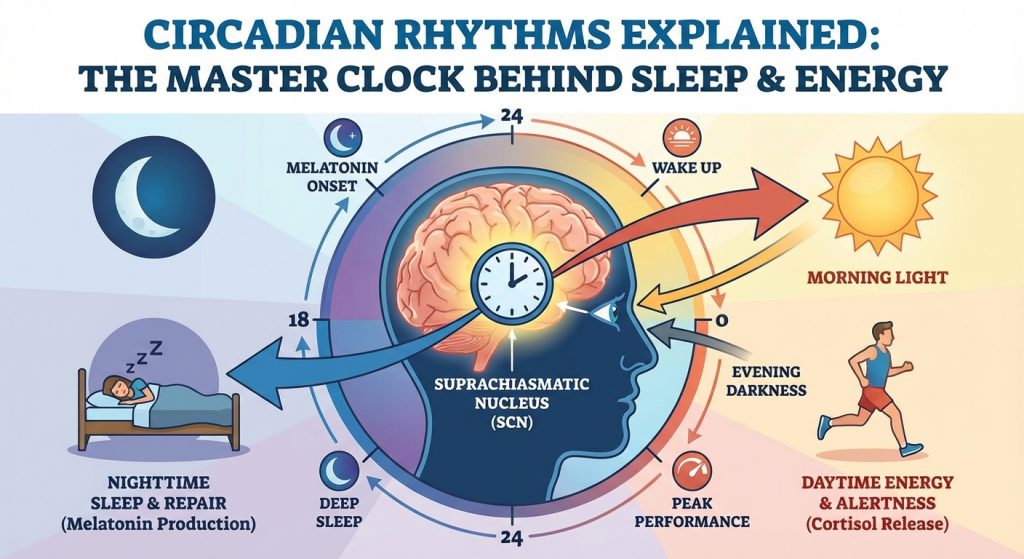
Deep inside your brain, located in the hypothalamus directly above where the optic nerves cross, sits a tiny bundle of approximately 20,000 neurons. This is the Suprachiasmatic Nucleus (SCN).
Think of the SCN as the conductor of an orchestra.
Every cell in your body—from your liver cells to your skin cells—has its own tiny clock. These are called “Peripheral Clocks.” Left to their own devices, these cellular clocks would drift apart, playing their own tempo. The SCN’s job is to synchronize them. It sends out a master signal that tells the heart, the gut, and the brain what time it is.
SCN function sleep regulation is binary:
- 1. Day Mode: It signals the body to raise temperature, release cortisol, and suppress melatonin.
- 2. Night Mode: It signals the body to cool down, suppress cortisol, and release melatonin.
When you feel “off,” it is usually because the Conductor (SCN) is shouting “Daytime!” while your Liver or Pancreas thinks it is “Nighttime.” This internal chaos is what we call circadian desynchronosis.
The Two-Process Model: Why You Get a “Second Wind”
To understand why you can be tired but unable to sleep, you must understand the interaction between two opposing forces. Scientists call this the “Two-Process Model of Sleep Regulation.”
Process S: The Sleep Drive (Homeostasis)
This is simple pressure. From the moment you wake up, a chemical called Adenosine builds up in your brain. It accumulates like sand in an hourglass. The longer you are awake, the more adenosine you have, and the more “sleep pressure” you feel. This is sleep-wake homeostasis.
Note: Caffeine works by temporarily blocking the sensors that detect this pressure.
Process C: The Circadian Drive (The Wake Signal)
This is the tricky part. Process C is an “alertness signal” sent by the SCN. Crucially, this alertness signal gets stronger as the day goes on to counteract the building sleep pressure.
The Forbidden Zone: In the early evening (approx. 6 PM to 9 PM), your Circadian Drive is at its peak intensity. It is shouting “Stay Awake!” to keep you functioning despite high levels of adenosine. This is why it is often hard to fall asleep at 8:00 PM, even if you are tired.
The Sleep Gate:
Around 10:00 PM to 11:00 PM (in a healthy rhythm), the Circadian Drive suddenly drops off. At the same time, the SCN allows melatonin to rise. This opening is the “Sleep Gate.” If you miss this window—if you push through the fatigue with bright lights or stress—the SCN interprets this as a need for emergency wakefulness and ramps the alertness signal back up. That is your “second wind,” and it destroys sleep quality.
The Hormonal Seesaw: Cortisol and Melatonin
Your circadian rhythm communicates with your body primarily through two hormones. They operate on a seesaw: when one is up, the other must be down.
1. Cortisol (The Day Hormone)
We often demonize cortisol as the “stress hormone,” but in the context of biological clock mechanics, it is the “activation hormone.”
- The Awakening: In a healthy rhythm, cortisol spikes sharply 30 minutes after you wake up. This is the Cortisol Awakening Response (CAR). It clears morning fog and mobilizes glucose for energy.
- The Descent: Cortisol should taper off throughout the day, reaching its lowest point (the nadir) around midnight.
If your cortisol fails to drop in the evening, the SCN cannot initiate the sleep sequence. This leads to the specific type of maintenance insomnia we cover in our guide on the 24h Salivary Cortisol Test: Why You Wake Up at 3 AM Tired but Wired”.
2. Melatonin (The Night Hormone)
Melatonin is not a sedative; it is the “Start” gun for the night shift. It tells the mitochondria to repair, the DNA to replicate, and the brain to wash itself (glymphatic system).
The Onset: Under instructions from the SCN, the pineal gland begins secreting melatonin roughly 2 hours before your natural sleep time. This secretion is easily blocked by blue light or stress.
Zeitgebers: How to Set the Clock
The SCN is not perfectly 24 hours. In most humans, it runs slightly longer (about 24 hours and 15 minutes). If you lived in a cave, you would drift later and later every day.
To stay aligned with the 24-hour world, the SCN needs daily recalibration. It relies on external cues called Zeitgebers (German for “Time Givers”).
1. Light (The Master Zeitgeber)
Light is the most powerful signal. Specialized cells in your retina (ipRGCs) detect the intensity and color of light and send that data directly to the SCN.
- Morning Blue: High-intensity blue light (Sunlight) signals “Start the Day.” It burns off the remaining melatonin and triggers the cortisol pulse. Without this, your clock drifts. This is the mechanism behind Morning Sunlight: The Huberman Protocol for Circadian Anchoring.
- Evening Darkness: The absence of blue light signals “End the Day.” If you stare at a phone screen at 10 PM, the SCN perceives this as “Noon” and halts melatonin production.
2. Temperature
Your core body temperature follows a circadian curve. It rises during the day and drops at night.
- The Trigger: A drop in core temperature is a biological requirement for sleep onset.
- The Manipulation: This is why supplements like L-Glycine (which cools the body) or hot showers before bed (which trigger heat dumping) are effective. They mimic the circadian temperature drop, tricking the SCN into allowing sleep.
3. Food (The Metabolic Clock)
While light controls the Central Clock (Brain), food controls the Peripheral Clocks (Liver, Pancreas, Gut).
- Metabolic Jet Lag: If you eat a heavy meal at 11:00 PM, your SCN (Brain) might say “It’s night,” but your Liver says “It’s morning, we have to process energy.” This conflict causes inflammation and fragmented sleep.
- The Fix: Aligning your eating window with daylight is critical. Eating late is a primary driver of Nocturnal Hypoglycemia and wake-ups caused by blood sugar dysregulation.
When the Rhythm Breaks: Health Consequences
Circadian desynchronosis is not just about being tired. It is a systemic failure. When your internal rhythm fights the external world, the consequences are profound.
1. Social Jetlag
This is the discrepancy between your biological clock and your social clock (alarm clock/work schedule). If you are a “Night Owl” forced to wake up at 6 AM, you are living in a permanent state of jet lag. This leads to chronic sleep debt and reliance on stimulants.
2. Immune and Repair Failure
Many immune functions are circadian-gated. They are scheduled to happen only during deep sleep. If your rhythm is fragmented, these repair processes (like autophagy) are skipped. This is why shift workers have higher risks of chronic diseases.
3. Hormonal Chaos
Misalignment affects hunger hormones (Ghrelin/Leptin) and reproductive hormones. It is a common cause of unexplained weight gain and mood instability.
Mapping Your Rhythm
How do you know if your clock is broken?
- 1. The Wake Up Test: Do you need an alarm clock to wake up every single day? If you were allowed to sleep freely, when would you wake up?
- 2. The Energy Dip: Do you have a massive slump at 3:00 PM? (A small dip is normal; a crash indicates a weak circadian amplitude).
- 3. The “Tired but Wired” Test: Are you exhausted at 9:00 PM but wide awake at 11:00 PM? This suggests you missed your sleep gate or have high evening cortisol.
If you suspect your rhythm is the root cause of your sleep issues, you do not necessarily need a prescription. You need entrainment.
Where to start:
- Light: You must anchor your morning. If you cannot get sunlight, review our guide on Light Therapy with the Beurer TL45.
- Darkness: You must protect your evening melatonin.
- Consistency: The SCN craves regularity. Waking up at the same time every day (even weekends) is the single most effective way to strengthen the clock.
Update for December 2025:
Since I first published this guide on Circadian Rhythms, the focus has shifted from simple “light timing” to the complex interplay between light intensity, feeding windows, and genetic clock variants.
1. The “Contrast Ratio” Theory (Luminosity Gap)
Research in 2025 has solidified that your SCN doesn’t just measure brightness; it measures the difference between your day and night.
The Science: A high “Luminosity Gap” (very bright days vs. very dark nights) amplifies the circadian signal.
The Problem: Most modern lifestyles have a “flat” light curve (dim offices all day, bright screens all night). This weak contrast confuses the clock.
The 2025 Fix: You must actively darken your evening environment (<10 lux) to make your morning light signal feel stronger to the brain.
2. The “Food Entrainable Oscillator” (FEO)
We now know that Food is the second most powerful Zeitgeber, specifically for the liver and metabolic organs.
The Protocol: The “Argonne Diet” concept has been revived. A 12-16 hour fast resets the FEO.
The Application: If you want to wake up earlier, stop eating earlier. Breaking a long fast with a high-protein breakfast is a stronger “Wake Up” signal to the peripheral clocks than coffee.
3. Genetic Chronotypes (PER3 Gene)
Accessible genetic testing has made knowing your “Clock Gene” variants easier.
The Insight: Variations in the PER3 gene dictate whether you are a “short” or “long” sleeper and your natural propensity for eveningness or morningness.
The Takeaway: You cannot force a “Night Owl” (genetic delayed phase) to become a “Morning Lark” without health consequences. The goal is to optimize your rhythm, not fight it.
4. Safety Update: “Darkness” Depression
A warning for winter optimization: While evening darkness aids sleep, extending the “dark window” too early in the afternoon (common in northern latitudes) can trigger Seasonal Affective Disorder.
The Balance: Maintain bright light exposure until 1 hour after sunset in winter to support serotonin, then switch strictly to red/amber lighting for melatonin protection.
Summary: The Science of a Good Night
Sleep is not a switch you flip. It is a symphony that starts playing the moment you wake up.
Your Circadian Rhythm is the conductor. By understanding SCN function sleep regulation, you stop fighting your body and start working with it. You realize that the bright light in the morning is just as important as the darkness at night. You understand that eating late confuses your organs.
If you have fixed your hygiene and your rhythm but still struggle, it is time to look deeper.
- Is it a breathing issue? Check The Sleep Triage Test for Apnea/UARS.
- Is it a bladder issue? Check our guide on Nocturia.
- Is it chemical? Explore our reviews on Supplements to see what might support your specific architecture.
But always remember: Biology honors Rhythm. Fix the clock, and the rest often follows.

By: Alex Warenstein.
Bio: Alex Warenstein is a sleep biohacker and founder of Night Time Comfort. After battling chronic insomnia and circadian disruption, he now helps others optimize their sleep using data-driven protocols. Read full story.
Disclaimer: Alex is not a doctor. This content is for educational purposes only. Always consult a specialist.