You have tried magnesium. You have tried blue light blockers. You have tried melatonin pills. But you still toss and turn at 11:00 PM, and you drag yourself out of bed at 7:00 AM feeling like a zombie.
The problem isn’t your nightly routine. The problem is your morning routine.
According to Dr. Andrew Huberman, a neuroscientist at Stanford University, the most critical factor for sleep quality is not what you do before bed—it is what you do within the first hour of waking up.
This guide explains the science of circadian anchoring, why viewing bright light in the morning is non-negotiable for fixing insomnia, and how to use artificial tools like the Beurer TL45 lamp if you live in a gloomy climate.
The Science: How Light Controls Your Hormones
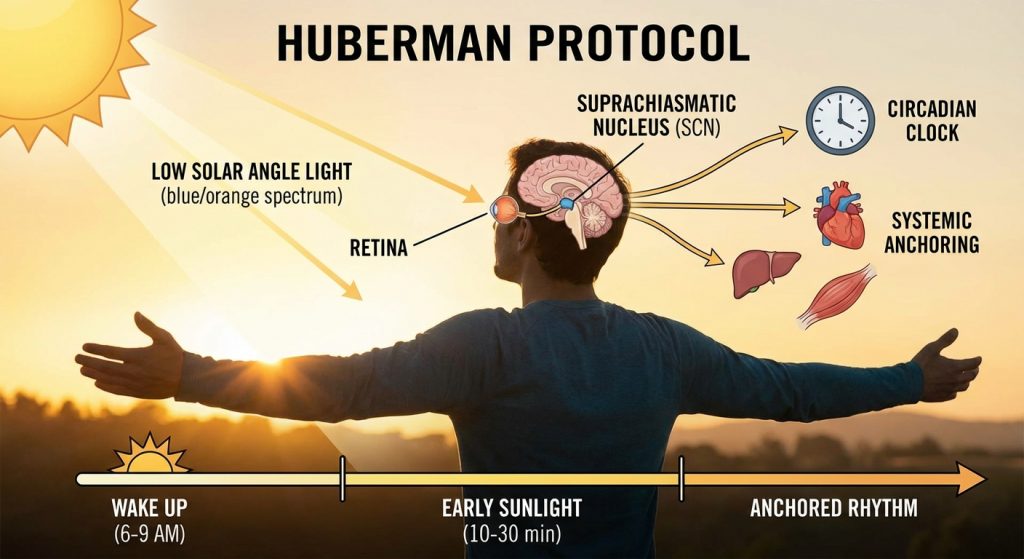
Your body runs on a 24-hour clock located in the brain called the Suprachiasmatic Nucleus (SCN). This master clock dictates when you feel alert and when you feel sleepy. It does not run on “time”; it runs on light.
The Cortisol Pulse
When specialized neurons in your eyes (melanopsin ganglion cells) detect bright light, they send a signal to the SCN. This triggers a healthy, natural spike in Cortisol and Adrenaline.
Why this is good: You want cortisol in the morning. It wakes you up, mobilizes energy, and sets the “start” timer for the day.
The Timer: This morning pulse starts a biological countdown. Approximately 12-16 hours after this light exposure, your brain releases Melatonin to put you to sleep.
The Failure: If you miss this morning light signal, your clock drifts. Your cortisol doesn’t spike until noon (leaving you groggy in the morning), and your melatonin doesn’t release until 2:00 AM (leaving you wired at night). This is the root cause of the “Tired but Wired” state discussed in our 24h Salivary Cortisol Test guide.
The Huberman Protocol: Step-by-Step
Dr. Huberman has popularized specific protocols based on peer-reviewed chronobiology research. Here is how to execute it perfectly.
- 1. View Sunlight Outdoors
You must go outside. Light measured in Lux (intensity) drops dramatically through windows.Sunny Day: 10 minutes.
Cloudy Day: 20 minutes.
Very Overcast: 30 minutes.
Timing: As close to waking up as possible (ideally within 30-60 minutes).Method: Do not wear sunglasses. Do not stare directly at the sun (safety first!), just look toward the light. Eyeglasses and contacts are fine.
- 2. Why Windows Don’t Work
A sunny day outside might be 50,000 to 100,000 Lux. Inside, behind a window, that light might drop to 5,000 Lux because glass filters out the specific blue/UV spectrums needed to trigger the SCN. You need the raw photon energy hitting the retina. - 3. Consistency
You must do this every single day. One day of missed light won’t ruin you, but consistent anchoring is required to shift a sleep cycle. It typically takes 30 days of strict adherence to permanently fix a delayed sleep phase.
The Winter Problem: Using Light Therapy Lamps
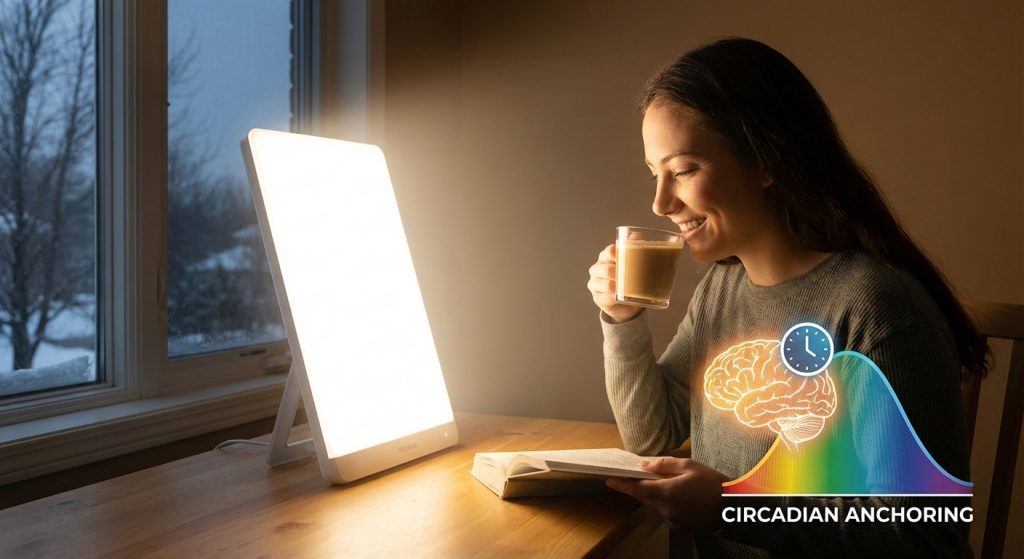
If you wake up before the sun, or live in a place like Seattle or London, you cannot get 10,000 Lux naturally in the morning. You need technology.
The Standard: 10,000 Lux
For a SAD (Seasonal Affective Disorder) lamp to be effective for circadian entrainment, it must produce 10,000 Lux.
Warning: Many cheap lamps on Amazon claim this but only deliver it if you press your face against the glass. You need a medical-grade device.
Alex’s Review: The Beurer TL45
On this site, we recommend the Beurer TL45 (or similar medical-grade lamps like the TL100).
My Experience: I use the Beurer TL45 every morning from 08:30 to 08:45. I sit about 12-15 inches away from it while I check emails.
The Setting: I use the “Therapy” (TheRapy) mode, which provides the full 10,000 Lux brightness.
The Result: Within 2 weeks of using this lamp, my 4:00 AM wake-ups decreased, and I felt naturally sleepy by 11:00 PM. It replaced coffee as my morning wake-up tool.
How to Use a Therapy Lamp
1. Placement: Place it to the side of your face (at 2 o’clock or 10 o’clock position). Do not stare directly into it.
2. Distance: Keep it within 12-20 inches. Light intensity follows the inverse-square law; moving twice as far away reduces intensity by four times.
3. Duration: 20 to 30 minutes.
When to Use Light (and When to Hide)
Timing is everything. Light is a drug. Use it at the wrong time, and you overdose.
- Morning (06:00 – 09:00): Blast yourself with light (Sun or Lamp).
- Afternoon (16:00 – Sunset): View the sunset. The specific wavelengths of evening light signal the brain to protect against the damaging effects of artificial light later.
- Evening (20:00 – Sleep): Avoid bright light. Never use your 10,000 Lux lamp after sunset! It will crush your melatonin production instantly. Dim the lights, use red hues, and avoid screens.
Community Consensus: Reddit & Critics
Is the Huberman Protocol hype, or is it real? We analyzed discussions on r/HubermanLab, r/Insomnia, and r/Biohackers.
The Pros:
- “Game Changer for Mood”: Users report that while sleep takes a few weeks to fix, mood and energy improve within 3 days.
- “Free and Effective”: It costs nothing to go outside. It is the most accessible biohack available.
The Cons/Critiques:
- “It didn’t work for my maintenance insomnia”: Some users report it helps them fall asleep, but doesn’t stop them from waking up at 3 AM. (Note: This is often because 3 AM wake-ups are metabolic/glucose related, not just circadian. See Nocturnal Hypoglycemia).
- “Hard in Winter”: Many find it impossible to stick to the routine when it is freezing outside. This validates the need for a Beurer TL45 or similar lamp.
Update for December 2025: The “Spectral Contrast” & The Luminosity Gap
Since I first published this article on the “Huberman Protocol,” the science has evolved. We are no longer just counting minutes of sunlight; we are measuring the Contrast Ratio between your day and night.
1. The “Luminosity Gap” (Why 10,000 Lux Might Not Be Enough)
New research in 2025 emphasizes the concept of Relative Contrast.
The Science: Your SCN (Master Clock) doesn’t just measure absolute brightness; it measures the difference between your brightest moment and your darkest moment.
The Problem: If you get 10,000 lux in the morning but sit in a brightly lit office (500 lux) until 10 PM, the contrast is weak.
The Fix: You must make your evenings darker to make your mornings feel brighter to the brain. The new standard is <10 lux after 8 PM. This widens the "Luminosity Gap," amplifying the circadian signal.
2. The “Afternoon Dip” Rescue
We used to focus only on morning light. In 2025, biohackers are using light to kill the “2 PM Slump.”
The Protocol: A 10-minute blast of 10,000 Lux (using your Beurer lamp) between 1:00 PM and 3:00 PM.
The Result: This stimulates a secondary cortisol micro-pulse, mitigating the adenosine crash that happens post-lunch. It is the “Optical Coffee” replacement.
3. The “Red Light” Sunset Mimicry
It’s not just about avoiding blue light; it’s about adding Red/NIR Light.
The Trend: Many users now switch their room lighting to pure Red LED bulbs (630nm-670nm) after sunset.
The Mechanism: Red light does not trigger the melanopsin cells in the eye, effectively rendering you “biologically invisible” to your own clock while still allowing you to see.
4. Bryan Johnson’s “100k Lux” Protocol
Tech centurion Bryan Johnson (Project Blueprint) has updated his light protocol for 2025.
The Intensity: He uses a 100,000 Lux industrial light panel (10x stronger than standard therapy lamps) for 5 minutes.
The Warning: Do not try this with standard lamps. You need specialized equipment to avoid retinal damage. For normal users, sticking to the 10,000 Lux standard for 20 minutes remains the safest effective dose.
Summary
You are a solar-powered organism. If you stay indoors all day and stare at screens all night, you are breaking your biological machinery.
The Protocol:
- 1. Wake Up: Get out of bed immediately.
- 2. Get Light: Go outside for 10-20 minutes. If dark, use a 10,000 Lux Lamp for 20 minutes.
- 3. Repeat: Do this for 30 days.
This is the anchor. Once you fix your light environment, supplements like Magnesium and L-Theanine will actually work because they aren’t fighting against a confused circadian rhythm.
Read Next:
24h Salivary Cortisol Test: Why You Wake Up at 3-5 AM
The Anti-Sleep Diet: 5 Foods That Destroy Sleep Quality

By: Alex Warenstein.
Bio: Alex Warenstein is a sleep biohacker and founder of Night Time Comfort. After battling chronic insomnia and circadian disruption, he now helps others optimize their sleep using data-driven protocols. Read full story.
Disclaimer: Alex is not a doctor. This content is for educational purposes only. Always consult a specialist.