Introduction: The Lie I Told Myself for Years
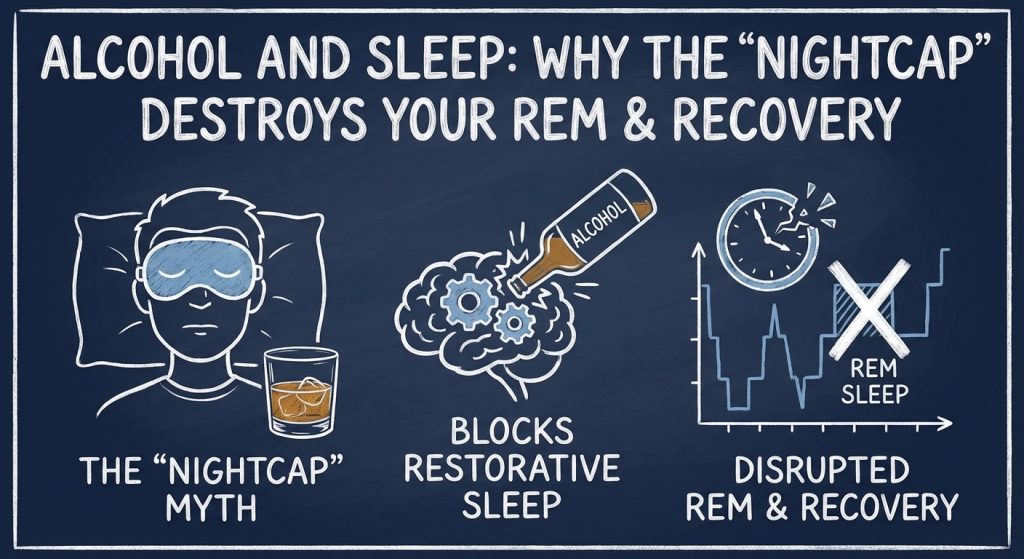
I used to be a “two glasses of Pinot Noir” guy. Every single night.
In my early 40s, when my insomnia first started shifting from “occasional annoyance” to “chronic nightmare,” I treated wine as my medication. It made sense at the time. I would come home, my brain buzzing with work stress and general anxiety, pour a glass, and feel that immediate physiological sigh of relief. The wine helped me fall asleep. There is no denying that. It knocked me out faster than any chamomile tea ever could.
But I was confusing sedation with sleep.
I would pass out at 11:00 PM, only to snap awake at 3:15 AM, heart pounding, sweating, and mind racing with catastrophic thoughts. I didn’t know it then, but I was experiencing a textbook alcohol rebound effect. I wasn’t an alcoholic in the clinical sense, but I was definitely dependent on that “nightcap” to bridge the gap between being awake and being unconscious.
Now, at 47, having analyzed my sleep data for years and fixed my circadian rhythm, I can look at the biology of what was happening. If you are reading this, you probably suspect that your evening drink is messing with you. You are right. And if you are over 40, you’ll often notice the downside more than you did in your 20s, because recovery just isn’t as forgiving.
Here is the unvarnished truth about alcohol and sleep, backed by data, not morality.
The Sedative Myth: Anesthesia is Not Sleep
We need to clarify definitions. Sleep is a complex, active neurological process involving cycles of REM (Rapid Eye Movement) and NREM (Non-REM) stages. It is the time when your brain cleans itself and your body repairs tissue.
Alcohol is a central nervous system depressant. It does not induce natural sleep; it induces sedation.
When you drink alcohol before bed, you are essentially sedating your cortex. You are flipping a switch to “off,” but you are bypassing the natural physiological cascade that leads to restorative rest.
Across sleep-lab studies summarized in Sleep Medicine Reviews, this state looks much closer to sedation than restorative sleep. That’s also why the American Academy of Sleep Medicine recommends keeping alcohol well away from bedtime.
In this sedated state, your brainwaves do not oscillate in the healthy patterns required for memory consolidation. You might be unconscious, but your brain isn’t sleeping; it’s just offline. And the bill for that sedation comes due about four hours later.
The Alcohol Rebound Effect: Why You Wake Up at 3 AM
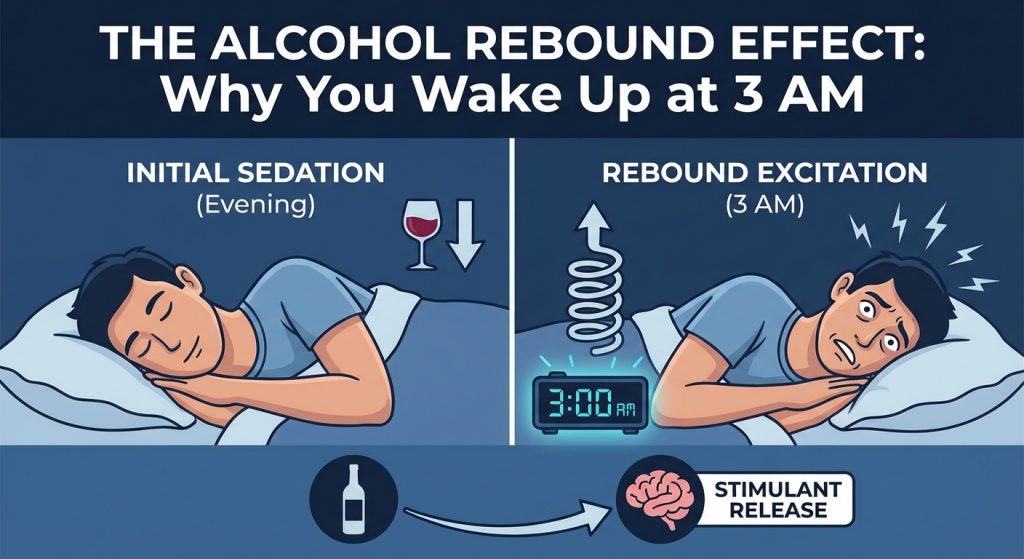
This is the most common symptom I see discussed on forums like SleepHQ and Reddit. You fall asleep fine, but you wake up in the middle of the night, wide awake, often feeling anxious or “wired.”
This is the alcohol rebound effect—a predictable, chemistry-driven pattern described in Alcohol Research: Current Reviews (NIAAA).
Your brain operates on a delicate balance between two neurotransmitters:
- 1. GABA: The “brake pedal.” It calms you down.
- 2. Glutamate: The “gas pedal.” It keeps you alert and anxious.
- Emotional Volatility: Without REM, you lose the ability to decode social cues and regulate anger. This is why you feel irritable and “snappy” the day after drinking, even if you aren’t hungover.
- Memory Loss: REM is essential for locking in what you learned the day before.
- The “Rebound Nightmare”: If you stop drinking after a period of heavy use, your brain often “binges” on REM sleep, leading to intense, terrifying vivid dreams.
- 1. Blood sugar drops.
- 2. Your brain senses a fuel crisis.
- 3. Your adrenal glands release adrenaline and cortisol to tell the liver to dump more sugar.
- 4. You wake up.
- Sedation ≠ Sleep: Alcohol knocks you out but destroys the architecture of restorative sleep.
- The Rebound: The Glutamate spike at 3:00 AM is why you wake up anxious and “wired.”
- HRV Destruction: Alcohol keeps your heart rate elevated all night, preventing physical recovery.
- Metabolic Chaos: It causes blood sugar crashes that trigger adrenaline spikes.
- The Experiment: If you don’t believe me, try 14 days without a single drop. Track your sleep. The data will scream the truth.
Alcohol acts as a massive dose of artificial GABA. It slams on the brakes. Your brain, detecting this massive influx of sedation, panics. To maintain homeostasis (balance), it frantically dumps Glutamate (the excitatory chemical) into your system to counter the alcohol.
For the first 3 to 4 hours, the alcohol wins. You are sedated. But around 3:00 AM, the alcohol is metabolized by your liver and leaves your bloodstream.
Suddenly, the “brakes” (alcohol) are gone, but your brain is still flooding the engine with “gas” (Glutamate). The result is a sharp swing toward alertness: lighter sleep, more wake-ups, and that “wired” feeling. You snap awake. Your mind races. You feel a level of anxiety that seems disproportionate to reality. This is also often accompanied by a spike in cortisol, the stress hormone.
It can feel like a mini crash as your nervous system swings back the other way. This is the mechanism behind the tired but wired sensation that destroys the second half of your night.
REM Suppression: Robbing Your Emotional Health
If deep sleep is for the body, REM sleep is for the brain. It is where we process emotions, consolidate memories, and maintain our mental health.
Alcohol is a potent REM suppression agent. Even a moderate dose can delay REM and reduce the total you get, especially in the second half of the night. (Nature)
Evolutionarily, we do most of our REM dreaming in the second half of the night. However, because of the alcohol rebound effect (the Glutamate spike), your sleep becomes fragmented exactly when you should be entering your longest REM periods.
The Consequence:
When I was tracking this with my devices, I noticed that on nights I drank, my REM duration would drop from my usual 90 minutes to under 40 minutes. I was effectively aging my brain by a decade every time I opened a bottle.
Physiological Stress: Heart Rate Variability and “The Sweats”
If you own a tracker like an Apple Watch, Whoop 4.0, or Garmin, you have likely seen this horror show already.
Alcohol is a vasodilator (it expands blood vessels), which is why you feel warm when you drink. However, at night, this messes with your core body temperature regulation. To get into deep sleep, your core temperature needs to drop a bit. Alcohol night sweats occur because your body is struggling to regulate its thermostat while metabolizing a toxin.
But the cardiovascular data is even more damning.
The Heart Rate Spike
On a sober night, my resting heart rate (RHR) drops to about 52 bpm. On a night with two glasses of wine, it stays elevated at 65–70 bpm all night. My heart can beat roughly 6,000 to 9,000 extra times over an 8-hour night, just because of the alcohol. That is not rest; that is a low-grade cardio workout while I am lying in bed.
HRV Crash
The impact of alcohol on heart rate variability is undeniable. HRV is the gold standard metric for recovery—it measures the variation in time between heartbeats. High HRV means your parasympathetic nervous system (rest and digest) is in charge. Low HRV means your sympathetic nervous system (fight or flight) is hammering you.
Alcohol consistently crushes HRV. My data shows a 30% to 50% drop in HRV on nights I drink. For me, this is a clear signal that even if I feel relaxed, my body is still working harder than it should overnight.
The Glymphatic System: Blocking Brain Detox
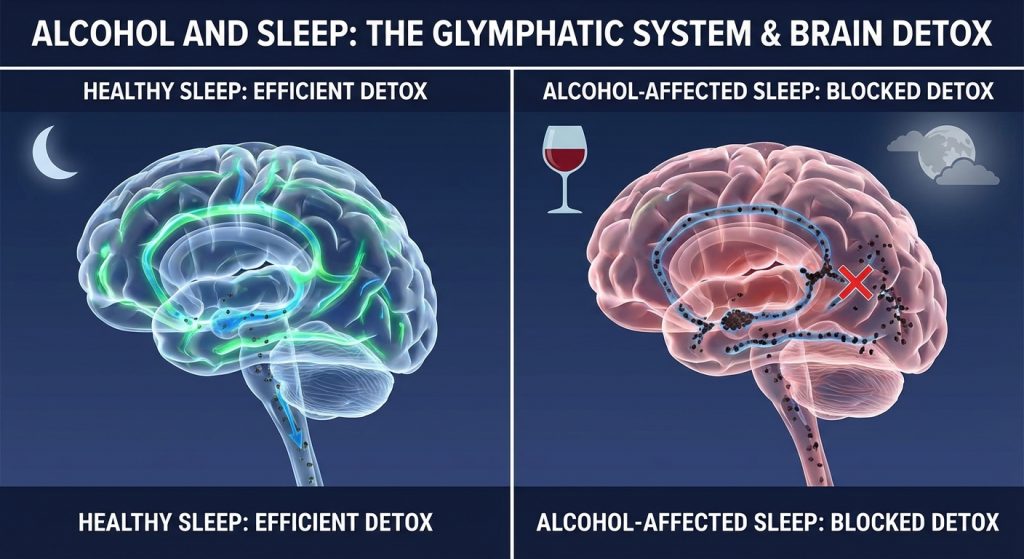
This is a topic we discuss frequently in the “Diagnostics” section of this site. The Glymphatic System is your brain’s sewage system. It is a plumbing network involving Glial cells that opens up only during deep sleep to wash away metabolic waste, including Beta-Amyloid plaques (linked to Alzheimer’s).
Mechanistic and animal research suggests alcohol can interfere with glymphatic clearance, with the clearest disruption seen at higher (binge-level) exposure—including changes around astrocytes and AQP4 in experimental models—while low-dose findings are mixed. The practical takeaway is simple: if alcohol fragments your sleep, the “brain-cleaning” window gets smaller.
Metabolic Impact: The Sugar Crash Connection
We often forget that alcohol becomes your liver’s top priority, and that can temporarily disrupt overnight glucose regulation. This ties directly into Nocturnal Hypoglycemia.
When your liver is busy processing alcohol (which it views as a poison and prioritizes above all else), it stops releasing glycogen (stored sugar) effectively. This can lead to a crash in blood sugar levels around 3:00 or 4:00 AM.
The Chain Reaction:
You aren’t waking up because you’re “done” sleeping; you’re waking up because your body is pushing out adrenaline and cortisol to correct a problem created by the alcohol.
Jan 2026 Updates (Research + Real-World Patterns)
Wearables caught an uncomfortable truth: your sleep stages can look “okay” while your body is clearly stressed.
A September 2025 prospective smartwatch study found that moderate alcohol raised nocturnal resting heart rate by ~3 bpm, even when sleep architecture didn’t shift much—meaning you can feel fine falling asleep, but your recovery signals are still worse.
Glymphatic research got sharper about “why brain fog feels real,” especially with regular or heavy drinking.
An October 2025 review pulled together evidence that chronic high-dose alcohol is linked to glymphatic dysfunction and AQP4-related changes (most clearly shown in mechanistic and experimental work). Translation: the nights you fragment your sleep are the nights you shrink the cleanup window.
The newest big synthesis reinforces that sleep disruption isn’t just a “one bad night” issue for many drinkers.
A January 2026 systematic review/meta-analysis across substance use disorders highlights consistent sleep alterations (including fragmentation and REM-related issues). In practice: for many people, sleep can take longer to normalize than motivation does.
Alcohol + snoring/apnea is getting treated as a bigger deal in the literature, not just an annoyance.
A recent meta-analysis on sleep apnea and substance use reports higher apnea-hypopnea index (AHI) among alcohol users. For regular snorers, alcohol near bedtime is increasingly viewed as “stacking the deck” against stable sleep.
“Dry January” stopped being just a culture trend and started being summarized as a sleep intervention people can actually feel.
A January 2026 Harvard review of the Dry January evidence highlights a common real-world outcome: many participants report sleeping better and feeling more rested after a sustained break.
Community “hard cutoff” rules kept spreading—and biohackers made them stricter.
Sleep communities increasingly default to an early cutoff (not a “nightcap”), and Bryan Johnson’s Blueprint approach is explicitly alcohol-avoidant, treating it as a reliable way to wreck recovery metrics. The practical version is simple: if you drink, move it earlier, and don’t let it overlap with the hours your body is trying to do repair work.
Summary
I am not here to preach prohibition. I am here to tell you that as a 47-year-old man, I cannot “afford” the physiological tax of alcohol anymore. The cost to my deep sleep and next-day performance is too high.
If you are suffering from insomnia, wine insomnia is real. You are trying to put out a fire with gasoline.
Key Takeaways:
If you need help relaxing without the booze, look into Magnesium L-Threonate or Apigenin—two popular options people use instead of a nightcap.
Related Articles:
O2Ring Data Analysis: Estimating Your Apnea/UARS Probability –
Sugar & Fruit Before Bed: Why Insulin Spikes Wake You Up –
The Anti-Sleep Diet: 5 Foods That Destroy Sleep Quality

By: Alex Warenstein.
Bio: Alex Warenstein is a sleep biohacker and founder of Night Time Comfort. After battling chronic insomnia and circadian disruption, he now helps others optimize their sleep using data-driven protocols. Read full story.
Disclaimer: Alex is not a doctor. This content is for educational purposes only. Always consult a specialist.