You fall asleep just fine. Your head hits the pillow at 11:00 PM, and you are out. But then, at 3:00 AM or 4:00 AM, your eyes snap open. You are wide awake. The birds aren’t even singing yet, but your brain is done sleeping.
This is Maintenance Insomnia (Early Morning Awakening).
Worth noting: for chronic insomnia, the first-line, evidence-based treatment is CBT-I, not supplements (American Academy of Sleep Medicine).
For years, people have tried standard (immediate-release) melatonin for this, but its blood levels often fall off within a few hours—so it may help with falling asleep, yet still leave a 3–4 AM gap. Enter Melatonin XR (Extended Release). The promise is simple: a slow-drip delivery system that mimics your body’s natural 8-hour secretion cycle.
Does it work? Or does it just leave you groggy the next day? This review analyzes the mechanism of time-release melatonin, explains why some European doctors are skeptical of it, and shares my (Alex’s) failed experiment with it.
What is Melatonin XR?
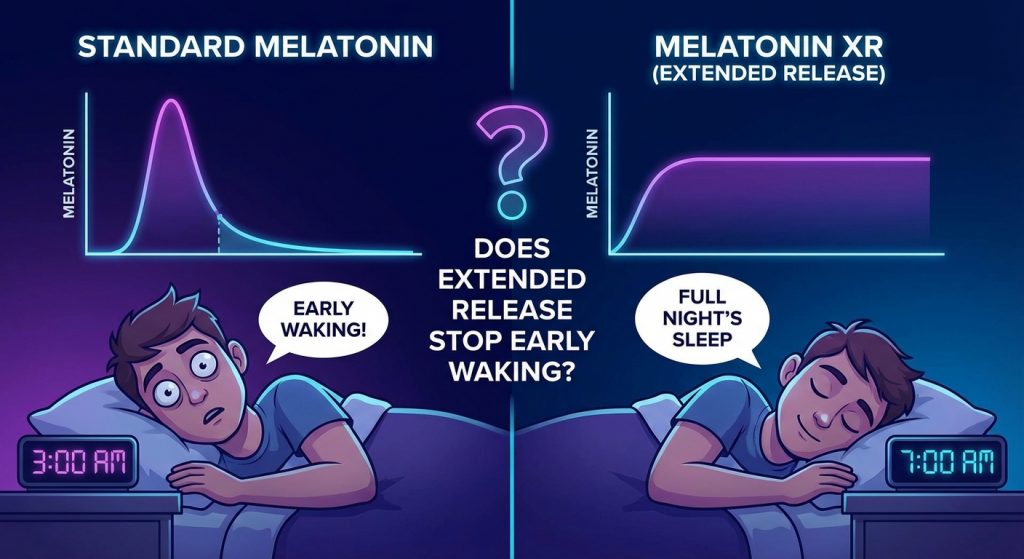
Standard melatonin (Immediate Release) creates a sharp spike in blood plasma levels that peaks in 60 minutes and drops off rapidly. This is great for falling asleep (Sleep Onset Latency).
Extended Release Melatonin uses a special matrix (often hydroxypropyl methylcellulose) to dissolve slowly.
- Release part of the dose quickly to help you fall asleep, then releases the rest slowly over ~6–8 hours to reduce early waking.
- The Mechanism: It tries to extend the body’s ‘night signal’ closer to morning, which can help some people stay asleep—but can also increase next-day grogginess.
How long does melatonin XR take to work?
Like regular tablets, the initial phase kicks in within 60 minutes. However, the full “sleep maintenance” effect is designed to last through the night.
The Controversy: USA vs. Europe
!!! Why is melatonin no longer recommended (specifically XR) by some European authorities?
In Europe, prolonged-release melatonin is treated more like a regulated medicine than a casual supplement: Circadin is a 2 mg prescription prolonged-release tablet indicated for short-term primary insomnia in adults 55+ (European Medicines Agency). That tighter ‘who it’s for + how long’ framing is one reason European clinicians are generally more conservative with long-term, higher-dose XR use.
In the U.S., melatonin is sold as a dietary supplement—so products are not ‘FDA-approved’ for safety and effectiveness before they appear on shelves (Food and Drug Administration). This reality makes high-dose XR gummies easy to buy, and it also makes next-morning ‘spillover’ drowsiness more common when the dose or release profile is too strong for you.
Also, the National Center for Complementary and Integrative Health notes that melatonin product contents may not match the label, which helps explain why the same ‘mg’ can feel different across brands (NCCIH).
Reddit & Community Consensus
What do users on r/Insomnia say about XR?
The Good:
- “The Bridge”: Some users report it bridges the gap between sleep cycles (e.g., the 3 AM wake-up). Instead of fully waking up, they roll over and go back to sleep.
- “Less Anxiety”: By keeping melatonin levels stable, it prevents the cortisol spike that often accompanies waking up.
The Bad:
- “Vivid Nightmares”: This is the 1 complaint. Because XR keeps melatonin high during the second half of the night (when REM sleep dominates), dreams become intense and sometimes terrifying.
- “Hangover”: Many report feeling like a zombie until noon because the pill was still releasing hormones at 7 AM.
- “Cyclic Waking”: Some users report a paradoxical effect where the slow release causes them to drift in and out of shallow sleep all night.
Alex’s Personal Review
The following is based on my personal logs.
I switched to Melatonin XR during a period where I was plagued by 4:00 AM wake-ups. I thought this would be the magic bullet.
My Experience:
I took a reputable 2mg Extended Release tablet. I fell asleep quickly (similar to my spray).
However, the 4 AM wake-up did not stop. In fact, on several nights, my sleep quality felt worse. I experienced a strange phenomenon of cyclic waking: I would fall asleep, wake up 10 minutes later, fall back asleep, and wake up again. It felt artificial and fragmented.
My Rating: 4/10
For me, the trade-off wasn’t worth it. It didn’t solve the maintenance insomnia (which, for me, seemed to track more with cortisol/glucose swings than with melatonin itself), and it introduced sleep fragmentation. I abandoned it and went back to my reliable Melatonin Spray.
Where to Buy:
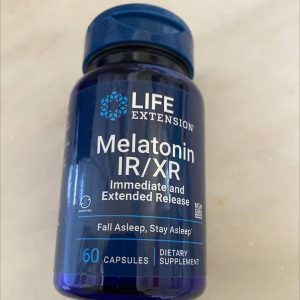
If you want to try it, look for Life Extension Melatonin IR/XR. They use a dual-layer technology. But start with a low dose.
Side Effects & Interactions
What are the side effects of extended release melatonin?
- Grogginess: Much higher risk than standard melatonin.
- Vivid Dreams: Due to REM interaction.
- Safety: The practical risks people notice most are next-morning drowsiness and medication interactions (especially with blood thinners, blood pressure meds, diabetes meds, and seizure meds), so XR is the version most likely to create a ‘hangover’ if it runs too long (Mayo Clinic).
Update for January 2026
Since late 2025, the most useful shift is this: Melatonin XR isn’t just “does it work?”—it’s “who does it help, at what dose, and what does long-term use look like?”
A real safety signal (but still not proof)
A large multinational database study presented at AHA 2025 reported that long-term prescribed melatonin use (≥12 months) in adults with insomnia was associated with higher heart failure risk versus matched controls; the authors explicitly note this is an association, not proof of cause (American College of Cardiology).
The “two-week self-test” idea got validated (and the result surprised people)
A 2025 randomized crossover series of N-of-1 trials using Fitbit + sleep diaries found that 0.5 mg or 3 mg melatonin did not meaningfully improve sleep duration or quality versus placebo on average—so tracking your own response (instead of assuming XR will fix early waking) is often the smartest move (JMIR Formative Research).
Europe doubled down on standardized 2 mg prolonged-release as “the model”
In December 2025, the EU recommended authorization of Melatomed (a generic 2 mg prolonged-release melatonin), reinforcing how Europe frames PR melatonin: standardized dose, medicine-style oversight, narrow insomnia indication (European Medicines Agency).
Glucose/metabolism became a bigger part of the melatonin conversation
A late-2025 meta-analysis reported that melatonin supplementation can shift insulin resistance/sensitivity metrics in some populations—one more reason early-waking problems that “feel metabolic” (wired + hungry + hard to re-sleep) may respond better to food timing/composition than to more XR (Endocrinology Research and Practice).
New mechanism: low natural night-melatonin was linked to future diabetes risk
A 2025 prospective cohort study found that lower nocturnal melatonin secretion (measured via first-morning urine marker) was associated with higher incident type 2 diabetes risk—supporting the idea that protecting the “darkness signal” (light control, consistent schedule) is not just sleep-hygiene theater (The Journal of Clinical Endocrinology & Metabolism).
Biohacker take that stayed consistent through late-2025: micro-dose, not mega-dose
In Bryan Johnson’s public Blueprint materials, melatonin is positioned as a small “before bed” tool (micro-dose) inside a bigger sleep system (light control, consistent bedtime, cool room), rather than a high-dose nightly hammer (Blueprint Protocol).
Summary
Melatonin XR is a theoretical solution that often fails in practice due to individual metabolism speeds.
- Try it if: You fall asleep easily but wake up at 2 AM and stay awake.
- Avoid it if: You are sensitive to grogginess or prone to nightmares.
For many people, addressing nocturnal hypoglycemia patterns or a cortisol-style ‘wired’ wake-up can be a more reliable route than forcing a strong all-night hormone signal.

By: Alex Warenstein.
Bio: Alex Warenstein is a sleep biohacker and founder of Night Time Comfort. After battling chronic insomnia and circadian disruption, he now helps others optimize their sleep using data-driven protocols. Read full story.
Disclaimer: Alex is not a doctor. This content is for educational purposes only. Always consult a specialist.