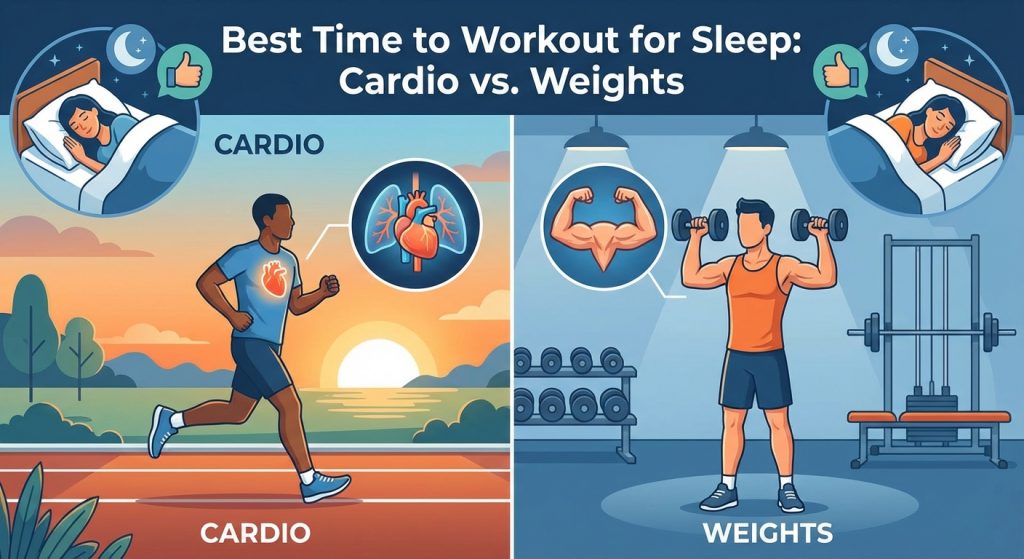
I used to treat exercise like an exorcism. If I had a stressful day at work, or if I knew the insomnia beast was waiting for me, I would hit the pavement at 9:00 PM. I’d run until my lungs burned, convinced that if I just physically exhausted myself enough, my brain would have no choice but to shut down.
I was wrong. I would collapse into bed, physically shattered, but my mind would be wired. My heart rate would thump against the mattress like a trapped bird. I’d stare at the ceiling, tired but wide awake, waiting for a sleep that wouldn’t come.
It took me years, a lot of failed experiments, and digging into the biochemistry of cortisol spikes and exercise responses to understand that when you train is just as important as how you train.
I am not a fitness influencer. I am a 47-year-old man with a family, a job, and a history of sleep struggles.
This guide isn’t about getting shredded abs; it’s about using practical levers (exercise timing, body temperature, and sleep pressure/adenosine) to stack the odds in your favor—because regular activity tends to help sleep, but being active too close to bedtime can backfire for some people (Mayo Clinic).
The Science: Why “Tiring Yourself Out” Can Backfire
To understand the best time to work out for sleep, you have to understand two opposing forces in your body: Adenosine and Cortisol.
1. Adenosine Build Up (The Good Tired)
Think of Adenosine as your brain’s fuel gauge. From the moment you wake up, adenosine begins to build up. It accumulates in your brain throughout the day, creating “sleep pressure.” The more you move and use energy, the more adenosine you generate. When levels get high enough, they bind to receptors in your brain to make you sleepy. This is why a day of hiking makes you sleep like a baby—usually.
2. Cortisol & Temperature (The Alert Signal)
Here is the trap I fell into. High-intensity exercise triggers the release of cortisol (the stress hormone). It also raises your core body temperature.
For sleep to come easily, your core temperature generally needs to start trending down in the evening; exercise pushes it up first, and then (often 30–90 minutes later) it begins falling—which is why timing matters (Johns Hopkins Medicine). If you are blasting your system with a heavy run or a brutal CrossFit session at 9 PM, you are essentially lighting a furnace inside your body. You are also telling your adrenal glands, “Hey, we are running from a tiger,” which spikes cortisol.
So, you have high adenosine (you feel heavy), but high cortisol and temperature (you feel alert). This is the classic recipe for “Tired but Wired.”
Cardio vs. Weights Sleep: The 2025 Consensus
For years, the general advice was “cardio is good, weights are for muscles.” But for those of us over 35 fighting insomnia, the script has flipped.
The Case Against Late-Night Cardio
Steady-state cardio—especially if it turns into a hard run—can keep your system ‘up’ longer than you expect, which is why many people sleep better when the hardest cardio is earlier and evenings stay lighter. In older adults with insomnia, a large pooled analysis found resistance/strength-focused exercise performed particularly well for improving sleep, with aerobic and mixed programs also helping—so both modality and timing matter (BMJ Group).
If I go for a hard run, my heart rate stays elevated for hours. This delays the onset of the parasympathetic nervous system (the “rest and digest” mode) that we need for sleep.
The Case for Resistance Training (Weights)
Lifting weights—controlled, heavy movements—appears to be superior for sleep quality, especially for older adults. It stimulates the release of myokines (muscle-derived proteins) that have anti-inflammatory effects on the brain.
More importantly, resistance training generally doesn’t push your heart rate as consistently high as endurance running, meaning the cortisol spike is often lower and easier to clear before bed.
My Experience: When I switched from evening running to afternoon lifting, my deep sleep scores (tracked on my Apple Watch Ultra 2) improved by roughly 15%. I stopped waking up in a pool of sweat.
The “Forbidden Zone”: Working Out at Night
If you take one thing from this article: use the 3-hour rule as your default—finish the hard stuff about ~3 hours before bed so your body can cool down and your nervous system can settle (Harvard Health).
Your body needs time to cool down. If you finish a workout at 10 PM and try to sleep at 11 PM, your core temperature is still too high. You are fighting your own biology.
However, biohacking is about nuance. If you must exercise at night due to work shifts, the type of exercise matters.
- High Intensity (HIIT/Running): Avoid. This is a cortisol bomb.
- Heavy Compound Lifts (Deadlifts/Squats): Risky. CNS (Central Nervous System) fatigue can keep you awake.
- Zone 2 Training Sleep Connection: This is the grey area. Zone 2 (steady, conversational pace) is less stressful. Some people can do this later, but for me, even Zone 2 raises my temperature too much if done past 7 PM.
Alex’s Protocol: The “Sweet Spot” Routine
I am not an elite athlete. I am a guy trying to stay healthy and sleep well. My routine is designed to maximize adenosine buildup without wrecking my evening cortisol curve.
Frequency: 3 days per week (usually Mon/Wed/Fri).
Time Window: 16:00 to 18:00.
- This is crucial. Finishing by 6 PM gives my body 5+ hours to cool down before my 11:40 PM bedtime.
- It also aligns with the body’s natural temperature peak, meaning my performance is usually better, and the post-workout drop helps mimic the natural circadian decline.
The Workout (Gym Based)
I follow a simple full-body split. I don’t do “bro-splits” (chest day, leg day) because if I miss a day, I miss a body part for a week.
1. Warm-up: 15-20 minutes of Zone 2 cardio (Incline walk or Elliptical). This gets the blood moving but doesn’t kill me.
2. Weights: 45 minutes. I pick 8 exercises, 3 sets each.
- Leg Press or Goblet Squats
- Chest Press (Dumbbell or Machine)
- Seated Row (for posture)
- Overhead Press
- Lat Pulldowns
- (And a few accessories for arms/abs)
3. Cool Down: 5 minutes of stretching.
This routine creates enough physical fatigue to help me fall asleep, but because it ends early, I am relaxed by bedtime.
Alternatives for Home (Age 40-55)
Not everyone wants to go to a gym. If you are 45, have a busy job, and just want to fix your sleep, you don’t need a barbell. You need consistent movement.
For Men (40-55)
If you can’t make the 4 PM window, try this “Exercise Snacking” approach. It focuses on large muscle groups to release those sleep-promoting myokines without spiking cortisol.
The “Commercial Break” Routine: Do this between 6 PM and 8 PM.
- 3 sets of 15 Bodyweight Squats.
- 3 sets of 10 Push-ups (use a wall or sofa if floor is too hard).
- Resistance Band Pull-aparts (great for desk workers).
- Why it works: It’s not enough intensity to trigger a “fight or flight” response, but it can help take the edge off evening restlessness and smooth out post-dinner energy swings for some people.
For Women (40-55)
Hormonal changes during perimenopause can make you more sensitive to cortisol. Cardio can sometimes exacerbate this.
The “Low Cortisol” Strength Routine:
- Pilates-style movements (glute bridges, bird-dogs).
- Light Dumbbells (2-4 kg): Lateral raises, bicep curls.
- Walking: A brisk 20-minute walk after dinner is arguably the best sleep hygiene checklist item there is. It aids digestion and lowers blood sugar.
The Universal Pre-Sleep Move: Yoga Nidra
If you worked out too late, or if you are feeling tired but wired, you need to manually switch off your nervous system. I use Yoga Nidra (NSDR) or light static stretching 30 minutes before bed. This isn’t exercise; it’s a signal to the body that the “hunt” is over.
Jan 2026 Updates: New Findings & Trends
Since September 2025, several useful signals have emerged about workouts and sleep: the “best” plan is still personal, but intensity and timing patterns are getting clearer.
- Afternoon moderate workouts usually don’t wreck sleep (but responses vary) — Sep 2025
A lab study using full polysomnography found that 40 minutes of moderate cycling around ~15:30 didn’t meaningfully change sleep for most good sleepers—yet individual responses varied a lot (ScienceDirect).
Practical takeaway: the afternoon remains a “safe default,” then adjust based on how you sleep.
- Even “small doses” of exercise can move the needle for sleep — Oct 2025
A 2025 meta-analysis of randomized trials in older adults found exercise meaningfully improved self-reported sleep, and the strongest effects often showed up with lower intensity, shorter sessions (≤30 minutes), and modest weekly frequency (Frontiers in Medicine).
Practical takeaway: you don’t need to annihilate yourself to get sleep benefits—consistency wins.
- Type and dose matter: strength ranks high, and mixed programs do well — Nov 2025
A network meta-analysis comparing exercise “recipes” for older adults with poor sleep found resistance/strength training performed strongly, and combined programs (strength + aerobic + balance/flexibility) also looked effective (BMC Geriatrics).
Practical takeaway: if sleep is the goal, keep 2–3 strength sessions/week and add easy cardio/walks.
- A clearer “evening rule”: keep late workouts easy, not heroic — Dec 2025
A large wearable-data analysis suggests low-intensity evening activity (roughly 12–15 hours after you wake up) is linked to better sleep efficiency, while higher-intensity efforts later are more likely to correlate with worse sleep (Nature).
Practical takeaway: if you must move at night, think “easy walk / very light Zone 2,” and keep the hard stuff earlier.
- Mind-body sessions (yoga/tai chi-style) show up as a sleep-friendly option — Jan 2026
A fresh meta-analysis in middle-aged and older adults found both aerobic and mind-body exercise improved subjective sleep, increased total sleep time, and reduced wake time during the night (PubMed).
Practical takeaway: if evening training makes you “tired but wired,” swapping one session for a calmer mind-body workout can be an easy experiment.
- Biohacker angle (without late-night stress): spread movement through the day — Jan 2026
In his regularly updated Blueprint protocol, Bryan Johnson emphasizes frequent low-intensity movement breaks and post-meal walking rather than saving all activity for one late, intense bout (Blueprint).
Practical takeaway: “small but frequent” movement can reduce the pressure to do hard workouts late—while still keeping total activity high.
Summary
If you are struggling with sleep, your workout routine is a powerful lever—use it deliberately.
- 1. Stop the Late Cardio: High-intensity cardio late at night spikes cortisol and temperature, mimicking stress. It is likely the cause of your morning run vs evening lift confusion.
- 2. Prioritize Weights: For those of us 35+, resistance training is superior for sleep quality and combating age-related sleep fragmentation.
- 3. The Golden Window: Try to finish your workout by 6:00 PM (or at least 3 hours before bed). This allows your core body temperature to drop, which is a physical requirement for deep sleep.
- 4. Exercise Snacking: If you can’t get to the gym, short ‘activity breaks’ can still help—one University of Otago trial found that doing ~3 minutes of simple bodyweight moves every 30 minutes during a long evening of sitting was linked to about 30 extra minutes of sleep (University of Otago).
- 5. Listen to your Body: If you feel tired but wired after a workout, you went too hard, too late. Dial it back.
I fixed my sleep not by working harder, but by working smarter. Put down the running shoes at 9 PM, pick up some dumbbells at 5 PM, and see if your nights don’t get a little darker and a little deeper.
Disclaimer: I am not a doctor or a personal trainer. I am a patient sharing my journey. Always consult with a physician before starting a new exercise program, especially if you have health conditions.

By: Alex Warenstein.
Bio: Alex Warenstein is a sleep biohacker and founder of Night Time Comfort. After battling chronic insomnia and circadian disruption, he now helps others optimize their sleep using data-driven protocols. Read full story.
Disclaimer: Alex is not a doctor. This content is for educational purposes only. Always consult a specialist.