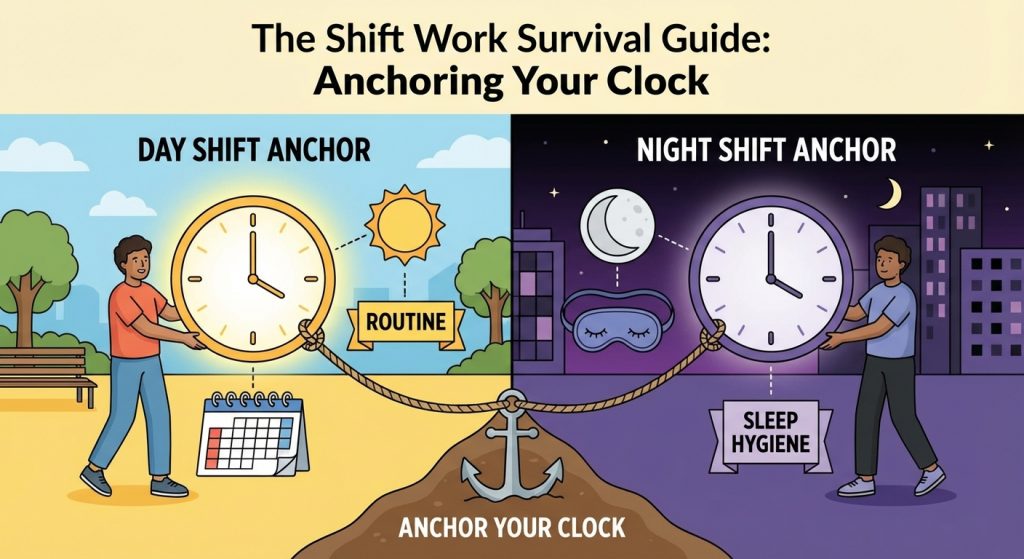
I am not a shift worker. My battle was with insomnia, the kind where you are lying in the dark at 3 AM begging your brain to shut off. But my close friend John is different. John drives a tram in the city. He doesn’t have the luxury of a consistent 23:40 bedtime. One week he starts at 5:00 AM; the next week he finishes at 2:00 AM. His circadian rhythm isn’t just “off”—it is being put through a meat grinder every seven days.
We were sitting in my kitchen a few months ago. He looked gray. His eyes had that glazed, “thousand-yard stare” that I used to see in the mirror during my worst insomnia years. He told me, “Alex, I feel like I’m permanently jet-lagged. I sleep five hours, but I wake up feeling like I’ve been hit by a truck.”
I told him what I tell everyone: You cannot cheat biology. You can’t “hack” sleep reduction. But you can engineer your environment to trick your biology into accepting a new reality.
This guide isn’t for the occasional late-night worker. This is for the tram drivers like John, the security guards, etc. This is the protocol we built for him.
It involves heavy environmental control, specific timing of light and food, and a supplement stack aimed at supporting sleep and recovery in a work pattern that the International Agency for Research on Cancer (IARC) classifies as “probably carcinogenic to humans” (Group 2A).
We call it “The Anchor Protocol.”
The Mechanism: Why You Feel Like Garbage
To fix the problem, you have to understand the machine. Your body is run by the Suprachiasmatic Nucleus (SCN), a tiny cluster of cells in the hypothalamus. Think of the SCN as the Master Clock. It uses light (Zeitgebers) to tell every cell in your body what time it is.
When John drives his tram at 2:00 AM under bright fluorescent streetlights, his SCN screams “IT IS NOON!” It suppresses melatonin and pumps out cortisol. Then, he goes home at 3:00 AM and tries to sleep. His body is confused. It’s physically exhausted, but hormonally wide awake. This is Circadian Friction.
The result isn’t just being tired. Over time, chronic circadian disruption is associated with cardiometabolic strain and poorer cognitive performance; some research also links fragmented sleep with less efficient overnight brain ‘housekeeping’ via the glymphatic system, so people may notice shifts in appetite, mood, and libido—think “system-wide drag,” not a single broken organ.
We needed to stop fighting the clock and start manipulating it.
Strategy 1: The “Anchor Sleep” Concept
The biggest mistake shift workers make is trying to flip their schedule completely on days off. If you work nights, and then try to be a “normal person” on Saturday and Sunday, you are subjecting your body to a trans-Atlantic flight every single weekend. This is what researchers call “Social Jetlag.”
We implemented Anchor Sleep (a practical compromise also described in the American Academy of Sleep Medicine ( AASM) shift-work provider factsheet).
The rule is simple: You must identify a block of 4 hours that you sleep every single day, regardless of whether you are working a night shift, a morning shift, or having a day off.
For John, whose shifts were rotating, we found his “Anchor” was 08:00 AM to 12:00 PM.
- On Night Shift: He gets home at 07:00, winds down, and sleeps from 08:00 to 15:00. (Anchor is covered).
- On Days Off: He stays up late (until 03:00 or 04:00) and sleeps until 12:00 PM. (Anchor is covered).
- On Early Shifts: This is the hardest part. If he has to be up at 04:00 AM, he treats his afternoon nap (14:00 to 16:00) as a sacred recovery tool, but he tries to keep his “main” sleep as consistent as possible during the rotation blocks.
By keeping these overlapping hours, you prevent the SCN from completely uncoupling from reality. You aren’t “shifting” your clock; you are stretching it.
Strategy 2: Light Control (The Dark Therapy)
Light is a powerful circadian signal—treat it like a drug. The CDC/NIOSH shift-work training recommends reducing light late in the shift and using wraparound blue-blocking sunglasses on the commute home to support daytime sleep — and bright, blue-rich light close to sleep can suppress your natural melatonin (NIH NCCIH).
Light is a drug. Treat it like one. If you see blue light (sunlight, LEDs, phone screens) after your shift, your brain deletes your melatonin.
For John, the drive home was the enemy. The sun was coming up at 06:00 AM, blasting 100,000 lux through the tram windshield. By the time he got home, his body was in “Wake Up Mode.”
The “Vampire” Commute
We bought John a pair of Spectra479 glasses (the wrap-around style). These aren’t just fashionable orange lenses; the goal is a wraparound lens that blocks most blue/blue-green wavelengths—ideally confirmed by the manufacturer’s spectral chart rather than a single marketing percentage.
- The Rule: The moment his shift ends, the glasses go on. He drives home looking like Bono, but his optic nerve perceives “darkness.”
- This preserves the melatonin onset that started naturally (or was supplemented) towards the end of his shift.
The “Day Sleep” Cave
When he gets home, his bedroom must be darker than a tomb. A sliver of light from under the door is enough to spike cortisol.
- Blackout Curtains: We didn’t just buy “blackout” curtains from IKEA. We used industrial velcro to seal the edges against the wall.
- Mask: He uses a Manta Sleep Mask for 100% occlusion.
- The Beurer TL45 Trick: When John wakes up at 16:00 (4 PM) to start his “day,” it’s often getting dark outside. This causes depression and lethargy. He uses a Beurer TL45 bright light lamp (10,000 lux) for 20 minutes immediately upon waking. This artificial “sunrise” tells his SCN, “Okay, the day has started,” anchoring his rhythm even if the sun is setting outside.
Strategy 3: Caffeine Timing and the “Nappuccino”
In healthy adults, caffeine’s half-life is commonly reported in the ~2–6 hour range (and can be longer in some people), so a big dose at 4:00 AM can still be meaningfully active when you’re trying to sleep later that day. (FDA)
The Caffeine Hard Stop:
We calculated his caffeine half-life. We set a strict cutoff: No caffeine within 8 hours of his intended bedtime. If he plans to sleep at 08:00 AM, his last coffee is at midnight.
The 3 AM Slump:
This is where the “Nappuccino” comes in. Around 03:00 AM, the biological pressure to sleep is massive.
- Protocol: John drinks a small espresso (before his cutoff window shifts) and immediately closes his eyes for exactly 20 minutes.
- Why? The sleep clears the adenosine (sleep pressure) just as the caffeine kicks in (takes ~20 minutes). He wakes up alert without the grogginess of deep sleep inertia.
If he gets jitters, he stacks L-Theanine (200mg) with the coffee. This amino acid smooths out the stimulant spike, preventing that “wired” feeling that leads to anxiety.
Strategy 4: Diet & The Gut Clock
New research in 2025 has clarified that we actually have two clocks. These are the Master Clock in the brain (set by light) and the Peripheral Clocks in the gut and liver (set by food).
If you eat a heavy burger at 03:00 AM, you are waking up your liver and pancreas when they are supposed to be in repair mode. This leads to nocturnal hypoglycemia and massive insulin resistance.
The “No-Eat” Window:
John now fasts during the second half of his night shift.
- 1. Main Meal: 21:00 (Before shift). High protein, healthy fats.
- 2. Snack: 01:00. Light protein or nuts.
- 3. Fast: 01:00 to 08:00. Only water or electrolytes.
- 4. Recovery Meal: 08:00 (Before bed? No!).
Correction: John found that eating a large breakfast before his day-sleep caused acid reflux and digestion issues. He now eats a small serving of complex carbs (like oatmeal) before sleep—this helps transport tryptophan to the brain—and saves his “Big Meal” for when he wakes up at 16:00.
The Shift Work Supplement Stack
This is the non-negotiable part of the protocol. John isn’t a biohacker by nature, but he admitted that without these, he feels “brittle.”
Note: This is an educational example of what worked for John, not personalized medical advice; if you have a diagnosed sleep disorder (especially sleep apnea), take prescription meds, or have chronic conditions, it’s worth sanity-checking any supplement stack with a clinician.
1. The Sleep Initiators (08:00 AM)
When the sun is up, you need chemical help to convince your body it’s night.
- Magnesium L-Threonate (144mg elemental): We chose magnesium L-threonate because review data suggest it crosses the blood-brain barrier better than citrate. It helps dampen the sympathetic nervous system activity that is usually high after a shift.
- Apigenin (50mg):
Chamomile extract. It’s often described as a mild calming compound with GABA-related activity—very different from prescription benzodiazepines, and still not “risk-free” for everyone. It shuts off the “racing mind” caused by the stress of driving a tram. (See my Apigenin review). - Melatonin Spray (0.5mg – 1mg):
Crucial Note: melatonin is better thought of as a “darkness signal” than a knockout pill. For shift work, we use a micro-dose spray (about 0.5 mg) right when he gets home; older guidance from the American Academy of Sleep Medicine notes that 0.5 mg has been as effective as higher doses in some shift-work contexts. We avoid the Time Release (Melatonin XR review) versions because we don’t want him groggy when he wakes up at 16:00. - L-Glycine (3 grams):
This amino acid lowers core body temperature. Since body temp naturally rises in the morning (fighting his attempt to sleep), L-Glycine is critical to mimic the thermal drop of night.
2. The Cognitive Protectors (During “Day”)
Severe sleep restriction and circadian misalignment can measurably impair attention, reaction time, and mood, and may increase oxidative stress over time—harsh on performance and recovery, even if it’s not “instant brain damage.”
- Creatine Monohydrate (5g):
Personal note from this protocol: Creatine has been John’s “MVP” for feeling less mentally brittle on short sleep; think of it as a simple “energy buffer” that some people find helps with night-shift brain fog. John takes this in his “morning” smoothie (16:00). - GlyNAC (Glycine + NAC):
We added NAC (N-Acetyl Cysteine) to his stack to boost Glutathione levels. This is the body’s master antioxidant. Since shift work creates massive inflammation, we need to scrub the system clean daily.
The Environment: Sound and Temperature
You cannot sleep during the day with normal city noise. A garbage truck at 11:00 AM can destroy a sleep cycle that took you 30 minutes to initiate.
Pink Noise:
We experimented with white noise, but John found it harsh. We switched to Pink Noise (deeper, flatter frequencies like heavy rain). It masks the high-pitch frequencies of traffic and doorbells better. He uses a Hatch Restore 2 simply as a sound machine, blasting pink noise at 60dB.
Temperature Control:
Daytime is hot. Sleeping hot means waking up.
John doesn’t have the budget for an Eight Sleep Pod, so we improvised.
- 1. Bamboo Sheets: High breathability.
- 2. AC Unit: Set to 19°C.
- 3. L-Glycine: As mentioned, to lower internal temp.
Social Jetlag: The Family Problem
The hardest part for John wasn’t the biology; it was his wife. She wanted him to be “normal” on Sundays.
We sat down and explained the concept of “Social Jetlag.” If he wakes up at 16:00 on Friday, and then tries to wake up at 08:00 on Saturday for a family breakfast, he is effectively flying from New York to Los Angeles and back in 24 hours.
The Compromise:
- John maintains his “Anchor Sleep” until at least 10:00 AM on weekends.
- He uses a low dose of caffeine to bridge the gap.
- He explains to his family that his sleep time is medical. It is not laziness. He put up a sign on his door: “Shift Worker Sleeping. Do Not Knock unless the house is on fire.”
January 2026 Updates
I keep a running log of what has actually moved the needle for real shift workers since September 2025. Here are the newest, most actionable updates.
1. Light may not “reset your clock” as easily in daytime as we used to assume.
A January 2026 paper suggests the retina has properties that can reduce how strongly daytime light shifts circadian timing, compared with light during your biological night. Translation: your biggest “clock-wrecking” light is still late-night/early-morning exposure at the wrong circadian phase—so keep prioritizing darkness before day-sleep, but don’t panic that a few seconds of daylight automatically “undoes everything.” [ PubMed ]
2. The best interventions are boring… because multi-component programs win.
A 2025 systematic review/meta-analysis of sleep-improvement programs in shift-work nurses found the strongest results came from bundled approaches (light strategy + sleep hygiene + scheduling + naps), not single magic bullets. Translation: Anchor Sleep + Light Control + Caffeine cutoff + bedroom setup is still the highest ROI package. [ BMC Nursing ]
A 6-year follow-up: cardiovascular risk factors can drift over time with rotating night work.
A longitudinal occupational study (published September 2025) tracked workers over multiple years and reinforced a practical point: even if you feel “fine,” chronic circadian strain can show up gradually in risk markers. Translation: treat recovery like maintenance, not a weekend hobby. [ BMJ Occupational & Environmental Medicine ]
Dose-response got clearer: more years of night work generally means more CVD risk (on average).
An October 2025 systematic review and dose-response meta-analysis across large cohorts found higher CVD event/mortality risk in night shift workers, with risk tending to increase with longer duration of night work. Translation: the earlier you lock in a protective routine (sleep window, meal timing, light discipline), the more it matters over the long run. [ Frontiers in Public Health ]
Your gut clock is not a metaphor: shift work correlates with microbiome changes.
A September 2025 systematic review links shift work/circadian disruption with changes in gut microbiota patterns. Translation: your “Diet & The Gut Clock” section aged well—consistent meal timing and avoiding heavy night eating remains one of the cleanest levers you can pull. [ MDPI ]
Biohacker + community convergence: protect the last hour before sleep, no matter your clock.
A January 2026 interview/profile of Bryan Johnson reinforces the same boring principle biohackers keep circling back to: ruthless consistency and an intentional “sleep runway.” Translation for shift workers: you may not have a 10 PM bedtime—but you can have a consistent “screens-off / wind-down” block before your Anchor Sleep. [ TIME ]
And for real-world execution tricks (blackout hacks, “do-not-disturb” boundaries, pre-sleep rituals) the ongoing, highly practical threads in Reddit r/nightshift mirror what sleep clinicians recommend in spirit: reduce stimulation and protect the sleep window.
Summary: The Shift Work Survival Protocol
If you are working nights or rotating shifts, you are an industrial athlete. You need to treat your recovery with the same seriousness as a professional athlete.
Here is the condensed protocol used by John:
- 1. Anchor Your Sleep: Find a 4-hour window (e.g., 08:00–12:00) that you sleep during every phase of your rotation.
- 2. Control the Light:
During Shift: Bright light is okay, but switch to Red Light if possible during breaks.Commute Home: Wear Blue Light Blocking Glasses (Spectra479 or similar). Do not let sunlight hit your retina.
Waking Up: Use a 10,000 lux lamp (Beurer TL45) immediately upon waking to simulate sunrise.
- 3. Dietary Fasting: Do not eat heavy meals between 01:00 and 06:00. Keep your gut clock anchored to the daytime.
- 4. Caffeine: Stop 8 hours before your intended sleep. Use the “Nappuccino” (coffee + 20 min nap) only early in the shift.
- 5. The Environment:
Blackout curtains + Sleep Mask.Pink Noise to mask city sounds.
Cool room (19°C).
- 6. The Stack:
Morning (Wake Up): Creatine (5g), Vitamin D3 (important as you miss the sun), B-Complex.Pre-Sleep (08:00 AM): Magnesium L-Threonate, Apigenin, Glycine (3g), Melatonin Spray (0.5mg).
You might not be able to quit the shift work, but you can quit the zombie life. It takes discipline, and it takes some gear, but it is possible to thrive in the dark. Good luck.

By: Alex Warenstein.
Bio: Alex Warenstein is a sleep biohacker and founder of Night Time Comfort. After battling chronic insomnia and circadian disruption, he now helps others optimize their sleep using data-driven protocols. Read full story.
Disclaimer: Alex is not a doctor. This content is for educational purposes only. Always consult a specialist.