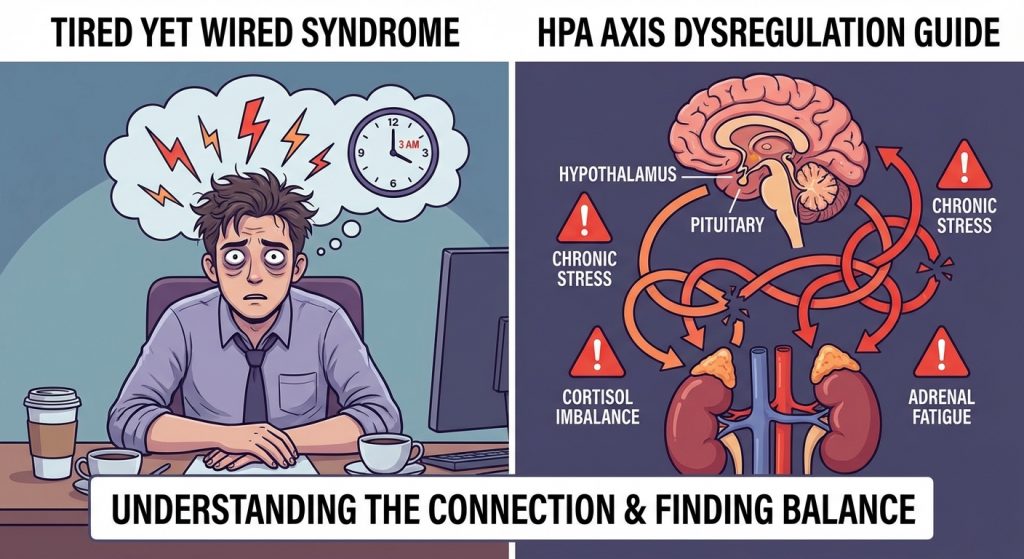
It is 11:30 PM. Your body feels like lead. Your muscles are aching with fatigue. You have been yawning since dinner. But the moment your head hits the pillow, your brain turns on.
It’s not just thoughts; it’s a physical sensation. You feel a “buzzing” in your chest or limbs. Your heart beats a little too hard. You are exhausted, but you are alert.
This is the “Tired but Wired” state.
In sleep research, this pattern is often described as insomnia with “hyperarousal”; online, you may also see it framed as “HPA axis dysregulation”, shorthand for an overactive stress-response system. It is one of the most frustrating sleep disorders because standard sleep hygiene (like reading a book or drinking chamomile tea) often fails to touch it. The problem isn’t that you aren’t sleepy; it’s that your nervous system is stuck in the “ON” position—and for persistent insomnia, CBT-I is widely considered first-line, as summarized by the American Academy of Sleep Medicine.
This guide explains the biology of sympathetic overdrive, why “Adrenal Fatigue” is a misleading term, and provides a step-by-step framework of low-risk techniques many people use to dial down nighttime arousal and make sleep more likely.
The Myth of “Adrenal Fatigue” vs. The Reality of Dysregulation
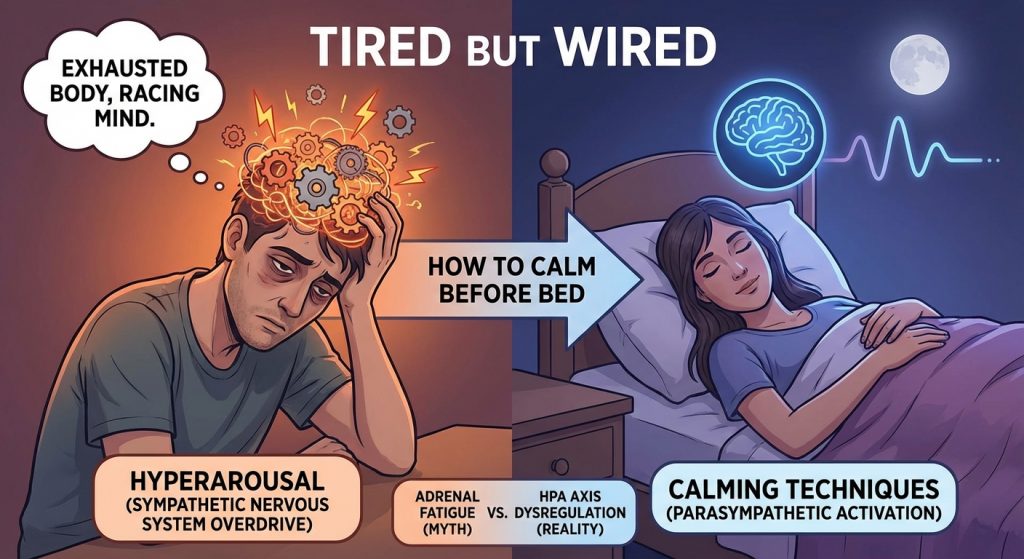
For years, alternative health practitioners used the term “Adrenal Fatigue” to explain this phenomenon. The theory was that your adrenal glands ran out of cortisol after years of stress, causing a crash.
Mainstream endocrinology does not treat “adrenal fatigue” as an established diagnosis (see the Endocrine Society and Mayo Clinic), but the symptoms people describe are real—and often relate to how the stress response is regulated and timed.
For many people, the issue isn’t that the adrenal glands “run out,” but that stress signaling can become poorly timed or overly reactive at the level of the HPA axis (hypothalamic–pituitary–adrenal).
The Thermostat Analogy:
- Imagine your stress response is a heating system.
- Adrenal Fatigue Theory: The furnace ran out of fuel.
- HPA Dysregulation Reality: The thermostat is broken. It thinks it is -20°F outside when it is actually 70°F, so it keeps blasting heat (Cortisol/Adrenaline) even when you don’t need it.
This dysregulation leads to a specific pattern:
- 1. Morning: You may feel slow to “boot up” and need longer (or more caffeine) to feel fully awake.
- 2. Night: You may get a late-evening “second wind”—a noticeable rise in alertness right when you want to sleep.
Symptoms: How to Identify Hyperarousal
Tired but wired symptoms are distinct from standard insomnia. Standard insomnia is often “I can’t stop thinking.” Hyperarousal is “My body won’t let me relax.”
The Checklist:
- The “Second Wind”: You feel like a zombie at 4:00 PM, but suddenly feel energetic and productive at 10:00 PM.
- Physical Buzzing: A sensation of internal vibration or jitteriness when lying still.
- Heart Rate Variability (HRV): If you track your sleep (see our Apple Watch Sleep Tracking Review or Oura Ring Gen 4 Review), your HRV is consistently low, which can be one signal of higher physiological stress load (useful context, but not a diagnosis on its own).
- Sensitivity: You are startled easily by noises (the cat jumping on the bed feels like a heart attack).
- Digestive Issues: Bloating or IBS symptoms can flare during prolonged stress, when “fight or flight” signaling is higher and the gut becomes more sensitive.
The Root Cause: Sympathetic Overdrive
Your Autonomic Nervous System has two branches:
- 1. Sympathetic (Gas Pedal): Fight, Flight, or Freeze. Releases Adrenaline and Cortisol.
- 2. Parasympathetic (Brake Pedal): Rest, Digest, Recover. Releases Acetylcholine.
In the “Tired but Wired” state, the Gas Pedal is stuck. You are biologically safe in your bedroom, but your brain is perceiving a threat. This can be driven by chronic stress, late-night light exposure, stimulants, and, in some people, blood-sugar dips during the night.
When arousal stays high, it can be harder for the body to downshift into deeper sleep (including the normal cooling and slowing that tends to accompany it).
Protocol Phase 1: The “Manual Brake” (Immediate Relief)
If you are lying in bed right now feeling wired, you cannot “think” your way into relaxation. You must use physiology to force the brain to switch gears.
1. The Physiological Sigh
- Popularized in modern sleep and stress discussions, this breathing pattern can quickly reduce the “wired” edge for many people.
- How to do it: Take a double inhale through the nose (a long breath, followed immediately by a short, sharp top-up breath to fully inflate the lungs). Then, exhale slowly and fully through the mouth.
- For many people, it’s one of the quickest ways to take the edge off the “ON” feeling.
2. NSDR (Non-Sleep Deep Rest) / Yoga Nidra
- If you cannot sleep, do not force it. Shift your goal from “Sleeping” to “Resting.”
- The Method: Use an app or YouTube audio for NSDR or Yoga Nidra (a body-scan meditation).
- The Science: These protocols guide your brain waves from Beta (alert) to Alpha (relaxed) by systematically relaxing muscle groups. Even if you don’t fall asleep, 15–20 minutes of NSDR can feel genuinely restorative and help break the “I’m not sleeping” panic loop.
Protocol Phase 2: Biochemistry (Supplements)
If your evenings feel “too revved up,” some people experiment with a small set of supplements to support relaxation—effects vary, so introduce one change at a time.
Note: For a detailed breakdown of specific products, refer to our individual reviews linked below.
1. Phosphatidylserine (The Cortisol Blocker)
This is the MVP for the “Wired” feeling.
- Mechanism (simplified): Some evidence suggests phosphatidylserine may influence the body’s stress response, and some people report that it takes the edge off the evening “wired” feeling.
- Protocol: If you try it, a conservative starting range that many people tolerate is 100mg–200mg with dinner; adjust based on response.
2. L-Theanine (The Alpha Wave Booster)
If your mind is racing with “To-Do” lists, your brain is stuck in Beta waves.
- Mechanism: L-Theanine may support a calmer “relaxed wakefulness” state (often associated with increased alpha-wave activity).
- Protocol: 100mg–200mg is a common starting point; some people use more depending on sensitivity.
3. Ashwagandha KSM-66 (The Long-Term Modulator)
For chronic hyperarousal, you need to lower the baseline stress.
- Mechanism: In some studies, ashwagandha has been associated with lower perceived stress and lower cortisol over time.
- Note: Some people feel “emotionally flat” or overly sedated on it—if that happens, pause and reassess. It’s usually positioned as a longer-term tool (weeks), not a same-night rescue.
4. Magnesium (The Physical Relaxant)
Hyperarousal causes muscle tension.
- Mechanism: Magnesium supports neuromuscular signaling and can help ease physical tension.
- Best Form: Many people choose glycinate for a gentler, “body-relaxing” feel; evidence is less clear on one universally “best” form.
Protocol Phase 3 (Optional) : The Vagus Nerve
The Vagus Nerve is the physical brake pedal. In Tired but Wired syndrome, the Vagus tone is low. You can strengthen it using technology.
Electrical Stimulation (taVNS):
New devices allow you to stimulate the Vagus nerve through the ear (the Cymba Concha region). This sends a signal directly to the brainstem to release calming neurotransmitters.
Evidence: Some studies suggest taVNS can influence autonomic balance and HRV, but results vary by protocol and population; a research overview is available via PubMed Central. Read more: Zenowell taVNS Review: Does Vagus Stimulation Work?
Cold Exposure (The Shock Reset):
Splashing ice-cold water on your face for 30 seconds triggers the “Mammalian Dive Reflex,” which instantly slows the heart rate and activates the Vagus nerve. It sounds counterintuitive to shock yourself before bed, but the rebound effect is profoundly relaxing.
Protocol Phase 4: Diagnosing the Curve
You cannot fix what you cannot measure. If you try these protocols and still feel wired, you need to see what your hormones are actually doing.
The 24-Hour Test:
A single morning cortisol draw may miss the day-night pattern, because cortisol naturally changes throughout the day (see Cleveland Clinic).
- The Tool: In some clinical contexts, multiple samples (blood/urine/saliva) across the day are used to map a cortisol rhythm.
- The Pattern: You are looking for a “U” shape or a flatline that rises at night.
- Full Guide: 24h Salivary Cortisol Test: Why You Wake Up at 3-5 AM.
Protocol Phase 5: Circadian Anchoring
You cannot calm the mind at night if the brain doesn’t know it’s night. HPA axis dysregulation is almost always accompanied by a circadian rhythm disorder.
Morning Anchoring:
If you don’t get bright light in your eyes within 30 minutes of waking, your brain doesn’t start the timer for melatonin release.
The Fix: View sunlight or use a Beurer TL45 lamp immediately upon waking. This is non-negotiable for fixing the “Tired” part of “Tired but Wired.” Read more: Morning Sunlight: The Huberman Protocol for Circadian Anchoring.
Evening Darkness:
If you are “Wired,” you are likely hypersensitive to blue light.
The Fix: After sunset, your home should be dimly lit with red or orange hues. Blue-heavy light in the evening is especially good at suppressing melatonin and shifting circadian timing; a practical overview is in Harvard Health Publishing.
Update for December 2025:
Since I first published this guide on HPA Axis Dysregulation, the conversation has moved from just “blunting cortisol” to actively “switching” the nervous system state using temperature and sound. We now have clearer protocols on how to manually override the “Wired” feeling.
1. The “Cold Shock” Protocol (The Mammalian Dive Reflex)
While warm baths are standard advice, in 2025, biohackers are using acute cold to break the panic loop.
The Science: Splashing ice-cold water on the face (specifically the forehead and eyes) triggers the Mammalian Dive Reflex. This reflex instantly slows the heart rate (bradycardia) via the Vagus Nerve to preserve oxygen.
The Use Case: If you are lying in bed with a racing heart and “looping thoughts,” get up. Splash ice water on your face for 30 seconds. The physiological reset is faster and stronger than any breathing exercise. It manually forces the system from Sympathetic to Parasympathetic.
2. The “Cortisol Switch” (Phosphatidylserine Timing)
New dosing guidelines have emerged from the functional medicine community regarding Phosphatidylserine (PS).
The Update: Taking PS right at bedtime might be too late.
The 2025 Protocol: Take a “loading dose” of 400mg-600mg at 5:00 PM (with dinner).
The Logic: By blunting the cortisol rise before it peaks in the evening, you prevent the “Second Wind” from ever happening. It is easier to stop a train as it’s leaving the station than to stop one moving at full speed.
3. “Pink Noise” for HPA Regulation
We used to think noise was just for masking sound. New data suggest that pink noise acts as a neural entrainment tool for the HPA axis.
The Finding: Listening to Pink Noise (rain/wind) stabilizes heart rate variability (HRV) in stressed individuals faster than silence.
The Strategy: Use a machine or app (like BetterSleep) to play Pink Noise during your wind-down routine, not just while sleeping. It provides a subconscious “safety signal” to the amygdala.
4. Safety Warning: Ashwagandha Cycling
A reminder for 2025: While Ashwagandha lowers cortisol, taking it forever can lead to HPA Axis suppression (too low cortisol in the morning) and emotional numbness.
The Rule: Cycle it. 3 weeks on, 1 week off. Or switch to Relora or Holy Basil, which are milder modulators for long-term use.
Summary: Your Calm Down Strategy
Tired but Wired is not a personality trait; it is a physiological state of HPA axis imbalance. To fix it, you must convince your body it is safe.
The Routine:
- 1. Morning: 10,000 Lux Light (Sun/Lamp) to anchor the rhythm.
- 2. Daytime: Manage stress spikes.
- 3. Evening (7 PM): Take Phosphatidylserine or Relora (See Relora Review) to blunt the evening cortisol rise.
- 4. Bedtime: 400mg Magnesium + L-Theanine.
- 5. In Bed: Do 5 minutes of Physiological Sighs or listen to an NSDR track.
By systematically lowering the sympathetic tone and boosting the parasympathetic signal, you can retrain your nervous system to accept rest.
Related Articles:
Relora Review: Stopping Stress Eating and Night Wakings |
Reishi Mushroom Extract Review: The “Spirit Calming” Fungi |
Waking Up at 4 AM? Silence the “Monkey Mind” & Fall Back Asleep Fast.

By: Alex Warenstein.
Bio: Alex Warenstein is a sleep biohacker and founder of Night Time Comfort. After battling chronic insomnia and circadian disruption, he now helps others optimize their sleep using data-driven protocols. Read full story.
Disclaimer: Alex is not a doctor. This content is for educational purposes only. Always consult a specialist.