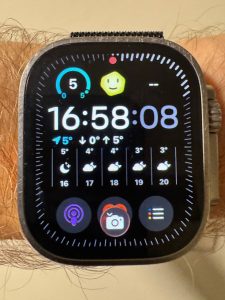
Apple Watch sleep tracking has matured into something genuinely useful—especially on the newest hardware, Apple Watch Series 11 and Apple Watch Ultra 3. But “useful” and “precise” are not the same thing. If you’re here because you want to know whether Apple Watch sleep stages are accurate—and whether that deep sleep data matches how you actually feel—this review will give you the grounded answer most marketing pages and many gadget reviews skip.
I’m going to focus on what matters for real people: how reliable the hypnogram is (the timeline of awake/core/deep/REM), where Apple Watch tends to be strong, where it still guesses, and how to interpret the numbers without overreacting to them.
What Apple Watch Series 11 and Ultra 3 can measure during sleep
Both Apple Watch Series 11 and Ultra 3 use a similar idea: they don’t measure brainwaves, so they estimate sleep and sleep stages using signals they can capture from the wrist—movement plus cardiovascular and breathing-related patterns.
According to Apple Newsroom, Apple Watch can capture sleep-adjacent signals like heart rate, wrist temperature, blood oxygen, and Apple Watch respiratory rate, and it can also surface indicators related to possible sleep apnea.
On the consumer side, this translates into a nightly breakdown that usually includes:
- Total sleep time.
- Time in bed.
- Estimated awakenings (and sometimes “awake” segments on the graph).
- Estimated time in core/light sleep, deep sleep, and REM.
- Breathing-related metrics (depending on settings, model, region, and compatible iPhone/software).
On Apple Watch Series 11, Apple explicitly positions the watch as able to monitor breathing disturbances over time and notify about possible sleep apnea.
And at the platform level, watchOS 26 (Apple) confirms the current ecosystem requirements and device compatibility (including Series 11 and Ultra 3, paired with an iPhone running iOS 26).
So: yes, the feature set is modern and broad. The real question is how accurate the stage algorithm is—and how much trust you should place in “deep sleep data” on any wrist tracker.
The core truth: wrist sleep staging is always an estimate
If you take nothing else from this review, take this:
- A wrist device can be excellent at tracking sleep habits and trends, and still be imperfect at telling you exactly when you were awake, exactly how much deep sleep you got, and exactly how much REM you got.
The reason is simple: the most precise stage scoring is based on EEG-style signals (brain activity), often combined with other channels. Watches do not measure that. They infer.
This doesn’t mean Apple Watch sleep tracking is “bad.” It means the output should be treated like a model of your night, not a literal recording.
How accurate are Apple Watch sleep stages in real life?
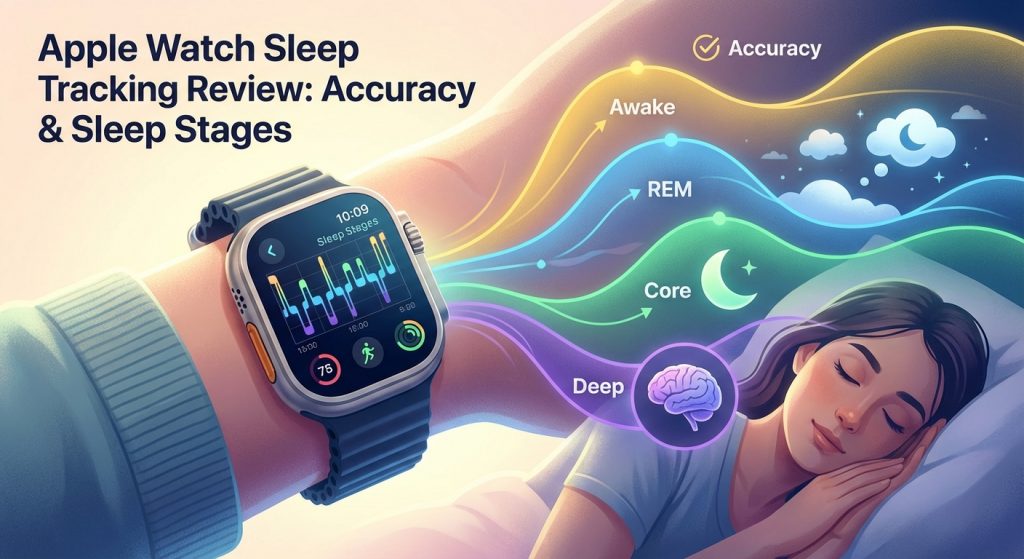
Sleep vs. wake: usually the strongest part
Most wearables (including Apple Watch) do best at identifying longer, sustained sleep blocks—especially if you have a consistent schedule and you’re not lying still awake for long stretches.
Where many people get frustrated: quiet wakefulness. If you’re awake but still—doomscrolling without moving much, meditating, or just lying there—wrist trackers frequently score parts of that as sleep. That’s not an Apple-only problem. It’s a wrist problem.
The hypnogram “shape” can look plausible even when details are wrong
Apple’s chart often looks realistic: more deep sleep earlier, more REM later. But the timeline can still miss short awakenings or misplace stage boundaries.
This is exactly why people feel a mismatch between “how I feel” and “what the watch said.” The graph can be directionally right while still being wrong in the details that matter to you—like that 15-minute awake period you clearly remember at 3:40 a.m.
Deep sleep is the most psychologically “sticky” metric—and often the least dependable
Deep sleep is the number everyone latches onto. It’s also the easiest to misinterpret because:
- Night-to-night deep sleep naturally varies.
- Watches often struggle to differentiate deeper sleep from certain forms of stillness and from some lighter-stage patterns.
- If you wake up feeling unrested, it’s tempting to blame a low “N3/deep” number—even when the cause may be something else (fragmentation, stress load, late alcohol, temperature, pain, a noisy environment, etc.).
This is the “deep sleep data vs. how I actually feel” trap. The watch gives a crisp number; your body gives a messy reality.
What independent reviewers/testing suggest about Apple Watch Series 11 accuracy
The Quantified Scientist perspective (why it matters)
The Quantified Scientist perspective (why it matters)
The most cited consumer-facing, methodology-driven testing in this space typically involves comparing a wearable’s output to an EEG-based reference. That’s valuable because it puts “sleep stage algorithm” claims into a measurable context.
In his Apple Watch Ultra 3 testing, The Quantified Scientist positions Ultra 3 as one of the stronger performers among consumer wearables.
Even when a wearable “wins” in this kind of testing, it doesn’t become an EEG. What it does mean is: if you want a wrist tracker, Apple Watch is often among the safer bets—particularly compared to devices that produce very confident-looking sleep staging with weaker validation.
DC Rainmaker’s practical take (very aligned with real-world use)
In day-to-day usage, reviewers who are strict about measurement nuance often land on a similar conclusion: sleep tracking is useful, sleep stages are not something to treat as gospel.
In his Ultra 3 deep-dive, DC Rainmaker notes that general sleep tracking is largely accurate in practice, but also cautions against overconfidence in stage precision—pointing out that even “gold standard” approaches don’t deliver perfection.
That’s the right framing for normal users: Apple Watch can be a solid tool for bedtime regularity, duration, and broad pattern recognition, without being a forensic stage-scoring machine.
Series 11 and Ultra 3: what’s improved for sleep tracking specifically?
Some upgrades are “sleep” upgrades directly; others are indirect but matter because they improve compliance (actually wearing the watch nightly).
The big sleep upgrade most people will feel: battery headroom
If your watch dies overnight—or you skip wearing it because you forgot to charge—it doesn’t matter how good the algorithm is.
Apple Watch Series 11’s battery and charging improvements are repeatedly highlighted as meaningful for real-life sleep tracking. In TechRadar’s Series 11 review , the practical benefit is clear: the Series 11 pushes closer to a full-day cycle, making overnight wear easier without micromanaging charging.
Ultra 3: more endurance, more consistency
Ultra models have always been “easier” for sleep tracking simply because you’re less likely to be forced into a charge window that conflicts with bedtime.
In The Verge Ultra 3 review, battery improvements are framed as incremental on paper but noticeable in lived use—meaning fewer missed nights and fewer partial nights.
Software maturity: watchOS 26 + iOS 26 ecosystem stability
It’s not just the algorithm. It’s the entire pipeline: sleep focus/schedule behavior, background processing, Health app presentation, and how consistently the watch captures signals overnight.
Apple’s watchOS 26 overview clarifies that this generation is designed around Series 11 / Ultra 3 as first-class devices, which is exactly where you want to be if your goal is stable overnight tracking.
What improved in Apple Watch Series 11 compared to Apple Watch Series 9
Based on the PhoneArena Series 11 vs Series 9 comparison and mainstream Series 11 coverage:
- 1. More battery headroom and faster charging
Series 11 is positioned with larger sizes and improved battery practicality, plus faster charging behavior compared to Series 9—this directly reduces “I couldn’t wear it overnight” friction. - 2. Connectivity step (5G vs LTE)
Series 11 adds a more modern cellular tier in supported configurations (which won’t change your sleep stages, but can improve overall device longevity and daily convenience). - 3. Newer platform baseline (watchOS 26 era experience)
Series 9 can run watchOS 26 (depending on region/device eligibility), but Series 11 is designed around it as the default experience. That matters because “sleep tracking accuracy” is often less about a single sensor and more about the stability of continuous overnight capture plus Health app interpretation. - 4. Feature positioning around sleep and breathing insights
Apple’s Series 11 messaging explicitly emphasizes sleep quality insights and breathing disturbance monitoring as part of the health suite (more prominent than the Series 9 era messaging).
If you’re upgrading primarily for sleep tracking: the practical “win” is not that Series 11 suddenly becomes EEG-accurate. The win is that it’s easier to wear consistently and less likely to miss nights due to charge timing.
Does Apple Watch accurately detect awakenings?
This is one of the most searched questions—and it’s also where most users feel the biggest mismatch.
Here’s the honest answer:
- Long awakenings with movement: Apple Watch often detects them.
- Short awakenings (especially if you stay still): commonly missed or undercounted.
- Restless light sleep: sometimes misread as awake, sometimes misread as deeper sleep, depending on your physiology and movement patterns.
So when someone says, “My watch didn’t mark the moments I know I was awake,” that is entirely plausible on a wrist tracker.
This is also why you can see an impressive-looking sleep score or “excellent sleep” summary on a night where you felt like you were up repeatedly. The watch may have captured “sleep continuity” better than your memory captured it—or the opposite: your memory may be right and the watch smoothed it over.
Is Apple Watch deep sleep accurate?
Deep sleep is the headline metric people use to self-diagnose their energy. I recommend a different approach:
Treat deep sleep as a trend line, not a nightly verdict
If your deep sleep is consistently low for weeks and you feel worse, that’s a meaningful pattern. If your deep sleep is “low” on one random Tuesday but you feel fine Wednesday, that Tuesday number is not worth spiraling over.
Why you can feel great after “low deep sleep”
Because sleep quality is not a single variable. You can feel good when:
- your sleep timing was stable.
- your total duration was adequate.
- your night had fewer disruptions.
- your body recovered well despite a modest deep sleep estimate.
Why you can feel awful after “high deep sleep”
Because the watch can overestimate segments—or your sleep can be long but fragmented; you can also wake at a biologically unlucky moment (sleep inertia), which feels terrible regardless of the stage totals.
If you want a single line: Apple Watch deep sleep data is useful for context, not for certainty. That aligns with how careful reviewers discuss the limitations of stage precision even when the overall sleep tracking experience is strong.
Apple Watch REM sleep accuracy: why REM is often “close but not exact”
REM estimation on a watch is partly driven by patterns like reduced movement plus changes in heart rate dynamics and breathing. That makes it possible to estimate, but it also makes it vulnerable to confounders:
- late heavy meals.
- alcohol.
- certain medications/supplements.
- illness or inflammation.
- stress load.
- atypical sleep timing.
So if you sometimes look at REM and think “that feels wrong,” your intuition may be right—without implying that the watch is useless. It may simply be doing what all wrist trackers do: mapping complex physiology into neat bins.
How Apple Watch compares to other popular sleep trackers
People searching in 2025–2026 commonly cross-shop Apple Watch against Oura 4.0, Whoop 4.0, Samsung rings, Garmin, and cheaper smartwatch brands.
From a sleep-staging standpoint, a reasonable generalization—supported by the fact that Apple Watch models often rank strongly in more rigorous consumer tests—is:
- Apple Watch is frequently better than mass-market smartwatches that provide sleep stages without strong validation culture.
- Apple Watch is often more consistent than many fitness-first devices that treat sleep as a secondary feature.
- Rings and straps can be more comfortable for some people, but comfort does not automatically translate into better stage accuracy.
Your key trade-off is still this: if you want precise stage timing, you’ll eventually end up in EEG-based territory. If you want everyday consistency in a device you already wear and trust, Apple Watch Ultra 3 and Series 11 are compelling.
The orthosomnia problem (why “better data” can make sleep worse)
Orthosomnia is the modern habit of chasing “perfect sleep numbers,” often leading to anxiety, more nighttime checking, and worse sleep—ironically driven by the same tools meant to help.
Apple Watch (and the Health app ecosystem) can nudge you into this if you start treating nightly sleep stages as a grade on your worth or your health.
A practical rule that works:
- Use the watch to observe behaviors (bedtime consistency, duration, late caffeine/alcohol impact).
- Avoid letting a single night of “low deep sleep” or “low REM” rewrite your entire story about your body.
How to get the most reliable Apple Watch sleep data?
If your goal is higher wrist tracker accuracy, your best levers are boring—but effective:
- 1. Wear it consistently (missed nights create misleading narratives)
- 2. Keep your fit consistent (too loose increases noise)
- 3. Charge in predictable windows (especially on Series 11—battery is improved, but consistency still matters)
- 4. Use comparisons, not absolutes
Compare your own nights to your own baseline, not to an idealized “textbook” hypnogram.
This is also where Ultra 3’s battery practicality is a quiet advantage: fewer missed nights means better long-term interpretability.
So, is Apple Watch sleep tracking “accurate” in 2026?
If we define accuracy the way most people actually mean it—“Can I trust what it shows?”—the best answer is nuanced:
- Accurate enough for nightly habits and trend tracking: yes, particularly on Ultra 3 and Series 11.
- Accurate enough to treat deep sleep minutes and REM minutes as precise: no, not consistently.
- Accurate enough to replace an EEG-style hypnogram: no.
If you keep your expectations calibrated, Apple Watch can be one of the most useful daily sleep tools available—especially because it’s a strong all-around wearable, not a single-purpose sleep gadget.
Alex’s Apple Watch Ultra 3 sleep tracking review (7/10)
My Rating: 7/10.
I’ve been using the Apple Watch Ultra 3 for sleep tracking (while keeping a Wellue O2Ring on my right hand for cross-reference) long enough to say this clearly: it’s a useful device, but it’s not a precise sleep lab. I rate it 7 out of 10 for sleep. The biggest issue is trust. I’ve seen nights where my hypnogram doesn’t mark awake moments that I’m absolutely sure happened, and that makes me skeptical about the finer details. I’m also not confident in the accuracy of the deep sleep (N3) number the Apple Watch shows—sometimes it feels too low, sometimes it looks fine, and I can’t reliably match it to how I actually feel the next day. REM sleep totals also occasionally look questionable to me.
That said, as a daily baseline tool—something I can wear every night and use to compare one day to another—it’s good enough. In my experience it’s still better than most alternatives I’ve tried or evaluated, including Samsung watches, Xiaomi/Honor watches, many Garmin watches, Oura Ring 4, Whoop 4.0, and the Samsung Galaxy Ring. The data is still approximate, but it’s consistently approximate, which is exactly what I need for long-term comparison. For truly accurate sleep staging and a precise hypnogram, you’re ultimately in EEG territory (including home EEG devices).
A quick note on third-party Apple Watch sleep apps
At the end of your Apple Watch sleep rabbit hole, you’ll notice something important: other apps can produce different-looking sleep outputs from the same watch.
Apps like AutoSleep, Bevel, and Athlytic are popular for Apple Watch sleep tracking. AutoSleep, in particular, uses its own method to estimate sleep stages, which is one reason its charts can diverge from what the Health app shows. This doesn’t automatically mean one is “right” and one is “wrong”—it often means they’re applying different rules to the same imperfect inputs.
Bottom line
Apple Watch Series 11 and Apple Watch Ultra 3 are among the best mainstream choices for sleep tracking if you want a wearable you’ll actually wear nightly and you value consistent long-term trends. But if your definition of “accuracy” is “I want every awakening and every deep-sleep minute to be correct,” no wrist tracker can promise that—Apple included.
Used correctly, Apple Watch sleep data can help you make smarter decisions about sleep habits. Used obsessively, it can turn into orthosomnia fuel. The difference is not the algorithm—it’s how you interpret the output.

By: Alex Warenstein.
Bio: Alex Warenstein is a sleep biohacker and founder of Night Time Comfort. After battling chronic insomnia and circadian disruption, he now helps others optimize their sleep using data-driven protocols. Read full story.
Disclaimer: Alex is not a doctor. This content is for educational purposes only. Always consult a specialist.