Introduction: The “Wired” Body
I am not a yogi. I am a 47-year-old man who spent years sitting in office chairs, driving cars, and stressing over deadlines. For a long time, I treated my body like a vehicle that I could just park in bed at 11:00 PM and expect to turn off.
It didn’t work. Even when my mind was relatively calm, my body was screaming. I would lie there, and if I paid close attention, I could feel it: my jaw was tight, my shoulders were up by my ears, and my lower back felt like a compressed spring.
We talk a lot about “Sleep Hygiene” (light, temperature), but we rarely talk about “Tissue Hygiene.” If your nervous system is trapped inside a cage of tight muscles, it sends a constant feedback signal to your brain: “We are tense. Danger is near. Do not enter deep sleep.”
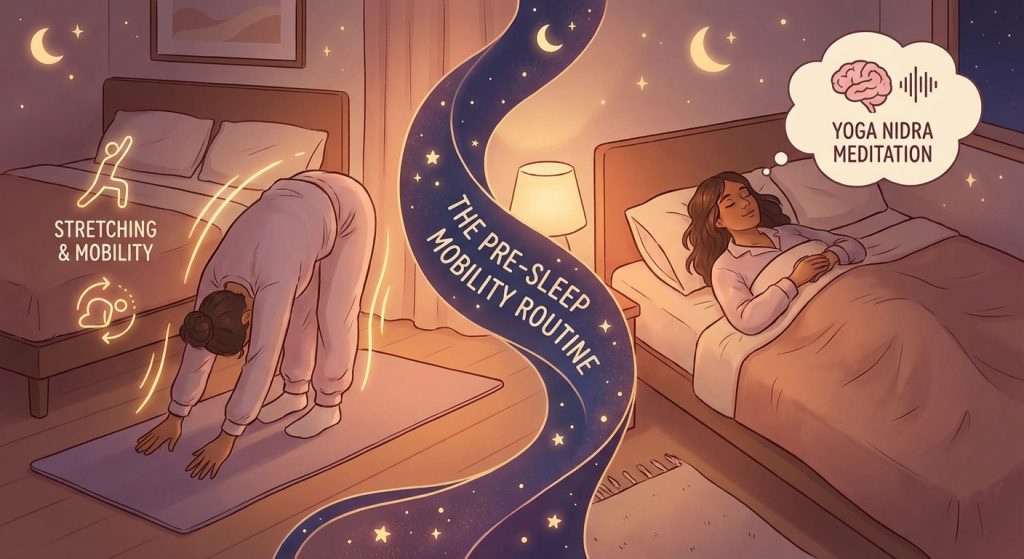
This article is not about becoming flexible or doing headstands. It is about a practical, repeatable way to nudge your nervous system from “Fight or Flight” (sympathetic) toward “Rest and Digest” (parasympathetic) before bed. It combines a short set of gentle, somatic stretches (hips and pelvis often hold “desk-body” tension) with Yoga Nidra — often discussed today under the NSDR label.
I don’t do this because it’s “spiritual.” I do it because, according to my Apple Watch Ultra 2 and my own logs, it reliably helps me downshift at night.
Yoga Nidra for Sleep: More Than Just “Savasana”
If you hang around the biohacking community—especially if you’ve seen NSDR (Non-Sleep Deep Rest) popularized by Huberman Lab—you’ve likely heard it described as a science-first label for Yoga Nidra. This is essentially a rebranded, science-first version of an ancient practice called Yoga Nidra (Yogic Sleep).
What Is It?
Yoga Nidra is not meditation in the way most people think of it. You don’t sit up. You don’t focus on a mantra. You lie down, cover yourself with a blanket, and listen to a script that guides you through a specific rotation of consciousness across different body parts.
It is a state of “sleep with a trace of awareness.” Your body falls asleep, but your mind hovers on the borderline of hypnagogia (the state between wakefulness and sleep).
The Mechanism: Why It Works for Insomnia
When you have insomnia or feel “tired but wired,” it’s often less about willpower and more about state: your body is in “go mode” even when you want to sleep. Yoga Nidra/NSDR gives your attention a simple track to follow (breath cues, a body scan), which can make it easier to downshift without “trying to fall asleep.”
Yoga Nidra acts as that bridge by systematically shifting your brainwave activity toward the alpha (relaxation) and theta (dream-like) ranges.
- Mental quieting: the script reduces decision-making and rumination.
- Physical downshift: many people notice slower breathing and less muscle guarding during a session.
- A repeatable bridge: if you wake up wired, it can function as a structured reset instead of scrolling.
!!! Alex’s Note: I don’t use this every single night, but on nights when my O2Ring data shows my pulse is high (above 60 bpm) before bed, I know I need an intervention. I put on my Soundcore Sleep A30 earbuds, select a track, and usually, I am gone before the track finishes.
Why You Need to Relax Muscles Before Bed: The Somatic Connection
You can try all the calming tricks you want, but if your psoas (the primary hip flexor) stays braced, your body can still behave like it’s “on alert” at bedtime.
The hips and pelvis are often called the “junk drawer of emotions.” In biological terms, this is where we hold tension from sitting and stress. When the pelvic floor is hypertonic (too tight), it can contribute to urinary urgency or the feeling that you “still need to go,” which some people may mistake for prostate-related symptoms. Cleveland Clinic has a clear overview of hypertonic pelvic floor symptoms, and UrologyHealth outlines the many possible causes of nocturia (nighttime urination).
We need to release this tension physically to allow the mind to settle.
Pre-Sleep Stretching Routine: A 10-Minute Mobility Guide
Do not turn this into a workout. The goal is not to burn calories or increase flexibility significantly. The goal is down-regulation. Keep the lights low (red light if you have it, or dim lamps). Do this on a rug or a yoga mat.
1. Child’s Pose (Balasana) – The Decompression
- Time: 2 Minutes
- Why: It gently stretches the lower back and signals safety to the primitive brain.
- How: Kneel on the floor, touch your big toes together, and sit on your heels. Separate your knees about as wide as your hips. Exhale and lay your torso down between your thighs. Reach your arms forward.
- Focus: Breathe into your back ribs. Imagine your spine lengthening.
2. Legs Up the Wall (Viparita Karani) – The Drain
- Time: 3 Minutes
- Why: This is the king of restorative poses. It’s a classic restorative pose that many people find calming, and it can make your legs feel lighter after a long day of sitting.
- How: Sit sideways next to a wall. Swing your legs up the wall and lie back. Your butt should be close to the wall (it doesn’t have to touch if your hamstrings are tight). Arms rest by your sides, palms up.
- Modification: If this hurts your back, put a pillow under your hips.
3. The Supine Twist – The Wring Out
- Time: 1 Minute per side
- Why: Releases tension along the spine and aids digestion (helpful if you ate too close to bed).
- How: Lie on your back. Hug your knees into your chest. Drop both knees over to the left. Extend your right arm out to the side and look at your right hand. Breathe deeply. Switch sides.
4. Happy Baby / Reclined Butterfly – The Pelvic Release
- Time: 2 Minutes
- Why: This is critical for men and women. It releases the inner thighs and the pelvic floor. If nighttime urination is a recurring annoyance for you, this one is worth testing for a week or two.
- How:
Option A (Happy Baby): Lie on your back. Grab the outsides of your feet. Pull your knees toward your armpits. Rock gently.
Option B (Butterfly): Lie on your back. Bring the soles of your feet together and let your knees fall open.
5. Progressive Muscle Relaxation (PMR) – The Transition
- Time: 1 Minute
- Why: This bridges the gap between movement and the stillness of Yoga Nidra.
- How: Lie flat on your back. Squeeze your toes—hold for 5 seconds—release. Squeeze your calves—hold—release. Move up to your thighs, glutes, belly, hands, shoulders, and face. Squeeze everything tight, then let go completely.
How to Perform Yoga Nidra for Sleep Onset
Once you have finished the stretches, crawl into bed. This is where the magic happens.
- 1. Environment: Ensure the room is cool (around 18–20°C / ~65°F; Sleep Foundation cites ~65°F as a common starting point). If you use a Weighted Blanket, pull it up now.
- 2. Audio: You need a guide. It is very hard to do this by yourself.
Apps: Insight Timer (free), BetterSleep, or Calm. Search for “Yoga Nidra for Sleep.”
YouTube: Search for “NSDR Andrew Huberman” (10 mins) or “Yoga Nidra for Sleep Ally Boothroyd” (20 mins).
- 3. The Sankalpa (Intention): Traditional Nidra asks you to set an intention. In a sleep context, keep it simple: “I am resting. I am safe.”
- 4. The Body Scan: The voice will ask you to feel your right thumb, second finger, third finger… follow the voice. Do not analyze. Just feel.
- 5. The Drift: You will likely zone out. You might miss parts of the recording. That is fine. If you fall asleep, let it happen.
!!! Playlist:
To save you the trouble of searching through thousands of clips, I have linked to an NSDR playlist containing the most suitable Yoga Nidra videos currently available on YouTube.
I find the female voice usually works better for me for sleep, while Huberman’s voice (NSDR) is better for a midday “power nap” reset.
Latest Research & Biohacking Updates
As of late 2025, the science on “static rest” has evolved significantly. We are moving away from the idea that sleep is just a passive “crash” and understanding it as an active physiological state we must prepare for.
1. What 2025 studies actually measured
Newer work is starting to measure biology, not just vibes. In 2025, a randomized trial in Stress and Health (Moszeik et al.) tracked both self-reported outcomes (stress/sleep) and diurnal salivary cortisol patterns; you can find it via PubMed.
Separately, a 2025 study in BMJ Open compared Yoga Nidra with sleep education and reported improved self-reported sleep outcomes in its study sample.
2. The “Pelvic Floor” Connection for Men
One under-discussed angle is simple muscle over-tension: long sitting + stress can leave the pelvic floor “stuck on,” which may show up as urinary urgency and a restless, braced feeling at night. That’s why this routine emphasizes down-regulation (breathing + gentle hip openers) rather than more “squeezing” work.
3. Bryan Johnson’s 2025 Protocol
Bryan Johnson (Blueprint) has updated his routine for late 2025. He has shifted his wake time to 04:30 AM, but crucial to his evening wind-down is a specific mobility block.
He incorporates Cobbler’s Pose (Butterfly) and dynamic hip openers to counteract the sitting he does during the day. He views this not as exercise, but as “structural maintenance” to ensure blood flow before sleep.
4. Somatic Shaking
There is a growing interest in “Somatic Shaking” (tremoring) to release trauma. While the clinical data is thinner here than with Yoga Nidra, many users on the SleepHQ forum report that 2 minutes of gentle shaking (standing up, bouncing on heels, shaking hands) before the stretching routine helps “discharge” the nervous energy of the day.
Summary
If you are just swallowing pills and hoping for the best, you are missing 50% of the equation. Your body holds the history of your day. If your hips are tight and your nervous system is vibrating with residual adrenaline, Melatonin can only do so much.
- The Routine: 2 mins Child’s Pose -> 3 mins Legs Up Wall -> 2 mins Happy Baby -> 1 min PMR.
- The Tool: Follow this immediately with 10-20 minutes of Yoga Nidra or NSDR audio in bed.
- The Goal: To manually force the autonomic nervous system to switch gears.
Give this 10 days. It costs nothing but 10 minutes of your time. You might find that the “bladder issue” or the “racing mind” was actually just tension waiting to be released.
Next Steps: Once your body is relaxed, you need to ensure your environment is optimized. Check out my guide on Bedroom Air Quality: Is High CO2 Causing Your Morning Headaches? or review the Sleep Hygiene Checklist to ensure your basics are covered.

By: Alex Warenstein.
Bio: Alex Warenstein is a sleep biohacker and founder of Night Time Comfort. After battling chronic insomnia and circadian disruption, he now helps others optimize their sleep using data-driven protocols. Read full story.
Disclaimer: Alex is not a doctor. This content is for educational purposes only. Always consult a specialist.