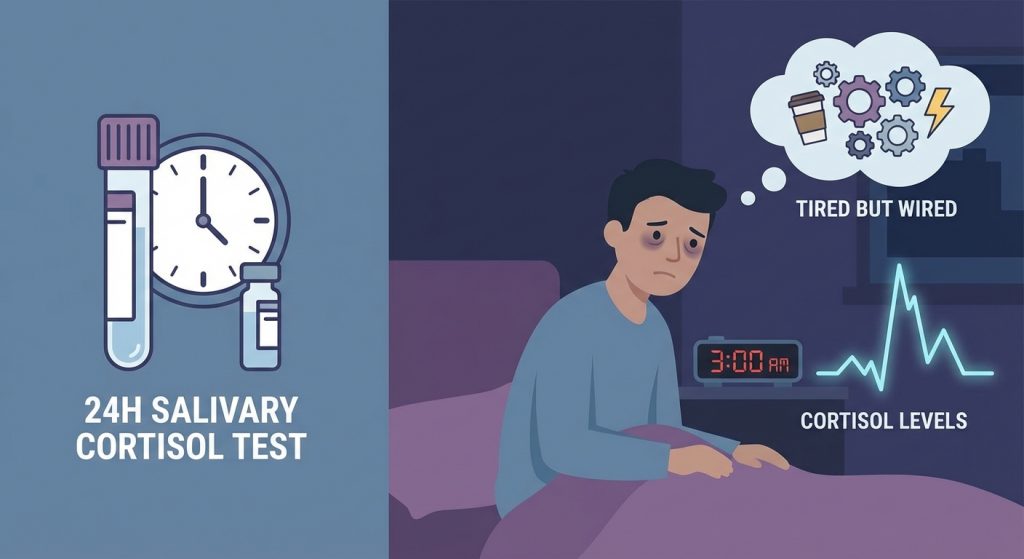
It happens like clockwork. You collapse into bed at 11:00 PM, exhausted. You fall asleep quickly. But then, at 3:00 AM or 4:00 AM, your eyes snap open.
You aren’t groggy. You aren’t relaxed. You are alert. Your mind starts racing about an email you sent three years ago, or a bill due next week. You feel a buzzing sensation in your chest or limbs. You look at the clock, calculating how much sleep you’re losing, which only makes it worse.
This is the classic “Tired but Wired” state. Early-morning wake-ups can have multiple drivers (stress load, sleep disorders, medication timing, alcohol/caffeine, hormonal transitions), and one pattern some people see is a delayed or nighttime cortisol rise—sometimes described as an “inverted” curve.
If you’ve tried melatonin, magnesium, and meditation and still stare at the ceiling at 4 AM, relaxation skills may not be the whole story—circadian timing, sleep physiology, and hormones can also play a role. This guide shows how a multi-point salivary cortisol test can map your daily rhythm and outlines low-risk timing and light strategies that may help; supplements are optional and best treated as “try-and-track” rather than guaranteed fixes.
The Biology: The Cortisol-Melatonin Seesaw
To understand why you wake up, you must understand the relationship between Cortisol and Melatonin. For a plain-English overview of what cortisol is and how it’s tested (blood/urine/saliva), see MedlinePlus. They work on a seesaw mechanism.
- Morning (The Launch): Around 6:00 AM – 8:00 AM, your body naturally produces a surge of cortisol. This is called the Cortisol Awakening Response (CAR). Think of it as a natural “kick-start.” It supports alertness and energy availability as you transition into the day.
- Night (The Crash): As the sun goes down, cortisol should drop to its lowest point (the nadir). As cortisol drops, melatonin rises. This crossover allows for deep, restorative sleep.
The Malfunction: High Cortisol at Night
With chronic stress, irregular light exposure, shift-like schedules, or circadian misalignment, the rhythm can drift later. In practice, some people see cortisol staying higher into the evening and/or rising overnight, which can line up with the 3 AM–4 AM “wired” feeling.
When cortisol spikes at 3 AM:
- 1. It suppresses melatonin immediately.
- 2. It releases glucose into the bloodstream (triggering energy).
- 3. It increases heart rate and body temperature.
Falling back asleep can feel nearly impossible because your body is acting like it’s in “problem-solving mode,” not “recovery mode.”
The Diagnostic: Why Blood Tests Fail
If you go to a standard doctor and ask for a cortisol test, they will likely draw your blood at 9:00 AM.
The Problem: A single morning blood draw is a snapshot—it can be useful for certain medical questions, but it may miss a timing problem that shows up at night.
The Solution: You need a movie, not a photo. That’s why a multi-point salivary cortisol test (often a 4-point day profile) is a practical way to visualize timing across the day—especially if your main complaint is “fine at bedtime, wired at 3 AM.”
If you’ve had frequent insomnia for months, clinical evaluation typically starts with a structured sleep history and screening for common contributors (like sleep apnea), as outlined by the American Academy of Sleep Medicine.
How the Saliva Test Works
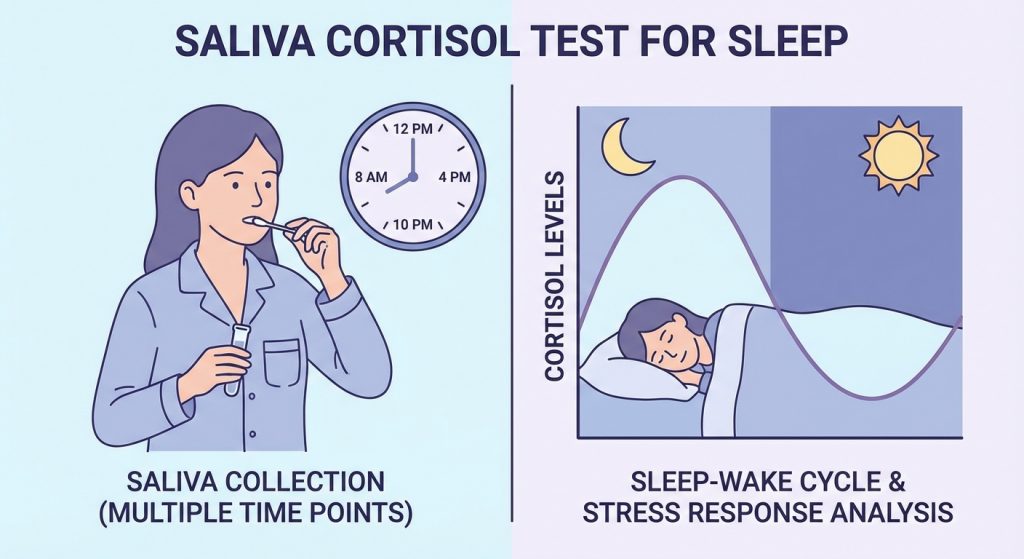
Availability varies by country and lab: in some places you can order a kit directly, while in others a clinician has to initiate the order. The kit comes with 4 or 5 plastic tubes containing a cotton swab.
The Protocol:
- 1. Sample 1 (Morning): Upon waking (within 30 mins). This measures your CAR.
- 2. Sample 2 (Noon): Before lunch.
- 3. Sample 3 (Evening): Before dinner (around 5-6 PM).
- 4. Sample 4 (Night): Right before bed (10-11 PM).
- 5. Optional Sample 5: Some advanced kits offer an extra tube to be used if you wake up in the middle of the night.
How to do it correctly:
- No Blood: Do not brush your teeth or floss vigorously right before the test. Blood in the saliva ruins the sample.
- No Food: Avoid eating or drinking 30 minutes before spitting.
- Storage: Cortisol degrades in heat. After collecting the sample, store it exactly as the kit instructs (many labs recommend prompt cooling and then freezing until shipment). Keep all samples frozen until you are ready to ship them to the lab.
Interpreting Your Results: The Curves
When you get your report back, you will see a graph. Here is how to read it.
- 1. The Normal Curve
Morning: High (Top of the green range).
Noon: Moderate drop.
Evening: Low.
Night: Very low (Bottom of the range).
Verdict: Your cortisol pattern is within the lab’s reference range. If you aren’t sleeping, look at Nocturnal Hypoglycemia or Sleep Apnea. - 2. The “Flatline” (Low-output / blunted pattern)
Morning: Low.
Night: Low.
Symptoms: You are exhausted all the time. You drag yourself out of bed and need coffee to function. You fall asleep easily but lack deep sleep.
Verdict: This pattern can align with prolonged stress load, under-recovery, or other health factors—but it’s not a diagnosis by itself. The term “adrenal fatigue” is not recognized as a formal medical diagnosis (see the Endocrine Society) - 3. The “Inverted” Curve (The Vampire Profile)
Morning: Low (You struggle to wake up).
Noon/Evening: It starts rising.
Night: High (Above the range).
Symptoms: You feel your best at 10 PM. You get a “second wind” right when you should be sleeping. You may notice a spike of alertness or anxiety-like symptoms around 3 AM.
Verdict: Your circadian rhythm is flipped. This article is specifically for you.
The Protocol: Fixing the Inverted Curve
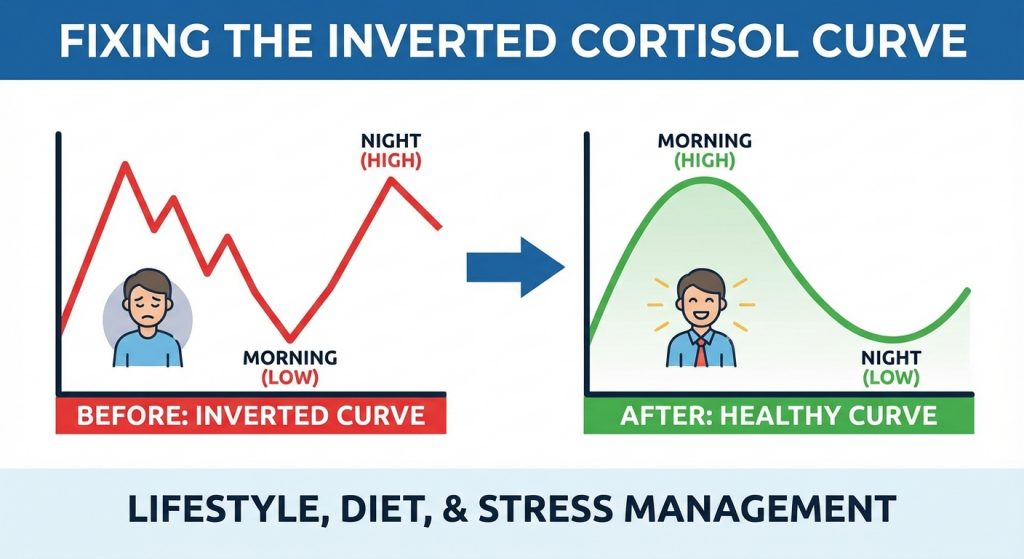
Correcting a cortisol rhythm is not a quick fix. Re-anchoring a rhythm usually takes consistent weeks, not days. We use a two-pronged approach: Light (to set the clock) and Supplements (to manipulate hormones).
Part 1: Light Therapy and Behavior
You cannot supplement your way out of a bad light environment (read more about sleep hygiene).
- 1. Morning Anchor (The Huberman Protocol)
To lower cortisol at night, you must spike it in the morning.
Action: Within 30 minutes of waking, get 10-20 minutes of bright light into your eyes.
Method: Go outside. Sunlight is 100x stronger than room light. If it is winter or you wake up before the sun, use a 10,000 Lux Therapy Lamp (like the Beurer TL45).
Why: This sets a timer in the Suprachiasmatic Nucleus (your brain’s clock). It helps anchor your body clock so your brain is more likely to feel sleepy at an appropriate hour later that evening (light-therapy basics are summarized by the Cleveland Clinic). - 2. Evening Darkness
If you have high night cortisol, you are likely hypersensitive to blue light.
Action: 2 hours before bed, block all blue light.
Method: Use red-tinted glasses or turn off overhead lights. Use floor lamps with red/orange bulbs. Blue-heavy light at night is strongly linked to melatonin suppression and higher alertness, which can make it harder to fall back asleep (Harvard Health Publishing). - 3. Stop HIIT at Night
High-Intensity Interval Training (HIIT) or heavy cardio raises cortisol. If you have an inverted curve, do not exercise after 6 PM. Switch evening workouts to walking or yoga.
Part 2: Supplements and Timing
Note: If you’re on prescription meds, pregnant, or managing thyroid, liver, or blood-pressure issues, review supplement choices with a licensed clinician.
For the “Tired but Wired” crowd, taking supplements at the wrong time makes things worse. You are trying to blunt the evening spike.
- 1. Phosphatidylserine (PS) – The Cortisol Blocker
This is one of the more commonly discussed options for people who feel “wired” at night. PS is a phospholipid that helps blunt the ACTH signal (the brain telling the adrenals to pump stress hormones).
Dose: 300mg to 600mg.
Timing: This is critical. If you wake up at 3 AM, take PS at dinner (5-6 PM) and again 1 hour before bed. You want it circulating in your blood before the spike happens.
Result: Some people report the 3 AM awakening feels less intense and easier to recover from—others notice no change. - 2. Ashwagandha (KSM-66) – The Modulator
Ashwagandha is studied for stress and sleep, but responses vary from person to person. However, it can be tricky.Safety note: It’s not a “free” herb—there are reports of side effects (including GI issues, drowsiness, and rare liver injury signals), and it may not be appropriate for everyone (NCCIH).
Timing: Take 300mg-600mg with dinner, not at bedtime. Let it lower your baseline stress levels in the evening hours.
If you try it, consider using it for a defined window and reassessing rather than taking it indefinitely. - 3. Holy Basil (Tulsi) & Reishi
These are milder adaptogens that are generally safer for bedtime use.
Reishi Mushroom: In Traditional Chinese Medicine, this “calms the spirit.” Some people find it calming without strong sedation, but effects are individual.
Holy Basil: lowers metabolic stress and glucose. - 4. L-Serine and L-Ornithine.
As mentioned in our supplement guide, ammonia buildup in the liver can trigger waking.
L-Ornithine (400-800mg): Helps the urea cycle clear ammonia. High ammonia is toxic to the brain and causes wakefulness.
L-Serine: Calms the central nervous system.
Alternative & Folk Remedies
Community forums often discuss DIY methods. Be careful here.
The “Adrenal Cocktail” (Salt)
On Reddit, you will often see the “Adrenal Cocktail” mentioned (Orange juice, cream of tartar, and sea salt).
The Logic: Your adrenal glands use a lot of sodium. Low sodium triggers a panic response (aldosterone release).
Application: A pinch of high-quality sea salt (like Redmond or Celtic) under the tongue before bed or when you wake up at 3 AM can sometimes blunt the adrenaline response.
Warning: Do not do this if you have high blood pressure.
The Licorice Root Trap
WARNING: Many “Adrenal Support” supplements contain Licorice Root (Glycyrrhizin).
What it does: It extends the half-life of cortisol. It stops your body from breaking it down.
Who it is for: People with Low Cortisol (Flatline curve) who can’t wake up in the morning.
Who should avoid it: If you already feel “tired but wired” at night, licorice can be a bad fit and may worsen the problem for some people.
Community Insights: What Reddit Says
On r/Insomnia, r/Nootropics, and r/Biohackers, the inverted cortisol curve is a frequent topic.
Top Rated Finds:
1. “The Glucose Link”: Many users found that their cortisol spike was actually triggered by Nocturnal Hypoglycemia (low blood sugar). Treating the sugar crash (with a protein snack) stopped the cortisol spike (Read more: Nocturnal Hypoglycemia).
2. “Stress management wasn’t sufficient on its own”: Users report that psychological stress management (meditation) didn’t fix the 3 AM wake-up, but physiological changes (PS, light therapy, diet) did. This suggests the issue can be physiological as well as psychological—not “just in your head.”
3. Paradoxical Reactions: A significant minority report that Ashwagandha keeps them awake. If you try it, start with a low dose with dinner.
Update for December 2025
Since I first published this guide, discussions in functional-medicine and biohacking circles have broadened. Many people now combine timing-based saliva snapshots with additional context (symptoms, sleep data, and—when appropriate—clinician-ordered testing). The biohacking community has shifted toward a more comprehensive view of hormone metabolism.
Here is the essential new information for late 2025.
1. The “CAR” Metric (Why You Feel Tired but Wired)
In 2025, Functional Medicine doctors are focusing less on the total cortisol and more on the Cortisol Awakening Response (CAR).
The Concept: Cortisol typically rises after waking and peaks around ~30 minutes, but the size of that rise varies.
The “Wired” Link: If your CAR is blunt (low morning spike), your body often overcompensates by spiking cortisol at night.
The Test: Modern saliva kits now include a dedicated “CAR” calculation. It requires strict timing (saliva collection exactly at waking, +30 mins, +60 mins). If you are buying a test in 2025, ensure it measures CAR, not just total diurnal cortisol.
2. The DUTCH Test vs. Saliva
The debate between simple Saliva testing and the DUTCH Test (Dried Urine Test for Comprehensive Hormones) has intensified.
Saliva: Measures Free Cortisol (what is circulating right now). Best for seeing the 3 AM spike.
DUTCH: Measures Metabolized Cortisol (total production over 24 hours).
The Verdict: These tests answer different questions. If you’re trying to understand a nighttime awakening pattern, a saliva day-profile can be useful; if you’re looking for a broader hormone-metabolism picture, other clinician-directed options may be considered.
3. The “Phosphatidylserine” Protocol Update
Some community protocols experimented with higher early-evening doses for acute “3 AM” awakenings, but evidence and tolerance vary. If you go beyond common label dosing, do it only with clinician oversight and careful tracking.
Summary
If you stare at the clock at 4 AM feeling like you could run a marathon, stop blaming yourself for “worrying too much.” Biology may be part of the story, and a delayed cortisol pattern is one possible contributor.
- 1. Test: Consider a reputable multi-point salivary cortisol kit (availability and ordering rules vary by country and lab).
- 2. Freeze: Store your saliva properly to get accurate results.
- 3. Analyze: Look for the evening spike.
- 4. Attack: Use Light (morning sun, evening darkness) and Timing (Phosphatidylserine at dinner) to force the curve back into alignment.
This is not an overnight fix. Re-entraining a circadian rhythm takes weeks. But seeing that flat line turn into a healthy curve—and sleeping through the night—is worth every second of effort.

By: Alex Warenstein.
Bio: Alex Warenstein is a sleep biohacker and founder of Night Time Comfort. After battling chronic insomnia and circadian disruption, he now helps others optimize their sleep using data-driven protocols. Read full story.
Disclaimer: Alex is not a doctor. This content is for educational purposes only. Always consult a specialist.