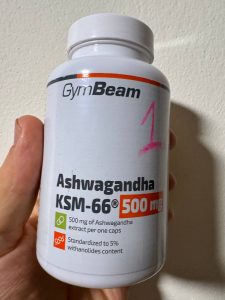
Adaptogens are herbs people use to support stress resilience. Ashwagandha is one of the most discussed adaptogens, and it’s commonly used for stress, sleep, and general well-being—though the quality of evidence depends heavily on the extract and study design, as summarized by NCCIH.
But Ashwagandha can be “context-dependent”: it doesn’t behave like a simple bedtime sedative (like Apigenin), and people report very different outcomes depending on timing, dose, and how long they run it. Short-term studies and safety summaries also note that tolerability is usually good for many people but not universally, and long-term data are thinner; this is also reflected in the NIH Office overview.
This review analyzes the specific benefits of the KSM-66 extract, explains how to time your dosage based on your cortisol curve, and shares my (Alex’s) complex relationship with this potent herb.
Why KSM-66? The Importance of the Extract
You will see cheap “Ashwagandha Root Powder” on Amazon. Avoid it.
To get a consistent effect, you need a standardized extract. KSM-66 is the gold standard because:
- 1. Full Spectrum: It is extracted only from the root (not leaves), maintaining the natural balance of constituents.
- 2. Standardization: KSM-66 is typically standardized to ≥5% withanolides, which helps make dosing more predictable compared with non-standardized powders (PMC).
- 3. Safety: It has negligible levels of Withaferin A, a compound found in leaves that can be cytotoxic.
The Mechanism: Crushing Cortisol
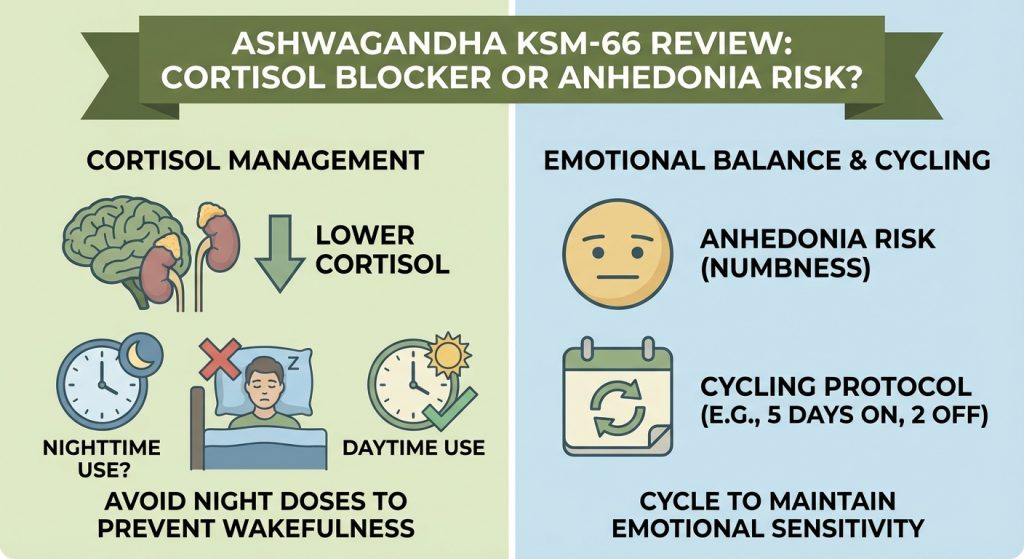
Does ashwagandha lower cortisol levels?
In a well-known randomized trial using KSM-66, the ashwagandha group showed about a 27.9% reduction in serum cortisol from baseline (vs ~7.9% in the placebo group), which is directionally consistent with the “less stress noise at night” idea while still not guaranteeing the same effect for every person (PubMed Central).
- The Benefit: High cortisol at night (“Tired but Wired“) destroys deep sleep and causes 3 AM wake-ups. By lowering cortisol, Ashwagandha allows the body to naturally transition into rest.
- The Risk: Cortisol is necessary for waking up and feeling alert. If you crush it too much or at the wrong time, you feel lethargic and unmotivated.
The Protocol: Calculating Dosage based on Cortisol
This is where most people fail. They take it right before bed.
If you have an Inverted Cortisol Curve (low morning energy, high night anxiety), timing is everything.
The Calculation Method:
You need to blunt the cortisol spike before it happens. Ashwagandha takes about 1-2 hours to reach peak plasma levels and can suppress cortisol for several hours.
- 1. If you wake up at 3:00 AM (The Night Spike):
Take it: With Dinner (6:00 PM – 7:00 PM).
Why: You want the adaptogen to be fully active in your system as your body prepares for sleep, preventing the evening cortisol rise that keeps you wired. Taking it right at bedtime might be too late to stop the momentum of the spike.
- 2. If you are anxious all day (High Baseline):
Take it: Morning (with breakfast) and Evening.
Why: This keeps a steady suppression of stress hormones.
- 3. Dosage: A common studied range for standardized root extracts is 300–600 mg/day; many people start at 300 mg to gauge response, and only move higher if the first couple of weeks don’t deliver the effect they’re looking for. (Mayo Clinic Press)
Is ashwagandha stimulating or sedating?
For some, it is stimulating. It can affect thyroid activity in some people (including reports consistent with increased thyroid hormone activity), so if you feel unexpectedly “wired,” thyroid sensitivity is one plausible explanation noted in safety summaries. (NIH). If you take it and feel “wired,” move your dose to the morning.
The Dark Side: Anhedonia & Cycling
What is the dark side of ashwagandha?
This is the top discussion on r/Nootropics. Long-term, continuous use of Ashwagandha can lead to Anhedonia—the inability to feel pleasure. You don’t feel sad, you just feel “flat.”
The Theory (mostly anecdotal): some users attribute “emotional flattening” to running higher doses continuously for too long, but the mechanism isn’t settled—and this is one reason many people treat it as a tool to cycle rather than a forever-daily habit.
How to avoid it (Cycling):
- The Cycle: Take it for 4-6 weeks, then take 2 weeks off.
- The Pulse: Or, take it 5 days on (weekdays), 2 days off (weekends).
Reddit & Community Consensus
What do 5+ users agree on?
- 1. “Vivid Dreams”: Many report intense, sometimes lucid dreams.
- 2. “Thyroid Boost”: Users with hyperthyroidism often report that it makes them jittery (it boosts thyroid function).
- 3. “Testosterone”: Men often report better gym recovery and libido (likely due to lower cortisol).
- 4. “The Numbness”: Confirmed by hundreds of reports. Usually resolves 1-2 weeks after stopping.
- 5. “Better than Melatonin?”: For stress-induced insomnia, users say yes. Is ashwagandha better for sleep than melatonin? They work differently. Melatonin sets the clock; Ashwagandha lowers the stress noise.
- 6. “Take it with Fat”: KSM-66 is often milk-extracted or fat-soluble; taking it with food improves absorption.
Alex’s Personal Review
The following is based on my personal logs.
I have a love-hate relationship with Ashwagandha KSM-66 (Jarrow Formulas).
My Experience:
- I took 600mg daily for a week during a high-stress period.
- The Good: It absolutely demolished my stress response. Things that normally panicked me felt distant. I stopped waking up with a racing heart.
- The Bad: I struggled to calculate the timing. Taking it right before bed made me feel too alert (thyroid effect?). Taking it at dinner made me too sleepy on the couch.
- The Ugly: After 7 days, I felt “too chill.” I stopped caring about work deadlines. I recognized the early signs of anhedonia and stopped.
My Rating: 7/10
It works. It is one of the few supplements that you can actually feel. It is a potent tool for fixing a broken cortisol rhythm, but it requires respect. I laid out the timing methodology above because I failed to use it correctly the first time.
Where to Buy:
Look for the KSM-66 logo on the bottle; brands like Jarrow and Nootropics Depot are available on iHerb.com.
Safety & Interactions
Who shouldn’t take ashwagandha?
- Hyperthyroidism / thyroid sensitivity: it may increase thyroid activity in some people.
- Autoimmune conditions: because it can influence immune activity, some safety summaries recommend extra caution.
- Pregnancy: most mainstream safety summaries advise avoiding it during pregnancy due to limited safety data and historical concerns.
What cannot be mixed with ashwagandha?
Be careful with alcohol or benzodiazepines, as it can potentiate sedation.
Update for January 2026
Since September 2025, the conversation has gotten more “grown-up”: not “Ashwagandha fixes everything,” but “which extract, what dose, what duration, and what signals mean you should stop.”
1. EU scrutiny is now a real storyline (not just internet drama).
A late-2025 regulatory review notes EU regulators have discussed an “Article 8” pathway that could restrict ashwagandha in food supplements—meaning quality, dose and labeling may become a bigger deal than brand hype. (ResearchGate).
2. The safety conversation is shifting from “dangerous herb” to “idiosyncratic reactions + incomplete long-term data.”
A Sept-2025 preclinical evidence review highlights that reported liver cases tend to be cholestatic/jaundice-type and weren’t predicted by animal studies—suggesting the key issue may be who is susceptible and what product they used, not a universal effect. (PubMed).
3. We finally got more “longer than 8 weeks” human tolerability data.
A Dec-2025 randomized trial in healthy men reported tolerability of a root extract protocol over a longer run (180 days) with monitoring—helpful for context, even though it doesn’t prove “forever safety.” (PubMed).
4. Cortisol + recovery got a fresh 2026 datapoint (athletes, real training stress).
A Jan-2026 Nutrients study (600 mg/day root extract) reported more stable stress-biomarker patterns during pre-season training and improved perceived recovery signals (one of the few settings where cortisol is being pushed on purpose). (MDPI).
5. The “adverse effects map” was updated in early 2026—especially endocrine + liver framing.
A Jan-8-2026 critical review explicitly groups concerns into GI effects (common), plus rarer but more serious buckets like liver toxicity and endocrine disruption, particularly with prolonged or excessive use—supporting the “precision tool + cycling” framing. (PubMed).
6. Two practical, non-specialist takeaways that keep repeating in 2025–Jan 2026 sleep communities: “start lower” and “move it earlier.”
In sleep forums, a common pattern is 150–300 mg with dinner (not at bedtime) to reduce 3AM wakeups without feeling flat the next morning; dose ranges in official monographs are also typically conservative and short-term oriented. (NHPID and Reddit).
Updated bottom line (Jan 2026): KSM-66 still looks like a legitimate stress/sleep-adjacent tool for the right person, but the “best practice” trend is: standardized extract, conservative dosing, earlier timing, and planned breaks.
Summary
Ashwagandha KSM-66 is a biological hammer for stress.
- Use it if: You are “tired but wired,” have high night cortisol, or high stress.
- Avoid it if: You have thyroid issues or want to avoid emotional blunting.
- Protocol: Cycle it. 300–600 mg/day is a common range for standardized root extracts, and timing is best treated as a lever (morning vs dinner) rather than a one-size bedtime rule.

By: Alex Warenstein.
Bio: Alex Warenstein is a sleep biohacker and founder of Night Time Comfort. After battling chronic insomnia and circadian disruption, he now helps others optimize their sleep using data-driven protocols. Read full story.
Disclaimer: Alex is not a doctor. This content is for educational purposes only. Always consult a specialist.