It sits on every pharmacy shelf in America: melatonin—one of the most commonly used sleep supplements in the U.S. (NIH NCCIH). Yet it’s also one of the most frequently mis-dosed.
Most people use melatonin as if it were a pharmaceutical knockout punch. They take massive doses (5mg, 10mg) and wake up groggy, confused, and convinced “it doesn’t work.”
The truth is, melatonin is a hormone, not a tranquilizer. It is a timing signal. Using it correctly requires precision, not potency. This review explores the benefits of liquid melatonin (spray) over pills, why many sleep researchers favor lower doses (roughly 0.3 mg to 2 mg) for sleep onset, and I (Alex) share my nightly protocol and personal assessment of how it works for me.
What Does Melatonin Do to Your Body?
Melatonin is produced by the pineal gland in response to darkness. It doesn’t “make” you sleep; it tells your body that it is time to sleep.
How quickly does melatonin work?
- Pills take 45-60 minutes to digest and enter the bloodstream.
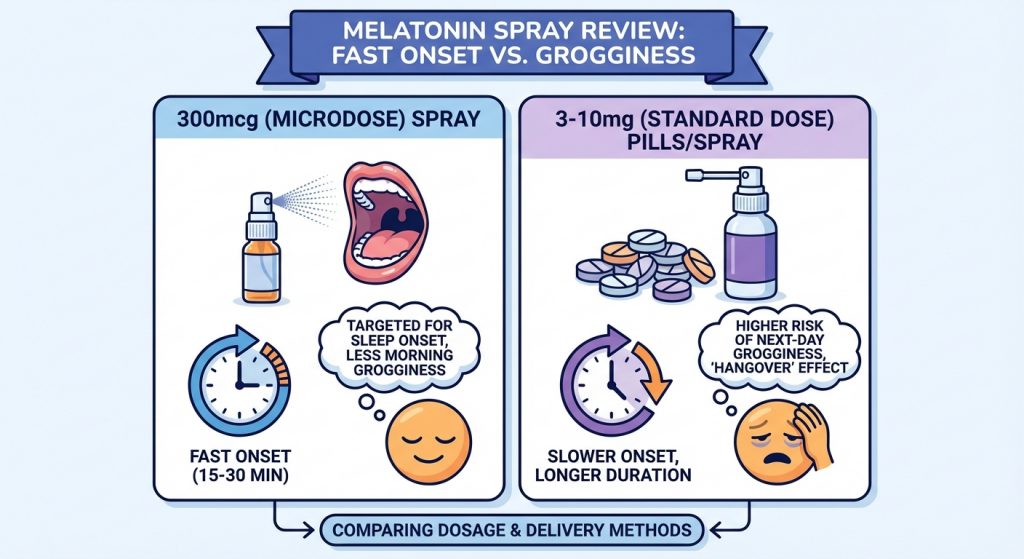
- Sublingual sprays are absorbed through the mucosa under the tongue, which can reduce (not eliminate) “first-pass” metabolism compared with swallowed pills; some studies show a faster rise—often within ~15–30 minutes—though timing varies by person and product.
Benefits beyond sleep:
Beyond circadian timing, melatonin has antioxidant activity in lab and animal research, but the real-world benefits of supplementation outside sleep are still being studied (Mayo Clinic). In this review, I’m focusing on the sleep-timing side of the story, because that’s where the most consistent day-to-day use case tends to be.
The Dosage Debate: USA vs. Europe
In the U.S., melatonin is sold as a dietary supplement, so very high-dose products are common; in parts of Europe, the best-known licensed insomnia product is a 2 mg prolonged-release formulation (EMA — Circadin), and availability rules differ by country.
The Science of Microdosing:
A 0.3 mg dose is often described as “physiologic-range” because it can bring blood melatonin levels into a nighttime-like range in controlled studies (PubMed).
- The MIT Study: In older adults with insomnia, researchers reported that 0.3 mg improved sleep efficiency while higher doses kept melatonin elevated into daytime, which can contribute to morning grogginess (MIT News).
- The “Supraphysiological” Dose: Taking 5mg or 10mg raises blood levels to 50x normal. This leads to receptor desensitization (tolerance) and the dreaded “Melatonin Hangover”—waking up foggy because your brain thinks it’s still dark.
Is 5-10 mg of melatonin too much?
For sleep onset, many people find 5–10 mg simply lingers too long and increases next-day fogginess; higher-dose uses are usually discussed in clinical contexts and are outside the scope of this sleep-onset review.
Timing: Two Schools of Thought
1. Method A: The “Chronobiotic” Shift (2-3 hours before bed)
Some chronobiologists recommend taking a tiny dose (0.5mg) hours before bed to shift your circadian rhythm earlier. This is ideal for Jet Lag Protocol.
2. Method B: The “Sleep Gate” (20 minutes before bed)
This is what most people want—immediate sleep onset.
Because the spray acts fast, you can take it right as you brush your teeth. It hits your system as you lay down, reducing sleep onset latency.
Side Effects: Is It Safe?
What are melatonin side effects?
- Grogginess: Can melatonin make you tired the next day? Yes, if the dose is too high or taken too late (e.g., at 3 AM).
- Vivid Dreams: High doses often increase REM intensity, leading to nightmares.
- Hormonal Impact: Does melatonin affect fertility? There is some debate about high doses suppressing the gonadal axis, but short-term low-dose use is generally considered safe for adults.
Is melatonin addictive?
No. It does not cause physical dependence like benzodiazepines. However, psychological dependence (“I can’t sleep without my spray”) is real.
Reddit & Community Consensus
What do users on r/Sleep and r/Biohackers say?
The Good:
- “Life Saver for Jet Lag“: It is universally praised for travel.
- “Spray is Superior”: Users report that sprays are easier to dose. You can do 1 spray (0.5mg) or 4 sprays (2mg) depending on how you feel, unlike cutting a pill.
The Bad:
- “Nightmares”: A frequent complaint with doses over 3mg.
- “Waking up at 3 AM”: Fast-release melatonin (like sprays) clears the system in 4 hours. Some users fall asleep fast but wake up when it wears off. For maintenance insomnia, Melatonin XR (Time Release) might be better.
Alex’s Personal Review
The following is based on my personal logs and is shared as an informational personal review—not a clinical protocol.
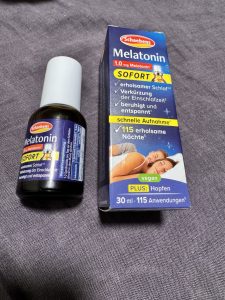
I use a high-quality German melatonin spray (often Schaebens or a similar pharma-grade brand).
My Protocol:
I take 2mg (usually 2-4 pumps depending on the brand concentration) exactly 20 minutes before lights out.
This timing is crucial. If I take it too early, I get drowsy on the couch and then catch a “second wind” when I walk to the bedroom. If I take it right in bed, it works perfectly.
My Experience:
Combined with Magnesium Magtein and Apigenin, the spray feels like a “closing of the curtains.” It doesn’t knock me out; it just makes my eyelids heavy.
On nights I skip it, I notice a difference. I might lie there for 45-60 minutes. With the spray, I am usually out within 15 minutes.
My Rating: 7.5/10
It is a staple. It is reliable, cheap, and effective for onset. By pairing it with Apigenin Liposomal, Magnesium L-Threonate, and L-Glycine, I have found the perfect synergy: Melatonin gets me to sleep fast, and the rest of the stack ensures I stay asleep. Together, they create a complete sleep architecture.
Where to Buy:
Look for Liposomal Melatonin Sprays (like Quicksilver Scientific) or reputable European brands on Amazon/iHerb, and prioritize products that publish third-party testing when possible. Label accuracy can vary widely across melatonin supplements, so a “reputable brand + testing” filter matters (Journal of Clinical Sleep Medicine).
Update for January 2026
Since I first wrote this review, the “melatonin conversation” has become more nuanced: not “strong vs. weak,” but “dose, timing, and long-term habits.” Here are the most useful updates (Sept 2025 → end of Jan 2026) in plain English:
1. A big long-term safety signal (preliminary, but hard to ignore).
A large AHA Scientific Sessions 2025 abstract reported an association between documented long-term melatonin use (12+ months) and higher heart-failure diagnosis/hospitalization risk in adults with chronic insomnia—important, but still not proof of cause-and-effect (American Heart Association).
2. “Circadian health” is now mainstream cardiometabolic advice.
A 2025 AHA scientific statement on circadian health emphasizes that late-night schedules (light + food timing) can push metabolism the wrong way; practical takeaway: if you use melatonin as a “night signal,” don’t pair it with late snacking—treat it as the start of your wind-down window (AHA — Circadian Health Statement).
3. New shift-worker evidence (and why it matters even if you’re not a nurse).
A randomized placebo-controlled trial (Sept 2025) in night-shift workers looked at melatonin before daytime sleep and reported improvements in a biological marker linked to oxidative DNA damage repair—another hint that melatonin’s best use case is “timing” when your schedule is misaligned (Occupational Cancer Research Centre).
4. Quality control got louder in late 2025 (especially gummies).
A BMJ note spotlighted FDA testing/analysis concerns around melatonin gummies, reinforcing a practical shopping rule: don’t assume the label is perfect—favor brands with testing and avoid “candy-style” formats if dose precision is your goal (BMJ).
5. The “microdose trend” went from forums to biohackers.
In sleep communities, the strongest 2025→2026 pattern is “smaller dose, cleaner morning.” Bryan Johnson echoed this publicly, saying he takes 300 mcg nightly and otherwise doesn’t take anything for sleep (Bryan Johnson).
6. January 2026: a pediatric reality-check (relevant if you have kids at home).
A January 2026 systematic review highlighted rising melatonin use in very young children while showing limited efficacy data for typically developing kids—good reminder to keep adult melatonin “adult,” and not normalize it as a casual household gummy (PubMed).
Summary
Melatonin Spray is a precise tool for the modern sleeper.
- Use it for: Falling asleep faster and fixing Jet Lag.
- Dose: Start low (0.5mg – 2mg). Avoid the 10mg trap.
- Timing: 20 minutes before bed for sprays; 60 minutes for pills.
It is a hormone, so treat it as a timing tool. Used thoughtfully (dose + timing + light hygiene), it can be a practical way to support circadian reset for many adults.

By: Alex Warenstein.
Bio: Alex Warenstein is a sleep biohacker and founder of Night Time Comfort. After battling chronic insomnia and circadian disruption, he now helps others optimize their sleep using data-driven protocols. Read full story.
Disclaimer: Alex is not a doctor. This content is for educational purposes only. Always consult a specialist.