If you are reading this, you are probably tired. Not just “I had a long week” tired, but a bone-deep exhaustion that coffee can’t touch. Maybe your partner has moved to the spare room because your snoring sounds like a freight train derailment. Maybe you wake up with a dry mouth, a pounding heart, or a headache that sits behind your eyes for half the day.
For years, I treated my own sleep issues as a puzzle of insomnia and “tired but wired” energy. I tracked my data with my Apple Watch Ultra 2, tweaked my sleep hygiene checklist, and experimented with everything from Magnesium L-Threonate to Apigenin. But while navigating the forums of ApneaBoard, SleepHQ, and Reddit, I realized that for millions of people, the problem isn’t just falling asleep—it is staying alive while they sleep.
This article is about Obstructive Sleep Apnea (OSA). It is not just about “loud snoring.” It is a mechanical failure of the human airway that leads to suffocation, hypoxia, and a slow-motion collapse of your metabolic and cardiovascular health.
I am not a doctor. I am a patient researcher who has spent years digging through clinical studies, FDA approvals, and the trenches of patient forums to understand what happens when the lights go out. This is a comprehensive guide to understanding the mechanics of airway collapse, why fit people get it too, and the very latest 2025/2026 treatments that are changing the game.
The Mechanics of Suffocation: It’s Not Just Noise
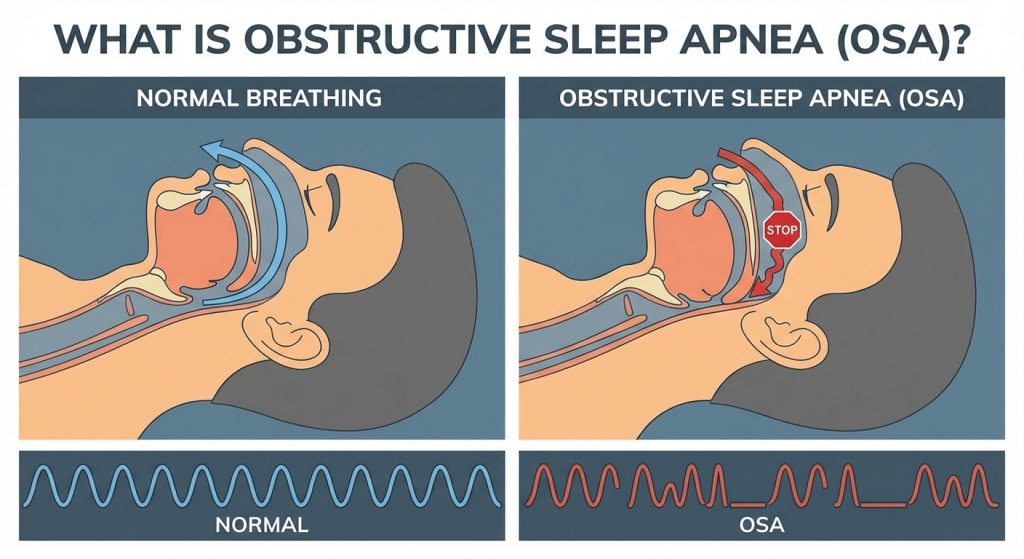
To understand OSA, you have to stop thinking about it as a “sleep problem” and start thinking about it as a plumbing problem.
Imagine a garden hose. Water flows through it easily. Now, imagine sucking air through that hose while someone steps on it. The flow stops. The pressure drops. You struggle. That is essentially what happens in your throat during an apnea event.
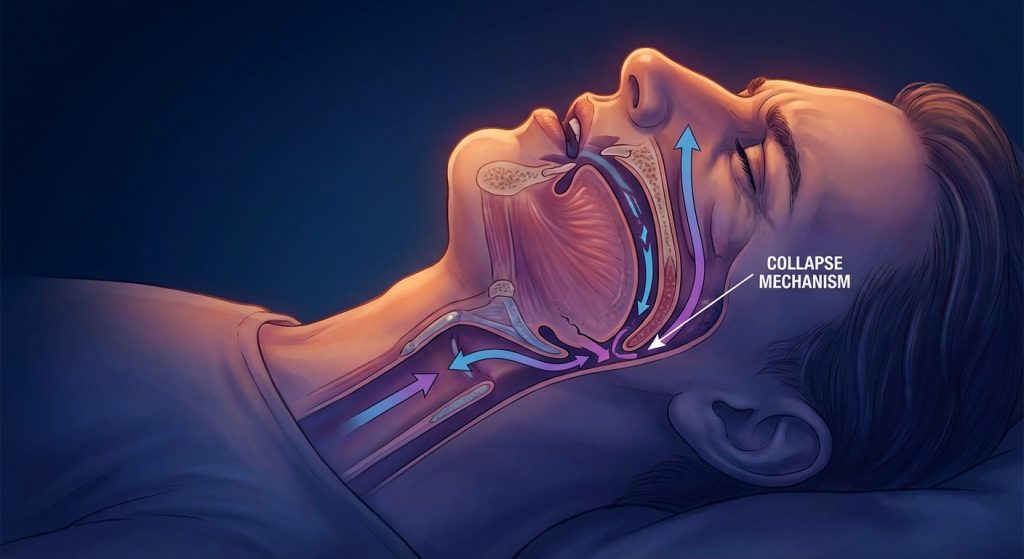
The Collapse Mechanism
When you are awake, the muscles in your throat—specifically the tongue and the soft palate—have tone. They are firm, keeping your airway open like a rigid pipe. But when you fall asleep, your nervous system relaxes these muscles. In a person with OSA, this relaxation goes too far.
As you drift into deeper stages of sleep, the tongue slides backward, and the soft walls of the throat collapse inward. When you try to inhale, the negative pressure (the vacuum created by your lungs) sucks these floppy tissues together, sealing the airway shut.
This is an “apnea”—a complete cessation of airflow for 10 seconds or more. A “hypopnea” is a partial collapse, where airflow is restricted enough to drop your blood oxygen levels.
Why Fit People Get It Too
There is a pervasive myth that sleep apnea is a disease exclusively of the overweight. While obesity is a major risk factor (excess tissue in the neck presses down on the airway), I have seen countless reports on Reddit and ApneaBoard from marathon runners, cyclists, and people with single-digit body fat percentages who suffer from severe OSA.
Why? Anatomy.
- 1. Retrognathia (Receding Chin): If your lower jaw is set slightly back, your tongue has nowhere to go but down your throat when you lie on your back.
- 2. Narrow Dental Arch: If you have a high, narrow palate (roof of the mouth), your nasal cavity is likely compressed, and your tongue is cramped.
- 3. Large Tonsils or Uvula: Genetic factors that crowd the airway regardless of your weight.
- 4. The “Vulnerable” Airway: Some people simply have airway muscles that are neurologically “lazier” during sleep.
My research into sleep mechanics revealed that you cannot judge an airway simply by looking at a person’s waistline. You can appear to be the picture of health during the day and yet suffocate 40 times an hour at night.
The Risks: Why Hypoxia is the “Silent Killer”
When your airway collapses, two catastrophic things happen:
- 1. Hypoxia (Oxygen Starvation): Your blood oxygen saturation (SpO2) drops. In a healthy sleeper, this stays above 95%. In severe OSA, it can plunge into the 80s, 70s, or even lower. This is the “Silent Oxygen Killer.” Every time this happens, your cells are starved of fuel.
- 2. Adrenaline Surge: Your brain realizes you are not breathing. In a panic, it fires a blast of cortisol and adrenaline to jerk you awake just enough to gasp for air. You might not remember this micro-awakening, but your heart does.
The Cardiovascular Toll
The American Heart Association (AHA) and the National Heart, Lung, and Blood Institute (NHLBI) have been sounding the alarm on this for years. This nightly cycle of hypoxia and adrenaline re-pressurization destroys your cardiovascular system.
- Hypertension: Your blood pressure spikes with every gasp. Eventually, it stays high even during the day.
- Atrial Fibrillation: The stress on the heart chambers can cause irregular heartbeats.
- Stroke: The fluctuation in oxygen and pressure increases the risk of clots.
Testosterone and Sexual Health
This is a massive topic on men’s health forums in 2025. There is a strong, clinically proven association between OSA and low testosterone.
Sleep is when your endocrine system produces testosterone. If your sleep is fragmented by hundreds of micro-awakenings, you never spend enough time in the deep, restorative stages where hormone production peaks. Furthermore, the chronic stress of hypoxia lowers T-levels further.
The Nuance: Treating OSA with CPAP (Continuous Positive Airway Pressure) reliably fixes the sleep structure and often improves libido and erectile function (ED). However, recent meta-analyses suggest that CPAP alone doesn’t always magically “boost” testosterone numbers on a blood test. It restores the function and the energy, but if the hypogonadism is severe, endocrinological support might still be needed. But make no mistake: trying to fix low testosterone without fixing the airway first is like trying to fill a bucket with a hole in the bottom.
Symptoms: The “Real” List (Beyond Snoring)
Doctors look for snoring and gasping. But if you spend time in the r/SleepApnea community or read the patient stories on SleepHQ, you realize the symptoms are far more diverse and often misunderstood.
The Classic Signs
- Loud Snoring: Specifically, snoring that stops abruptly, followed by silence, and then a loud snort or gasp.
- Choking/Gasping: Waking up feeling like you are drowning.
- Daytime Sleepiness: Falling asleep at red lights or in meetings.
The “Hidden” Symptoms (Community Reported)
These are the symptoms that often send people to psychiatrists or neurologists, missing the root cause entirely.
- 1. Brain Fog & Derealization: This is the number one complaint I see discussed. It is described as a feeling of being “drunk” without alcohol, walking through mud, or living behind a pane of glass. It is a direct result of sleep fragmentation and frontal lobe hypoxia.
- 2. Nocturia (Waking up to Pee): This is a huge red flag. When you struggle to breathe, the pressure in your chest changes. This signals your heart to release a peptide (ANP) that tells your kidneys to dump fluid. If you are waking up 2-3 times a night to urinate, it might not be your prostate or your bladder – it might be apnea. In my article on Pygeum Africanum, I discuss bladder health, but if the root cause is apnea, no supplement will fix it.
- 3. Anxiety and “Night Terrors”: Waking up with a racing heart and a sense of doom. This is often the adrenaline spike from an apnea event.
- 4. Morning Headaches: Usually caused by carbon dioxide buildup (hypercapnia) or the vascular strain of the night.
- 5. GERD / Acid Reflux: The negative pressure created by trying to inhale against a closed throat can suck stomach acid up into the esophagus. Many people cure their “heartburn” simply by treating their apnea.
- 6. The “Silent” Sufferer: You can have OSA without snoring. If you wake up exhausted every day but your partner says you are quiet, do not rule out apnea.
The Danger Zone: REM Sleep and “Sedatives”
This section is critical. If you suspect you have OSA, you need to understand the biology of REM (Rapid Eye Movement) sleep and why certain medications are dangerous.
The REM Trap
REM sleep is when we dream. It is essential for emotional regulation and memory. But physiologically, REM is dangerous for an apnea patient. During REM, your body enters a state of “atonia”—essentially, paralysis. This prevents you from acting out your dreams.
However, this paralysis also applies to your airway muscles. Your throat becomes floppier than at any other time. Additionally, the brain’s drive to breathe is somewhat suppressed in REM.
This leads to “REM-predominant Apnea.” You might breathe okay for the first half of the night, but as REM cycles get longer in the early morning (4 AM – 6 AM), you enter a storm of suffocating events. This is often why people wake up feeling like they have been hit by a truck despite sleeping “enough” hours.
Why You Must Avoid Sedatives
In my personal journey to optimize sleep, I have used substances like Atarax (Hydroxyzine) and Trittico (Trazodone). I have written guides on them. However, I do not have Sleep Apnea.
If you have untreated OSA, taking these drugs can be incredibly dangerous. Here is why:
- 1. Muscle Relaxation: Alcohol, benzodiazepines, and many sleep aids (including OTC antihistamines like Doxylamine or Atarax) further relax the throat muscles. This turns a mild collapse into a complete blockage.
- 2. The Arousal Threshold: This is the most frightening part. Normally, when you stop breathing, your brain wakes you up to gasp. This is a survival mechanism. Sedatives “numb” the brain to this signal. They increase the “arousal threshold.”
- Result: You stop breathing, but your brain is too sedated to wake you up. The apnea event lasts longer—30 seconds, 40 seconds, a minute. Your oxygen drops deeper. The hypoxic damage to your brain and heart is multiplied.
Leading guidelines from the Mayo Clinic and AASM (American Academy of Sleep Medicine) strictly advise against using alcohol, sedatives, and muscle relaxants if you have untreated OSA.
Regarding Trittico (Trazodone): It is complex. Some studies suggest it might actually help a specific subset of patients by preventing them from waking up too easily (stabilizing “loop gain”), but this is highly experimental territory for specialists. For the average person without a doctor’s supervision, taking Trazodone with undiagnosed apnea is a gamble with your oxygen levels.
Diagnostics: From Bedroom to Lab
So, how do you know if you are choking?
1. The Bed Partner Test
Your sleeping partner is the most sensitive diagnostic tool available. Ask them to listen. Are there pauses? Do you stop breathing for 10 seconds and then snort? Do you look like you are struggling? If the answer is yes, you almost certainly have an issue.
2. Home Screening: O2Ring and WatchPAT
In 2025/2026, you don’t always need to wait six months for a sleep lab to get a clue.
- Wellue O2Ring: I have reviewed this device extensively. It is an FDA-cleared pulse oximeter ring. It tracks your oxygen and heart rate 24/7.
- What to look for: A healthy graph is a flat line above 95%. An apnea graph looks like a saw-tooth pattern—constant dips (desaturations) throughout the night. If your ODI (Oxygen Desaturation Index) is high (more than 5-10 drops per hour), you need to see a doctor.
- Note: I use an Apple Watch Ultra 2, which tracks respiratory rate and can flag irregularities, but for granular second-by-second oxygen data, the O2Ring form factor is often superior for detection because it takes measurements continuously on the finger, where perfusion is better than the wrist.
- WatchPAT One: This is the “Gold Standard” of home tests. It is a disposable device you can often order online (depending on your country’s regulations). It uses “Peripheral Arterial Tonometry” (PAT) to measure not just oxygen, but also changes in arterial volume that indicate respiratory effort. It is far more accurate than a simple oximeter and can diagnose OSA with high reliability.
3. Polysomnography (PSG)
This is the in-lab sleep study. They wire your head (EEG), your chest, your legs, and your breath. It is the only way to get a 100% complete picture, including sleep architecture and limb movements. If home tests are inconclusive, this is the path.
Treatment: The 2025/2026 Landscape
If you are diagnosed, do not panic. The days of “just wear this giant mask” being the only option are ending, though PAP therapy remains the king. The medical landscape in late 2025/2026 has expanded significantly.
1. CPAP / APAP / BiPAP (The Gold Standard)
CPAP works. It creates a pneumatic splint—a column of air—that holds your throat open.
- Modern Tech: Machines like the ResMed AirSense 11 AutoSet or the Lowenstein Prisma Smart Max are whisper-quiet. They use “Auto” algorithms (APAP) that adjust pressure breath-by-breath. You don’t get blasted with high pressure unless you need it.
- Masks: The “Darth Vader” masks are history. Modern minimalist masks like the ResMed P30i (nasal pillows with the tube on top of the head) or the Bleep Eclipse (no headgear at all) make it possible to sleep on your side comfortably.
2. Mandibular Advancement Devices (MAD)
These are custom-made dental mouthguards. They push your lower jaw forward, pulling the tongue away from the back of the throat.
- Effective for mild to moderate apnea. Not usually enough for severe cases.
3. Positional Therapy (The “Tennis Ball” Upgrade)
If your apnea only happens on your back (Supine OSA), you can treat it by staying on your side.
- Tech: Devices like the Philips NightBalance or vibrational backpacks buzz gently when you roll onto your back, training you to stay on your side without waking you up. Meta-analyses in 2025 confirm this is a valid medical therapy for specific positional patients.
4. Neurostimulation (The “Pacemaker for the Tongue”)
This is the frontier.
- Hypoglossal Nerve Stimulation: A device is implanted in the chest with a lead to the nerve that controls the tongue. It zaps the tongue slightly with every breath, stiffening it so it doesn’t collapse.
- New in 2025: The FDA approval of the Nyxoah Genio system (August 2025) has brought a battery-free, leadless implant option to the US market for moderate-to-severe OSA. This is a massive step forward for those who cannot tolerate CPAP.
- Note: Do not confuse this with “Vagus Nerve Stimulation” (like the Zenowell taVNS I tested). Vagus stimulation is for relaxation/mood; Hypoglossal stimulation is for keeping the airway open. In fact, incorrect vagus stimulation can sometimes worsen apnea, so keep the technologies separate.
5. The Pharmaceutical Revolution: Pills for Apnea?
For decades, there were no pills for OSA. That changed in late 2024 and throughout 2025.
- Zepbound (Tirzepatide): In a landmark decision, the FDA approved Tirzepatide (the active ingredient in Zepbound/Mounjaro) specifically for the treatment of OSA in adults with obesity.
The Mechanism: It isn’t a “breathing pill.” It is a potent weight loss and metabolic drug. By stripping visceral fat from the neck and tongue, and improving metabolic inflammation, it significantly reduces the AHI (Apnea-Hypopnea Index). The SURMOUNT-OSA trials showed massive reductions in disease severity. - AD109 (Aroxybutynin + Atomoxetine): This is the one to watch. It is currently in advanced Phase 3 trials (LunAIRo / SynAIRy studies).
The Mechanism: It combines a drug that boosts norepinephrine (to activate airway muscles) with a drug that blocks the muscarinic receptors (to prevent the side effects of the first drug). It aims to chemically restore muscle tone in the throat during sleep. Early data suggests it could be a game-changer for people who refuse CPAP. - Sulthiame: Another contender showing up in 2025 research (FLOW trial). It is a carbonic anhydrase inhibitor that stabilizes breathing control, helping to prevent the “overshoot and undershoot” breathing patterns (high loop gain) that plague some patients.
Conclusion: Don’t Ignore the Silence
If there is one thing I have learned from running Night Time Comfort, it is that you cannot biohack your way out of a mechanical failure. You can take all the Ashwagandha KSM-66 in the world for stress, or tape your mouth to force nasal breathing (which helps, see my Sleep Mouth Taping Guide), but if your airway is collapsing, you are fighting a losing battle against biology.
Apnea doesn’t mean you are broken; it is simply a treatable mechanical issue. The improvements people report after starting treatment—whether via CPAP, a dental device, or the new weight-loss protocols—are life-altering. They talk about colors being brighter, the “brain fog” lifting like a curtain, and the return of energy they haven’t felt in decades.
If you suspect you have OSA:
- 1. Don’t take sedatives.
- 2. Visit a sleep specialist or use an O2Ring / WatchPAT to gather data.
- 3. Take action immediately—your health depends on it.
Disclaimer: I am not a doctor. This content is for informational purposes only and is based on my personal research and experience. Always consult with a qualified healthcare provider for diagnosis and treatment of medical conditions.

By: Alex Warenstein.
Bio: Alex Warenstein is a sleep biohacker and founder of Night Time Comfort. After battling chronic insomnia and circadian disruption, he now helps others optimize their sleep using data-driven protocols. Read full story.
Disclaimer: Alex is not a doctor. This content is for educational purposes only. Always consult a specialist.