You sleep for eight hours. Your oxygen levels look perfect on your smart ring. You don’t have the classic “choking” gasps associated with sleep apnea. Yet, you wake up feeling like you have been hit by a truck—exhausted, anxious, and suffering from a brain fog so thick you can barely function until noon. You visit a doctor, perhaps even a sleep specialist. They run a standard home test, look at your AHI (Apnea-Hypopnea Index), tell you it is less than 5, and say: “You are fine. It is just stress. Maybe try therapy or sleep hygiene.”
You are not fine. You are likely suffering from Upper Airway Resistance Syndrome (UARS).
This is the “invisible” sleep disorder. It is the gap between “perfectly healthy” and “obstructive sleep apnea,” a gray zone where standard medicine frequently fails patients. In 2025, despite significant advancements in sleep medicine, UARS remains the most underdiagnosed cause of chronic fatigue and “tired but wired” hyperarousal.
This guide is a comprehensive deep dive into the mechanics, symptoms, diagnosis, and treatment of UARS. It aggregates the latest medical consensus from late 2025, including the new Pang-Vicini classification system, updated AASM position statements, and the collective wisdom of patients from online communities like ApneaBoard, SleepHQ, Reddit, etc., who had to fight for their diagnosis.
The Physiology of the “Invisible” Choke
To understand UARS, you must first understand how it differs from Obstructive Sleep Apnea (OSA). In classic OSA, the airway collapses completely (apnea) or partially (hypopnea) for 10 seconds or longer. This usually leads to a drop in blood oxygen levels (desaturation). Your brain detects the lack of oxygen and shocks you awake to breathe.
UARS is more subtle. It is not about stopping breathing; it is about the effort required to breathe.
Imagine breathing through a wide pipe. That is normal sleep. Now, imagine breathing through a thin stirring straw. You are still getting enough air. Your oxygen levels might not drop at all (which is why the Wellue O2Ring often fails to detect UARS). However, your body has to work significantly harder to pull that air in.
Flow Limitation and the Vacuum Effect
This phenomenon is called Flow Limitation. As your muscles relax during sleep, the airway narrows slightly. In a UARS patient, this narrowing creates resistance. To overcome this resistance, your diaphragm pulls harder. This creates negative pressure in the chest (intrathoracic pressure).
Your brain monitors this effort. When the struggle to inhale becomes too great—even if you are still getting oxygen—the brain senses danger. It triggers a “micro-arousal.” You do not wake up fully; you don’t sit up in bed gasping. instead, your brain shifts from deep, restorative sleep (NREM3) or REM sleep into light sleep (NREM1) just for a few seconds to restore muscle tone to the airway.
The RERA (Respiratory Effort-Related Arousal)
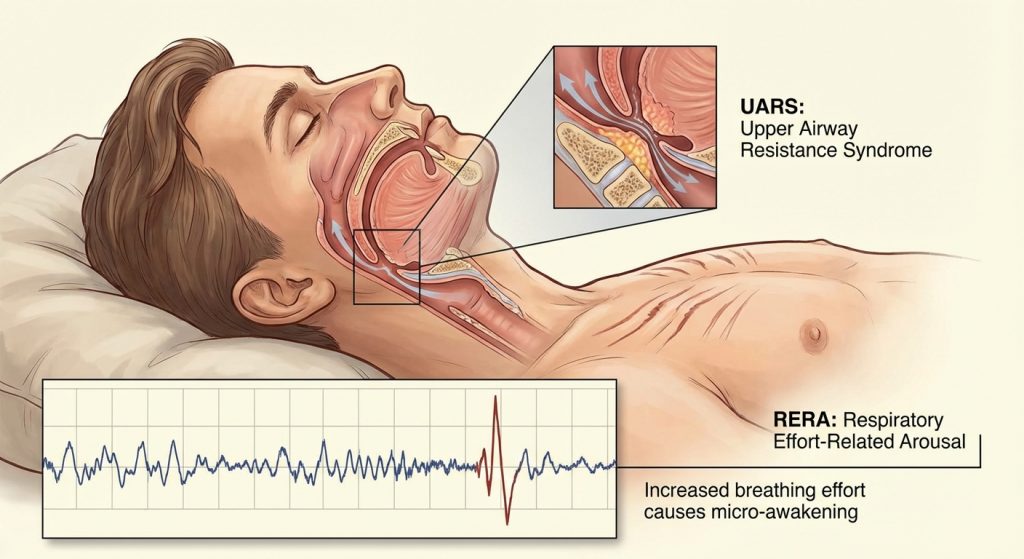
This event is clinically defined as a RERA. The sequence is:
- 1. Flow Limitation: The breath flattens (visible on a nasal pressure graph).
- 2. Increased Effort: The body fights to inhale.
- 3. Arousal: The brain jolts out of deep sleep to open the throat.
- 4. Recovery: Breathing normalizes, but the sleep cycle is shattered.
If this happens 20 or 30 times an hour, you are technically “sleeping,” but you are never achieving the sustained deep sleep duration or REM continuity required for physical and mental repair. You are running a marathon while lying in bed. This is why you wake up exhausted despite “normal” oxygen saturation.
The Diagnostic Gap: Why Doctors Miss It
The tragedy of UARS is largely bureaucratic. The primary metric used to diagnose sleep disorders is the AHI (Apnea-Hypopnea Index). AHI counts only full apneas and hypopneas (usually events with a 3% or 4% oxygen drop).
Because UARS patients often maintain their oxygen levels (non-hypoxic events), their AHI can be 0 or close to it.
The metric that actually matters for UARS is the RDI (Respiratory Disturbance Index).
- AHI = Apneas + Hypopneas.
- RDI = Apneas + Hypopneas + RERAs.
If a sleep clinic does not score RERAs, or if your insurance company does not recognize RDI as a valid diagnostic criterion, you will be sent home with a diagnosis of “Idiopathic Hypersomnia” or “Psychological Insomnia.”
The 2025 Shift: AASM Position Statement
A critical development occurred in late 2025. The American Academy of Sleep Medicine (AASM) released a strengthened position statement emphasizing that Polysomnography (PSG) must include arousal-based scoring. This means that scoring hypopneas based solely on oxygen drops (desaturation) is insufficient for symptomatic patients. Labs are now strongly encouraged to identify events that cause arousals, even without oxygen desaturation.
This is a massive win for the patient community, but clinical practice is slow to change. Many doctors trained 20 years ago still look only at the oxygen line. If you are navigating this system, you must be your own advocate.
Symptoms: The “Tired But Wired” Phenotype
While OSA patients often fit a stereotype (older, overweight, loud snoring), the UARS phenotype is distinct. According to the latest 2025 systematic review proposing the Pang-Vicini classification, UARS patients—specifically “Type I”—are often younger, thinner, and disproportionately female.
However, UARS affects men and women of all body types. If you have the following cluster of symptoms, you should investigate flow limitation regardless of your BMI.
1. Chronic Fatigue vs. Sleepiness
There is a clinical difference. OSA patients often fall asleep instantly (at the wheel, watching TV). UARS patients typically suffer from fatigue and sleep inertia – a heavy, groggy feeling that takes hours to shake off. You might not fall asleep during the day, but you feel like a zombie.
2. “Tired but Wired” (Hyperarousal)
Because your body is fighting for air all night, your sympathetic nervous system (Fight or Flight) is chronically activated. You wake up with a racing heart or “internal vibrations.” This leads to tired but wired symptoms, where you are exhausted but your mind is racing, preventing you from napping or falling asleep easily.
3. Cold Hands and Feet (POTS-like Symptoms)
This is a massive topic on forums like Reddit’s r/UARS. The chronic nocturnal stress response constricts blood vessels. Many UARS patients report cold extremities (Raynaud’s phenomenon) or dizziness upon standing (Orthostatic Intolerance/POTS). This is not a heart problem; it is an autonomic nervous system dysregulation caused by sleep fragmentation.
4. Nocturia (Waking Up to Pee)
Before you buy Pygeum Africanum or search for nocturia causes, consider your airway. When you struggle to breathe, the negative pressure in your chest compresses the heart slightly. The heart perceives this as “fluid overload” and releases a hormone called Atrial Natriuretic Peptide (ANP). ANP tells the kidneys to dump fluid. If you wake up 2-3 times a night to urinate, it is often a sign of respiratory effort, not a bladder issue.
5. Somatic Syndromes (IBS, Headaches, TMD)
Research by Dr. Avram Gold and the new 2025 classification highlights the link between UARS and functional somatic syndromes.
- TMD/Bruxism: You grind your teeth to push your jaw forward and open the airway.
- Morning Headaches: Often tension-based, radiating from the neck.
- IBS: Gut motility is linked to the nervous system, which is dysregulated by lack of restorative sleep.
6. Cognitive Dysfunction (“Brain Fog”)
Patients describe this as “cotton wool” in the head. It affects working memory, executive function, and emotional regulation. It is often misdiagnosed as ADHD.
Why “Sleeping Pills” Are Dangerous for UARS
When a UARS patient complains of insomnia, a well-meaning GP often prescribes sedatives like Atarax (Hydroxyzine), Trittico (Trazodone), or even benzodiazepines. In the biohacking world, people reach for Ashwagandha KSM-66, etc.
For UARS, this can be disastrous.
The Muscle Tone Problem
The upper airway is a muscular tube. To stay open, it needs muscle tone. Most sedatives and sleeping pills work by relaxing the central nervous system and reducing muscle tone.
The Result: Your airway becomes floppier. The resistance increases. You might sleep “through” the struggle because the drug raises your arousal threshold, but the physiological stress on your body increases. You are effectively suffocating more, but waking up less to fix it.
The “Sedative Hangover”
Patients on forums frequently report that taking Doxylamine or Hydroxyzine makes them feel 10 times worse the next day. This is not just a chemical hangover; it is the result of a night spent in severe flow limitation.
Note: Some specialists are experimenting with specific drugs (like acetazolamide or new agents like AD109 targeting OSA), but standard sedatives are widely considered contraindicated by UARS-literate practitioners unless used in conjunction with PAP therapy.
Diagnosing UARS: The Testing Minefield
If you suspect UARS, you cannot rely on standard metrics. Here is the hierarchy of testing accuracy as of late 2025.
1. The O2Ring and Pulse Oximetry (Low Accuracy)
Devices like the Wellue O2Ring are excellent for screening classic sleep apnea where oxygen drops are present. However, because UARS is often non-hypoxic, you can have an O2Ring score of 99% SpO2 and still have severe UARS.
!!! Use it to rule in classic apnea. Do not use it to rule out UARS.
2. WatchPAT One (Medium Accuracy)
The Home Sleep Apnea Test (HSAT) market is dominated by WatchPAT technology. Unlike oximeters, WatchPAT uses Peripheral Arterial Tone (PAT) to measure sympathetic nervous system surges.
- It calculates pRDI (peripheral RDI).
- It is better than a standard flow/oxygen test because it can detect the sympathetic stress of a RERA.
- Limitation: It lacks EEG (brainwaves). It cannot definitively distinguish between awake and asleep states or detect cortical arousals that don’t trigger a massive autonomic response. It is a good “first step,” but a negative WatchPAT result does not 100% rule out UARS.
3. Polysomnography (PSG) Type 1 (Gold Standard)
To truly see UARS, you need a full in-lab sleep study. But not just any study. You must request specific technical parameters:
- Nasal Pressure Cannula: Essential for seeing the “flattening” of the breath.
- Arousal-Based Scoring: The lab must score RERAs or hypopneas that result in arousal (Rule 1A usually).
- Optional: Esophageal Manometry (The “Old” Gold Standard): This involves a thin pressure probe down the nose into the esophagus to measure effort directly. It is rarely used now because it is uncomfortable, but it remains the most accurate way to measure intrathoracic pressure.
What to ask your doctor: “Does your lab score RERAs? Do you report RDI? Do you use the AASM recommended arousal-based scoring for hypopneas?”
Treatment Protocols: Beyond “Just Use a CPAP”
Treating UARS is notoriously more difficult than treating severe OSA. UARS patients are often “light sleepers” with sensitive nervous systems. They tolerate pressure changes poorly.
1. PAP Therapy: CPAP vs. BiLevel
CPAP (Continuous Positive Airway Pressure) provides a static pressure (e.g., 7 cmH2O) to stent the airway open.
The Problem: UARS patients often struggle to exhale against this pressure. The constant force can feel suffocating or disturbing, causing more arousals.
BiLevel (BiPAP/VPAP) is the Game Changer.
Machines like the ResMed AirCurve 10 VAuto or the Lowenstein Prisma 25S (popular in Europe) allow for two distinct pressures:
- IPAP: Higher pressure on inhale to splint the airway open.
- EPAP: Lower pressure on exhale to allow you to breathe out naturally.
- PS (Pressure Support): The difference between IPAP and EPAP.
For UARS, Pressure Support is the therapeutic key. It assists the breath, effectively overcoming the flow limitation. It acts like a “power steering” for your breathing muscles. The 2025 community consensus on forums like ApneaBoard strongly favors BiLevel therapy for UARS over standard APAP because of the ability to fine-tune Pressure Support to target flow limitation directly.
The Lowenstein Prisma 25S is specifically praised for its “autoS” algorithm and “SoftPAP” technology, which many find gentler and more responsive to the subtle flow limitations of UARS compared to aggressive APAP algorithms.
2. Oral Appliances (MAD)
Mandibular Advancement Devices move the lower jaw forward to open the airway. The 2025 Pang-Vicini classification suggests that Type I UARS (younger, non-obese, TMD-prone) often responds better to oral appliances than to CPAP.
- Pros: No mask, no noise.
- Cons: Risk of bite changes, jaw pain. Requires a specialized sleep dentist, not just a boil-and-bite guard from Amazon.
3. Nasal Optimization & Surgery
Because UARS is essentially a resistance problem, the nose is critical. If your nose is blocked (deviated septum, turbinate hypertrophy), the vacuum pressure downstream increases.
- Nasal Dilators: Products like Intake Breathing or Mute (or simply sleep mouth taping with 3M Micropore tape to enforce nasal breathing) are first-line interventions.
- Surgery: Procedures like Septoplasty or Turbinate Reduction can reduce resistance. While surgery alone rarely cures OSA, it can be highly effective for UARS by reducing the “input resistance,” making PAP therapy or oral appliances much more effective.
4. Myofunctional Therapy
This is physical therapy for the tongue and throat. Exercises to strengthen the genioglossus muscle can stiffen the airway walls. It is a long-term commitment but serves as a non-invasive adjunct treatment.
New Frontiers 2026: Medications and Tech
The landscape is shifting. While FDA approvals in late 2024 and 2025 focused heavily on Tirzepatide (Zepbound) for obesity-related sleep apnea, the implications for UARS are nuanced.
- GLP-1 Agonists (Tirzepatide): For the “Type II” UARS phenotype (overweight/OSA spectrum), weight loss drugs are showing promise in reducing airway collapse.
- AD109: A combination drug (aroxybutynin + atomoxetine) is in advanced trials. It aims to activate upper airway muscles during sleep (atomoxetine) while preventing the side effect of insomnia (aroxybutynin). While not yet a standard prescription for UARS, it represents the future of pharmacological treatment: increasing muscle tone rather than sedating the patient.
Community Wisdom:
If there is one takeaway from the patient communities on Reddit and SleepHQ, it is this: Do not let a “normal” test result gaslight you.
Thousands of people have lived for decades with debilitating fatigue, anxiety, and cognitive failure, only to be told they are depressed. When they finally accessed raw data (using software like OSCAR to view their breath-by-breath flow rate) or found a UARS-literate doctor (like the followers of the late Dr. Guilleminault or Dr. Barry Krakow’s protocols), they found the validation they needed.
The “Mental Health” diagnosis is the most common misstep. Treating UARS often resolves the anxiety and “tired but wired” state because the physiological trigger (nocturnal suffocation/panic) is removed.
Summary: Your Action Plan
If you suspect UARS, here is your roadmap:
- 1. Analyze Symptoms: Do you have cold hands, low blood pressure/dizziness, nocturia, and unrefreshing sleep despite “normal” duration?
- 2. Test Smart: Do not rely on an O2Ring. Try a WatchPAT One for a better home estimate, but push for a Type 1 PSG.
- 3. Demand Data: Ensure your sleep study scores RERAs and reports RDI.
- 4. Avoid Sedatives: Be very wary of Atarax or Trazodone unless prescribed by a doctor who specifically understands their effect on the arousal threshold in UARS.
- 5. Explore BiLevel: If prescribed PAP therapy, discuss ResMed AirCurve 10 VAuto or Lowenstein Prisma options if you struggle with standard CPAP exhalation.
- 6. Optimize the Nose: Use nasal strips, saline rinses, or consult an ENT. The nose is the gateway to the airway.
UARS is treatable. The path is harder than for standard apnea, requiring more advocacy and often more sophisticated gear, but the recovery—the return of your brain, your energy, and your calmness—is worth every step.

By: Alex Warenstein.
Bio: Alex Warenstein is a sleep biohacker and founder of Night Time Comfort. After battling chronic insomnia and circadian disruption, he now helps others optimize their sleep using data-driven protocols. Read full story.
Disclaimer: Alex is not a doctor. This content is for educational purposes only. Always consult a specialist.