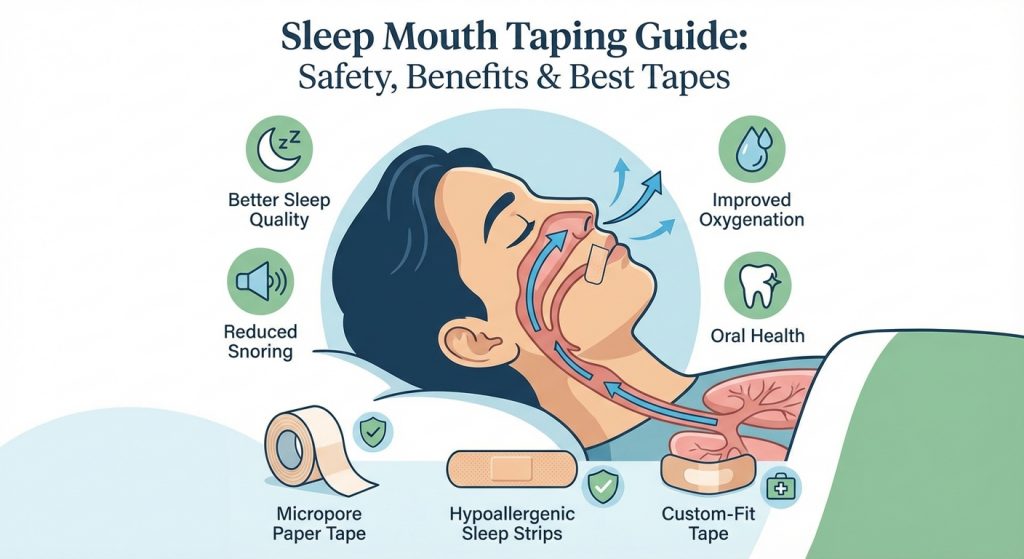
If you wake up with a mouth so dry it feels like you’ve been chewing cotton, or if your partner complains about the “freight train” sounds coming from your side of the bed, you have likely stumbled upon the concept of mouth taping.
It sounds ridiculous at first. Perhaps even dangerous. The idea of sealing your lips shut before losing consciousness seems to go against our primal survival instincts.
By late 2025, this practice had moved from biohacking forums into mainstream social media and podcasts (including Andrew Huberman), but sleep-medicine organizations emphasize that evidence is still limited and that mouth taping can be risky for some people—see the American Academy of Sleep Medicine and the discussion in JAMA.
However, there is a massive gap between viral TikTok trends promising a chiseled jawline and what research actually supports; a 2025 systematic review in PLOS ONE describes the evidence as limited and heterogeneous. Mouth taping is not a magic cure for everything, and for some people—especially with undiagnosed sleep-disordered breathing or blocked nasal airflow—it can introduce real risk.
This guide is not just about how to stick a piece of tape on your face. It is a deep dive into the mechanics of nasal breathing during sleep, the biochemistry of Nitric Oxide, and a brutal comparison of the tools available, from the budget-friendly 3M Micropore tape to the specialized MyoTape.
The Physiology: Why The Nose is Non-Negotiable
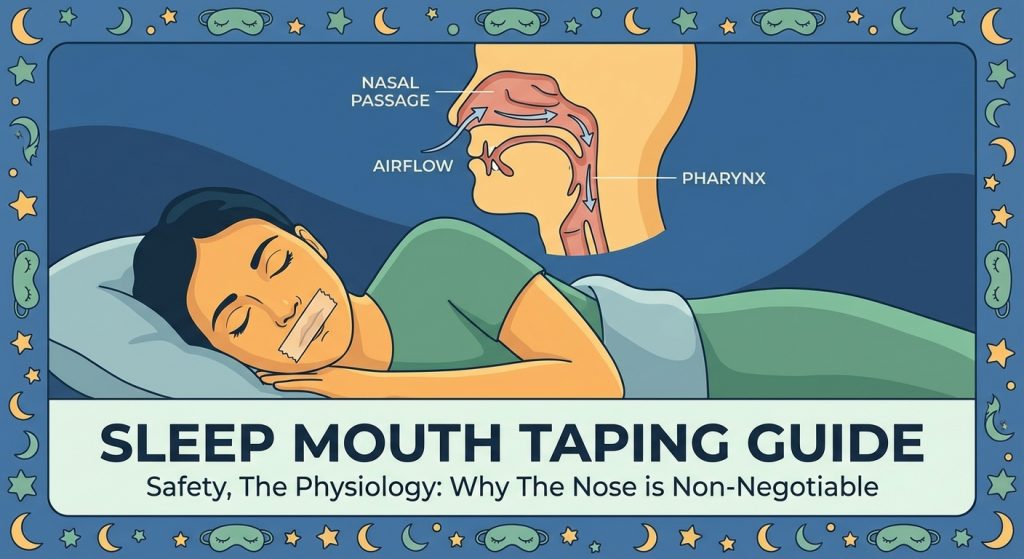
To understand why anyone would voluntarily tape their mouth, you must understand the failure of mouth breathing. Evolutionarily, the mouth is a backup system for breathing. It is designed for high-stress, fight-or-flight situations where you need to take in a massive volume of air quickly. It is not designed for restoration.
When you breathe through your mouth at night, several physiological failures occur:
- 1. Loss of Airway Hydration: The nose is a turbulent humidifier. It spins the air, warms it, and saturates it with moisture before it hits the delicate tissues of your lungs. Mouth breathing bypasses this. The result can be dry mouth at night, throat/tonsil irritation, and over time a higher risk of dental issues; the NHS notes that persistent dry mouth makes tooth decay more likely.
- 2. Collapsed Airway Architecture: The tongue is a heavy muscle. When your jaw drops open, the tongue tends to slide backward, narrowing the pharyngeal space. This increases air resistance, causing snoring and potentially contributing to flow limitations seen in UARS (Upper Airway Resistance Syndrome).
- 3. The Nitric Oxide Deficit: This is the biochemistry that most people miss.
The Nitric Oxide Advantage
Nitric Oxide (NO) is a potent vasodilator. It relaxes the inner muscles of your blood vessels, causing them to widen and increasing circulation. Here is the critical part: the paranasal sinuses act as a major reservoir of nasal Nitric Oxide, as summarized in a CDC review.
When you breathe through your nose, you pick up this reservoir of NO and carry it into your lungs. Research confirms that nasal breathing significantly increases NO absorption compared to oral breathing. Once in the lungs, NO can influence pulmonary vascular tone and may support ventilation–perfusion matching, but translating this into guaranteed ‘better oxygen extraction’ for everyone is an overreach.
When you mouth breathe, you bypass the sinuses. You miss the NO. You are reducing exposure to a signaling molecule involved in vascular tone and airway physiology—so the most realistic upside, if any, is about breathing mechanics and comfort rather than a guaranteed systemic ‘upgrade.’ This is why the benefits of mouth taping extend beyond just stopping snoring; they reach into the metabolic quality of your sleep.
Safety First: The “Do Not Tape” List
Before you buy a roll of tape, we must address the risks. By 2025, the tone from clinicians had largely shifted to cautious skepticism: some people report benefits, but the research base is still small and uneven. The main concern is indiscriminate use—especially if it delays evaluation for sleep apnea or untreated nasal obstruction.
You must NOT tape your mouth if:
- 1. You Cannot Pass the “Nose Test”: Sit quietly for 10 minutes with your mouth closed. Can you breathe easily? If you feel air hunger, panic, or physical obstruction due to a deviated septum, polyps, or severe congestion, you cannot tape. Taping in this situation can be unsafe and may trigger significant breathing difficulty or panic. In practice, addressing the nasal obstruction with an ENT specialist is the sensible first step.
- 2. You Have Moderate to Severe Sleep Apnea (Untreated): If your brain wakes you up because you stop breathing, your body might gasp for air through the mouth as a survival mechanism. Sealing this emergency hatch without using a CPAP machine is dangerous.
If you haven’t done any screening (for example, a home sleep apnea test as described by Mayo Clinic) to rule out clinically significant events, treat mouth taping as off-limits until you’ve spoken with a sleep professional.
- 3. You Have Consumed Alcohol or Sedatives: If you are intoxicated or heavily sedated (even with strong sleeping pills), your gag reflex and arousal threshold are compromised. If you need to vomit, tape could lead to aspiration.
- 4. You Have nasal congestion from an illness: If you have a cold or the flu, wait until it passes.
The Hardware: 3M Micropore vs. MyoTape
There are expensive “sleep strips” marketed on Instagram, and there are medical supplies. Let’s analyze the two most valid approaches: the DIY medical tape and the structural tension patch.
1. 3M Micropore S (The “Paper Tape”)
This is the gold standard for biohackers on a budget. Specifically, you are looking for 3M Micropore Surgical Tape (White, 1 inch), often labeled as “Paper Tape” or model 1530-1.
- The Mechanism: It is a gentle, breathable paper tape designed for securing bandages on fragile skin. It adheres well but allows air to pass through the micropores.
- The Application: You take a small vertical strip (about the size of a postage stamp) and place it swiftly across the center of your lips.
- Pros: It is incredibly cheap. One roll lasts a year. It is hypoallergenic for most.
- Cons:
- The “Seal” Risk: Even a vertical strip creates a seal. If your nose blocks completely, you have to physically wake up and peel it off.
- Residue: It can leave a sticky residue on the lips.
- Drool Failure: If you drool heavily, the adhesive often fails halfway through the night.
- Community Consensus (2025): On forums like ApneaBoard and SleepHQ, 3M Micropore remains the favorite due to cost. However, many users report skin irritation after months of daily use. A common “hack” is to fold over a tiny tab at the end of the tape, creating a handle for rapid removal in the morning or in an emergency.
2. MyoTape (The “Safety” Option)
MyoTape operates on a different principle. It does not physically tape your lips shut. Instead, it is a cotton, elastic frame that goes around your mouth.
- The Mechanism: The elasticity of the tape creates tension. It pulls the skin surrounding the lips inward, triggering a neurological response that encourages the lips to close naturally. Crucially, the center remains open.
- The Application: You stretch the tape slightly and apply it to the skin surrounding the lips (the beard area for men, though it doesn’t stick well to heavy stubble).
- Pros:
- Safety: You can talk, drink water, and cough through the opening. If your nose blocks, you can simply open your mouth against the tension. It is a set of training wheels, not a cage.
- Anxiety-Free: Much better for people who feel claustrophobic with traditional tape.
- Cons:
- Cost: It is significantly more expensive than 3M tape.
- Facial Hair: It struggles to stick to men with beards.
- Effectiveness: For die-hard mouth breathers, the tension might not be strong enough to keep the jaw closed without a chin strap.
My Analysis: If you are new to this and have anxiety about suffocation, or if you are trying to fix sleep breathing for a child (under supervision), MyoTape is the superior entry point. If you are an experienced biohacker looking for efficiency, 3M Micropore is the standard.
The Protocol: How to Stop Mouth Breathing Safely
You don’t just slap tape on and hope for the best. To minimize skin damage and maximize airway hydration, follow this protocol derived from clinical recommendations and user experience.
Step 1: Skin Preparation
The number one reason for failure is grease. Oils from your skin or evening moisturizer will prevent adhesion.
- Wash the area around your mouth and your lips.
- Dry thoroughly.
- Pro-Tip: Apply a thin layer of plain lip balm (like Vaseline or pure lanolin) to the lips themselves, but keep the skin around the lips dry. This prevents the tape from sticking aggressively to the delicate mucosal tissue of the lips, preventing that painful “ripping” sensation in the morning.
Step 2: The Application (Vertical vs. Horizontal)
- Vertical (The Safety Strip): Place a single piece of 3M micropore tape vertically from the philtrum (under the nose) to the chin indentation. This holds the lips together but leaves the corners of the mouth open. In an emergency (coughing/vomiting), air can escape through the sides. If someone decides to experiment despite the cautions above, this is generally the lower-risk starting approach compared with a full horizontal seal.
- Horizontal (The Full Seal): Cover the entire mouth with a horizontal strip of tape. This is risky and generally unnecessary unless the vertical strip fails to prevent “puffer fish” cheeks (where air puffs out the cheeks). Avoid this unless you are highly experienced and have zero nasal congestion.
Step 3: The Morning Removal
Do not rip it off like a waxing strip. Your facial skin is thin.
- Soak the tape with warm water or stick your tongue against the back of the tape to loosen the adhesive with saliva.
- Peel gently downward.
For CPAP and UARS Patients
This guide would be incomplete without addressing the “Mask Warriors.” If you use a CPAP machine, specifically with a nasal mask or nasal pillows (like the ResMed N30i AirTouch), mouth leaks are your enemy.
When pressurized air hits the back of your throat and escapes through your open mouth, it dries out the airway instantly and renders the therapy useless. The machine registers this as a “leak.”
The Debate: Chin Strap vs. Tape
Many doctors prescribe a chin strap (like the Knightsbridge Dual Band) to keep the mouth closed. However, a chin strap keeps the jaw closed, but your lips can still blow open, leading to dry mouth.
- The Consensus: Many CPAP users on Reddit (r/CPAP) find that mouth tape is vastly superior to chin straps for leak control. It creates a hermetic seal that allows the nasal pillows to pressurize the airway correctly.
- Warning: If you have UARS or Flow Limitation and you are not treating either condition, your body might be opening your mouth to reduce resistance. Taping in this scenario without fixing the root cause (using nasal dilators or Mouth Taping alongside therapy) can make you feel worse.
Troubleshooting Common Issues
1. “I rip it off in my sleep.”
This is normal for the first 1-2 weeks. Your body fights the restriction. It usually means you are still trying to mouth breathe out of habit or necessity. Ensure your nose is clear. Use a nasal saline rinse or a nasal dilator (like Intake Breathing) in combination with the tape to make nasal breathing the path of least resistance.
2. “My skin is red and irritated.”
You are reacting to the acrylic adhesive.
- Switch brands. Try “Gentle Paper Tape” or silicone-based tapes.
- Rotate the position of the tape slightly each night (move the vertical strip left or right by a few millimeters).
- Ensure you are using the “lip balm buffer” method mentioned in the protocol.
3. “I still wake up with dry mouth.”
If your mouth is taped shut but you still have dry mouth at night, check your environment.
- Is your bedroom humidity too low? (Aim for 40-60%).
- Are you dehydrated before bed?
- If you are on CPAP, increase the humidity setting on your machine (e.g., ResMed AirSense 11 humidity settings).
Summary
Mouth taping is a potent intervention for your sleep hygiene checklist, but it is not a toy. It forces your body to utilize the superior filtration and biochemistry of the nose.
The Strategy:
- 1. Verify your nasal patency (ensure you can breathe through your nose).
- 2. Start with 3M Micropore tape applied vertically (a narrow vertical strip centered under the nose).
- 3. If you have anxiety or facial hair issues, invest in MyoTape.
- 4. Monitor your results. You should wake up with moist gums, no sore throat, and higher energy levels.
If you suspect your mouth breathing is a symptom of choking (Apnea), do not tape over the problem. Tape is a tool for optimization, not a mask for pathology.
Related Articles:

By: Alex Warenstein.
Bio: Alex Warenstein is a sleep biohacker and founder of Night Time Comfort. After battling chronic insomnia and circadian disruption, he now helps others optimize their sleep using data-driven protocols. Read full story.
Disclaimer: Alex is not a doctor. This content is for educational purposes only. Always consult a specialist.