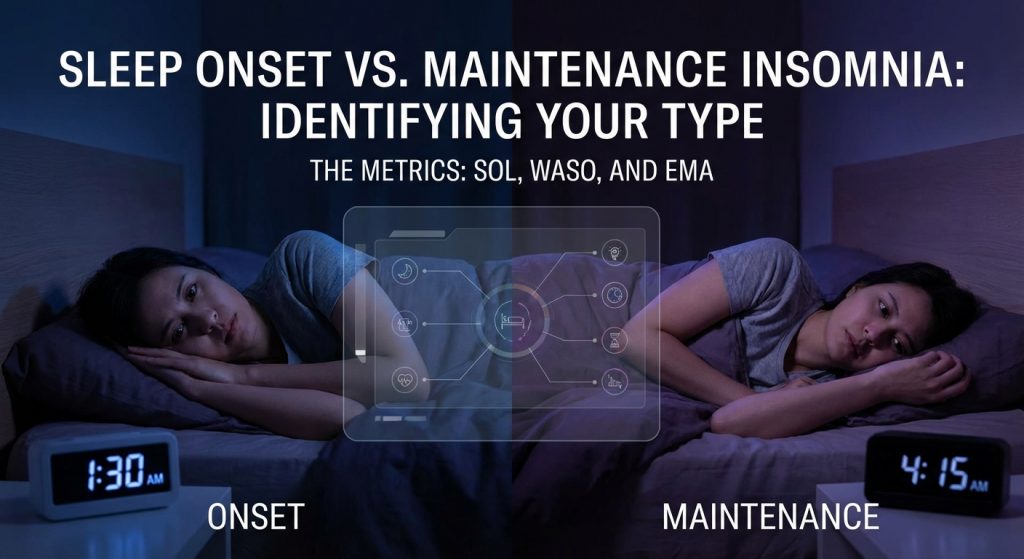
You are lying in bed. The room is pitch black, the temperature is set to a crisp 19 degrees Celsius, and you have done everything “right” according to standard sleep hygiene. Yet, your eyes are wide open. Your brain is replaying a conversation from 2014, or perhaps you are just vibrating with a strange, unplaceable energy. You look at the clock: It has been 90 minutes. You cannot fall asleep.
Or, consider the alternative scenario. You crash the moment your head hits the pillow. You think, “Finally, a good night.” Then, at exactly 3:14 AM, your eyes snap open. You aren’t groggy; you are alert. Your heart might be beating a little faster than usual. You try to roll over, but the sleep pressure is gone. You spend the next three hours wrestling with the sheets until your alarm goes off, leaving you exhausted.
In the world of sleep science and biohacking, we often lump these two distinct tortures under the single umbrella of “Insomnia.” But treating them as the same condition is why so many people fail to fix their sleep. These are two physiologically different beasts. The first is a problem of Sleep Onset Latency (SOL). The second is a problem of Wake After Sleep Onset (WASO).
By early 2026, clinicians are much more explicit about whether the main issue is falling asleep (SOL) or staying asleep (WASO), because the likely drivers and first-line tools can differ (NHS). “Taking something for sleep” without knowing which part is failing can miss the target. A stack that helps onset may do little for maintenance, and vice versa.
This guide is designed to help you identify your most likely pattern using wearable trends, research, and community patterns, so you can stop guessing and start testing the most plausible drivers.
The Metrics: SOL, WASO, and EMA
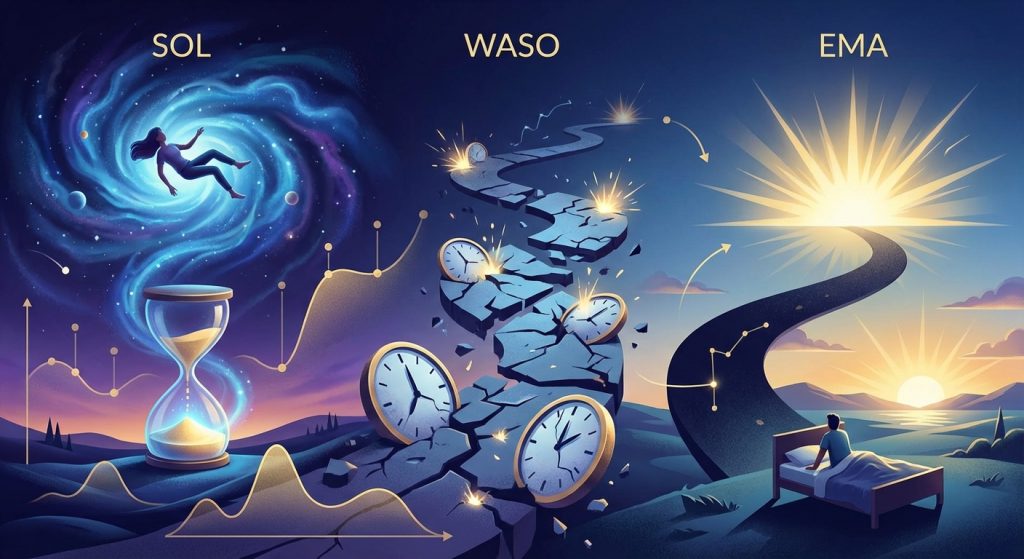
Before we look at solutions, we must define the metrics. If you use a tracker like the Oura Ring 4, WHOOP 4.0, or an Apple Watch with sleep staging, you likely have access to these numbers already (treat staging as an estimate; trends matter more than single nights). If you don’t track, a simple sleep diary for 1–2 weeks is a common starting point in clinical evaluations, as noted by the NIH’s NHLBI.
Sleep Onset Latency (SOL)
This is the “Time to Fall Asleep.” Technically, it is the duration from the moment you attempt to sleep (lights out) to the first epoch of Stage 1 or Stage 2 sleep.
- Normal Range: 10 to 20 minutes.
- The Problem Zone: Consistently taking longer than 30 minutes.
- The “Crash” Zone: Falling asleep in less than 5 minutes often indicates severe sleep deprivation or adenosine overload, which is its own problem.
Wake After Sleep Onset (WASO)
This metric tracks the total minutes you spend awake after you have initially fallen asleep. This includes the micro-awakenings you don’t remember and the long, frustrating bouts of staring at the ceiling at 3 AM.
- Normal Range: Everyone wakes up briefly. Less than 20-30 minutes of total WASO is considered healthy for an adult.
- The Problem Zone: WASO exceeding 45-60 minutes suggests Sleep Maintenance Insomnia.
Early Morning Awakening (EMA)
Sometimes called “Terminal Insomnia,” this is when you wake up too early (e.g., 4:30 AM) and cannot return to sleep, even though you haven’t had a full night’s rest. While clinically often grouped with maintenance issues, in 2025-2026 research, we increasingly view this as a distinct phenotype often linked to circadian shifts or cortisol dysregulation.
The “SOL” Profile: Why You Can’t Turn Off
If your primary struggle is SOL, you are likely dealing with a state of Hyperarousal. In the most recent literature, insomnia is no longer viewed just as a “sleep deficit” but as a 24-hour disorder of hyper-alertness.
The Mechanics of Onset Failure
- 1. The “Tired but Wired” Phenotype
This is the most common complaint I see in community discussions. You feel physically exhausted—your body is heavy, your eyes burn—but your mind is racing at 100 miles per hour. This pattern often reflects a stress-response system that stays “on” into the night (sometimes discussed as HPA-axis overactivation). Your sympathetic nervous system (fight or flight) is failing to hand over control to the parasympathetic nervous system (rest and digest). You have essentially “missed the bus” of your natural melatonin window, and your body is running on evening adrenaline and cortisol.
- 2. Circadian Phase Delay
If you simply do not feel tired until 2:00 AM, you might not have insomnia in the traditional sense; you might have a Delayed Sleep Phase. Your internal biological clock (the Suprachiasmatic Nucleus) is desynchronized from the external world. This is incredibly common in people who get insufficient morning sunlight or are exposed to blue light late at night.
- 3. Psychophysiological Insomnia (Conditioned Arousal)
This is a learned response. Over months of struggling, your brain has associated the bed with frustration, not rest. The moment you enter the bedroom, your brain wakes up. This is why you might fall asleep on the couch effortlessly but become wide awake the moment you brush your teeth and get under the duvet.
The SOL Protocol: Deceleration
If you identify as an SOL sufferer, your goal is “Deceleration.” You need to sedate the mind and cool the body.
Behavioral Interventions:
One of the most practical non-pill tools here is breathwork. The 4-7-8 breathing technique or generic diaphragmatic breathing stimulates the Vagus Nerve, mechanically forcing the heart rate to slow down. In 2025, we also see a massive rise in the popularity of Yoga Nidra (or Non-Sleep Deep Rest / NSDR). These audio-guided protocols are meant to help you shift from a high-alert state into a calmer, drowsier one.
The Supplement Stack for Onset:
When looking at supplements to lower SOL, we want compounds that increase GABA or mechanically lower body temperature.
- Magnesium L-Threonate: Unlike other forms, L-Threonate is celebrated for its ability to cross the blood-brain barrier. It doesn’t just relax muscles; it relaxes the brain. Many users find it quiets the “internal monologue.”
- Apigenin: This bioflavonoid from chamomile may interact with calming GABA-A pathways (including the benzodiazepine binding site), which is why some people find it mildly calming. It acts as a very mild, non-addictive sedative. It is a core component of the popular “Huberman Stack” for this very reason.
- Melatonin (Specifics Matter):
Evidence in chronic insomnia is mixed, and the American Academy of Sleep Medicine does not recommend melatonin as a routine treatment for adult chronic insomnia; if you still experiment, many people start low (e.g., 0.3mg to 1mg) rather than megadoses and watch for morning grogginess. A fast-onset format (like a Melatonin Spray) can be easier to time than a long timed-release dose. - L-Glycine: This amino acid helps lower core body temperature via vasodilation (widening blood vessels). A drop in core temperature is a biological prerequisite for sleep onset.
The “WASO” Profile: The 3 AM Enemy
Sleep Maintenance Insomnia is often more complex to treat because the “waking trigger” is usually physiological, not psychological. You are asleep, so you aren’t thinking anxious thoughts. Something in your body is hitting the emergency eject button.
The Mechanics of Maintenance Failure
- 1. The Metabolic Wake-Up (Sugar Insomnia)
This is a massive focus in 2025-2026 biohacking circles. If you eat a high-carbohydrate meal or sugar too close to bed, you get a glucose spike, followed by a crash while you sleep. When your blood sugar drops too low (nocturnal hypoglycemia), your brain views this as a survival threat. It releases cortisol and adrenaline to liberate stored glucose. This adrenaline surge wakes you up instantly—often with a racing heart or a sweat. This is Sugar Insomnia.
- 2. Respiratory Fragmentation (UARS and Apnea)
If you track your sleep and see high WASO, it’s worth considering airway issues such as sleep apnea, which can drive repeated awakenings (Mayo Clinic).
Obstructive Sleep Apnea (OSA) is obvious (choking/gasping), but UARS (Upper Airway Resistance Syndrome) is silent. It involves struggling to breathe against a narrowed airway, which triggers a stress response and micro-awakenings. You might not fully wake up, but your sleep architecture is shattered, and you eventually wake up fully exhausted. Devices like the Wellue O2Ring can help track oxygen drops, but UARS often requires looking at flow limitations.
- 3. Silent Reflux (LPR)
Unlike GERD, you might not feel heartburn. Silent Reflux involves pepsin gas rising into the throat and nasal cavity, causing inflammation. This often wakes people up with a cough or just a sudden arousal due to irritation.
- 4. Thermal Regulation
If your room is too warm, or your mattress retains heat (common with dense memory foam), your body cannot maintain the temperature drop required for deep sleep. The body wakes up to cool down.
The WASO Protocol: Stability
Treating maintenance issues requires stabilizing the body’s systems.
Behavioral and Environmental Interventions:
- Temperature: Ensure the room is cool (18-19°C). Consider cooling bedding or active cooling mattress covers if you run hot.
- Dietary Stop-Gap: If you suspect metabolic wakes, stop eating 3-4 hours before bed. However, some people find a small amount of complex fat/protein (like almond butter) before bed stabilizes blood sugar. This is highly individual.
- Alcohol Removal: Alcohol is the king of WASO. It sedates you initially (improves SOL) but creates a massive “rebound effect” as it metabolizes, destroying REM sleep and causing frequent awakenings in the second half of the night.
The Decision on Supplements:
Standard sedatives often fail here. You need things that last or treat the specific trigger.
- Extended Release Melatonin: Can help keep you asleep, but use with caution regarding morning grogginess.
- Cortisol Management: If you wake up alert (High Cortisol), adaptogens like Phosphatidylserine taken in the early evening may help blunt the nighttime cortisol spike.
- Prostate/Bladder Support: If Nocturia (waking to pee) is the cause of your WASO, supplements like Pygeum Africanum or Graminex (flower pollen) are more effective sleep aids than any sedative, simply because they remove the mechanical need to wake up.
The “EMA” Profile: Terminal Insomnia
Waking up at 4:30 AM or 5:00 AM when you wanted to sleep until 7:00 AM is a distinct torture.
This is often linked to Advanced Sleep Phase Disorder (your clock is just too fast) or high physiologic stress. In clinical depression, EMA is a hallmark symptom. From a biohacking perspective, it often signifies that your Cortisol Awakening Response (CAR) is triggering too early.
Managing EMA:
- Light Therapy: Unlike SOL patients who need morning light, EMA patients often benefit from light exposure in the early evening to “push” the clock later.
- Blackout Curtains: Ensure that absolutely no dawn light is triggering your wake-up, especially in summer.
- Acceptance (CBT-I): CBT-I is widely recommended as a first-line approach for chronic insomnia by the American College of Physicians, and one common tactic is to stop “fighting” wakefulness—if you can’t fall back asleep in ~20 minutes, get out of bed briefly rather than reinforcing the “bed = stress” loop.
Real Patient Scenarios: Which One Are You?
After analyzing thousands of threads on forums through late 2025, I have seen distinct patterns emerge. Do you recognize yourself in these profiles?
Profile 1: The “SOL Hell”
- Patient Voice: “I lie there for two hours. My body is exhausted, but my brain is writing a screenplay, planning tomorrow’s dinner, and replaying a mistake from work. I check the clock constantly. The anxiety that I won’t sleep keeps me awake.”
- Analysis: This is classic psychophysiological insomnia driven by hyperarousal.
- Priority: Stop checking the clock. Implement 4-7-8 breathing to force a heart rate drop. Use Magnesium L-Threonate and Apigenin to dampen the neural firing.
Profile 2: The “3 AM Wide Awake”
- Patient Voice: “I fall asleep instantly. But every single night, like clockwork, I wake up at 3:15 AM. I’m not groggy; I’m wide awake. My thoughts immediately turn to worries. It takes me 90 minutes to fall back asleep, and then the alarm goes off.”
- Analysis: This screams of a physiological trigger—likely a glucose crash (Sugar Insomnia) or a cortisol spike.
- Priority: Look at Metabolic Health. Wear a CGM (like the Freestyle Libre 3) for two weeks to see if glucose drops precede the wake-up. Try Phosphatidylserine to lower cortisol. Ensure you aren’t drinking alcohol.
Profile 3: The “Bladder Alarm”
- Patient Voice: “I sleep okay, but I have to get up to pee three times a night. I fall back asleep, but the quality is trash because it’s so fragmented.”
- Analysis: This is Nocturia driving WASO.
- Priority: This isn’t an insomnia problem; it’s a bladder problem. Look into Pygeum Africanum or restrict fluids after 6 PM. Check for sleep apnea. During apnea events, the heart releases a hormone (ANP) that signals the kidneys to produce urine, causing the urge to wake up.
Profile 4: The “Shift Worker” (Social Jetlag)
- Patient Voice: “I sleep fine on weekends, but Sunday night is a disaster. I can’t fall asleep until 3 AM, and Monday is a wreck.”
- Analysis: This is Social Jetlag. You are shifting your time zone every weekend.
- Priority: Wake up at the same time on weekends as weekdays. Anchor your circadian rhythm with Morning Sunlight.
Sleep Misperception: A Critical 2026 Update
We must address a phenomenon that has become prominent with the rise of sleep trackers: Paradoxical Insomnia or Sleep Misperception.
Recent studies and user reports from 2025 highlight a discrepancy where patients feel they have been awake for hours (high SOL or high WASO), but their EEG or high-end tracker (like a Hypnodyne ZMax or even an Oura Ring Gen 4) shows they were in Stage 1 or Stage 2 sleep.
Why does this happen? In light sleep (Stage 1/2), the brain can maintain a level of environmental awareness. You might hear a car drive by or “think” thoughts, leading you to believe you are fully awake. If your tracker says you slept, but you feel you didn’t, you might have hyper-aware light sleep. The solution here is often to reduce anxiety about the “wakefulness,” as you are getting some rest. However, heavily fragmented light sleep is still non-restorative.
The Decision Logic: Building Your Protocol
Don’t buy everything. Use this logic to choose your path.
Path A: You cannot fall asleep (SOL > 30 mins)
- 1. Environment: Is your room cool and dark?
- 2. Behavior: Are you viewing blue light after 9 PM? (Use Blue Light Blocking Glasses).
- 3. Physical: Are you practicing a wind-down routine (Yoga Nidra/Reading)?
- 4. Supplements: Start with the “Input Stack”: Magnesium L-Threonate + Apigenin. If needed, add Melatonin Spray (0.5mg) 30 minutes before bed.
- 5. Tech: Use Morning Sunlight to anchor your clock earlier.
Path B: You cannot stay asleep (WASO > 45 mins)
- 1. Rule Outs: Do you snore? (Check SnoreLab or an O2Ring). Do you have reflux? Do you pee frequently?
- 2. Metabolic: Eliminate alcohol and sugar before bed.
- 3. Stress: If you wake up “wired,” try Phosphatidylserine or Relora in the evening to blunt cortisol.
- 4. Behavior: If you wake up, do NOT look at the clock. If you can’t sleep after 20 minutes, leave the bed (Stimulus Control) until you are tired again.
Path C: The Mixed Bag
Many of us suffer from both. In this case, treat the WASO first. Fragmented sleep is often more damaging to health than a delayed onset. Often, stabilizing the metabolic and respiratory factors that cause waking will also lower the systemic stress that prevents falling asleep.
Summary
Understanding whether you suffer from Sleep Onset vs. Maintenance Insomnia is the only way to effectively biohack your rest. The “shotgun approach”—taking a potent sedative just to knock yourself out—often results in poor sleep architecture and does not solve the underlying maintenance issues.
By late 2025, the science is clear: Insomnia is a phenotype. It is a specific malfunction of either the “switch on” mechanism (Onset) or the “stay on” mechanism (Maintenance).
If you are the “Wide Awake at 11 PM” person, focus on calming the nervous system, dimming lights, and using onset-specific tools like Magnesium L-Threonate and 4-7-8 breathing.
If you are the “Wide Awake at 3 AM” person, look deeper. Look at your airway, your blood sugar, and your cortisol levels. Your body is waking you up for a reason. Listen to it, track it, and treat the root cause, not just the symptom.

By: Alex Warenstein.
Bio: Alex Warenstein is a sleep biohacker and founder of Night Time Comfort. After battling chronic insomnia and circadian disruption, he now helps others optimize their sleep using data-driven protocols. Read full story.
Disclaimer: Alex is not a doctor. This content is for educational purposes only. Always consult a specialist.