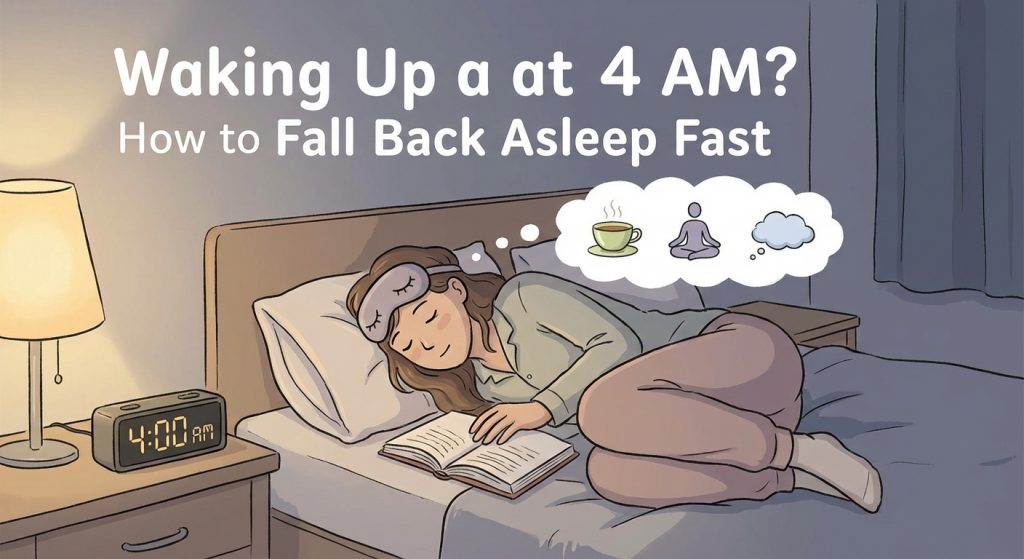
It starts the same way every time. The room is pitch black. My blackout curtains are doing their job. My Apple watch ultra 2 is silently tracking on my finger. But my eyes are wide open. I look at the ceiling, and though I can’t see it, I feel the crushing weight of the silence.
It is 3:48 AM. Again.
I haven’t just woken up; I have been ejected from sleep. My heart isn’t racing, but it’s thumping just hard enough to be annoying. And then, the “Monkey Mind” starts. It doesn’t begin with panic. It begins with a trivial thought: Did I send that email? Is the dog breathing okay? Did I buy the right dog food? Then, within seconds, it spirals into existential dread, financial planning for 2030, and a replay of an awkward conversation I had in 2014.
If you are reading this, you know exactly what I am talking about. This is early morning awakening, often a symptom of sleep maintenance insomnia. You fall asleep fine, but you cannot stay asleep.
I spent two years fighting this battle. I used to lie there for three hours, praying for sleep, only to drift off ten minutes before my alarm went off at 08:00, leaving me wrecked for the day. I tried brute force. I tried ignoring it. I tried pills.
Through endless experimentation, scouring the depths of r/insomnia, analyzing the 2025 clinical guidelines for CBT-I, and testing protocols from the likes of Huberman and Walker, I found a “stack” of techniques that actually work. This isn’t about sleep hygiene (you should have done that before bed). This is emergency triage for when you are awake in the dark.
Here is how I learned to kill the Monkey Mind and fall back asleep fast.
The Physiology of the 3 AM Wake-Up
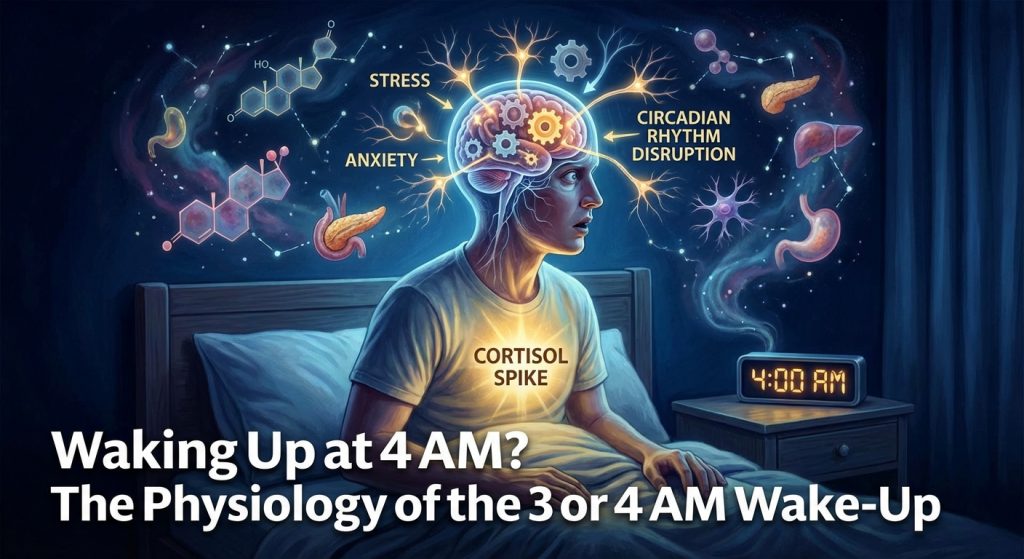
Before we fix it, you need to understand why this happens, so you stop blaming yourself. You are not broken; your biology is just sensitive.
Between 3:00 AM and 5:00 AM, your sleep architecture changes. You have exhausted most of your Deep Sleep (NREM3) pressure in the first half of the night. Now, you are cycling primarily between Light Sleep and REM (Rapid Eye Movement). This stage is naturally more fragile. Your arousal threshold is lower. A car door slamming down the street might not wake you at midnight, but it will jolt you awake at 4 AM.
Simultaneously, your body temperature is reaching its absolute minimum (the nadir), and your system is preparing to slowly ramp up cortisol to wake you up later. If you are suffering from tired but wired syndrome or have HPA axis dysregulation (which you might know if you’ve taken a 24h salivary cortisol test), this cortisol ramp might be happening too early or too aggressively.
But here is the critical realization I had to make: The wake-up isn’t the problem. The reaction is.
We all wake up 10-12 times a night. Most people just roll over and forget it. I, however, would wake up, notice I was awake, and immediately engage my prefrontal cortex (the logic center). I would check the time. I would judge my sleep. That is what turns a micro-awakening into full-blown insomnia.
Step 0: The “Clock Ban” (The Golden Rule)
If you take nothing else from this article, take this: Never, under any circumstances, look at the time.
I used to look. I would see “04:12” and my brain would instantly calculate: “Okay, I have to be up at 08:00. That gives me less than 4 hours. If I fall asleep in 10 minutes, I can get 3 cycles. But if I don’t…”
This math is fatal. It creates “performance anxiety.” The moment you calculate how much sleep you are losing, you trigger a spike of norepinephrine. You are now in fight-or-flight mode.
I physically taped over the LED display of my alarm clock. I removed the watch face from my Apple Watch sleep mode so I couldn’t see it even if I tapped the screen. When I wake up now, I assume it is “night.” It doesn’t matter if it’s 2 AM or 5 AM. If the alarm hasn’t gone off, it is simply “night,” and my only job is to rest.
Technique 1: Physiological Braking (Get Heart Rate < 60)
When I wake up and the Monkey Mind starts chattering, my first check is physical. Usually, my pulse is slightly elevated. Dr. Michael Breus, a well-known sleep specialist, has noted that you generally need a heart rate of 60 BPM or lower to enter unconsciousness. If you are lying there agitated, you are likely at 70 or 80.
You cannot “think” your heart rate down. You have to use mechanics.
The 4-7-8 Breathing Method
I have a separate article detailing the 4-7-8 breathing technique, but here is the emergency version I use at 4 AM:
- 1. Place the tip of your tongue against the ridge of tissue just behind your upper front teeth.
- 2. Exhale completely through your mouth.
- 3. Close your mouth and inhale quietly through your nose to a count of 4.
- 4. Hold your breath for a count of 7.
- 5. Exhale completely through your mouth, making a whoosh sound, to a count of 8.
I do this for 4 to 8 cycles. No more. The long exhale activates the Vagus Nerve, forcing the parasympathetic nervous system (rest and digest) to take over. It physically acts as a brake pedal for your heart.
Personal Note: At first, I felt ridiculous doing this in the dark. But after the third cycle, I can usually feel my body sink heavier into the mattress. It signals to my brain: “We are safe. We are not hunting.”
Technique 2: The Cognitive Shuffle (The Monkey Mind Cure)
This is the most effective psychological tool I have found in 2025. It is superior to counting sheep, superior to meditation, and superior to trying to “clear your mind.”
The problem with the Monkey Mind is that it is coherent. It plans. It worries. It builds narratives. (“If I don’t sleep, I’ll be tired, then I’ll mess up the presentation, then I’ll get fired…”).
The brain cannot engage in coherent worrying and random visualization at the same time. The Cognitive Shuffle forces your brain into a state that mimics the fragmented, nonsensical thoughts that occur naturally just before sleep onset (hypnagogia).
How I Do It (Serial Diverse Imaging):
- 1. Pick a letter. Let’s say “B”.
- 2. Visualize a word starting with B. “Ball.” I visualize a basketball bouncing for 3 seconds.
- 3. Next word. “Bear.” I visualize a bear eating honey.
- 4. Next word. “Boat.” I visualize a sailboat.
- 5. Next word. “Bread.” I visualize a loaf of sourdough.
- 6. Switch letters. When I run out of B words, I switch to “M”. “Mountain,” “Mouse,” “Mars…”
The key is the visualization. You must see the image for a few seconds. This scrambles the “narrative” loops of anxiety. It is incredibly boring, and that is the point. It occupies the cognitive workspace just enough to block the worries, but it is too nonsensical to keep you alert.
I usually don’t make it past the third letter before I drift off. This technique, also known as “Serial Diverse Imaging,” is gaining massive traction on sleep forums like SleepHQ and Reddit because it breaks the “hyper-logical” state of 4 AM insomnia.
Technique 3: The “Mental Walk”
If the Cognitive Shuffle feels too much like work, I use the “Mental Walk” technique often championed by neuroscientists like Matt Walker.
I close my eyes and visualize a walk I know perfectly. For me, it’s the walk from my front door to the park where I take my Spaniel.
- I see the texture of the doormat.
- I feel the cold handle of the door.
- I count the steps to the gate. 1, 2, 3, 4, 5.
- I see the neighbor’s red car.
The level of granular detail is what matters. You are moving your brain from “internal worry” (the future/past) to “spatial memory” (the present). It is very hard to worry about your mortgage while you are concentrating on remembering the exact color of your neighbor’s fence.
Technique 4: Paradoxical Intention
This sounds counter-intuitive, but it is backed by clinical research in 2024 and 2025 as a treatment for sleep performance anxiety.
The more you try to sleep, the more awake you become. It’s a Chinese finger trap.
So, I stop trying. I lie on my back (even though I am a side sleeper usually) and I keep my eyes gently open, staring at the darkness. I tell myself: “I am going to stay awake for the next 5 minutes. I will just lie here and rest my body. I don’t need to sleep, I just need to rest.”
By giving myself permission to stay awake, the anxiety of “not sleeping” evaporates. The adrenaline drops. Often, my eyelids become heavy within moments because I have removed the struggle. This is a core component of psychological insomnia relief—removing the effort.
Technique 5: NSDR (Non-Sleep Deep Rest)
If the silence is too loud and my thoughts are too aggressive for the Cognitive Shuffle, I outsource the relaxation. I put in one earbud (I use the Soundcore Sleep A30 because they are flat enough for side sleeping) and turn on an NSDR track.
Popularized by Andrew Huberman, NSDR (or Yoga Nidra) is a guided script that moves your attention through your body. “Feel your left big toe. Feel your left ankle…”
It acts as a manual override for the nervous system. Even if I don’t fall back asleep, 20 minutes of NSDR replenishes dopamine and reduces cortisol, so I feel less “wrecked” the next morning compared to 20 minutes of tossing and turning. It is a safety net. If I can’t sleep, I do NSDR, and I accept that as “good enough.”
The “Nuclear Option”: Stimulus Control (The 20-Minute Rule)
This is the hardest one to do. I hate doing it. But it is the “Gold Standard” of CBT-I (Cognitive Behavioral Therapy for Insomnia) for a reason.
If I have been awake for what feels like 20 minutes (remember, I don’t look at the clock), and I am feeling frustrated, angry, or agitated… I get out of bed.
Staying in bed while angry creates a Pavlovian association: Bed = Frustration. You must break this link.
- 1. I get up.
- 2. I go to the living room (or a chair in my bedroom if it’s too cold).
- 3. I keep the lights off or use a very dim amber nightlight (blue light blocking is essential here).
- 4. I do something incredibly boring. I read a user manual for a gadget I already know how to use. I listen to a “Sleep With Me” podcast episode I’ve heard before.
- 5. I do not eat. (Eating spikes insulin — see my article on sugar before bed and resets your peripheral circadian rhythms, telling your liver it’s morning).
- 6. I do not check my phone. (Doomscrolling is the death of sleep).
I wait until the “sleep wave” hits me again—that feeling of heavy eyelids and head drooping. Only then do I return to bed. This resets the “sleep pressure.”
What About Supplements in the Middle of the Night?
I am generally cautious about taking pills at 3 AM because of the “hangover” effect. If you take a standard sleeping pill or even high-dose melatonin now, you will be a zombie when your alarm goes off at 7 or 8 AM.
However, based on discussions in biohacking communities (like the Bryan Johnson Blueprint group), there are a few “soft” options for the middle of the night:
- L-Theanine (Sublingual/Chewable): I keep 200mg of L-Theanine by my bedside. It promotes alpha brain waves (relaxation) without heavy sedation. It dissolves fast and doesn’t leave me grogginess.
- Low-Dose Melatonin Spray: If I know I have at least 4 hours left, I might use a micro-dose (0.3mg – 0.5mg) of melatonin spray. But if it’s 5 AM, I never touch it.
- Myo-Inositol: Some users find a small scoop of Myo-Inositol helps calm the racing mind, though I prefer taking this before bed (2g) rather than during the night to avoid messing with digestion.
Note: Avoid Valerian or heavy antihistamines (like Doxylamine) at this hour. The half-life is too long.
The Role of “Sleep Maintenance Tips” from the Community
In researching this article, I trawled through the latest posts (late 2025) on r/insomnia and the SleepHQ forums to see what real patients are doing right now. The trends are shifting away from medication and toward behavioral changes.
- 1. Boring Audio is King: The “Sleep With Me” podcast and “Nothing Much Happens” are consistently cited as lifesavers. The trick is setting the volume so low you have to strain slightly to hear it. This forces focus and prevents the Monkey Mind from wandering.
- 2. Weighted Blankets: Many users report that pulling a heavy blanket up to their chin helps settle the physical restlessness that comes with 4 AM anxiety.
- 3. Acceptance: The most successful sleepers are those who have stopped fighting. As one user on ApneaBoard put it: “I stopped trying to sleep and started trying to just enjoy the quiet. Ironically, that’s when I started sleeping again.”
Summary: My 4 AM Protocol
When I wake up tonight (and I might, I am human), this is exactly what I will do. I suggest you try this sequence before you reach for your phone or a pill.
- 1. Don’t Move: Stay still. Don’t check the clock. Assume it is still “night.”
- 2. Physiological Sigh: Do three rounds of 4-7-8 breathing to dump CO2 and slow my heart.
- 3. Cognitive Shuffle: Start visualizing random words. “Apple… Barn… Cloud…”
- 4. Acceptance: If I am still awake, I tell myself, “It’s okay. I am just resting.”
- 5. Bail Out: If the anxiety spikes, I put in my earbud and start an NSDR track.
- 6. The Nuclear Button: If 20 minutes pass and I am angry, I get up, sit in the chair, and stare at the wall until I am sleepy again.
You can retrain your brain. The 4 AM wake-up doesn’t have to be a catastrophe. It can just be a moment of quiet before you drift back off. Treat it with indifference, and the sleep will follow.

By: Alex Warenstein.
Bio: Alex Warenstein is a sleep biohacker and founder of Night Time Comfort. After battling chronic insomnia and circadian disruption, he now helps others optimize their sleep using data-driven protocols. Read full story.
Disclaimer: Alex is not a doctor. This content is for educational purposes only. Always consult a specialist.