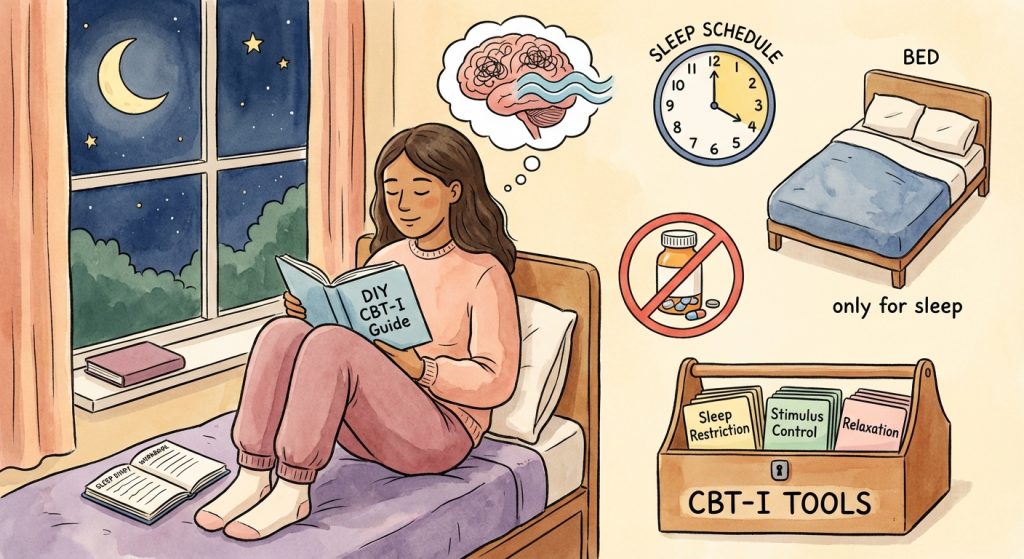
*** Cognitive Behavioral Therapy for Insomnia (CBT-I) is a guideline-recommended first-line approach for chronic insomnia. You have probably heard this phrase a thousand times. If you have visited a doctor, they likely told you to do it. If you have read the European Insomnia Guidelines 2023 or the American College of Physicians recommendations, they all say the same thing: CBT-I is the first-line treatment. Not pills. Not gadgets. But behavioral retraining.
I know what you are thinking because I thought it, too: “Alex, I am too exhausted for therapy. I just want a pill that knocks me out.”
I have been there. I spent months cycling through Atarax, Trittico, and Doxylamine, hoping for a miracle. They worked for a while, and then they didn’t. Pills can sometimes help with short-term sedation, but they usually don’t retrain the habits and conditioning that keep insomnia going—like learning to associate your bed with anxiety, frustration, and staring at the ceiling.
This guide is my attempt to translate the clinical protocols of behavioral sleep medicine into a practical, brutal, and effective home strategy. I’ve leaned on established CBT-I protocols, major guidelines (including the American Academy of Sleep Medicine clinical practice guideline on behavioral treatments), and systematic reviews, and I’ve also cross-checked what actually feels doable through communities like Insomnia Coach and r/insomnia.
This is not a relaxation guide. This is a boot camp for your brain. It will be hard. But if you follow these CBT-I steps consistently, many people are able to meaningfully reduce the cycle of sleepless nights.
The Hierarchy of Efficacy: What Actually Works?
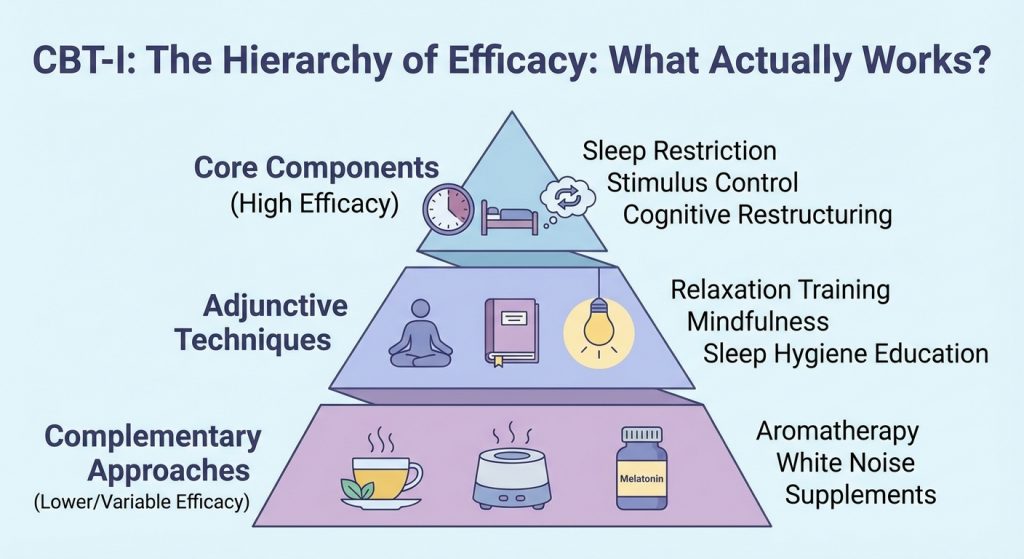
Before we start the CBT-I protocol, we need to be honest about the method. In practice, “CBT-I” isn’t just one thing—it’s a bundle of techniques. Below is a usability ranking (how easy it is to stick with) based on community experience and real-world coaching patterns—not a scientific ranking of “what works best.”
You need to choose the path that fits your current mental state.
1. The “Digital” Route (dCBT-I)
Best for: People who need hand-holding and hate math.
If you can afford it (and if it’s available where you live), structured programs like Sleepio or Somryst can reduce a lot of the “do the math yourself” burden. Reviews and randomized trials published in Nature (npj Digital Medicine) suggest that fully automated digital CBT-I can meaningfully reduce insomnia symptoms for many adults. These apps act like a coach—calculating sleep efficiency and giving you a clear bedtime/wake-time plan. If you struggle with self-discipline, start here.
2. Sleep Compression (The “Humane” Way)
Best for: High-anxiety individuals and those terrified of sleep deprivation.
Instead of slashing your sleep time immediately, you slowly “squeeze” your time in bed. This is the preferred method on Reddit in 2025 because it avoids the initial crash of exhaustion.
3. Sleep Restriction (The “Nuclear” Option)
Best for: Severe, stubborn insomnia where nothing else works.
This is the classic, unadulterated protocol. It involves significantly restricting your time in bed to match your actual sleep time. It is miserable for the first two weeks, but it is the fastest way to build “sleep pressure.”
For this guide, I will focus on a hybrid approach: The Core Protocol, which uses elements of Restriction and Stimulus Control, as this is the most powerful tool for treating insomnia at home.
Phase 1: The Setup (Don’t Skip This!)
You cannot manage what you do not measure. Before you change a single thing about your sleep, you need data.
If you are currently wearing an Oura Ring 4 (or another sleep tracker) or an Apple Watch, I want you to be very careful.
The Problem of “Orthosomnia”
The term “orthosomnia” is used to describe sleep anxiety fueled by obsessing over tracker data, and it was popularized in a 2017 paper available via NIH PubMed Central. I see this constantly: people waking up, feeling okay, checking their ring, seeing a “Red” recovery score, and immediately feeling terrible.
For the duration of this CBT-I protocol, I recommend hiding your sleep score. Use your tracker only to estimate when you fell asleep and woke up, but ignore the “Sleep Stages” or “Readiness” scores. Sleep-stage readouts are estimates and can differ from lab measurements; right now, they can easily become fuel for your anxiety.
The Sleep Diary
For 7 days, track the following manually (on paper or a simple note app):
- 1. Time you got into bed.
- 2. Estimated time it took to fall asleep (Sleep Onset Latency).
- 3. Number of awakenings.
- 4. Total time spent awake in the middle of the night (WASO).
- 5. Final wake-up time.
- 6. Time you got out of bed.
After 7 days, calculate your Average Sleep Time (AST).
Example: You spend 9 hours in bed (23:00 to 08:00), but you only actually sleep for 5.5 hours. Your AST is 5.5 hours!
Phase 2: The Biological Re-Set (Sleep Restriction)
This is the engine of CBT-I for many people who want to reduce reliance on sleep meds. We are going to use your body’s own chemistry—especially rising sleep pressure (often explained via adenosine)—to tilt the odds toward sleep.
Step 1: Set Your “Anchor”
You must pick a wake-up time. This time is non-negotiable. It stays the same on weekdays, weekends, and holidays.
- My Anchor: 07:00 AM.
- Why: Your circadian rhythm is anchored by morning light. If you sleep in until 10:00 AM on Saturday (what we call Social Jetlag), you destroy your drive to sleep Sunday night.
Step 2: Calculate Your Sleep Window
Take your Average Sleep Time (AST) from your diary and add 30 minutes. This is your new “Time in Bed” window.
- Rule: Many sleep restriction protocols keep a minimum “time in bed” floor; for this guide, don’t go below 5.5 hours (this is also the floor used in Stanford Healthcare’s patient-facing sleep restriction instructions).
- Alex’s Math: If you sleep 5.5 hours on average, your window is 6 hours.
- The Calculation: If your Anchor is 07:00 AM, and your window is 6 hours, your new bedtime is 01:00 AM.
Step 3: The Rules of the Window
This is the hardest part. You are not allowed to go to bed before 01:00 AM.
I don’t care if you are falling asleep standing up at 22:00. You must stay awake. You are building massive sleep pressure. When you finally hit the pillow at 01:00 AM, your brain should be so starved for sleep that the anxiety doesn’t have time to kick in.
What to do between 22:00 and 01:00?
This is where people fail. You need a ‘Buffer Zone’ (see my article on sleep hygiene for more details).
- Light: Keep lights very dim. Use Blue Light Blocking Glasses (Red lenses like Spectra479 are best here) to reduce short-wavelength light exposure late at night.
- Activity: Read a paper book, listen to an audiobook, or fold laundry. Do not doom-scroll.
- Snacks: If hunger tends to wake you up, have a small Bedtime Snack (like a handful of pistachios or a kiwi) to reduce the odds of a hunger-driven wake-up (often discussed as “nocturnal hypoglycemia”), but avoid heavy meals that spike insulin.
Phase 3: Stimulus Control (Breaking the Spell)
If Sleep Restriction is the engine, Stimulus Control is the steering wheel. This technique re-trains your brain to stop associating the bed with “being awake and miserable.”
The “15-Minute” Rule (The Bed is Lava)
The rule is simple: The bed is for sleeping and sex only.
If you go to bed at your new time (01:00 AM) and you are not asleep in roughly 15-20 minutes, you must get out of bed.
Do not look at the clock. If you start feeling frustrated, annoyed, or your mind starts racing—that is your cue.
- 1. Get up. Leave the bedroom if possible.
- 2. Go to a dim room. Sit in a comfortable chair.
- 3. Do something boring. Read a manual, do a puzzle, listen to pink noise.
- 4. Return to bed ONLY when you are literally nodding off.
Why this works: Right now, your brain sees your pillow and triggers a “Fight or Flight” cortisol response. By refusing to stay in bed while awake, you break that neural pathway. You are teaching your brain: Bed = Unconscious.
Community Tip: On the Insomnia Coach forums, users often modify this. If getting out of bed makes you more alert (due to the cold or movement), try “sitting up in bed” or shifting to the floor on a rug. The key is to change the context. You cannot remain lying down, waiting for sleep.
Phase 4: Cognitive Restructuring (Taming the Monkey Mind)
You are lying in bed, and the thoughts start: “If I don’t sleep now, I will be a zombie tomorrow. I will lose my job. I will crash my car.”
This is “Catastrophizing.” It spikes your adrenaline and guarantees you won’t sleep.
Technique 1: Scheduled Worry Time
Your brain needs to process problems. If you don’t give it time during the day, it will do it at night.
- Protocol: Every day at 18:00 (not right before bed), sit down with a notebook for 15 minutes. Write down everything that worries you. Plan solutions.
- The Result: When the thought comes at 02:00 AM, you can tell your brain: “We already processed that. We have a plan. Shut up.”
Technique 2: Paradoxical Intention
This is a favorite in the Sleep Coach School (Daniel Erichsen) approach.
Instead of trying to sleep, try to stay awake. Lie in bed with your eyes open (in the dark) and tell yourself: “I am just going to rest my body. I am fine with just resting.”
By removing the effort to sleep, you lower the performance anxiety, and often, sleep comes naturally.
Technique 3: 4-7-8 Breathing & NSDR
If your heart is racing (physical hyperarousal), cognitive tools might not be enough. You need to manually engage the parasympathetic nervous system.
- 4-7-8 Breathing: Inhale for 4, hold for 7, exhale for 8. This slows your heart rate physically.
- NSDR (Non-Sleep Deep Rest): If you really cannot sleep, listen to a Yoga Nidra or NSDR script (Huberman recommends this often). Even if you don’t sleep, this can feel like deep rest and make the next day more manageable; it’s not a replacement for sleep, but it can reduce the “I’m spiraling at 3 a.m.” feeling.
Phase 5: The “Dip” and Titration
Warning: The first 7-10 days of this DIY CBT-I guide will be brutal. You will be tired. You will be irritable. This is called the “Extinction Burst.” Your brain is fighting the new routine.
- Do not nap. Napping relieves the sleep pressure you worked so hard to build.
- Do not drive if you feel unsafe.
- Caffeine: Use the “half-life” logic—caffeine often sticks around for hours (CDC notes a typical half-life around 5 to 6 hours), so many people do best by cutting it after lunch (roughly 12:00–14:00).
How to Expand the Window
Every week, look at your sleep efficiency (Total Sleep / Time in Bed).
- If SE > 90%: You are falling asleep fast and staying asleep. Congratulations. Add 15 minutes to your window (go to bed at 00:45).
- If SE is 85-90%: Keep the window the same.
- If SE < 85%: You are still spending too much time awake. Shrink the window by 15 minutes, but do not go below your 5.5-hour safety floor.
Where Do Supplements Fit In?
I run a site about supplements, so I know the temptation to just take Magnesium L-Threonate or Apigenin 50mg and hope for the best.
The Hard Truth: Supplements are supportive, not curative of chronic insomnia.
During CBT-I, you can continue your Core Stack (Magnesium, L-Theanine, melatonin spray, etc.), as they can help lower the physiological “noise” and relax the body. However, do not start new potent substances during the first weeks of restriction. You need to know that you are sleeping, not the pill.
If you are currently on prescription meds (like Trittico or Doxylamine), treat the prescribing clinician as the quarterback—don’t stop abruptly while starting CBT-I. A common plan is to build steadier sleep with CBT-I first, then (if appropriate) discuss a gradual taper.
Troubleshooting: Why Isn’t It Working?
Based on feedback from the SleepHQ community and my own analysis, here are the common failure points:
1. Hidden Sleep Disorders
If you are doing everything right but still wake up unrefreshed or with a racing heart, you might have Sleep Apnea or UARS.
- Check: Do you wake up to pee multiple times (Nocturia)? Do you have dry mouth?
- Action: Use a Wellue O2Ring or a Home Sleep Apnea Test to rule this out. CBT-I cannot cure a closed airway.
2. Metabolic Wake-Ups
Are you waking up at 03:00 AM sweating or hungry?
- Check: One possible pattern is a stress-hormone surge following a blood-sugar dip—but it’s not the only explanation.
- Action: Review the Nocturnal Hypoglycemia guide. Try a small protein/fat snack before bed or consider taking Myo-Inositol.
3. The “Comfort” Trap
Is your environment actually conducive to sleep?
- Check: Is your mattress causing pressure points? (See Mattress Firmness Selector). Is your pillow aligning your neck? (See Pillow Height Guide). Physical pain will override psychological training.
Frequently Asked Questions (from the Forums)
- Q: Can I read on my phone during the “Stimulus Control” phase?
Most experts say no. The blue light and the dopamine hits from scrolling are counter-productive. However, some modern “realist” guides suggest that if listening to a podcast or an audiobook on your phone (screen off) keeps you calm, do it. The goal is low arousal.
- Q: What about weekends? Can I sleep in?
Absolutely not. This is the most common reason for failure. If you sleep in until 10 AM on Saturday, you will not have enough “sleep pressure” to fall asleep at your anchored time on Sunday night. You will stare at the ceiling, panic, and restart the insomnia cycle. This is Social Jetlag.
- Q: I have anxiety. Is Sleep Restriction safe?
If you have bipolar disorder or seizure disorders, consult a doctor first. For pure anxiety, it is effective, but it spikes anxiety initially. Many Reddit users prefer Sleep Compression (Phase 2, Step 2 modified) where you reduce the window by only 15 minutes a week rather than ripping the bandage off. It takes longer, but it is gentler.
Summary: The Light at the End of the Tunnel
I won’t lie to you—DIY CBT-I is work. It requires you to be disciplined when you are at your weakest. But the evidence base is strong. By compressing your sleep window and removing the stimuli that cause anxiety, you force your brain to remember how to sleep.
The Roadmap:
- 1. Keep a Diary. Know your numbers.
- 2. Restrict. Set your window (Average Sleep + 30 mins).
- 3. Anchor. Wake up at the same time every day. Get Morning Sunlight.
- 4. Escape. If you are awake, get out of bed (Stimulus Control).
- 5. Expand. Slowly add time back only when your sleep is solid.
You are not broken. Your sleep system is just out of sync. This protocol is how you reset the clock. Good luck.

By: Alex Warenstein.
Bio: Alex Warenstein is a sleep biohacker and founder of Night Time Comfort. After battling chronic insomnia and circadian disruption, he now helps others optimize their sleep using data-driven protocols. Read full story.
Disclaimer: Alex is not a doctor. This content is for educational purposes only. Always consult a specialist.