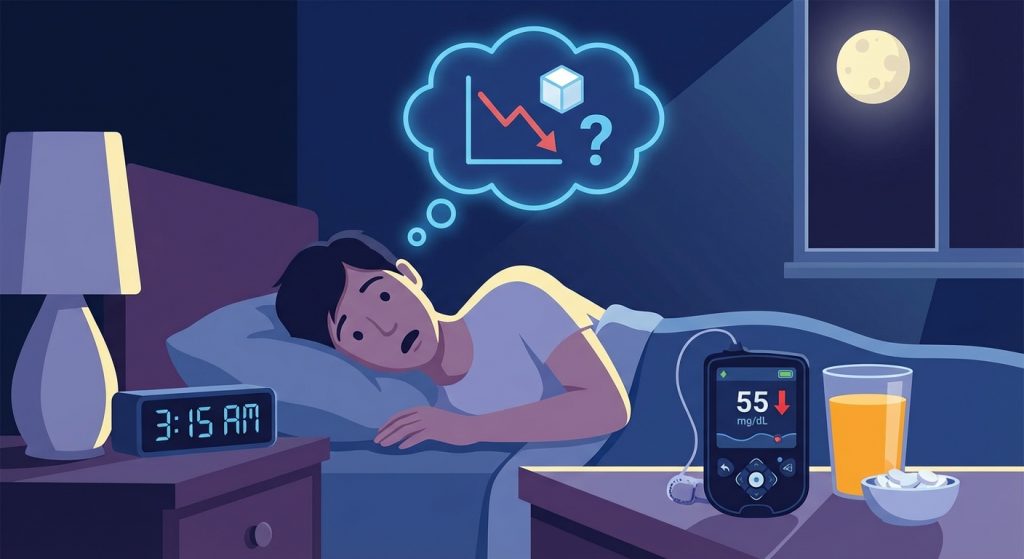
It is 3:00 AM. You were sleeping soundly, and then, without warning, your eyes snap open. You aren’t groggy or relaxed. Your heart is pounding in your chest, your sheets are damp with sweat, and you feel an inexplicable surge of anxiety or alertness. You might even feel a gnawing hollowness in your stomach.
You assume it’s stress. You assume it’s a nightmare you can’t remember. But often, the culprit isn’t in your mind—it is in your blood.
One possible explanation is nocturnal hypoglycemia—low blood sugar during sleep. It’s most commonly discussed in diabetes, but people without diabetes can also experience nighttime glucose dips or fast drops that feel like a “3 AM alarm,” especially after late, carb-heavy meals (Mayo Clinic). This guide is written for people without diabetes (and not using glucose-lowering medication) who suspect glucose swings may be part of their wake-ups.
This guide explores the connection between blood sugar crashes and the 3am adrenaline spike, how to test yourself using modern technology like the Freestyle Libre 3, and dietary protocols to stabilize your nights.
The Mechanism: Why a Crash Wakes You Up
To understand why you wake up, you must understand how the brain protects itself. Glucose is the brain’s primary fuel source. Unlike muscles, the brain cannot easily store energy. It requires a steady stream of sugar from the blood.
When you sleep, you are fasting. During sleep, glucose naturally drifts because you’re fasting. Many CGMs flag anything under 70 mg/dL (3.9 mmol/L) as “low,” but in people without diabetes, true hypoglycemia is typically discussed at lower numbers (around 55 mg/dL / 3.0 mmol/L)—especially when symptoms match the reading (MedlinePlus). When glucose drops fast or low enough for your body, it can trigger a stress response that wakes you up.
To save you, the brain triggers a Counter-Regulatory Hormone Response:
1. Glucagon is released to tell the liver to release stored sugar.
2. Adrenaline (epinephrine) and cortisol are released into the bloodstream to speed up the process.
The Result: Your blood sugar returns to normal, but your body is now flooded with fight-or-flight hormones. You wake up with a racing heart, fully alert, and unable to fall back asleep. This is blood sugar insomnia.
Non-Diabetic Reactive Hypoglycemia
You do not need to have diabetes to experience glucose-related wake-ups. One common pattern is reactive hypoglycemia—an exaggerated insulin response after a carb-heavy meal that can push glucose down a few hours later (Cleveland Clinic).
The Spike: Your blood sugar shoots up rapidly.
The Overshoot: Your pancreas releases a massive amount of insulin to bring it down.
The Crash: The insulin works too well, dropping your blood sugar too low about 3-4 hours later (right in the middle of your sleep cycle).
Symptoms: The “Nightmare” Checklist
How do you distinguish a glucose-driven wake-up from more common issues like stress insomnia or sleep apnea (which can also cause sudden awakenings and night sweats) (Sleep Foundation). Look for these specific physiological signs:
- 1. The “3 AM Adrenaline Spike”: Waking up suddenly with a fast heart rate (tachycardia) and a feeling of panic or doom, rather than just “waking up.”
- 2. Night Sweats: Unlike menopausal hot flashes which feel like internal heat, hypoglycemic sweats are often “cold and clammy.” You wake up shivering in damp sheets. (The causes of night sweats vary, but if they accompany hunger, think glucose.)
- 3. Waking Up Hungry: If you wake up with a hollow feeling in your stomach or an intense craving for food.
- 4. Morning Headache: A “hangover” feeling despite not drinking alcohol, caused by the brain’s energy deficit during the night.
- 5. Vivid Nightmares: The brain often incorporates the physiological stress of the crash into frightening dream narratives.
Diagnosis: Technology and The “Snack Test”
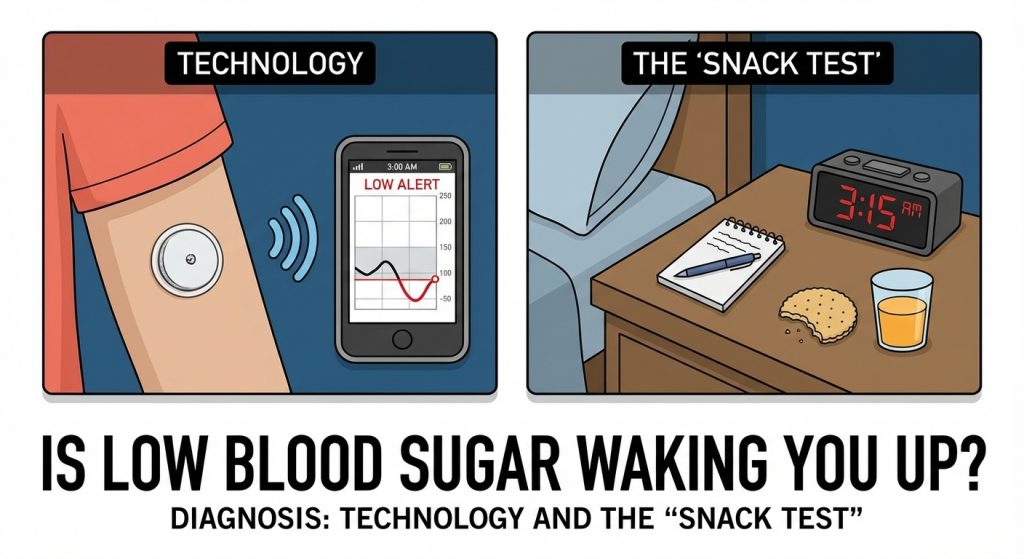
If you suspect nocturnal hypoglycemia, you need data. Subjective feelings are useful, but seeing a repeatable pattern in data can make troubleshooting much clearer.
1. The Gold Standard: Continuous Glucose Monitor (CGM)
Devices like the FreeStyle Libre 3 can show you what your glucose is doing while you sleep; in the U.S., Libre 3 / Libre 3 Plus are typically obtained with a prescription. Most CGM platforms also draw the “low” line at 70 mg/dL, which is why that number is commonly highlighted on charts (American Diabetes Association).
A CGM tracks your glucose every minute while you sleep.
What to look for: A graph that looks like a rollercoaster. A sharp rise after dinner, followed by a steep drop that hits the “Red Zone” (below 70 mg/dL) coincident with the time you woke up.
Common Pitfall: The “Compression Low” Error
If you use a Freestyle Libre 3 or similar sensor, you must be aware of a common false positive often discussed on Reddit biohacking groups.
The Error: If you sleep on the sensor (pressing it into the mattress), you restrict blood flow to the area. The sensor will read a false low (e.g., 50 mg/dL).
How to tell the difference:
Real Low: The graph slopes down gradually over 30-60 minutes.
Compression Low: The graph drops off a cliff (vertical line) instantly and shoots back up instantly when you roll over.
Action: If your CGM screams “Low” but you feel fine and the graph looks like a vertical drop, it is likely a sensor error.
2. The DIY “Snack Test”
If you cannot access a CGM, you can use a process of elimination using food. This involves consuming a specific, blood-sugar-stabilizing snack right before bed for 3 nights to see if the wake-ups stop.
The Theory: By providing a slow-burning fuel source, you prevent the crash. If the snack stops the insomnia, you have confirmed the root cause is metabolic.
Protocol A: The Fat/Fiber Buffer
Snack: 10-15 raw Almonds or Walnuts.
Why: High fat and fiber slow down digestion and stabilize blood sugar without spiking insulin.
Protocol B: The Casein Drip
Snack: 1/2 cup of plain Greek Yogurt (unsweetened).
Why: Dairy contains Casein protein, which digests very slowly over 6-8 hours, releasing a steady stream of amino acids and preventing liver glycogen depletion.
Note: Do not use fruit, bread, or sweets for this test. They will cause a spike and a worse crash.
Diet and Triggers: What Wrecks Your Night?
Your sleep is dictated by what you ate 4-6 hours ago.
- 1. The “Naked Carb”
Eating carbohydrates alone (e.g., a bowl of pasta, a piece of fruit, a sugary dessert) causes a rapid glucose spike. Without protein, fat, or fiber to blunt the absorption, insulin floods the system, leading to the rebound crash.
Read more: The Anti-Sleep Diet: 5 Foods That Destroy Sleep Quality. - 2. Alcohol
Alcohol is the arch-enemy of blood sugar stability.
The Mechanism: Your liver is responsible for releasing stored sugar (gluconeogenesis) while you sleep to keep your brain fueled. However, the liver prioritizes metabolizing alcohol as a toxin.
The Result: While the liver is busy processing the wine you drank at dinner, it stops releasing sugar. Your blood glucose plummets, and you wake up at 3 AM. - 3. Intermittent Fasting (Aggressive)
For some people, stopping eating at 4 PM or 6 PM leaves too large a window before sleep. If your liver glycogen stores are low (common in low-carb dieters or athletes), you may run out of fuel by 3 AM.
Solutions: How to Stabilize Your Night
To stop waking up hungry and anxious, you must flatten the glucose curve.
- 1. The “Safety Snack”
If you confirmed you have nocturnal hypoglycemia, the “don’t eat before bed” rule applies differently to you. You should not eat a meal, but a targeted tool.
Best Options: A spoonful of almond butter, a hard-boiled egg, or a small piece of cheese.
Read more: Best Bedtime Snacks for Deep Sleep: What to Eat & When. - 2. The 3-Hour Gap (With Caveats)
General sleep hygiene suggests stopping food 3 hours before bed. This is correct for preventing heartburn and high body temperature. However, for hypoglycemics, the composition of the last meal is key.
The Fix: Your dinner must be high in protein and healthy fats. These macronutrients keep you satiated and stabilize glucose levels through the night. - 3. Vinegar Hack
Some clinical research suggests vinegar taken with or just before a meal can modestly blunt post-meal glucose spikes for some people; if your wake-ups reliably follow a big dinner spike, it can be a low-effort experiment to try for a few nights (Frontiers in Nutrition).
Community Insights: What Reddit Says
On forums like r/Insomnia and r/Biohackers, users frequently discuss the “Adrenaline Wake-Up.”
- The “Salt” Trick: Some users report that taking a pinch of sea salt before bed helps. This supports the adrenal glands, although scientific data is thinner here than for protein snacks.
- Electrolytes: Dehydration mimics hunger and stress. Ensuring proper electrolyte balance (Sodium, Potassium, Magnesium) is a common fix mentioned in the community.
- Sensor Anxiety: Many users report anxiety from the CGM alerts. It is vital to turn off “High” alerts at night and set “Low” alerts to a reasonable level (e.g., 65 mg/dL) to avoid being woken up by minor fluctuations or compression lows.
When to See a Doctor (Red Flags)
While occasional low blood sugar at night is common, persistent issues can signal underlying pathology. Seek medical attention immediately if:
- 1. If you have diabetes or use glucose-lowering medication, nighttime lows are managed differently and should be handled with your prescribing clinician.
- 2. Confusion/Seizures: If you wake up confused, unable to speak, or have bitten your tongue.
- 3. Daytime Fainting: If blood sugar issues persist during the day.
- 4. No Diet Link: If you change your diet perfectly and still experience crashes, this could indicate an insulinoma (rare tumor) or adrenal insufficiency.
Jan-2026 updates: What’s New Since Fall 2025 (for non-diabetics)
Since fall 2025, the most useful updates are less about “perfect numbers” and more about spotting repeatable patterns: what you ate, how fast glucose moved, and what your sensor is really measuring.
1. The brain has a “night-shift” backup system. A Sept-2025 paper mapped a brain circuit that helps prevent glucose from dropping too low during a normal overnight fast—basically, it helps your body mobilize fuel when you haven’t eaten for hours (ScienceDirect). Practical takeaway: if your dinner leaves you low on usable fuel, your body may compensate with a stress response that feels like a sudden 3 AM wake-up.
2. What “normal” CGM nights look like in people without diabetes (late-2025 data). A late-2025 dataset tracking CGM patterns in healthy people found that truly low readings were uncommon, and most overnight lines stayed fairly stable (NIH PubMed Central). Practical takeaway: repeated dramatic lows on your chart are a reason to look for artifacts, sensor placement issues, and meal-timing patterns—not to assume something rare on day one.
3. FDA flagged a real-world issue: some Libre 3 sensors could read falsely low (Dec-2025 / Jan-2026). The FDA posted an early alert about certain FreeStyle Libre 3 / 3 Plus sensors that may provide incorrect low readings (FDA). Practical takeaway: one scary “low” that doesn’t match how you feel—especially if it’s a sudden vertical drop—can be device-related.
4. Non-diabetic hypoglycemia: experts emphasized “match the number to the feeling.” An Oct-2025 position statement stressed that confirming true non-diabetic hypoglycemia is about a low glucose value plus typical symptoms plus clear relief after eating—not just a single graph point (SpringerLink). Practical takeaway: combine symptoms + pattern + food timing before concluding you have a rare medical cause.
Summary
Nocturnal Hypoglycemia is a metabolic alarm clock. It is your body screaming for fuel. If you are chasing sleep hygiene by buying blackout curtains and tape for your mouth, but ignoring your blood sugar, you are missing the biological driver of your insomnia.
Use a Freestyle Libre 3 to see the truth. Use the “Snack Test” with almonds or Greek Yogurt to troubleshoot. If the 3am adrenaline spike disappears when you stabilize your glucose, you’ve likely found an important piece of the puzzle.
Read Next:
Stop Waking Up to Pee: Nocturia, Prostate & Natural Fixes |
SpO2 & Oxygen Desaturation: Understanding the 4% Drop Rule.

By: Alex Warenstein.
Bio: Alex Warenstein is a sleep biohacker and founder of Night Time Comfort. After battling chronic insomnia and circadian disruption, he now helps others optimize their sleep using data-driven protocols. Read full story.
Disclaimer: Alex is not a doctor. This content is for educational purposes only. Always consult a specialist.