The Travel Dilemma: To Lug or To Mini?
I’m Josh. If you frequent the same circles as the founder of this site, you might know that while some people are obsessed with optimizing deep sleep scores, my battle is a bit more straightforward: I just want to stop choking in my sleep without checking a separate suitcase for my medical equipment.
I have obstructive sleep apnea (OSA). At home, I sleep with a ResMed AirSense 11 Autoset. It is quiet, it keeps my airway open, and it humidifies my air perfectly. But I travel—a lot. For years, I hauled that machine around like a sacred brick. Distilled water battles in foreign hotels, TSA agents inspecting every inch of the humidifier chamber, and the sheer bulk of it made travel miserable.
Enter the ResMed AirMini.
I bought this device with my own money (insurance usually laughs at “travel” prescriptions), hoping it would be the silver bullet. After six months of flights, road trips, and hotel nights, my verdict is a complicated 7 out of 10.
It is a marvel of engineering, but it has a “dark side” that you need to hear about before you drop $900+. This isn’t a spec sheet review; this is a patient’s reality check on the noise, the dryness, and the trade-offs.
The Form Factor: Why We Buy It
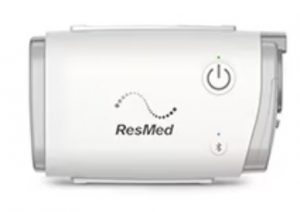
Let’s get the good part out of the way. The AirMini is absurdly small.
It weighs about 0.66 lbs (300g). It fits in the palm of your hand. When I pack it, I don’t even use a dedicated medical bag; I slide it into a side pocket of my camera backpack.
- The Power Brick: It is annoying that the power supply is almost half the size of the unit itself, but combined, it’s still a fraction of a home unit.
- The “Eco-System”: You don’t need a humidifier tank. This is the killer feature for travel. No more hunting for distilled water in rural Italy or explaining to a flight attendant why you have a jug of liquid.
If portability is your only metric, this device is a 10/10. But you have to sleep with it.
The Noise: Addressing the “Darth Vader” in the Room
If you browse r/CPAP or ApneaBoard, you will see one complaint dominate every AirMini thread: The Noise.
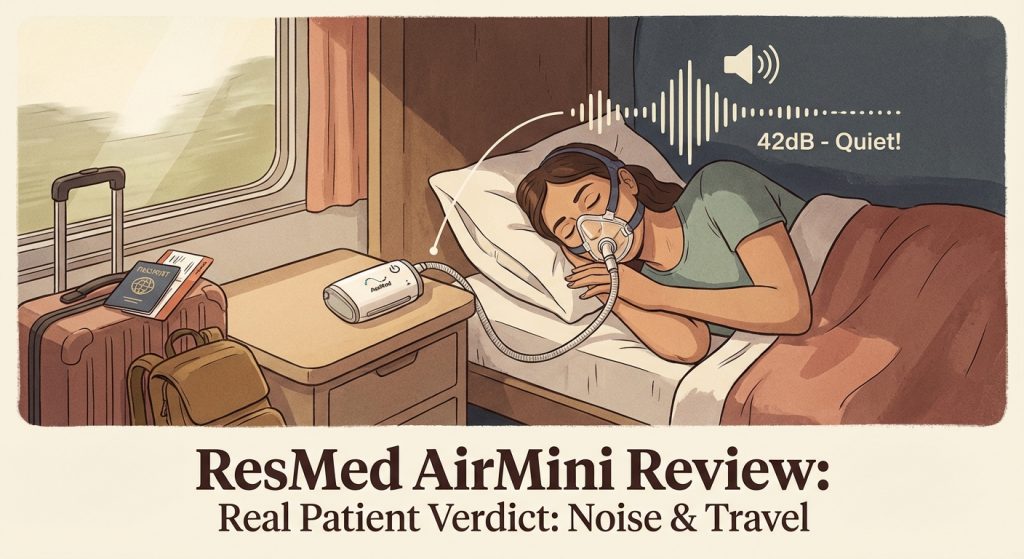
Here is the nuance that most reviews miss. It is not the motor that is loud. If you put the AirMini on a nightstand and turn it on, the machine itself is surprisingly quiet—about 30 decibels. It’s a low hum, slightly higher pitched than the AirSense 11, but manageable.
The problem is Intake Noise and Conducted Noise.
The “Darth Vader” Effect
Because the machine is so small, ResMed had to remove the traditional dampening foam found in larger units. Additionally, the HumidX system (more on that later) requires a specialized venting system right near your face.
When you inhale, the sound travels up the slimline tube and echoes in your mask. It sounds like a hollow, rushing wind.
- On the Inhale: A sharp whoosh.
- On the Exhale: A noticeable venting hiss.
To you, the patient, it sounds like Darth Vader is breathing directly into your ear canal. To your partner, it’s actually not that bad—it’s white noise. But for the user, that conducted noise can be maddening if you are a light sleeper.
Community Consensus (Late 2025):
- The Happy Campers: About 50% of users on Reddit say they get used to it after 3 nights. They treat it as white noise and actually sleep better because it drowns out hotel hallway sounds.
- The Dealbreakers: The other 50% cannot tolerate it. They report waking up every time they inhale.
Can you fix it?
I tried the popular “Q-Lite” muffler. It helps slightly with the air turbulence noise in the tube, but it does not eliminate the intake noise generated by the turbine itself. The most effective “hack” I found was simply putting the AirMini unit on a soft surface (like a mousepad or a folded towel) on the floor, rather than the nightstand. This distances the motor whine, though the tube noise remains.
Waterless Humidification: The HumidX System
Since there is no water tank, ResMed uses a disk called HumidX. It’s a Heat and Moisture Exchanger (HME). Essentially, it traps the moisture from your exhale and gives it back to you on your inhale. Think of it as a high-tech sponge for your nose.
There are two versions:
- 1. Standard HumidX (Blue/Grey): For normal climates.
- 2. HumidX Plus (Black): For dry climates or airplane cabins.
My Experience:
It works… okay. It is nowhere near the comfort of the heated humidifier on my ResMed AirSense 11 Autoset or ResMed AirCurve 10 vAuto.
- Pros: Zero maintenance. No water needed.
- Cons: My nose definitely feels drier in the morning. Also, in cold hotel rooms, the HumidX Plus can work too well, causing “rainout” (condensation) where water droplets form in the mask and splash your nose.
Important Cost Note: These disks are disposable. ResMed says to change them every 30 days. If you travel constantly, this is a recurring subscription cost you need to factor in.
The “Walled Garden” of Masks
This is the most controversial part of the AirMini design. You cannot just plug in your favorite mask. The device uses a proprietary connection ring that only fits specific ResMed masks:
- AirFit P10 for AirMini (Nasal Pillows)
- AirFit N20 (Nasal)
- AirFit F20 / F30 (Full Face)
- AirFit N30 for AirMini (Nasal Cradle)
If you love your Evora Full, Resmed N30i AirTouch, Bleep Eclipse, or your DreamWear, you are officially out of luck—unless you hack it.
The Adapter Hack:
You can buy third-party adapters (like the ZephAir adapter) on Amazon that convert the AirMini’s weird port to a standard 22mm CPAP hose.
- The Win: You can use ANY mask.
- The Loss: You lose the HumidX system. The HumidX disks live inside the proprietary ResMed connector. If you use an adapter, you have zero humidification. For me, that’s a dealbreaker, but for many on the forums, this is the only way they can tolerate the machine.
Data Black Box: The Missing SD Card
If you are a data nerd who uses OSCAR to analyze every breath, flow limitation, and leak rate, the AirMini will frustrate you.
There is no SD Card slot.
The device stores detailed data internally, but it only pushes a “Summary” to the AirMini App on your phone via Bluetooth. You get:
- Usage hours
- AHI (Events per hour)
- Leak rate validation
- A basic 0-100 score
You cannot see your flow rate graphs. You cannot zoom in to see if a specific event was a central apnea or an obstructive one.
For a travel machine, this is acceptable. I don’t need to analyze my flow waves while I’m on a business trip in London. I just need to know I slept. But please—do not buy this as your primary home machine. You are flying blind regarding the efficacy of your therapy compared to a full-sized unit.
Clinical Menu Access:
You can change your pressure settings (APAP range, EPR) via the app, but you have to enter the “Clinical Mode.” (Usually accessible by tapping the ResMed and AirMini logos simultaneously on the welcome screen—check current YouTube guides for the latest app interface method).
Off-Grid: Camping and Planes
The AirMini uses a 24V power supply. It does NOT have a built-in battery.
If you want to sleep on a plane or in a tent, you need an external battery.
- Medistrom Pilot-24 Lite: This is the gold standard. It acts as a UPS (backup battery) at home and a travel battery on the road. It usually gets me 1.5 to 2 nights on a single charge with the AirMini.
- Generic Power Banks: You can use generic DC batteries (like those for laptops) if you buy a specific DC-converter cable for the AirMini.
Flying:
- I have used it in Lie-Flat seats. The background noise of the Boeing 777 engine completely masks the “Darth Vader” noise of the AirMini. It’s actually the best place to use it. Just remember to turn Bluetooth OFF (Airplane Mode) on the unit itself so the blue light doesn’t blink all night.
Community Consensus: Who is this for?
I spent weeks reading the German Schnarch forums, ApneaBoard, and Reddit before buying. Here is the distilled truth of hundreds of users.
Group A: The “It Saved My Life” Travelers
- Profile: Frequent flyers, campers, people who carry carry-on luggage only.
- Feedback: “I used to skip therapy on trips because the AirSense was too heavy. Now I sleep safely everywhere.”
- Verdict: They accept the noise and the dryness as the price of admission for mobility.
Group B: The “Sensory Sensitive”
- Profile: Light sleepers, people with anxiety about noise, people who need high humidity.
- Feedback: “I felt like I was suffocating because of the intake noise,” or “My wife made me turn it off.”
- Verdict: Many of these users end up selling their AirMini on eBay and going back to lugging their AirSense 11.
Summary: Is it worth $900?
If you travel more than 10-15 nights a year, yes. The convenience of leaving your home setup intact and just grabbing a tiny bag is worth the money.
However, you must manage your expectations.
- 1. It is louder (conducted breath noise) than your home machine.
- 2. It is drier (HumidX is not a heated tank).
- 3. It is limited (No SD card/OSCAR data).
For me, the ResMed AirMini is a specialized tool. I don’t love using it, but I love having it. It means I can say “yes” to a spontaneous weekend trip without feeling like a medical patient packing a hospital room.
My Rating: 7/10 (Points deducted solely for the proprietary mask ecosystem and intake noise).
*** Disclaimer: I am not a doctor. I am a patient sharing my experience and the consensus of the patient community. This device is for treating Obstructive Sleep Apnea (OSA). Always consult your sleep specialist regarding your pressure settings and therapy needs.

By: Alex Warenstein.
Bio: Alex Warenstein is a sleep biohacker and founder of Night Time Comfort. After battling chronic insomnia and circadian disruption, he now helps others optimize their sleep using data-driven protocols. Read full story.
Disclaimer: Alex is not a doctor. This content is for educational purposes only. Always consult a specialist.