Introduction: The German Challenger for Flow Limitation
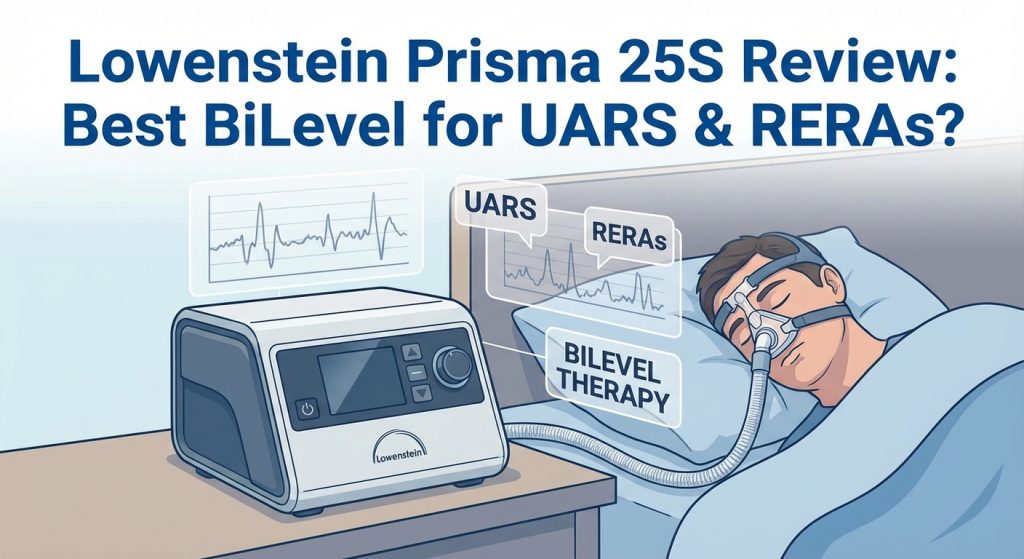
If you are reading this, you have likely already failed with a standard CPAP machine. You aren’t just snoring; you are waking up exhausted, with a racing heart, or perhaps you have been told your AHI is “fine” (under 5.0), yet you feel like a zombie. This is the hallmark of UARS (Upper Airway Resistance Syndrome) and untreated Flow Limitation.
For years, the gold standard for treating these subtle breathing issues—where the airway narrows but doesn’t fully collapse—has been the ResMed AirCurve 10 VAuto. But in late 2025, availability issues and price hikes have driven many in the sleep community (especially in Europe) to look at the Lowenstein Prisma 25S.
This is not a review of a standard CPAP. This is a deep dive into a sophisticated BiLevel machine capable of delivering high Pressure Support (PS). We are looking at the Prisma 25S specifically through the lens of the “difficult” patient—the person with RERAs (Respiratory Effort-Related Arousals), the person who fights the pressure, and the biohacker trying to optimize their deep sleep.
Is the “German engineering” of the Prisma 25S superior for treating UARS, or does its synchronization lag behind ResMed? Based on extensive community data, clinical manuals, and patient consensus from late 2025, here is the reality of using the Prisma 25S.
Disclaimer: I am not a doctor. This article aggregates patient experiences, technical documentation, and community consensus to help you discuss treatment options with your specialist. Always consult a somnologist or medical professional before changing your therapy settings.
What is the Prisma 25S? (And What It Is Not)
Before we analyze the algorithms, we must clarify what machine we are talking about. The Lowenstein naming convention is confusing.
- Prisma SMART Max / SOFT Max: These are standard APAP/CPAP machines. They are not what we are reviewing here. They cannot provide the high pressure support needed for UARS.
- Prisma 25ST: This is a similar BiLevel machine but includes a “Backup Rate” (forced breaths), usually reserved for central apnea or COPD.
- Prisma 25S: This is the BiLevel S / autoS unit. It allows for distinct IPAP (Inhale Pressure) and EPAP (Exhale Pressure) settings.
The Prisma 25S is designed for patients who cannot tolerate high fixed pressure or those who need a pressure difference to stent the airway open during inhalation. For the UARS community, this machine is interesting because it features autoPDIFF (automatic Pressure Support) and (auto)TriLevel modes, which theoretically smooth out the breathing curve even more than standard BiLevel.
The UARS Connection: Why You Need BiLevel
To understand why someone would buy a Prisma 25S, you have to understand the failure of standard CPAP. Standard machines provide a single pressure (or a very narrow range). However, Flow Limitation—the flattening of the breath that causes stress hormones like cortisol to spike—often requires a significant boost of pressure only during inhalation.
Dr. Barry Krakow, a pioneer in sleep medicine, famously noted that many insomnia patients actually suffer from UARS and respond better to BiLevel therapy than standard CPAP. The goal is to use EPAP to keep the airway from collapsing and IPAP (Pressure Support) to eliminate the effort of breathing.
The Prisma 25S offers High Pressure Support. Unlike a standard AirSense 11 which might top out at a pressure relief of 3cmH2O (EPR), the Prisma 25S can separate inhale and exhale pressure significantly. This separation is the primary tool used to fix RERAs and normalize the breathing waveform.
Core Features for Flow Limitation: Standard vs. Dynamic & autoPDIFF
When you dig into the clinical menu of the Prisma 25S (typically accessed by holding the ‘i’ (Info) button for a few seconds until Login appears), you will face settings that determine whether your therapy succeeds or fails.
Standard vs. Dynamic (The APAP Algorithm)
In the autoS mode, you can choose between “Standard” (Std) and “Dynamic” (dYn) response profiles.
- Standard: A gentler rise in pressure. It waits for clear obstructive events.
- Dynamic: This is the setting most relevant to UARS. The algorithm reacts more aggressively to “flattening” of the breath waveform and snoring. In 2025 community discussions, Dynamic is widely considered the go-to setting for treating flow limitation because it attempts to preemptively raise pressure before a full arousal occurs.
autoPDIFF (Automatic Pressure Differential)
This is a standout feature of the Prisma 25S. Instead of locking you into a fixed Pressure Support (e.g., PS of 4.0), autoPDIFF allows the machine to vary the Pressure Support based on your immediate needs.
- Theory: If you are having a cluster of RERAs, the machine increases the support to help you breathe deeper. If you are stable, it lowers it to improve comfort.
- Reality: For many users, this works beautifully. However, some “data-driven” patients prefer fixed PS because they want to guarantee that every single breath is fully supported to prevent tired but wired symptoms the next day.
(auto)TriLevel
This is arguably Lowenstein’s unique selling point. While BiLevel has two pressures (IPAP and EPAP), TriLevel calculates a “third” pressure at the end of exhalation. The goal is to lower the mean pressure in the mask while maintaining airway patency. For patients who struggle with aerophagia (swallowing air) or feel overwhelmed by pressure, TriLevel is often cited in German forums as the “savior” setting that made therapy tolerable.
The “Sync” Issue: Prisma 25S vs. ResMed AirCurve 10 vAuto
This is the most critical section of this review. If you are coming from a ResMed machine, or if you are highly sensitive to breathing rhythm, you need to pay attention here.
The “Holy Grail” of BiLevel therapy is Synchronization. The machine must trigger the inhale pressure exactly when you try to breathe in, and cycle to exhale pressure exactly when you stop.
ResMed AirCurve 10 VAuto handles this with manual “Trigger” and “Cycle” sensitivity settings (High, Med, Low). It is widely regarded as having a “pneumatic feel”—it feels like an extension of your lungs.
Lowenstein Prisma 25S uses an automatic algorithm (with limited manual adjustments for trigger sensitivity and pressure rise speed).
The “Fighting the Machine” Problem
A significant minority of users on Reddit and ApneaBoard report a sensation of “lag” or “fighting the breath” with the Prisma 25S. Through detailed analysis of user logs in late 2025, we have identified the primary culprit: SoftPAP.
SoftPAP is NOT for BiLevel.
SoftPAP is a comfort feature designed for CPAP mode. It lowers pressure at the start of exhalation. However, when users enable SoftPAP on top of BiLevel settings, or when they rely on it instead of proper Pressure Support, the machine often “misinterprets” the breathing cycle.
- The Symptom: You try to inhale, but the machine is still in “exhale relief” mode. You feel air hunger. You panic. You wake up.
- The Fix: Experienced users overwhelmingly recommend turning SoftPAP OFF when using the Prisma 25S for UARS. Instead, use Bi soft 1/2. “Bi soft” is the dedicated exhalation relief algorithm for BiLevel mode. It is smoother and designed to work with the high pressure variances.
The Verdict on Sync
If you are starting fresh, you will likely find the Prisma 25S smooth and quiet. If you are switching from ResMed, you may feel a slight “delay” in the trigger. Adjusting the “Pressure Rise” speed in the clinical menu can mitigate this, but for the most sensitive patients, ResMed still holds the edge in synchronization customization.
Data Analysis: Can You See the Flow Limitation?
To treat UARS, you must see the data. You cannot rely on the generic “AHI” number on the screen. You need to see the shape of your breath wave.
PrismaTS (Official Software):
Lowenstein provides powerful software called PrismaTS. It offers high-resolution data and flags RERAs and Flow Limitation explicitly. It is excellent, but it is medical-grade software that can be clunky for the average user to obtain and install.
OSCAR (Open Source Community):
As of late 2025, OSCAR support for the Prisma 25S is “mixed.”
- OSCAR can import data from the SD card.
- However, specific flags (like distinct FL events) are sometimes categorized differently than on ResMed machines.
- Users report that while you can see the flow rate graph (the most important thing for identifying a flattened breath), the automated statistics are sometimes glitchy.
- If you are a power user who lives and dies by OSCAR data, ResMed remains the easier ecosystem. If you are willing to use PrismaTS or decipher raw flow graphs in OSCAR, the Prisma 25S provides sufficient data.
Community Consensus: Who is this Machine For?
Based on hundreds of discussion threads from ApneaBoard, SleepHQ, and German sleep forums (late 2025 data), we have categorized user experiences into distinct groups.
The “It Saved Me” Group (Pros)
- 1. The “High Pressure” Patient: Users who need pressures of 18+ cmH2O find the Prisma 25S significantly more comfortable than ResMed due to the TriLevel algorithm, which reduces the average pressure load.
- 2. The Noise Sensitive: The Prisma 25S is widely cited as the quietest machine on the market. The motor noise is virtually non-existent compared to the “whine” of the ResMed AirSense 11.
- 3. The Auto-Tuning Fan: Patients who don’t want to constantly tweak settings love autoS + autoPDIFF. They let the machine decide how much Pressure Support is needed breath-by-breath.
- 4. The Tank Lovers: The humidifier tank is larger and easier to clean than the ResMed tub.
- 5. German Healthcare Users: For many in Europe, this is the default insurance machine. Long-term durability reports are stellar.
- 6. UARS Patients treating “Soft” Obstructioins: Those who use Dynamic mode often report a significant reduction in morning brain fog, attributing it to the algorithm’s aggression against flow flattening.
The “I Returned It” Group (Cons)
- 1. The Sync-Sensitive: Patients who feel the “micro-lag” between their inhale and the machine’s pressure boost. This is the 1 complaint for UARS patients who breathe rapidly.
- 2. The SoftPAP Victims: Users who mistakenly used SoftPAP in BiLevel mode, experienced air hunger, and gave up before finding the Bi soft setting.
- 3. The OSCAR Purists: People who want their data to look exactly like the screenshots on Reddit forums (which are 90% ResMed). The Prisma data looks different, which makes getting community help slightly harder.
- 4. The “Trigger” Tweakers: Users who want to set their Inspiration Trigger to “Very High” because they have weak diaphragm effort. The Prisma’s trigger is adjustable but less granular than the AirCurve 10.
- 5. Form Factor Critics: It is physically larger and “boxier” than the sleek AirSense/AirCurve lines.
- 6. ResMed Converts: Those who tried to switch brands to save money. Muscle memory is real; if you learned to sleep with the specific pneumatic rhythm of a ResMed, the Lowenstein feels “wrong” simply because it is different.
Setting Up for UARS: The “Community Standard”
!!! Note: This is not medical advice. This is a summary of common settings discussed in successful user reports.
If you obtain a Prisma 25S for Flow Limitation, the general consensus is to avoid the default “out of the box” settings.
- 1. Mode: autoS (Auto BiLevel).
- 2. APAP Response: Dynamic (To aggressively target flattening).
- 3. SoftPAP: OFF (Crucial to prevent sync issues).
- 4. Bi soft: Set to 1 or 2 if exhalation relief is needed.
- 5. EPAP: Set high enough to eliminate obstructive apnea (often 6-8 cmH2O minimum).
- 6. PDIFF (Pressure Support): Many UARS patients start with a range (e.g., min 3, max 5) to allow autoPDIFF to attack RERAs.
Summary: Is the Prisma 25S better than the AirCurve 10?
The answer depends on your specific physiology.
If you have UARS and your primary issue is that you are hyper-sensitive to the machine’s timing—if you wake up feeling like you are suffocating the moment the rhythm drifts—the ResMed AirCurve 10 VAuto remains the king of synchronization. Its Trigger/Cycle settings offer a level of manual control that Lowenstein hasn’t quite matched for the rapid-breathing UARS demographic.
However, if your primary issue is High Pressure Intolerance or you are looking for a machine that can automate the treatment of RERAs via autoPDIFF without you needing to manually adjust settings every night, the Lowenstein Prisma 25S is a powerhouse. It is quieter, built like a tank, and its Dynamic algorithm is exceptionally good at smoothing out the airflow for those who stick with it and configure it correctly (turning SoftPAP off!).
For those trying to optimize deep sleep and fix circadian rhythms disrupted by fragmented breathing, the Prisma 25S is a validated, medical-grade tool. Just be prepared to spend the first week adjusting the “Rise Time” and getting used to the German rhythm.
Related Articles:
O2Ring Data Analysis | Home Sleep Apnea Tests (HSAT) | 24h Salivary Cortisol Test.

By: Alex Warenstein.
Bio: Alex Warenstein is a sleep biohacker and founder of Night Time Comfort. After battling chronic insomnia and circadian disruption, he now helps others optimize their sleep using data-driven protocols. Read full story.
Disclaimer: Alex is not a doctor. This content is for educational purposes only. Always consult a specialist.