I am Josh. I am not a biohacker. I don’t tape electrodes to my ears to stimulate my vagus nerve, and I don’t track my sleep stages with an EEG headband.
I was diagnosed with Obstructive Sleep Apnea (OSA). My relationship with sleep is purely mechanical: I rely on air pressure to keep my airway open so I don’t rack up the kind of event rate that had me stopping (or struggling) to breathe roughly 30 times an hour on my sleep study.
I have been on this journey for years. My daily driver is a ResMed AirSense 11 AutoSet, and for travel, I carry the noisy but necessary ResMed AirMini. I have spent thousands of dollars out of pocket testing interfaces because, as any CPAP user knows, the machine is easy—the mask is hell.
Currently, I have “graduated” to what I consider the pinnacle of leak-free performance: the Bleep Eclipse (for zero leaks) and the ResMed AirTouch N30i (for comfort). But before I landed on these advanced 2025/2026 solutions, I spent years cycling between the “classics”: the ResMed AirFit P10 and the ResMed AirFit N30.
There is a massive trend right now toward “Unicorn” masks—the “i” series (P30i, N30i) where the tube connects at the top of the head. I get it. I use one. But there’s a trade-off with those popular masks that many people only notice after real-world use: they can sound louder to the wearer, and their leak pattern can be different from the classics.
In this review, I am going back to the front-tube basics. I will compare the ultra-light N30 and P10 against their top-tube cousins. If you are struggling with the noise of the P30i or the stability of the N30i, you might find that the “classic” front-tube designs are simply a better fit for your priorities.
The Great Divide: Front Tube vs. Top Tube
To understand why we are even talking about the N30 and P10 in 2025, you have to understand the mechanics of CPAP noise.
In the ResMed P30i and N30i designs, the air travels from the top of your head, down through the hollow frame channels that run along your cheeks, to your nose. That design can create structure-borne “conductive” noise—especially if one side of the frame is pressed into a pillow. ResMed explicitly markets the tube-up concept as freedom-of-movement; the trade-off is that air is routed through the frame near your ears.
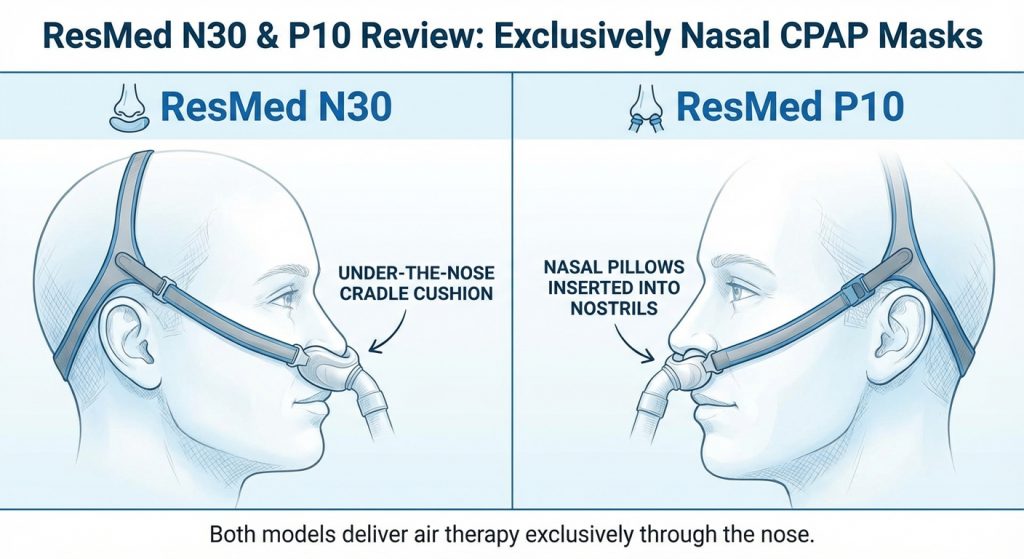
The ResMed AirFit P10 and ResMed AirFit N30 are “front-tube” masks. The air comes directly from the hose to your nose. There is no air channel running past your ears. In practice, many users (including me) find this architecture easier to make quiet, particularly if you are sensitive to sound—though you do give up some freedom because the hose is in front.
Here is my deep dive into whether the silence is worth the leash.
ResMed AirFit P10: The Ninja of Nasal Pillows
If you ask for a recommendation on Reddit or ApneaBoard, a huge portion of people will immediately say “P10!” It’s one of the most commonly recommended minimalist options—and a frequent baseline people compare everything else to.
My Rating: 7.5/10
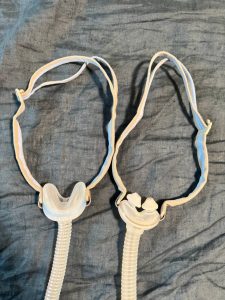
The P10 is a nasal pillows mask. It has two small silicone cones that sit at (and slightly into) your nostrils. It uses a split-strap elastic headgear that looks like two rubber bands.
The Sound of Silence
A key feature of the P10 is its QuietAir venting. Instead of a more concentrated jet of exhaust, it diffuses exhaled air through a woven-mesh-style vent, which ResMed rates at around 21 dBA in its product materials.
In my experience, when the P10 is clean and seated properly, it can be remarkably quiet. On CPAP Talk forums, one of the most repeated observations is that the P10’s exhaust is so diffused that “vent noise” often only becomes noticeable when it’s bouncing off bedding (covers, pillows, etc.).
The Seal and Stability
Here is where the P10 often has an advantage over the N30. Because the pillows anchor at the nares, they create a “mechanical lock.” You can turn your head, sleep on your side, or partially bury your face into a pillow, and the P10 often stays sealed better than cradle-style cushions—assuming sizing is correct and the strap still has elasticity.
This aligns with clinical evidence that interface choice can influence leak, comfort, and adherence—and that nasal interfaces (including pillows) are a common, effective option for many patients (JCSM / American Academy of Sleep Medicine).
The Pain Points (Why I moved on)
However, the P10 is not perfect.
- 1. The “Pig Nose” Effect: To get a seal, many people end up pulling the strap tighter than they should. This can lift the nose tip and irritate the nares. For the first couple of weeks, my nostrils were sore—raw—especially at higher pressures. This is easily the most common complaint you’ll see in groups: “My nose hurts.”
- 2. The Headgear Stretch: This is the fatal flaw. The elastic strap is minimal by design, but it can stretch out over time and become leak-prone. The DIY ecosystem around “fixing” the P10 strap is huge (clips, stitches, staples, swapping in other headgear).
- 3. The “Whipping” Hose: Because the hose attaches to the front, you don’t get the same free-rotation feel as the ResMed P30i/N30i. If you roll aggressively, the hose can tug the pillows and break the seal. You usually have to manage the hose (blanket tuck, routing above the headboard, hose lift).
My opinion: It is a high-performance tool. Excellent seal, very low vent noise, but potentially high physical tax on the nostrils—plus the headgear wear-and-tear tax.
ResMed AirFit N30: The Soft Compromise
The N30 was ResMed’s answer to people who hated things inside their nose. It is a “nasal cradle.” It sits under the nose, covering the nostrils but not entering them.
My Rating: 7.0/10
Comfort King
I put on the N30, and the first thing I felt was… nothing. It is incredibly light. The “cradle” is a curved piece of silicone that hugs the base of the nose.
If you read the comparison threads on r/CPAP, the recurring theme is consistent: many people find the N30 more “forget-it’s-there” comfortable than pillows, especially if pillows irritate their nares or if they have anatomy that makes pillows finicky.
The “QuietAir” Gamble
The N30 uses QuietAir venting as well, and ResMed positions it as a low-noise design.
In practice, it’s a bit more sensitive to real-world variables than the P10. When the N30 is perfectly positioned and the vent path is clear, it can be quiet. But if the vent is partially blocked by bedding, or if there’s moisture/condensation interacting with the vent area, some users report a higher-pitched hiss/whistle (this “moisture + vent whistle” complaint shows up across CPAP communities in general, not just one model).
Also, unlike the P10, the N30 vent sits right on the front of the cushion. If your pillow or blanket presses into that area, back-pressure and airflow direction can change, and sound becomes more noticeable.
The Side-Sleeping Struggle
This is the main reason I rate it lower than the P10. The N30 relies on the tension of the strap to hold the cradle against the nose. It does not have the same “lock” effect pillows do.
When I sleep on my side, the pressure of my bed pillow pushes against the mask. Because the silicone is soft and flexible (which is great for comfort), the cradle can deform or shift slightly. That creates what we call a movement leak.
ResMed markets the N30 as a design that can work for side sleepers, and for some people it absolutely does.
But in day-to-day community troubleshooting, “side-sleeping leaks” are a frequent theme for cradle masks—especially when the cushion is slightly off-angle or the strap is over-tightened and wrinkling the seal.
My Opinion on N30: It is one of the most comfortable masks you can wear while reading a book. But once the lights go out and you start moving, it can demand more “setup discipline” than the P10.
The Comparison: Front Tube vs. The “i” Series (P30i / N30i)
This is the question I see posted every day: “Should I get the N30 or the N30i?”
I spent a year on the “i” series (specifically the ResMed P30i and ResMed N30i). Later, I upgraded to the AirTouch N30i. Here is the blunt truth about how they compare to the front-tube classics.
1. The Noise Factor
This is where the N30 and P10 often win.
The “i” series routes airflow through the frame to a top-of-head connection (that’s the whole point), and many users report they hear their own breathing more clearly—especially when one side of the frame is compressed into a pillow.
- P30i/N30i: You may hear a rhythmic “ocean” sound inside the frame. Side sleeping can amplify it if one side is pinned.
- P10/N30: No air channel runs by your ears; sound tends to be dominated by the vent and whatever it’s reflecting off.
If noise is your primary sleep-disruptor, front-tube masks are often the easier starting point.
2. The Seal Quality
- P30i vs P10: The P30i can stabilize well because the tube-up frame distributes movement. But the top connection can torque the pillow assembly if you move sharply. The P10, despite the flimsy strap, often seals exceptionally well at the nostril because the interface is small and light.
- N30i vs N30: Both are cradle-style cushions, so both can be movement-sensitive. The difference is how forces are applied: the tube-up design changes the direction of tension and hose drag, which for some people improves stability compared to a front hose pulling forward/down.
3. Freedom of Movement
The “i” series wins here, hands down. The top-of-head swivel is designed to keep the hose out of your face so you can roll left/right without fighting a front tether.
With the N30 and P10, you are tethered. You usually learn a hose-management routine (routing up, or “hose flip” when you roll).
The 2025 Game Changer: AirTouch N30i
I mentioned earlier that I moved away from the N30 and P10. Why?
ResMed’s AirTouch N30i became the first tube-up option (in this style) that I found genuinely comfort-forward without feeling slippery. Importantly, the AirTouch N30i is not a “memory foam cushion” in the classic AirTouch sense; ResMed describes it as a mask with a fabric-wrapped frame and a ComfiSoft fabric cushion aimed at softness and reduced facial irritation.
Timeline-wise, ResMed announced AirTouch N30i on September 30, 2024 and stated U.S. availability starting the week of October 28, 2024 (ResMed).
This changed the math for me.
Previously, I used the ResMed N30 because I wanted comfort, but I hated the leaks. The AirTouch N30i improved the “feel” of contact points on my face and reduced the amount of strap tension I needed for a stable night. It also reduced the little squeaks and micro-movements that can happen when silicone shifts against a pillowcase.
However, if you are a purist for silence, even the AirTouch N30i cannot consistently beat the P10. The physics of routing air through a tube-up frame can still create audible breathing resonance for some sleepers.
Community Consensus: What the Data Says
I don’t just trust my own face. To write this, I combed through discussions across Reddit, ApneaBoard, and CPAPtalk—and then sanity-checked the core claims against manufacturer documentation and peer-reviewed interface comparisons so it’s not just forum noise. Here is the aggregated sentiment (expressed as patterns, not made-up “percentages”).
The “P10 is the GOAT” Faction
There is a large, loyal following for the P10, mostly because it seals well with minimal surface area and has very low perceived vent noise.
The universal caveat: the strap. Even people who love the P10 often end up modding, clipping, or otherwise tightening stretched headgear over time.
The “N30 Side-Sleeper” Warning
The N30 tends to have two camps: people who love the comfort and people who cannot keep it sealed when the pillow presses the cushion sideways. The phrase “pushes out of place” is basically the recurring motif in side-sleep troubleshooting.
The “i-Series” Noise Complaint
In direct comparisons, people frequently accept that tube-up masks can be louder to the wearer, but still choose them because hose freedom matters more than absolute quiet. That trade-off is real—and it’s why the “i” series stays popular.
Practical Guide: Which One Should You Choose?
This isn’t about which mask is “best.” It is about which set of trade-offs you prefer to manage. Every mask has a failure mode.
Choose the ResMed AirFit P10 if:
- 1. Silence is your #1 priority. The P10’s QuietAir venting is specifically designed to reduce perceived noise.
- 2. You have facial hair. Pillows bypass the mustache/beard seal zone that can challenge cradle cushions.
- 3. You sleep with your mouth closed (or you manage mouth leak with your preferred method; see our Sleep Mouth Taping Guide).
- 4. You are claustrophobic. This is among the smallest nasal interfaces available.
Choose the ResMed AirFit N30 if:
- 1. Your nostrils are sensitive. You tried pillows, and they hurt.
- 2. You sleep mostly on your back. The stability issues often matter less in the supine position.
- 3. You want to read/watch TV in bed. The visual field is open and the mask is low-profile.
Choose the P30i / N30i / AirTouch N30i if:
- 1. You are an active sleeper. You toss, turn, and rotate frequently; tube-up routing reduces front-hose tug.
- 2. You hate front-hose drag. The top connection keeps the tubing out of your face.
- 3. You want the AirTouch N30i fabric feel. If you want that specific contact experience, it’s currently tied to the N30i tube-up design.
Maintenance and Durability
A quick note on longevity, based on my wallet’s experience.
- The P10 vents: The diffuser can accumulate oils and residue over time. Regular cleaning helps maintain easy exhalation and keeps the vent quiet. ResMed’s product materials emphasize the P10’s minimal parts, which does make routine cleaning simpler.
- The N30 frame/cushion behavior: The N30’s comfort comes from flexible silicone. Over time, cushions can soften and become more movement-sensitive, which can show up as “mysterious” leaks.
- The headgear: As mentioned, the P10 headgear tends to “die young” for some users. The N30 headgear is adjustable, which often improves long-term usability—though any Velcro system eventually wears.
The “Bleep” Alternative
I have to mention this because it is where I ended up. If you try the P10 and hate the strap, and try the N30 and hate the leaks, look at the Bleep Eclipse.
It uses a reusable connector kit plus disposable adhesive “Halos” instead of traditional headgear. That means: no strap tension, no mask lines, and (for some users) extremely stable sealing—at the cost of ongoing consumables and a nightly skin-prep routine (most people de-oil the area so the adhesive bonds consistently).
It’s a commitment. For the average user, the P10 is a much easier starting point.
Frequently Asked Questions (User Experience)
Does the P10 work with the ResMed AirMini?
Yes—officially, with the correct kit, as documented in ResMed’s AirMini materials (ResMed AirMini User Guide). ResMed sells an AirMini-specific P10 mask kit/setup pack because the AirMini system uses a proprietary connection and integrates the HumidX waterless humidification component in the AirMini ecosystem.
Unofficially: third-party adapters exist that let you connect standard masks/hoses, but you generally lose the integrated HumidX-style setup when you go off-label.
Can I use the N30 cushion on the P10 frame?
No. They use different connection mechanisms. However, the **N30i and P30i** are designed around a shared tube-up platform, which is why swapping between cradle and pillows is a common advantage people cite for the “i” series.
How do I stop the N30 from leaking on my side?
The community fix is often not “crank it tighter.” Over-tightening can wrinkle the seal and make leaks worse. Also try “shaping” your pillow to create a small divot for the mask, or invest in a CPAP-specific pillow—like the one mentioned in our Cloudpilo Review—which has cutouts for mask gear.
Is the P10 better for high pressure?
Often, yes—at least in the practical sense that pillows can remain stable because they anchor at the nares. Clinical research has found nasal pillows can perform effectively at higher pressures (including ≥12 cmH₂O) in comparative testing, though individual fit still varies (PubMed).
Summary: Old Tech Still Wins on Decibels
It is tempting to look at the “i” series masks and assume they are upgrades. They aren’t. They are side-grades. They trade silence (and often simpler airflow acoustics) for hose freedom.
For me, Josh, the ResMed AirFit P10 remains the benchmark for performance. I rate it 7.5/10 because, despite the headgear and the initial nostril pain risk, it does the one job a CPAP mask must do: deliver stable therapy without waking me up with leaks.
The ResMed AirFit N30 gets a 7/10. It is a lovely, gentle mask that can be phenomenal for comfort—but it may require more finesse for consistent side-sleeping stability.
If you are new to this, many people find the P10 a straightforward starting point. If your nose can take it, it is often the cleanest path to quiet, stable therapy. If your nose rebels, try the N30. And if you find yourself constantly fighting the hose, only then should you accept the extra noise risk and move to the “i” series—especially the newer AirTouch N30i if comfort is your priority.

By: Alex Warenstein.
Bio: Alex Warenstein is a sleep biohacker and founder of Night Time Comfort. After battling chronic insomnia and circadian disruption, he now helps others optimize their sleep using data-driven protocols. Read full story.
Disclaimer: Alex is not a doctor. This content is for educational purposes only. Always consult a specialist.