I used to think that “blue light” was just a marketing term invented by optic companies to sell expensive coatings on prescription lenses. I sat in front of my monitors all day, scrolling on my phone at night, and wondered why, despite being physically exhausted, my brain felt like it was running a marathon at 11:30 PM. I was “tired but wired,” a state I now know is a hallmark of HPA axis dysregulation and cortisol spikes.
When I started my journey to fix my chronic insomnia and optimize my deep sleep, I realized that light is not just for vision. Light is a drug. It is the primary zeitgeber (time-giver) that tells your Suprachiasmatic Nucleus (the master clock) whether to release cortisol to wake you up or melatonin to put you to sleep.
In 2025, the market is flooded with glasses. You have clear ones, yellow ones, orange ones, and deep red ones. You have $10 pairs from Amazon and $150 pairs endorsed by biohackers. I have spent the last few years—and a significant amount of money—testing the spectrum. I compared Spectra479, Ra Optics, and generic “Amazon cheapies” to answer one question: which specific color spectrum actually protects melatonin production and saves your circadian rhythm?
This is not a review of how they look. This is a review of how they impact your biology.
The Science of Junk Light: Why Your “Computer Glasses” Don’t Work for Sleep
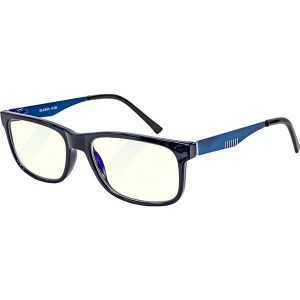
Before we get into the brands, we have to address the biggest misconception in this industry, one that I fell for early on. Most people buy “blue light glasses” to prevent eye strain or headaches during the workday. These lenses are usually clear or have a very faint yellow tint.
If your goal is to reduce digital eye strain, those are fine. But if your goal is melatonin protection glasses to fix your sleep, clear lenses are useless.
Here is the science as we understand it in late 2025. Our eyes contain special cells called Intrinsically Photosensitive Retinal Ganglion Cells (ipRGCs). These cells contain a photopigment called melanopsin, which is exquisitely sensitive to a specific range of light. When these cells detect light in the blue and green spectrum, they send a direct signal to the brain: “It is noon. Be alert.”
Recent research, including a pivotal 2025 review in Translational Vision Science & Technology, has shifted our understanding. We used to think the danger zone was strictly blue light (around 460nm). We now know that the circadian system is sensitive to a broader range, extending well into the green spectrum (up to 550nm).
Clear or lightly tinted lenses might block 20% to 30% of blue light spikes from an LED screen. That is not enough. To physically prevent the suppression of melatonin, you need to block nearly 100% of the signal in the 460–480nm range and a significant portion of the green spectrum.
This is why, if you are serious about sleep, you have to look at colored lenses. The darker the lens, generally, the higher the “Circadian Reduction” or Melanopic Filtering—a metric that matters far more than the marketing claims on the box.
The Contenders: Red vs. Amber vs. Yellow
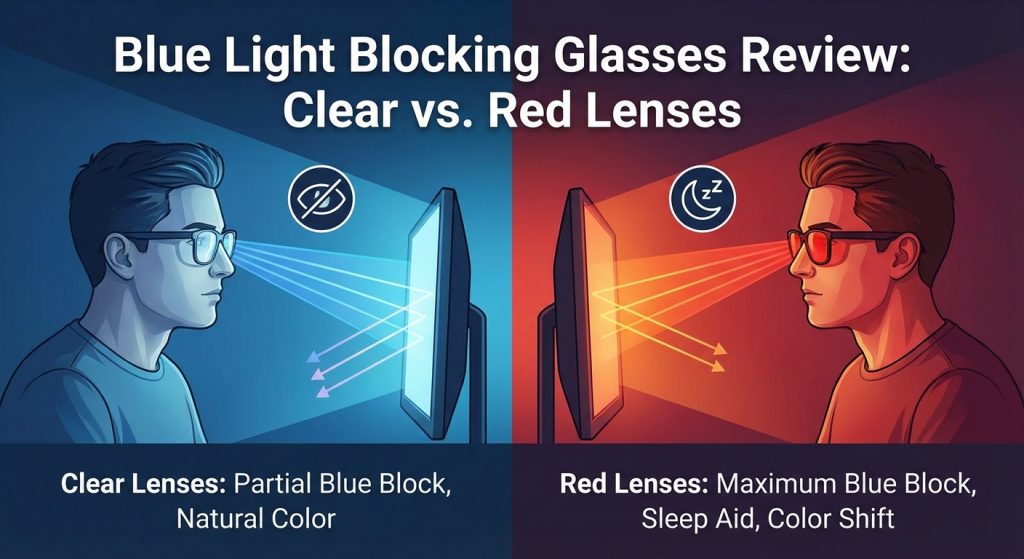
I have tested three distinct categories of glasses. My testing protocol involved wearing them consistently starting at sunset (or 2 hours before bed) and tracking my sleep metrics—specifically Sleep Onset Latency and Deep Sleep duration—using my Apple watch ultra 2 (Bevel app).
1. The “Daytime” Yellows (Ra Optics Daylight / Generic Yellows)
- These are meant for daytime use under fluorescent office lights. They take the harsh edge off the white light but allow enough blue light through to keep you awake.
- My Experience: Good for preventing headaches at 2 PM. Useless for falling asleep at 10 PM. If I wore these at night, my Apple Watch sleep tracking accuracy showed no improvement in onset latency. I was still getting the “daytime” signal.
2. The “Twilight” Ambers (Spectra479 / Uvex)
- These are the most common “biohacker” glasses. They block 100% of blue light up to around 500nm but let some green in.
- My Experience: This is the sweet spot for many. When I wear these, the world looks orange, but I can still navigate my house and watch a movie without it looking too distorted.
3. The “Blackout” Reds (Ra Optics Sunset / TrueDark)
- These are the heavy artillery. They block blue (400-495nm) and the majority of green light (up to 550nm).
- My Experience: Putting these on causes an immediate physiological shift. It is almost like taking a low dose of Apigenin or a Melatonin Spray. The visual input is so dim and red that my brain assumes the sun has set. However, color perception is gone. Traffic lights, phone apps, and movies become hard to decipher.
- The Tech: Independent lab tests from databases like “Optimize Your Biology” show that Ra Optics Dark Amber (Sunset) lenses are absolute powerhouses. They block roughly 99.7% of blue light and, critically, over 92% of green light. Their “Circadian Reduction” score is nearly 98.4%. This is clinical-grade darkness.
- The Build: This is where they justify the price. They look like high-end Italian sunglasses. They use quality acetate frames. When I wear them, I look eccentric, but I don’t look like I’m working on a construction site.
- My Experience: These are the most effective glasses I have verified. When I commit to wearing them at 8:00 PM, I am yawning by 9:30 PM. The “tired but wired” feeling—that buzzing anxiety in the chest—seems to dampen. My Apple Watch sleep data showed a consistent reduction in sleep onset latency (the time it takes to fall asleep) by about 10-15 minutes on nights I wore them versus nights I didn’t.
- The Tech: Their marketing is less flashy, but the data is solid. They block 99.7% of blue light and about 84% of green light. Their “Circadian Reduction” is around 97.5%. It is marginally less green-blocking than the Ra Optics Sunset, but statistically, it is very close.
- The Build: They are sporty, wraparound style. They are lightweight but feel a bit cheaper than Ra Optics. However, the wraparound design is actually superior for blocking “peripheral light leakage”—light that sneaks in from the sides of your eyes.
- My Experience: Functionally, these worked just as well for me as the expensive pair. The visual clarity is excellent. If you don’t care about fashion and just want melatonin protection glasses that work, this is the logical choice.
- The Tech: The Uvex Skypers are legendary in the community. Independent tests show they block nearly 98% of blue light. They are surprisingly effective. The generic red ones, however, were a disaster. They were just red-tinted plastic that didn’t actually filter the specific wavelengths, proving that “red” does not automatically mean “protective.”
- The Build: Terrible. Uncomfortable, scratching my nose, fogging up. My wife refused to be in the same room with me when I wore the Uvex glasses because I looked like a mad scientist.
- My Experience: The Uvex worked. I felt sleepy. But they were so uncomfortable that I took them off constantly to rub my nose or adjust them, exposing my eyes to the very light I was trying to block. Comfort is a compliance factor.
- Amber/Dark Yellow lenses allow you to function. You can watch TV, you can read a book, and you can interact with your family without total disorientation. They block the specific 460-480nm spike that LED bulbs emit.
- Red Lenses are the “nuclear option.” By blocking green, they provide a deeper signal of darkness. There is a theory, supported by some in the biohacking community like Dave Asprey, that our skin and eyes have mitochondria that react to green light as a daytime signal.
- For me, Red Lens glasses are too restrictive for daily evening use. I cannot cook dinner in them (I can’t tell if the meat is cooked). I cannot enjoy a film. I found myself taking them off to “see clearly” for a second, which defeats the purpose.
- My personal preference settled on the Dark Amber spectrum (like Spectra479 or Ra Optics Sunset). It offers 99% of the benefit with 50% less annoyance.
- 1. Metabolic Signal: I stop eating 3 hours before bed to prevent insulin spikes.
- 2. Chemical Signal: I take Magnesium L-Threonate and Apigenin 50mg about an hour before sleep to prime the GABA receptors.
- 3. Light Signal: I put on the glasses 2 hours before bed. This is the physical barrier that allows the supplements to work. If you take melatonin supplements but blast your eyes with blue light, you are stepping on the gas and the brake at the same time.
- 1. Skip the Clear: The community has largely turned against “clear blue blockers” for sleep. They are viewed as placebo for insomnia.
- 2. Ra Optics is the Gold Standard: Despite the high price, Ra Optics is consistently cited as the best for clarity and build quality. Users like “The Quantified Scientist” have provided data backing their efficacy.
- 3. Consistency is Key: The most common review isn’t about the lens color, but the habit. People who put them on every single night at the same time report the best results in stabilizing their circadian rhythms.
- 4. Green Light Matters: More users are acknowledging that standard yellow lenses aren’t enough if you have very bright modern LED lights in your home, pushing people toward darker amber or red options.
- Scientifically proven to preserve melatonin if the spectrum is right.
- Drastically reduces eye strain in the evening.
- Noticeable effect on sleepiness (the “yawn” reflex).
- Color distortion makes movies and phone use difficult (especially with red lenses).
- Socially awkward.
- Uncomfortable to wear over prescription glasses (unless you buy fit-overs).
- Cheap versions are often fake and non-functional.
Detailed Brand Review
Ra Optics (Sunset Lenses)
Ra Optics, founded by Matt Maruca, is the brand you see on every major biohacker, from the Huberman protocol followers to The Quantified Scientist.
Spectra479 (Amber Lenses)
Spectra479 is a brand that focuses purely on the science of the 479nm wavelength—the peak sensitivity for melanopsin.
The “Amazon Cheapies” (Uvex Skyper / DeWalt / Generic)
I bought a pair of Uvex Skyper safety glasses for about $15. I also tried a generic “red lens” pair that cost $20.
The Great Debate: Amber vs. Red Lenses
So, which spectrum should you choose?
If you look at the 2025 data from the “Optimize Your Biology” database, the difference in “Circadian Reduction” between a high-quality Amber (like Spectra479) and a high-quality Red (like Ra Optics Sunset) is often less than 5% (97.5% vs 98.4%).
However, the visual experience is vastly different.
Integrating Glasses into Your Stack
Wearing these glasses is part of a broader protocol. You cannot put these on and then drink a double espresso. Here is how they fit into the workflow:
It is also worth mentioning that if you use Red Light Therapy panels (like a FlexBeam or Joovv) in the evening, you do not need to wear these glasses during the session, as the red light itself is not suppressive. But the moment you step out of that red light and into your hallway? The glasses go back on.
The Social Friction Factor
I have to be honest with you. This is the hardest part.
Wearing orange or red glasses makes you look strange. When my son brings friends over, I feel self-conscious. When I want to have a serious conversation with my wife, she says she can’t take me seriously when I look like Bono from 1995.
This “social friction” is the number one reason I fail to use them. It’s not that they don’t work; it’s that I feel silly wearing them. I have spoken to many people on forums who feel the same. We often sacrifice our biology for social conformity.
To combat this, I established a rule: after 9:00 PM, the house is a “low light zone.” We turn off the overhead LEDs and rely on lamps with warm bulbs. This lowers the ambient blue light level, so if I do take the glasses off, the damage is minimized.
What The Community Says (2025 Consensus)
I spend a lot of time on r/Biohackers and Sleephq, and the consensus has shifted in the last year.
Alex’s Review: 7/10
My Take: I am giving these a 7 out of 10. Why not higher? Because the technology works perfectly (10/10), but the human element fails. I find it incredibly difficult to remember to wear them every night, and the social awkwardness of wearing red goggles around family and friends creates a barrier to consistency. When I wear them, my deep sleep improves and I fall asleep faster. But all too often, I find them sitting on the nightstand the next morning, unused.
If you live alone or have a partner who is also a biohacker, these might be a 10/10 for you. For a regular guy trying to be a normal father and husband, they require a lot of discipline.
Pros:
Cons:
Summary
Do blue light blocking glasses work? Yes, but only if they block the correct spectrum.
If you are buying clear lenses hoping to cure your insomnia, you are wasting your money. You need lenses that look visibly amber, orange, or red.
For the absolute best protection of your melatonin levels, deep red lenses are superior because they block the green spectrum. However, they are difficult to live with. High-quality Dark Amber lenses (like Spectra479 or Ra Optics) offer the best balance of “circadian protection” and “actually being able to see your life.”
They are a tool, not a magic pill. They work best when combined with a dark room, sleep hygiene, and a cool temperature.

By: Alex Warenstein.
Bio: Alex Warenstein is a sleep biohacker and founder of Night Time Comfort. After battling chronic insomnia and circadian disruption, he now helps others optimize their sleep using data-driven protocols. Read full story.
Disclaimer: Alex is not a doctor. This content is for educational purposes only. Always consult a specialist.