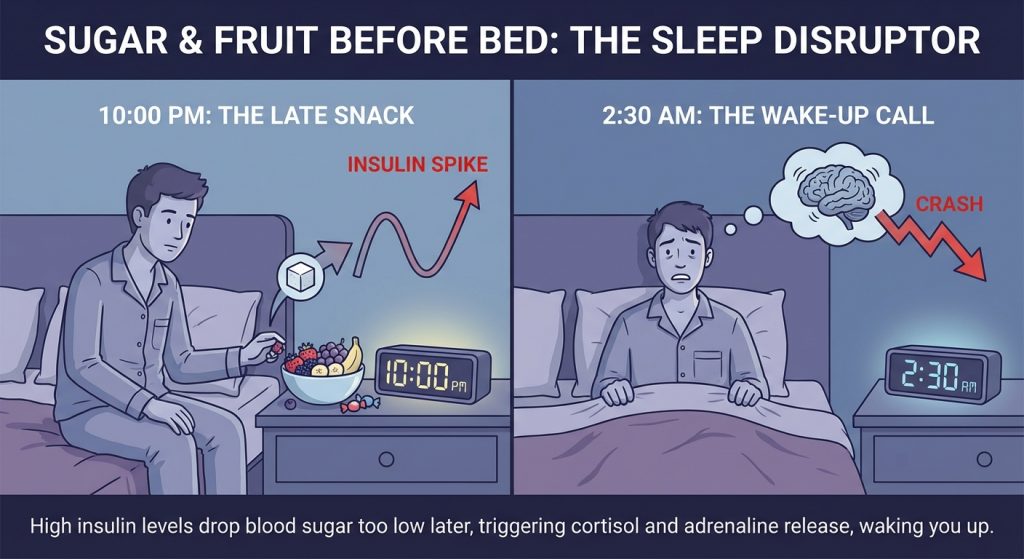
You finish dinner at 7 PM. Around 9:30 PM, you feel a little peckish, so you grab a “healthy” snack—maybe an apple, a handful of grapes, or a square of dark chocolate. You fall asleep fine.
But at 3:00 AM, you jolt awake. Your heart is racing, you feel hot, and your mind is instantly alert.
You blame stress. You blame the dog. But in a surprising number of cases, the trigger is that late-night ‘healthy’ carb—yes, even an apple.
This guide explains the biology of sugar before bed, why even “healthy” fruit can disrupt sleep for some people, and which food groups most commonly wreck your night.
The Mechanism: The Glucose Rollercoaster
Meal timing interacts with circadian biology and glucose regulation—especially insulin, glucose, and stress hormones like cortisol (Harvard Sleep Medicine).
- Phase 1: The Spike
When you eat simple carbohydrates (sugar, fruit, white rice, candy) without protein or fat, your blood sugar (glucose) shoots up rapidly.
The Feeling: You might feel a short burst of energy or a “sugar high,” followed by drowsiness (the “food coma”). This drowsiness is often mistaken for healthy sleepiness.
- Phase 2: The Crash (The Wake-Up Call)
Your pancreas detects the high blood sugar and floods your system with insulin to store the excess glucose. Because simple carbs digest so fast, the insulin often works too well.
The Drop: About 3 to 4 hours after eating (right in the middle of your sleep), your blood sugar plummets below baseline.
The Panic Button: If glucose drops fast enough, your body may counter with “fight-or-flight” hormones (especially adrenaline/epinephrine), which can feel like a sudden jolt awake—racing heart, sweating, anxiety (American Diabetes Association).
The Result: Some people wake up with a pounding heart, sweating, and feeling “wired”—a pattern many describe as “sugar insomnia.”
The Myth of the “Healthy” Bedtime Snack: Fruit
One of the most common mistakes people make is assuming that because fruit is natural, it is safe for sleep.
Fructose and Liver Stress
While fruit contains fiber, portion size and ripeness still matter—especially late at night.
Apples, Grapes, and Bananas: Depending on portion and ripeness, these can raise glucose fairly quickly for some people when eaten “naked” at night.
The Liver: Fructose is processed largely by the liver; a late sweet snack can keep digestion and metabolism more “active” when your body is trying to wind down.
Temperature: Deep sleep typically starts as your body gradually cools down, so anything that keeps you metabolically “revved up” close to bed can make sleep feel lighter.
Better Alternatives
If you must have fruit, choose low-glycemic berries (raspberries, blackberries) and pair them with a fat source (like almond butter or heavy cream) to blunt the spike (see our guide on Best Bedtime Snacks for Deep Sleep).
Bad Food for Sleep: The “No-Go” List
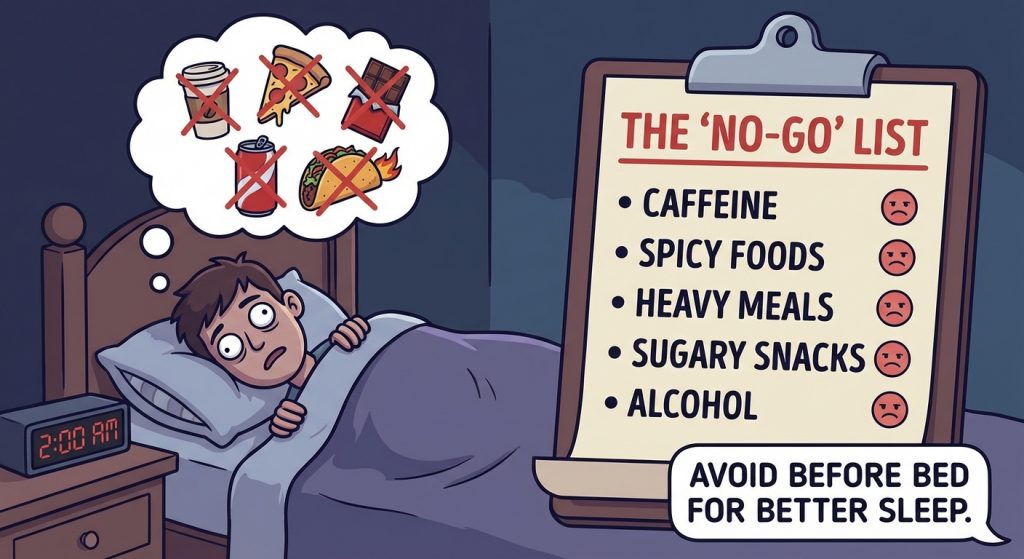
Beyond fruit, there are specific categories of food that destroy sleep architecture.
- 1. The “Hidden” Sugars (Desserts & Processed Snacks)
This is obvious, but it bears repeating. Ice cream, cookies, and even “healthy” granola bars are packed with processed sugar.Effect: Often a large insulin response, followed by a dip a few hours later in people who are sensitive to late sugar.
The 3 AM Pattern: If you consistently wake up at 3 AM, cut processed sugar after 6 PM for three days and see whether the wake-ups improve.
- 2. Dark Chocolate (The Theobromine Trap)
Many health-conscious people eat 85% or 90% dark chocolate before bed.The Problem: Cocoa contains theobromine (and some Caffeine), and theobromine can increase heart rate in some people—one reason dark chocolate can be quietly stimulating at night (Cleveland Clinic).
The Result: While it might not make you feel “wired” like coffee, it prevents your resting heart rate from dropping low enough to enter deep sleep.
- 3. Salty Snacks (Chips & Popcorn)
Late-night salt cravings are usually driven by habit, dehydration, or simple comfort-eating—but giving in to chips is still a trap.Dehydration: Salt draws water out of your cells. This triggers a thirst signal in the middle of the night.
Nocturia: If you drink water to quench that thirst, you will wake up to pee.Blood Pressure: High sodium can raise blood pressure, and the American Heart Association recommends no more than 2,300 mg/day (ideal <1,500 mg for most adults)—the opposite direction of the normal overnight dip.
- 4. Spicy Foods (Capsaicin)
Thermoregulation: Spicy food raises your body temperature.
Heartburn: Certain foods (including spicy foods) can trigger heartburn for some people, and lying down soon after eating can worsen reflux and fragment sleep—even when the “burn” isn’t obvious (Mayo Clinic).
- 5. Sugar-Free Candy & Gum (Polyols)
You might think skipping the sugar and eating “Sugar-Free” gummies is a hack. It isn’t.The Culprit: Sorbitol, Mannitol, Xylitol (Sugar Alcohols).
The Effect: These are osmotic laxatives. They pull water into your intestines. This causes gas, bloating, and increased pressure on the bladder.The Result: You wake up needing to use the bathroom (Nocturia), not because you drank too much water, but because the sweetener irritated your gut (Read more in Stop Waking Up to Pee: Nocturia).
- 6. Acidic Foods (Tomatoes & Citrus)
Bladder Irritation: Acidic foods (like tomato products or orange juice) can be a trigger for some people—especially those with a sensitive bladder—so a late serving can translate into nighttime urgency (NIDDK).
Tracking the Crash: Technology
How do you know if your 3 AM wake-up is glucose crash sleep or something else?
1. The Freestyle Libre 3 (CGM)
As detailed in our Nocturnal Hypoglycemia guide, using a Continuous Glucose Monitor is one of the clearest ways to confirm (or rule out) a nighttime glucose dip; if you’re managing diabetes or using glucose-lowering meds, review nighttime low readings with your clinician.
What to watch: Look for the spike after your evening snack, followed by a steep drop into the red zone (hypoglycemia) at the exact time you woke up.
2. The Pulse Test (O2Ring/Watch)
If you don’t have a CGM, look at your heart rate data.
The Pattern: If your heart rate spikes suddenly (e.g., from 55 to 90 bpm) at 3 AM without any movement preceding it, this is often the adrenaline surge from a sugar crash.Reddit & Community Consensus
On biohacking and insomnia forums, the connection between diet and sleep is a hot topic.
- “The Honey Hack”: Some users argue that a small amount of raw honey (1 tsp) before bed actually helps. The theory is that it restocks liver glycogen just enough to prevent the liver from running out of fuel, but not enough to cause a massive spike. Note: This works for some, but fails for those with severe insulin resistance.
- “The Protein Anchor”: The most consistent advice is to never eat carbs at night “naked.” Always wrap them in protein or fat. Eating an apple alone = crash. Eating an apple with beef jerky = stable sleep.
- “The Alcohol Rebound”: Users consistently report that alcohol is the worst offender. Alcohol can impair the liver’s overnight glucose handling and make blood sugar swings more likely—one reason many people report worse 2–4 AM wake-ups after drinking.
Summary
If you are struggling with sleep maintenance (staying asleep), your kitchen is the first place to look.
The Rules:
- 1. Stop: No fruit, candy, chocolate, or simple carbs 3 hours before bed.
- 2. Avoid: “Sugar-Free” sweeteners that upset the bladder.
- 3. Swap: If you need a snack, choose protein or fat (See Best Bedtime Snacks for Deep Sleep).
- 4. Test: If you aren’t sure, use a Freestyle Libre 3 for two weeks to see exactly how that “healthy” apple affects your biology.
Food is information. Don’t send your body a “wake up” signal right before you want to shut down.

By: Alex Warenstein.
Bio: Alex Warenstein is a sleep biohacker and founder of Night Time Comfort. After battling chronic insomnia and circadian disruption, he now helps others optimize their sleep using data-driven protocols. Read full story.
Disclaimer: Alex is not a doctor. This content is for educational purposes only. Always consult a specialist. - 1. The “Hidden” Sugars (Desserts & Processed Snacks)