The Invisible Choke : Silent Reflux
I don’t have acid reflux. I can drink a double espresso at 8 PM and sleep like a baby (well, as much as my O2Ring and circadian rhythm allow me to). My stomach is lined with steel.
But my friend Mark? Mark is a different story.
About six months ago, Mark called me in a panic. He knows I run this site and spend my nights analyzing sleep data like a lunatic. “Alex,” he said, “I think I have Sleep Apnea. I’m waking up gasping. My throat is on fire every morning. I feel like I’m choking on air.”
Naturally, I told him to get tested. He did a home sleep test. The result? A mild AHI (Apnea-Hypopnea Index) of 4. Not great, but technically not “clinical apnea.” He tried a CPAP anyway. It made things worse. The air pressure seemed to inflate his stomach, and he woke up burping and miserable.
Mark didn’t have Obstructive Sleep Apnea. He didn’t have standard heartburn. He had the “Silent Killer” of sleep quality: Laryngopharyngeal Reflux (LPR), also known as Silent Reflux.
If you are waking up with a metallic taste in your mouth, a lump in your throat, or a cough that won’t quit, but you never feel chest burn—this article is for you.
LPR vs. GERD: The Mist vs. The River
Most people know GERD (Gastroesophageal Reflux Disease). That’s the burning river. You eat a spicy taco, and an hour later, you feel liquid fire rising behind your breastbone. You know it’s happening. You pop a Tums, and you move on.
Silent Reflux (LPR) is entirely different. It is a stealth assassin.
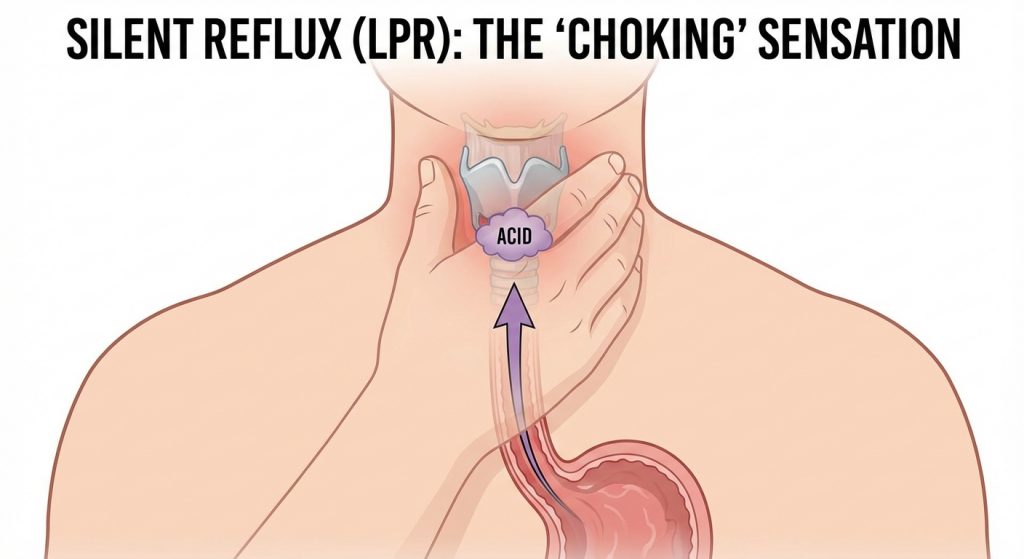
In LPR, the stomach contents don’t just stop in the esophagus; they travel all the way up through the Upper Esophageal Sphincter (UES) and spray into your throat, voice box (larynx), and sometimes even your nasal passages.
Here is the kicker: You don’t need to feel heartburn to have LPR.
The stomach lining is built to handle acid. The esophagus is somewhat tough. But your vocal cords and throat tissues? They are incredibly delicate. They can be damaged by a tiny amount of reflux that you don’t even feel happening while you sleep.
The “Pepsin” Problem
For years, doctors thought acid was the only enemy. In 2025, we know better. The real villain in LPR is an enzyme called Pepsin.
Pepsin is a stomach enzyme designed to digest protein. When you reflux at night, pepsin is sprayed onto your throat tissues. It binds to the cells in your larynx. It sits there, waiting. The next day, you drink a carbonated water or eat something mildly acidic, and bam—the pepsin reactivates and starts digesting your own throat cells. This causes inflammation, swelling, and that sensation of a “lump” in your throat (Globus Sensation).
The Diagnostic Checklist: Do You Have LPR?
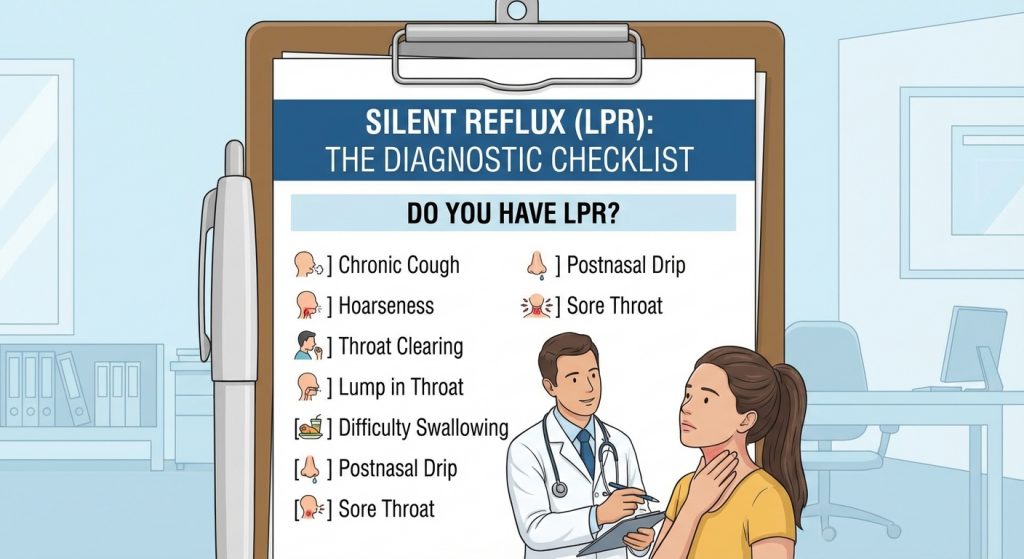
Mark didn’t believe me at first because he “didn’t have heartburn.” If this sounds like you, check these symptoms against your experience:
- 1. The Morning Voice: Do you sound like you smoked a pack of cigarettes when you wake up? Hoarseness is a classic sign of vocal cord damage.
- 2. The Lump (Globus): Do you feel like there is a pill stuck in your throat that you can’t swallow? That is swelling, not an obstruction.
- 3. Chronic Throat Clearing: Do you constantly clear your throat, but nothing comes up? That is your body trying to clear the mucus produced to protect against the pepsin.
- 4. The Metallic Taste: Waking up with a sour or bitter taste in the mouth.
- 5. Pseudo-Asthma: Coughing fits at night or difficulty breathing in deep.
The Sleep Saboteur: Why It Wakes You Up
Why is this on a sleep site? Because acid reflux insomnia is real, and it creates a vicious cycle with sleep apnea.
When you lay flat (supine), gravity—your best defense against reflux—is gone. If your Lower Esophageal Sphincter (LES) is weak (hello, stress and age), the door flies open.
The Apnea-Reflux Loop
This is what happened to Mark. He likely had Upper Airway Resistance Syndrome (UARS). When his airway narrowed at night, his body had to struggle to breathe in. This struggle creates negative pressure in the chest—essentially a vacuum effect.
Think of a syringe. When you pull the plunger back (diaphragm pulling down against a closed throat), it sucks liquid up. Mark was literally vacuuming stomach acid into his throat with every struggling breath. The acid hit his vocal cords, causing a spasm (laryngospasm), and he would wake up choking.
If you suspect this, you need to differentiate. An O2Ring can help. If you see massive oxygen drops (below 90%), you might have Apnea driving the reflux. If your oxygen is stable but you still wake up choking, it’s likely pure LPR.
The Protocol: How Mark Fixed the Plumbing
You cannot “cure” reflux with just a pill. PPIs (Proton Pump Inhibitors like Omeprazole) are often prescribed, but Mark found out quickly that they didn’t solve his specific problem. The data in 2025 suggests they are less effective for LPR than for GERD because they stop acid, but they don’t stop the reflux event itself, and they don’t clean up the pepsin.
Mark is stubborn. He refused to accept that choking in his sleep was his new normal. He spent weeks digging through the same forums I frequent, piecing together a strategy based on biohacking consensus and clinical papers. Here is the setup that finally worked for him.
1. Mechanical Defense: Gravity is King
Mark realized he had to stop the liquid from physically travelling up.
- The Wedge Pillow Failure: Like most people, Mark first bought a cheap foam wedge from Amazon. It was a disaster. He kept sliding down it during the night, which crunched his stomach and actually made the reflux worse.
- The Solution: He found a better way online: elevating the entire head of the bed. He bought 6-inch bed risers and placed them under the front legs of his bed frame. It looks ridiculous, and his wife hated it initially, but he told me the results were instant. The entire bed is on a slant, so gravity works for him 100% of the night without bending his spine.
- Sleeping on the Left Side: This turned out to be non-negotiable. Mark learned that because the stomach is curved, sleeping on the left side keeps the stomach below the esophagus. When he slept on his right, the exit (LES) was submerged in acid. He even resorted to the “backpack technique” (wearing a t-shirt with a tennis ball sewn into the back) for a few weeks to train himself to stay off his back.
2. Chemical Defense: The Alginate Raft
This is the biggest secret in the LPR community.
In the US, standard antacids just neutralize acid. In the UK, there is a product called Gaviscon Advance.
- Why it’s different: The UK version contains a high concentration of Sodium Alginate (from seaweed). When it hits your stomach acid, it forms a thick, foamy “raft” that floats on top of your food.
- The Effect: It creates a physical cork. If you reflux, the raft hits the esophagus first, coating it and blocking the acid/pepsin.
- The Hack: You can buy Gaviscon Advance (Aniseed flavor is potent, but effective) on Amazon via importers. If you are in the US and can’t wait, a brand called Reflux Gourmet is a solid alternative with a similar alginate mechanism.
- Dosage: Take 10ml after your last meal and before bed. Do not drink water after taking it, or you break the raft.
3. The Pepsin Wash: Alkaline Water
Remember the Pepsin enzyme that eats your throat? It is invincible against acid, but it has a kryptonite: Alkalinity.
Studies (championed by Dr. Jamie Koufman) show that water with a pH of 8.8 or higher permanently kills pepsin on contact.
- The Protocol: Buy alkaline water (Essentia or similar, verify pH > 8.8). Keep it on your nightstand. If you wake up coughing, do not just drink it. Gargle it deep in your throat and then swallow. You are physically washing the enzyme off your tissue. Mark keeps a spray bottle of alkaline water to mist his throat before bed.
4. Supplement Strategy: Tightening the Sphincter
Mark read that the goal wasn’t just to neutralize acid, but to make the LES (the valve) tighter so it doesn’t open at night.
- Melatonin: I use Melatonin for sleep onset, but Mark found research suggesting it’s also produced in the gut and can increase LES tone. He started using a Melatonin Spray (small dose, 1-2mg) and felt it helped not just his sleep, but his digestion too.
- D-Limonene: He stumbled upon this terpene (from orange peels) in a forum thread. The internet loves it, though the mechanism is debated. Mark tried it (1000mg capsule every other day). He told me it caused him more heartburn initially (the “orange burps”), but after two weeks, he felt it helped promote gastric clearing. He uses it with caution.
- Warning on Magnesium: I swear by Magnesium L-Threonate for deep sleep. Mark tried it, but he also experimented with Magnesium Glycinate. He mentioned that the Glycinate form seemed to relax his stomach muscles too much, worsening his reflux. He cycled off it for a week, and his symptoms improved. It’s a good reminder that what works for my sleep might not work for his physiology.
The Anti-Sleep Diet: Triggers
You know about coffee and spicy food. But LPR triggers are weirder.
- Mint: Menthol is a potent relaxant for the LES. Never drink peppermint tea before bed if you have reflux. It guarantees an open valve.
- Chocolate: Contains methylxanthine, another valve relaxant.
- The 3-Hour Rule: This is part of my Sleep Hygiene Checklist, but for LPR, it is critical. You cannot have food in your stomach when you lie down. Dinner at 7 PM. Bed at 11 PM. No snacks. No “healthy” apple (acidic). Nothing but water (preferably alkaline).
The Stress-Reflux Loop
This is where our experiences overlapped. Mark noticed a direct link to the “Tired but Wired” syndrome I often talk about. Stress activates the sympathetic nervous system (fight or flight), while digestion is a parasympathetic process (rest and digest).
Mark realized that when he was stressed, his digestion essentially stopped. Food sat in his stomach longer (delayed gastric emptying), increasing the chance of reflux.
He started using the 4-7-8 Breathing technique before meals—not just before bed. He told me that taking those few minutes to switch his body into “digest mode” made a noticeable difference in how he felt after eating.
2025 Community & Research Update
Latest trends from r/LPR, SleepHQ, and Biohacking Forums (Dec 2025)
The “IQoro” Device Debate:
A significant topic on Reddit/LPR groups in late 2025 is the IQoro device. It is a neuromuscular training tool from Sweden designed to strengthen the diaphragm and the muscles involved in swallowing.
Consensus: The community is divided but leaning positive. Many users report that after 3–6 months of daily training (pulling on the device with lips sealed), their LPR symptoms reduced significantly without medication. It effectively “gym trains” the internal sphincters.
My Take: It is expensive for a piece of plastic, but for those who want to avoid long-term PPIs, the mechanical training logic holds up.
Alginates > PPIs:
There is a massive shift in the community away from long-term Omeprazole use for LPR. New meta-analyses discussed on Pubmed and forums suggest that because LPR is often “non-acidic” (gas or pepsin-based), acid suppressors don’t solve the issue. The “Raft Therapy” (Alginates) is now considered the gold standard by patient advocacy groups because it blocks the event, not just the acid.
The “Baking Soda” Nasal Spray:
A niche but growing biohack involves neutralizing pepsin in the sinuses (for those with post-nasal drip LPR). Users are mixing a tiny amount of sodium bicarbonate (baking soda) and alkaline water into a nasal rinse bottle.
Warning: While the chemistry makes sense (alkalinity deactivates pepsin), messing with nasal pH can be risky for infection. Stick to the throat gargle unless advised by an ENT.
Stress & The Vagus Nerve:
There is increasing chatter about the “Vagus-Reflux” connection. Some biohackers using taVNS devices (like the Zenowell I reviewed) for anxiety are reporting incidental improvements in their reflux, likely due to better parasympathetic tone aiding digestion.
Summary: The LPR Rescue Plan
If you suspect Silent Reflux is ruining your sleep, stop guessing and start engineering your environment.
- 1. Elevate: Put 6-inch risers under the head of your bed. Pillows are not enough.
- 2. Position: Force yourself to sleep on your left side to let anatomy help you.
- 3. The Raft: Use Gaviscon Advance (UK) or Reflux Gourmet before bed to create a physical barrier.
- 4. The Wash: Gargle with pH 8.8 Alkaline Water to kill the pepsin enzyme in your throat.
- 5. Diet: Absolute prohibition on food 3 hours before sleep. Avoid mint and chocolate.
- 6. Rule out Apnea: If you are gasping, check your SpO2 data. Reflux can be a symptom of a closed airway, not just a stomach issue.
Reflux doesn’t have to burn to leave scars. Treat the silence before it screams.

By: Alex Warenstein.
Bio: Alex Warenstein is a sleep biohacker and founder of Night Time Comfort. After battling chronic insomnia and circadian disruption, he now helps others optimize their sleep using data-driven protocols. Read full story.
Disclaimer: Alex is not a doctor. This content is for educational purposes only. Always consult a specialist.