
If you’re not diabetic but you keep waking up at 3:00 a.m., 4:00 a.m., or 5:00 a.m., it’s normal to wonder whether something “metabolic” is happening—especially if those wake-ups follow a late dinner, dessert, or alcohol. This review is written for non-diabetics who want to use a Freestyle Libre 3 CGM specifically to rule in or rule out overnight glucose dips as a trigger for awakenings.
That framing matters. A CGM is not a sleep tracker, and most night awakenings are not caused by glucose. But a CGM can answer one very practical question: “Do my wake-ups line up with a meaningful glucose drop after certain meals or meal timing?” If yes, you can run simple, low-effort experiments (change dinner timing, composition, or add a small bedtime snack) and see whether the pattern changes.
The FreeStyle Libre 3 family is one of the easiest CGM options to use: small sensor on the back of the arm, automatic streaming to your phone, and (depending on the version) up to about two weeks of wear. It’s a strong “short-term investigation tool” for people who want to understand whether late food choices are followed by overnight dips.
Where people get into trouble is interpretation—especially at night. Compression lows (sleeping on the sensor), sensor lag, and even rare manufacturing-lot issues can create scary-looking “lows” that aren’t real. The good news: once you know the failure modes, Libre becomes much more useful—and much less anxiety-provoking. (LloydsPharmacy)
What Libre 3 actually measures
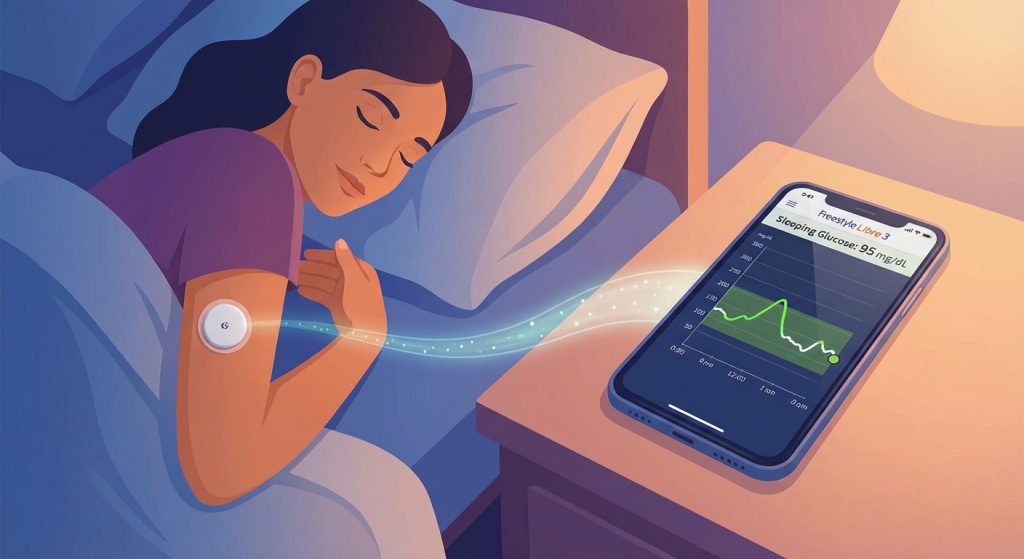
Libre 3 measures glucose in interstitial fluid (the fluid between cells), not directly in blood. That means your CGM value can lag behind a fingerstick during fast changes (like after a sugary meal, intense exercise, or a quick drop). At night, this matters because your graph may show the drop a bit later than your symptoms. (ADCES)
Libre 3 streams frequent readings to your phone (minute-to-minute in many setups), and alarm delivery depends on having your phone close enough to the sensor.
Why late dinners can lead to 3 a.m. wake-ups
For some people, a late meal—especially one that’s heavy on fast carbs—can set up a pattern like this:
- 1. Big glucose rise after dinner/dessert.
- 2. Strong insulin response (your body tries to bring glucose down).
- 3. Overshoot (glucose drops faster or farther than your body “likes”).
- 4. You wake up—sometimes with a “wired,” hungry, shaky, sweaty, or anxious feeling.
Not everyone experiences this, and true clinically significant hypoglycemia in non-diabetics is uncommon. But relative drops (a fast fall, even if it doesn’t go dangerously low) can still feel disruptive—especially if it happens consistently after certain foods or eating late.
Libre 3 is useful here because it can reveal whether your awakenings cluster around (a) a fast downward slope, (b) a specific threshold (often around the 70–90 mg/dL area for sensitive sleepers), or (c) no glucose change at all (which pushes you to look elsewhere).
“How accurate is Libre 3 for non-diabetics at night?”
Two practical realities:
- Device accuracy: In a 2025 head-to-head evaluation comparing several CGMs (including Libre 3), Libre 3 showed overall accuracy in the range you’d expect for modern CGMs (reported as overall MARD values in the ~9–12% range depending on the reference method), and performance varied by glucose range (as it does with every CGM). (PMC)
- Night-specific issues: Your biggest “night accuracy” threats are not daytime-style calibration problems—they’re compression lows and lag during fast changes.
In other words: Libre 3 can be accurate enough to answer your sleep question *if* you interpret nights with a CGM-specific mindset (trend + context), and you treat any surprising low as something to verify rather than something to panic over. For diabetics, the FDA also emphasizes using a meter when CGM readings don’t match symptoms or expectations. That principle is just as important for non-diabetics who are using CGM as a diagnostic tool.
The night traps that confuse almost everyone
- 1. Compression lows
This is the classic “I rolled onto the sensor and the CGM thinks I’m crashing” problem. Pressure on the sensor site can reduce local fluid flow and create an artificially low reading. People often see it as a sudden drop, a flat low “plateau,” then a quick recovery once they move. It is especially common during sleep.How to spot it:
- The drop looks too sharp to match your usual physiology.
- It happens on nights you slept on the sensor side.
- It resolves soon after you change position.
- 2. False low lots (rare, but real)
In late 2025, the FDA posted an early alert about certain Libre 3 / Libre 3 Plus sensor lots that could provide incorrect low readings and advised people to verify whether their sensors were affected and discontinue use if so.
For a non-diabetic using CGM to explain awakenings, this matters because your entire “sleep-glucose” theory can be built on a faulty low pattern if you’re unlucky with a sensor lot.
- 3. Lag during fast drops
If you ate late, your glucose can rise and fall quickly. The CGM value can trail behind blood glucose during these changes. So your wake-up might occur “before” the CGM shows the lowest point. Trendlines and timing windows are more informative than a single lowest number. - 4. Alarm behavior can worsen sleep
Libre systems may have mandatory urgent low behavior in some configurations, and optional alarms for high/low or signal loss. If your goal is to investigate sleep awakenings, your alarm settings need to support sleep—not sabotage it.
A simple 14-day plan to test “3 a.m. glucose dips”
You want a plan that creates clear comparisons. The biggest mistake is changing ten things at once.
Step 1: Set your baseline (3–5 nights)
Keep dinner timing and composition consistent. Ideally:
- Finish dinner 3–4 hours before sleep.
- Avoid dessert, alcohol, and large late snacks.
- Keep caffeine timing stable.
Your baseline answers: What does my glucose do overnight when I don’t sabotage it?
Step 2: Add a meal log (takes 60 seconds)
For each day, write:
- Dinner time
- Dinner notes (carb-heavy? dessert? alcohol?)
- Bedtime
- Wake-ups (time + how you felt)
You don’t need calorie counting. You need patterns.
Step 3: Run controlled “challenge” nights (2–4 nights total)
Pick just one variable at a time:
- A later dinner (still reasonable portions)
- A carb-heavier dinner
- Dessert
- Alcohol
- A late salty snack
Then compare your CGM overnight curve and wake-ups to baseline.
Step 4: Use the “bedtime snack test” when you see dips
If you see repeatable overnight drops after late/fast-carb dinners, try a small snack before bed for 2–3 nights and compare:
- A small handful of nuts (almonds, macadamia)
- A serving of Greek yogurt
The goal isn’t to “treat” anything—it’s to see whether adding protein/fat changes the overnight curve and reduces awakenings.
Step 5: Interpret using patterns, not single points
You’re looking for one of three outcomes:
- Outcome A: Wake-ups align with a clear drop pattern
The curve rises after dinner, then falls steeply, and wake-ups cluster near the fall or the low point.
This supports “late food → drop → awakening” as a plausible contributor.
- Outcome B: Wake-ups happen while glucose is stable
The curve is flat and normal, but you still wake up.
Glucose is unlikely to be the trigger.
- Outcome C: You see dramatic lows that look suspicious
Sudden cliff-drops, flat low plateaus, fast recoveries—especially on the sensor side.
Think compression lows first.
What numbers matter for non-diabetics
For sleep troubleshooting, these tend to be more meaningful than “average glucose”:
- Rate of change: a fast downward slope is often more disruptive than the exact low.
- Repeatability: the same pattern after the same kind of dinner is your strongest evidence.
- Time window: if you always wake 3–5 hours after dinner, meal timing becomes the prime suspect.
A single low reading, especially at night, is not a conclusion—especially given compression lows and the FDA-documented risk of incorrect low readings in certain lots.
Practical setup tips for sleep testing
Placement
Libre sensors are commonly worn on the back of the upper arm.
If you’re a strict side sleeper, be thoughtful: if you always sleep on your right side, wearing the sensor on the right arm increases compression-low risk.
Phone distance
Your sensor-to-phone connection has real limits, and alarms require connectivity. Keep your phone near the bed.
First-night weirdness
Many CGMs are a bit “noisier” early on. Don’t over-interpret your very first night unless it repeats.
Availability: Europe vs. U.S.
- In the U.S., Libre 3 systems are typically positioned as prescription products.
- In parts of Europe (including the UK), Libre 3 sensors may be available for private purchase without a prescription through pharmacies, even though prescriptions can still apply for reimbursement pathways. (The Care Pharmacy)
- In the U.S., Abbott also sells an over-the-counter glucose biosensor designed for non-diabetics under a different product line than Libre (useful if your goal is wellness-style glucose tracking without prescription logistics).
What to do with what you learn
If dips are real and repeatable
Focus on the highest-yield levers first:
- 1. Finish dinner 3–4 hours before bed.
- 2. Reduce fast carbs at dinner (especially dessert).
- 3. Add protein/fat/fiber to slow digestion.
- 4. Use a small bedtime snack (nuts or Greek yogurt) only if you consistently see a problematic drop.
Also, pay attention to alcohol. For some people, alcohol can scramble overnight stability—especially when paired with late food.
If glucose is stable but you still wake up
That’s a useful “no.” It pushes you toward other common drivers of 3–5 a.m. awakenings: sleep apnea/UARS/arousals, temperature swings, reflux, stress physiology, medications/supplements timing, and light/noise disruptions.
Orthosomnia (brief but important)
Tracking is supposed to reduce uncertainty. Sometimes it does the opposite—especially when you start watching graphs at 2 a.m. If you notice that CGM data is increasing pre-sleep anxiety, reduce alerts, stop checking the app overnight, and treat the CGM as a next-day analysis tool, not a live performance review.
FAQ
“Will Libre wake me up?”
It can. If alarms are enabled (or mandatory urgent low behavior applies in your configuration), the device may alert overnight. If your goal is investigating awakenings, set alarms intentionally so you don’t create the very sleep disruption you’re trying to measure.
“How do I know if it’s a compression low?”
Look for a sudden drop that doesn’t match how you feel, that occurs on the sensor side, and that resolves quickly after you move.
“What if I see very low numbers?”
Treat it as a signal to verify and contextualize: position (compression), recent exercise, alcohol, sensor lot issues, and whether the reading matches how you feel. The FDA’s guidance for affected lots underscores verifying sensors and using other measurement methods when readings don’t match symptoms/expectations.
Alex’s 14-day review (8/10)
My Rating: 8/10.
I wore the FreeStyle Libre 3 for 14 days specifically to figure out whether my night awakenings at 3, 4, or 5 a.m. were tied to glucose drops.
My rating is 8 out of 10. It’s an extremely important device because it can confirm or rule out one major trigger that’s otherwise hard to test—especially if you eat late, eat the wrong foods before bed, or you’re worried you might be borderline.
The biggest value for me was running simple experiments: when I violated basic sleep hygiene rules (eating too close to bedtime, heavier carbs late), I could see clear dips overnight. Then I adjusted dinner timing and food choices, and the next nights showed improvement. On nights when I had to skip dinner because of work, a small bedtime snack sometimes helped stabilize things.
After two weeks, I knew glucose wasn’t the main driver anymore, and my awakenings became less frequent. I also liked that it gave me a clean “yes/no” on a problem I’d been guessing about for months—and that alone made it worth doing at least once.
Summary
If you’re a non-diabetic trying to solve persistent 3 a.m. wake-ups, Libre 3 can be a high-signal way to test whether late meals are followed by meaningful overnight drops. The device is most useful when you:
- run baseline vs. challenge nights,
- interpret trend + repeatability, and
- avoid the classic night traps (compression lows, lag, and overreacting to a single data point).

By: Alex Warenstein.
Bio: Alex Warenstein is a sleep biohacker and founder of Night Time Comfort. After battling chronic insomnia and circadian disruption, he now helps others optimize their sleep using data-driven protocols. Read full story.
Disclaimer: Alex is not a doctor. This content is for educational purposes only. Always consult a specialist.