In the rapidly expanding world of legal cannabis and hemp, CBD (Cannabidiol) has been the superstar for anxiety and pain. But recently, a new challenger has emerged: CBN (Cannabinol).
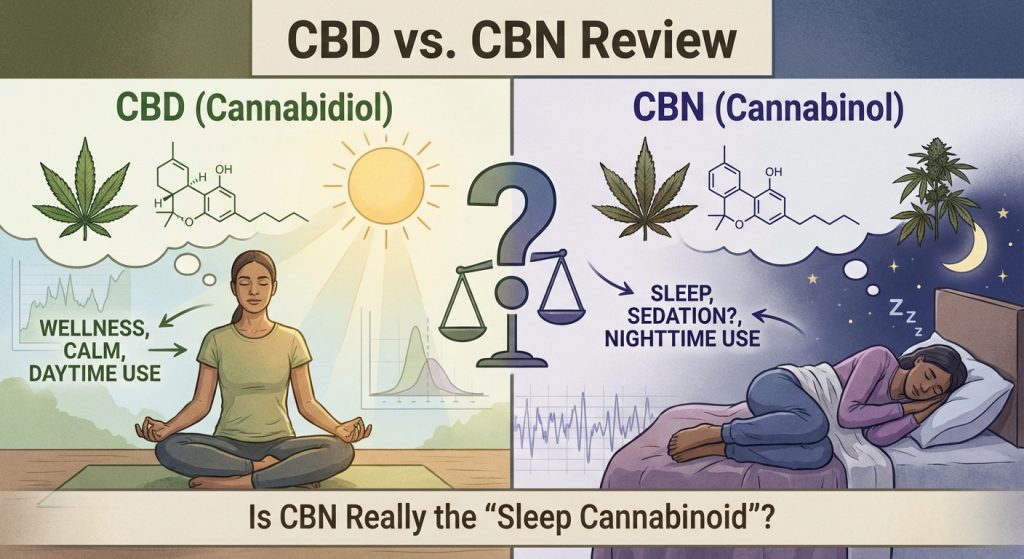
Marketers are aggressively pushing CBN as the specific “Sleep Cannabinoid,” claiming it is a potent sedative that outperforms CBD for insomnia. The theory is that while CBD calms you down, CBN actually knocks you out.
But is there science to back this up? Or is it just aged hemp sold at a premium? This review analyzes the cannabinol effects on the endocannabinoid system, compares it to CBD for sleep maintenance, and I (Alex) share my mixed experience with dosage and paradoxical reactions.
What is CBN vs. CBD?
To understand the difference, you have to understand the plant’s lifecycle.
CBD (Cannabidiol):
- Source: Extracted directly from the hemp plant.
- Effect: It is non-intoxicating. It interacts indirectly with the Endocannabinoid System (ECS) to reduce inflammation and anxiety. It doesn’t typically make you “sleepy” on its own; it removes the anxiety that keeps you awake.
CBN (Cannabinol):
- Source: It is the degradation product of THC. When THC ages and is exposed to oxygen and light, it breaks down into CBN.
- Is CBN natural or synthetic? It is natural, but in supplements, it is usually created by accelerating the aging process of hemp extract.
- Effect: Why is CBN sedating? Anecdotal evidence suggests it is far more sedating than CBD. It binds weakly to the CB1 receptor (like THC does, but much weaker), which may explain its heavier, more physical relaxation effect.
The Sleep Mechanism: Why Take It?
What does CBN/CBD do for sleep?
The combination is often sold to target two different problems:
- 1. Sleep Onset (CBN): The theory is that CBN acts as a hypnotic, physically sedating the body.
- 2. Sleep Maintenance (CBD): By reducing cortisol and inflammation, CBD prevents the 3 AM wake-up caused by stress or pain.
Does CBN improve sleep quality?
Some limited studies suggest it may extend total sleep time, but evidence on whether it increases Deep Sleep or REM is currently inconclusive compared to the robust data we have for melatonin or magnesium.
Is CBN good for inflammation?
Yes. Like other cannabinoids, it is a potent anti-inflammatory, which can help if pain is keeping you awake.
Reddit & Community Consensus
I analyzed threads from r/CBD, r/Biohackers, and r/AltCannabinoids.
The Good:
- 1. “The Heavy Eyelids”: Users consistently report that CBN feels more “physical” than CBD. “CBD makes me calm; CBN makes me heavy.”
- 2. “The Entourage Effect”: The consensus is that neither works well alone. They work best together to create a synergistic sedation.
- 3. “Staying Asleep”: Many users with maintenance insomnia report that CBN stops the “racing mind” when they wake up at 3 AM, allowing them to drift back off.
The Bad:
- 1. “Grogginess”: Does CBN make you groggy the next day? Yes. Unlike CBD, many users report a “weed hangover” feeling—brain fog and lethargy—especially at doses over 10mg.
- 2. “Tolerance”: Users report building a tolerance to CBN much faster than CBD.
- 3. “The Paradoxical Reaction”: A significant minority report that high doses make them wide awake or anxious, rather than sleepy.
Alex’s Personal Review
The following is based on my personal logs.
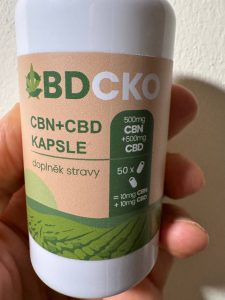
I purchased a high-quality CBD/CBN Capsule blend (from a reputable Czech manufacturer) to test if it could solve my sleep onset issues.
My Experience:
I ran a one-week experiment.
- Days 1-5 (1 Capsule): The dose was likely around 10mg CBN / 10mg CBD. The effect was subtle but positive. I felt a “heaviness” behind my eyes about 60 minutes after taking it. My sleep onset was faster. I gave it a solid 7/10.
- Days 6-8 (2 Capsules): I decided to double the dose to see if it would keep me asleep longer. Mistake.
- The Reaction: Instead of sleeping deeper, I lay in bed staring at the ceiling for hours. I felt “wired but tired.” My mind was racing, but my body felt glued to the mattress. It was a classic paradoxical reaction.
My Rating: 7/10
It works, but the dosage window is narrow. At low doses, it is an effective sedative. At high doses, it backfired on me completely. I decided not to buy it again immediately because I prefer supplements with a wider margin of error (like Magnesium or Apigenin), but I acknowledge its power.
Where to Buy:
Look for “Full Spectrum” or “Broad Spectrum” oils that specifically list the mg of CBN on the lab report (COA). If they hide the amount, it’s likely trace amounts.
Safety & Side Effects
What medications should not be taken with CBN?
Avoid mixing with other sedatives (benzodiazepines, alcohol) or medications with a “Grapefruit Warning,” as cannabinoids inhibit the CYP450 enzyme system.
Update for December 2025:
Since I first wrote this review, the landscape for cannabinoids has shifted dramatically. We have moved from anecdotal marketing to hard data from major universities. The results? A massive safety warning for CBD users and a surprising debunking of the “Entourage Effect” for sleep.
1. The Safety Warning: CBD & Liver Enzymes (JAMA 2025)
The biggest news in 2025 is safety, not sleep. A landmark study published in JAMA Internal Medicine (July 2025) has forced the biohacking community to reconsider high-dose CBD.
The Findings: In healthy adults taking high doses of CBD (commonly used for sleep/anxiety), roughly 6% developed elevated liver enzymes (ALT/AST) indicative of liver stress.
The Nuance: While no one suffered liver failure, this silent inflammation is a major red flag for anyone also drinking alcohol or taking other medications (like Tylenol).
The Protocol: If you take CBD daily, get a standard blood panel every 6 months. If you drink alcohol, do not stack it with high-dose CBD.
2. The “Sedation Myth” Busted (Griffith University Study)
For years, marketing claimed CBN + CBD was the ultimate sleep stack. A massive 2024/2025 double-blind trial has effectively killed this theory.
The Data: Researchers found that 20mg of CBN did reduce nighttime awakenings (WASO). However, adding CBD to the mix did not improve results and, in some cases, blunted the efficacy.
The Takeaway: The “Entourage Effect” might apply to getting high, but for sleep, it appears to be marketing fluff. If you want sedation, use CBN Isolate (20mg+) alone. Don’t pay extra for the CBD blend if your goal is purely sleep.
3. The New Format: “Nano-Emulsion” (Water Soluble)
My original review complained about the slow onset of oils (60+ minutes). In 2025, the market has solved this with Nano-Emulsified (Water Soluble) cannabinoids.
The Tech: By breaking the oil into microscopic particles, these formulas bypass standard digestion.
The Result: Onset time drops to 10-15 minutes, making it a viable tool for “acute” insomnia (when you realize you can’t sleep at 11:30 PM).
Recommendation: Stop buying oil droppers. Look for “Nano” or “Water Soluble” gummies/drinks.
4. The “Blueprint” Verdict (Why Bryan Johnson Skips It)
As of late 2025, tech centurion Bryan Johnson (Project Blueprint) still avoids daily CBD/CBN use.
The Reason: REM Suppression. While CBN helps you stay asleep, data from Oura Ring Gen 4 and Whoop 4.0 users suggests it (and especially any trace THC) creates a “sedated” sleep architecture with reduced REM cycles.
The Alternative: He focuses on Melatonin (300mcg) and Temperature Control for sleep, viewing cannabinoids as a “dirty” tool that compromises sleep quality for sleep duration.
5. The Rising Star: CBG for “Daytime” Sleep Prep
A surprising trend on r/Biohackers in 2025 is the use of CBG (Cannabigerol).
The Use Case: While CBN is for night, users are taking CBG during the day to manage “Gut-Brain” anxiety.
The Logic: By lowering baseline inflammation and anxiety during the day with CBG (which is non-sedating), they find they need less heavy sedation at night. It is the “Preventative” cannabinoid.
Summary
CBN is a legitimate tool for the biohacker, but it is not a magic bullet.
- Use it if: You find CBD too weak and need a physical sedative sensation.
- Avoid it if: You are subject to drug testing or are sensitive to “grogginess” the next day.
- Protocol: Start very low (5mg CBN). Do not double the dose casually.

By: Alex Warenstein.
Bio: Alex Warenstein is a sleep biohacker and founder of Night Time Comfort. After battling chronic insomnia and circadian disruption, he now helps others optimize their sleep using data-driven protocols. Read full story.
Disclaimer: Alex is not a doctor. This content is for educational purposes only. Always consult a specialist.