You wake up, grab your phone, and stare at a colorful bar chart generated by your smart ring or watch. It says you spent 45 minutes in “Deep Sleep” and 2 hours in “REM.” But you feel exhausted. The next night, the numbers flip, but you feel great.
What is actually happening inside your brain?
To improve your sleep, it helps to stop obsessing over ‘Total Time Asleep’ and start understanding Sleep Architecture—how your night is built from repeating cycles. Sleep is not a monolith; it is a complex structure of cycles. If the foundation (Deep Sleep) is cracked, the house falls. If the roof (REM) is missing, the house leaks.
This guide will teach you how to read a hypnogram (the medical term for that sleep graph), explain the critical battle of Deep Sleep vs. REM, and help you interpret why your sleep chart might look like a fragmented mess.
Understanding Sleep Stages: The 5 Phases of the Night
Before we analyze the graph, we must define the players. In sleep labs, stages are scored from brain-wave data (EEG) using the American Academy of Sleep Medicine rules, and one full cycle typically runs about 90–110 minutes (not always exactly 90). You can think of your hypnogram as a repeatable pattern: down into deeper NREM, then back up toward REM.
- 1. NREM Stage 1 (N1): The Gateway
What it is: The transition from wakefulness to sleep.
The Feeling: This is where hypnagogia occurs—that weird sensation of falling or hearing random noises.
Duration: Very short (1-5 minutes).
Hypnogram appearance: The top “step” of sleep.
Is hypnagogia good or bad? It is normal. However, if you spend too much time here during the night, it means your sleep is fragmented. - 2. NREM Stage 2 (N2): Light Sleep
What it is: The “baseline” of sleep. Your heart rate slows, and body temperature drops. The brain produces “Sleep Spindles” and “K-complexes” to block out external noise.
Duration: This makes up the bulk of your night (approx. 50%).
Importance: Often undervalued, but crucial for motor skill memory and refreshing the brain for learning. - 3. NREM Stage 3 (N3): Deep Sleep (Slow Wave Sleep)
What it is: Often the most physically restorative stage of sleep. Brain waves slow down to high-amplitude Delta waves.The Function: Physical repair. The glymphatic system is often described as the brain’s “cleanup flow”; Harvard Health notes that this clearance is most active during deeper sleep phases. Human Growth Hormone (HGH) secretion is also tightly linked to deep sleep, especially earlier in the night (Mayo Clinic Laboratories).
Hard to Wake: This is the hardest sleep stage to wake from. If an alarm pulls you out of N3, you will experience severe “sleep inertia” (grogginess).
- 4. REM (Rapid Eye Movement): The Dream State
What it is: The brain becomes almost as active as it is when awake, but the body is paralyzed (atonia).The Function: REM is strongly involved in emotional learning and memory processing, and many people notice it supports mood stability and mental flexibility.
Does dreaming mean you’re in REM sleep? Mostly, yes. While you can dream in other stages, the vivid, movie-like dreams happen here.
- 5. Wake (W): Interruptions
What it is: Brief awakenings (WASO – Wake After Sleep Onset).
Normalcy: It is normal to wake up briefly between cycles. If you fall back asleep instantly, you won’t remember it.
Deep Sleep vs. REM: Is One Better?
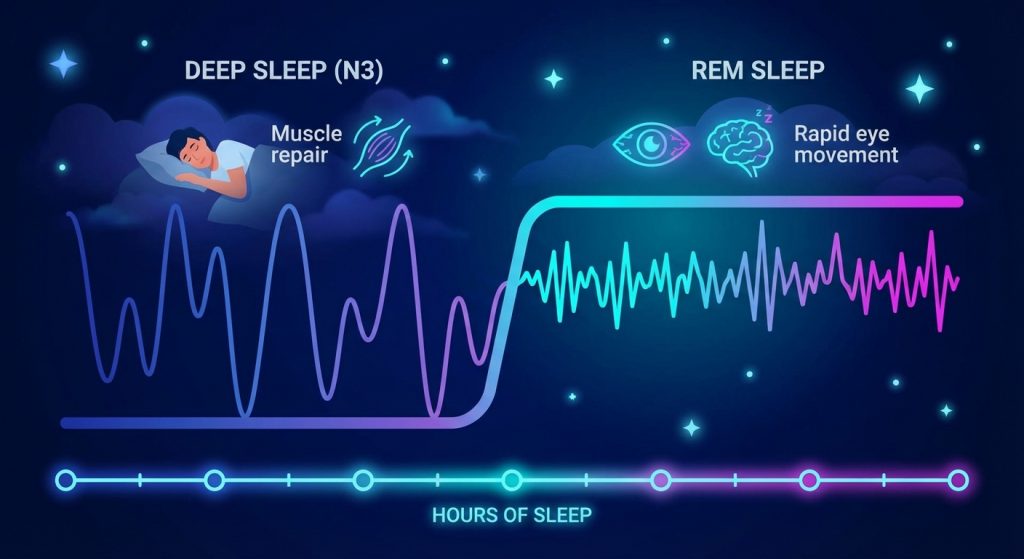
A common question on forums is: “Is it better to have REM or deep sleep?”
This is like asking if it is better to have a heart or a liver. You need both, but they serve different masters.
- Deep Sleep (NREM3) is more concentrated in the earlier cycles of the night, so if you delay bedtime or shorten total sleep, you often reduce the part of the hypnogram where deep sleep tends to cluster.
- REM Sleep is more concentrated later in the night, so waking up early often trims your longest REM-rich cycles.
The Verdict:
If you are physically exhausted or in pain, you crave Deep Sleep. If you are anxious, depressed, or learning a new language, you crave REM. You cannot hack one without the other.
How to Read a Sleep Hypnogram
When you look at your sleep graph (on Apple Watch, Oura 4 Ring, or Samsung Ring, or a Samsung watch), you are looking at a simplified, consumer version of a hypnogram—useful for patterns, but not the same EEG-scored chart used in a formal sleep study. Here is how to interpret your sleep graph:
- 1. The X-Axis (Time): This is the duration of your night.
- 2. The Y-Axis (Depth): Usually arranged as Wake (top), REM/Light (middle), Deep (bottom).
- 3. The Staircase: A healthy sleeper descends from Wake -> Light -> Deep. They stay in Deep for 20-40 minutes, then rise to Light -> REM. This is one cycle.
- 4. The “Front-Loading” Rule: Look at the first 4 hours of your graph. You should see thick blocks of Deep Sleep (NREM3).
- 5. The “Back-Loading” Rule: Look at the last 3 hours. You should see thick blocks of REM.
- 6. The Fragmentation (The Enemy): Look for red spikes (Wake) or constant shifts between stages. A fragmented sleep chart looks like a barcode rather than smooth blocks.
This suggests frequent micro-awakenings, which can come from plain environmental disruption — but a ‘barcode’ pattern is also commonly seen with sleep-disordered breathing (sleep apnea/UARS) that repeatedly bumps you into lighter sleep (Cleveland Clinic).
Age and Architecture: What is Normal?
Stop comparing your sleep to a 20-year-old’s if you are 50. Sleep architecture reliably shifts with age (less N3, lighter sleep, more awakenings), which is why your hypnogram should be judged against your own baseline (Sleep Foundation).
- The 20s
Deep Sleep: High (20-25%). Robust physical repair.
REM: High (20-25%).
Cycle: Very distinct, blocky cycles. - The 30s
Deep Sleep: Starts to diminish (16-20%).
REM: Stable.
Note: This is often when people first notice “I can’t recover from workouts like I used to.” - The 40s
Deep Sleep: Noticeable drop (15-18%). The amplitude of delta waves shrinks.
REM: Stable, but lighter.
Fragmentation: Increased sensitivity to noise and light. - The 50s
Deep Sleep: Can drop to 10-15%.
REM: Stable (20%).
Menopause/Andropause: Hormonal shifts often cause increased Wake (W) time. - The 60s+
Deep Sleep: Significantly reduced (5-10%). Some healthy seniors get almost zero detectable Deep Sleep but compensate with N2.
REM: Still required for cognitive health.
Sleep Pressure: The drive to sleep weakens, leading to earlier wake times.
Q: Is 40 minutes of deep sleep normal?
For a person over 40, yes. For a teenager, no.
Q: Is 4.5 hours of deep sleep too much?
For most adults, that number is unusual unless total sleep time is very long; more often it’s a staging error where the tracker is over-labeling quiet, low-movement sleep as ‘Deep.’
The Technology Trap: Why Your Tracker Might Be Lying
Before you panic over a fragmented sleep chart, you must understand the limitations of consumer tech.
Wearables (Apple Watch, Oura Ring 4, Samsung Ring, Whoop 4)
These devices do not measure brain waves. They use actigraphy (movement) and PPG (heart rate).
The Guess: If you are motionless and your heart rate lowers, they guess you are in Deep Sleep. If your heart rate varies (HRV) and you are still, they guess REM.
The Reality: Accuracy varies widely by device, stage, and person; in a sleep-lab comparison published in Scientific Reports, overall four-stage sleep classification accuracy for ring-style trackers landed roughly in the ~35–53% range, which is why these charts are best for spotting patterns and shifts — not auditing a single night.
Home EEG: The Muse S Experience
The only way to truly track sleep architecture is to measure brain waves via EEG.
My Experience: I tried the Muse S (Gen 3/Athena model). This headband promises clinical-grade data at home.
The Failure: It consistently told me I had 0 to 5 minutes of deep sleep. This caused me immense anxiety. However, after researching forums and Reddit, I realized the issue was likely contact quality. The soft fabric sensors shift during the night. If the sensor loses contact with your forehead skin, the algorithm assumes you are in Light Sleep or Awake.
The Verdict: While EEG is the gold standard, consumer EEG devices are finicky. Unless you glue electrodes to your head (like in a clinic), take the data with a grain of salt. We are waiting for the next generation of home EEG tech to solve this.
Consequences of Missing Stages
What happens if your hypnogram is actually broken?
- 1. Missing Deep Sleep (NREM3)
Symptoms: Chronic physical fatigue, muscle aches (fibromyalgia-like pain), “brain fog,” and insulin resistance.
Outcome: Accelerated aging and metabolic issues. - 2. Missing REM Sleep
Symptoms: Emotional volatility (snapping at loved ones), inability to concentrate, poor memory retention.
Outcome: Increased risk of depression and dementia. - 3. Missing Light Sleep (N2) / Too Much Wake
Symptoms: Feeling unrefreshed despite “sleeping.”
Outcome: This is the hallmark of Sleep Apnea or UARS.
The Apnea/UARS Connection
Why do people with breathing issues often have low REM?
During REM sleep, your body undergoes atonia (paralysis) to stop you from acting out dreams. This paralysis affects the muscles of the throat.
If you have Sleep Apnea or UARS, your airway collapses most easily during REM.
Your brain senses the choking, surges adrenaline, and kicks you out of REM into Light Sleep to breathe.
Result: A hypnogram with very little REM, or REM that is constantly fragmented by red “Wake” spikes.
How to Increase Total Sleep Time & Optimize Architecture
You cannot force your brain into Deep Sleep, but you can build the right environment.
- 1. Increase Deep Sleep (The Body)
Temperature: Your core temp must drop. Keep the room at 65°F (18°C).
Diet: Avoid foods that kill sleep (sugar/heavy carbs) within 3 hours of bedtime. Insulin spikes heat up the body.Supplements: Forms of magnesium such as L-threonate and glycinate are commonly used as sleep-support options, and glycine has been studied in gram-range doses (often ~3g) for its potential to support nighttime cooling and subjective sleep quality.
- 2. Increase REM Sleep (The Mind)
Alcohol: Cut it out. Alcohol is the #1 killer of REM sleep.
Wake Up Later: Since REM is back-loaded, sleeping an extra 30 minutes in the morning can drastically boost REM numbers.Supplements: Alpha GPC and Choline are sometimes used to support acetylcholine (a key neurotransmitter in REM), and some people report more vivid dreams when they use them.
- 3. Reduce Fragmentation (The Environment)
Sound: Use Pink Noise or Loop Earplugs to mask noise.
Nasal Breathing: Use nasal strips or mouth tape to prevent snoring, which fragments sleep.Hygiene: Follow the 10-3-2-1 rule. Avoid work for 2 hours before bed; it allows the brain to downshift from Beta waves (alert) to Alpha waves (relaxed).
Jan-2026 updates
Deep sleep is not just “minutes” — it’s the “pressure release” phase
New human research suggests that the body’s “sleep pressure” shows up in measurable brain-and-fluid dynamics: after sleep deprivation, slow-wave activity and cerebrospinal fluid mobility change in ways that look like the brain pushing hard to recover.
Translation for your hypnogram: a smaller N3 block can still be meaningful if your night is smooth and consolidated, while a big N3 number with lots of spikes may not feel restorative. (Nature Neuroscience)
For 35+, fragmentation often matters more than “perfect stage targets”
A late-2025 study in older adults linked more fragmented sleep (more night waking / “barcode” patterns) with slower mental processing speed.
Practical hypnogram takeaway: watch your red wake spikes and frequent stage flipping — they can explain “I slept 7–8 hours but feel off” better than small changes in N3 vs REM minutes. (Pubmed)
Next-gen sleep staging is moving beyond motion + heart rate
A December-2025 paper showed that using just three easy signals — oxygen saturation (SpO₂), heart rate, and breathing effort — a deep learning model can classify sleep stages with weighted F1 around 68% (5-stage) and 71% (4-stage) in large datasets.
For consumers, this means future hypnograms will likely improve most when wearables get better at breathing/oxygen sensing, not when they add more “sleep scores.” (Journal of Sleep Research)
Closed-loop “pink noise” is getting smarter about timing
A November-2025 SagePub paper highlights what many sleep communities already see in practice: auditory stimulation isn’t “one size fits all” — the timing relative to your brain rhythms matters, and the same protocol can help one person and do little for another. Hypnogram takeaway: if you experiment with pink-noise bursts, judge it by week-over-week trends in continuity and next-day feel, not by a single-night N3 bump.
Sleep position: the simplest “REM protection” hack (when breathing is the issue)
A 2025 Johns Hopkins Medicine update notes that side (or stomach) positioning can help keep airways more open, reducing snoring and easing mild apnea in some people. On a hypnogram this often looks like fewer wake spikes later in the night — exactly where REM-rich cycles usually sit.
Thermal “pre-cooling” went mainstream: hot bath/sauna ~60–90 minutes before bed
A December-2025 National Sleep Foundation write-up highlights research on before-bed hot-tub bathing improving sleep metrics (especially in older adults), likely by accelerating the body’s cool-down afterward — a key trigger for sleep onset and deeper early-night sleep. This overlaps with popular biohacker routines: Bryan Johnson’s Blueprint also emphasizes a hot bath/sauna timing window as part of his sleep stack.
Summary
Your hypnogram is a map of your health. Do not obsess over a single night’s data, especially from a watch. Look for trends. If you consistently see zero Deep Sleep or highly fragmented charts, use the Sleep Triage Test to see if a medical issue is at play. But for most, fixing sleep hygiene and temperature is the key to balancing the architecture.
Read Next:
The Anti-Sleep Diet: 5 Foods That Destroy Sleep Quality

By: Alex Warenstein.
Bio: Alex Warenstein is a sleep biohacker and founder of Night Time Comfort. After battling chronic insomnia and circadian disruption, he now helps others optimize their sleep using data-driven protocols. Read full story.
Disclaimer: Alex is not a doctor. This content is for educational purposes only. Always consult a specialist.