In the world of sleep supplements, we often look for the “sledgehammer.” We want something that knocks us out like a heavy dose of melatonin or a strong sedative. But sometimes, the reason we cannot sleep isn’t a lack of sedation; it is an excess of stress.
Enter Holy Basil, known in Ayurveda as Tulsi or “The Incomparable One.”
For thousands of years, it has been revered not just as a plant, but as the “Elixir of Life.” While modern biohackers are obsessed with powerful compounds like Ashwagandha, Holy Basil offers a different approach. It is the gentle regulator. It doesn’t force your body into submission; it helps your body handle the metabolic and psychological burden of the day so that sleep can happen naturally.
This review pulls together the most relevant human and mechanistic papers on Tulsi indexed in PubMed, plus my three-month experiment with this ancient herb.
What is Holy Basil? (The “Elixir of Life” Herb)
First, a critical distinction: What is the difference between basil and holy basil?
The basil you put on your pizza or pasta is Ocimum basilicum (Sweet Basil). It is delicious, but biologically mild.
Holy Basil is Ocimum sanctum or Ocimum tenuiflorum. It is a traditionally used herb native to the Indian subcontinent, with a growing—but still uneven—modern research base.
What does holy basil do to the body?
In herbal medicine, it’s often described as an adaptogen—a term used for plants that may help people stay more resilient under stress (the evidence depends heavily on the extract and the study design).
The “Liquid Yoga”: Practitioners often call Tulsi “liquid yoga” because it induces a state of relaxed alertness. It doesn’t make you drowsy in the way an antihistamine does; it makes you calm in the way meditation does.
What organ is basil good for?
Rather than ‘targeting an organ,’ most practical discussions focus on two buckets that can indirectly affect sleep: stress-response signaling (HPA axis) and metabolic stability (blood sugar variability).
The Mechanism: How Tulsi Affects Sleep
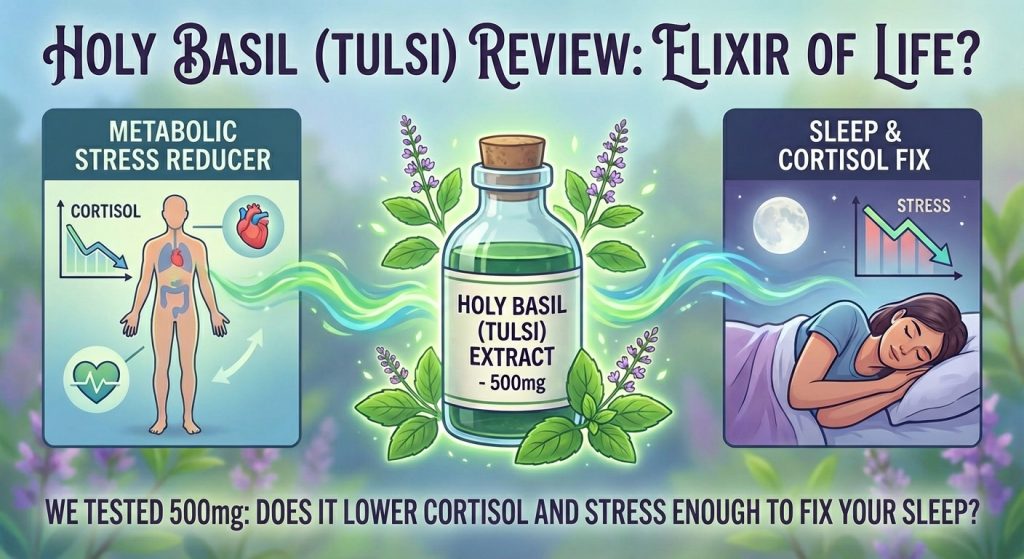
Holy Basil does not act like a sleeping pill. If you take it and expect to black out in 20 minutes, you will be disappointed. Its potential lies in supporting a few underlying drivers that can make sleep fragile for some people—especially stress load and metabolic volatility—rather than acting like a direct sedative.
1. Cortisol Modulation (The Soft Touch)
How to bring down cortisol?
Quick context: cortisol has a normal daily rhythm (higher after waking, lower at night), and the cortisol awakening response is part of that rhythm (see the Endocrine Society overview).
- Many people turn to Ashwagandha. However, some people find it a bit “too heavy” over time—especially if it noticeably lowers their stress response and they start to feel emotionally flat.
- In a randomized, placebo-controlled study in stressed adults, a standardized tulsi extract was associated with improvements in perceived stress (and some cortisol readouts), though results can vary by product and dose (see Frontiers in Nutrition).
- The Benefit: By lowering the baseline “buzz” of anxiety in the evening, it prevents the HPA axis from triggering a false “fight or flight” alarm when you are trying to drift off.
2. Metabolic Stress Relief (The Glucose Connection)
- This is one of the more common “invisible” sleep disruptors—especially for people who wake up wired in the early morning. As discussed in our Nocturnal Hypoglycemia guide, crashing blood sugar at 3:00 AM causes an adrenaline spike that wakes you up.
- The Science: Human trials summarized in a meta-analysis suggest tulsi can modestly improve fasting glucose and some lipid markers, but the studies use very different preparations and doses (see Journal of Functional Foods).
- The Sleep Link: By stabilizing blood sugar throughout the night, Tulsi prevents the metabolic crash that triggers the wake-up call. It keeps the fuel supply to the brain steady.
3. Neurochemistry
What does holy basil do to your brain?
Lab and animal research suggest Tulsi has anti-inflammatory signaling effects (often discussed around COX-2 pathways) and may influence stress-related neurotransmitter systems. In real life, that can translate into “less mental chatter” for some people—more calm, not a knockout sedative.
Comparison: Holy Basil vs. Ashwagandha
A common question in the community is: Which is better, ashwagandha or holy basil?
Ashwagandha:
- Action: Strong, sedating, heavy.
- Best for: Severe anxiety, high physical stress, people who need a “heavy hitter.”
- Risk: Emotional blunting (anhedonia) with long-term use.
Holy Basil:
- Action: Mild, uplifting, balancing.
- Best for: Metabolic stress, mild anxiety, “tired but wired” feelings, long-term daily use.
- Risk: Often reported as well tolerated, but individual sensitivity varies—especially if you’re stacking multiple calming compounds.
Can I mix ashwagandha and holy basil? Yes. In fact, they are often stacked. Ashwagandha does the heavy lifting, while Tulsi handles metabolic balance.
Dosage and Timing: Fixing the Inverted Curve
If you are suffering from sleep issues, simply drinking a cup of tea might not be enough. You need to dial in the protocol.
How much holy basil should you take a day?
- Extract: 500mg to 1000mg standardized extract (usually 2% Ursolic Acid).
- Tea: 1-3 cups using pharmacopoeial grade dried leaves.
The Timing Strategy:
Your timing depends on why you aren’t sleeping.
Scenario A: The “Wired at Night” (Inverted Cortisol)
If you are tired all day but energetic at 10 PM, your cortisol is spiking when it should be dropping.
- Protocol: Take 500mg with Dinner.
- Why: Taking it with your evening meal helps blunt the glucose spike from food and signals the adrenals to begin their evening descent.
Scenario B: The “Stressed All Day”
- Protocol: Take 500mg with Breakfast and 500mg with Dinner.
- Why: This maintains a steady level of adaptogenic support, preventing stress from accumulating throughout the day.
Should I take holy basil at night or morning?
Because it is not a sedative, it is safe to take in the morning. However, for sleep purposes, the evening dose is critical to manage metabolic stress during the night.
Tea vs. Capsules: The Experience
Does holy basil taste like licorice?
Yes. Tulsi has a distinct, spicy, clove-like, and slightly peppermint/licorice flavor. It is aromatic and warming.
The Tea Ritual:
Many people find the act of drinking Tulsi tea to be more effective than the pill. For many people, the warmth + aroma + routine can feel like a downshift in arousal, which may help sleep indirectly. If your sleep issue is anxiety-based, the tea form might be superior simply due to the ritual.
Recommendation: Organic India Tulsi Tea (Original or Rose).
The Extract:
If your issue is metabolic (blood sugar), the capsule form ensures you get a consistent dose of Ursolic Acid without the need to drink fluid before bed (which causes nocturia).
Reddit & Community Consensus
What do 6 to 12 users agree on across r/Supplements and r/Herbalism?
- 1. “The Mood Lifter”: Unlike sedatives that make you feel “flat,” users report Tulsi makes them feel “lighter.” It’s often described as a mood-lifting herb that may help sleep indirectly by reducing stress.
- 2. “Dreams”: A small percentage of users report vivid or lucid dreams. This is less common than with Mugwort or Valerian, but it happens.
- 3. “Not a Knockout”: Users consistently warn: “Don’t expect an instant sedative.” It requires a few weeks to build up.
- 4. “The Stack”: It is frequently stacked with Magnesium L-Threonate and L-Theanine. The consensus is that Tulsi provides the base layer of calm, while Magnesium does the physical relaxation.
- 5. “Histamine Issues”: A very small minority of users with MCAS (Mast Cell Activation Syndrome) report reactions, as basil is high in histamines.
- 6. “Tea is Best”: The general community sentiment leans toward the tea for anxiety and the extract for inflammation/blood sugar.
Alex’s Personal Review
The following is based on my personal logs.
I added Holy Basil (500mg Extract) to my stack during a period where I was waking up consistently at 4:00 AM. My hypothesis was that my cortisol curve was slightly inverted or my blood sugar was unstable.
My Experience:
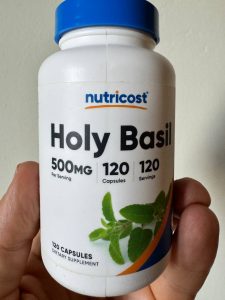
I took 500mg with dinner for three months. I used a high-quality standardized extract.
Subjective Feel: I felt… fine. I didn’t feel a wave of relaxation. I didn’t feel sleepy. I experienced no side effects.
Sleep Data: My 4:00 AM wake-ups did not stop. They didn’t get worse, but they didn’t get better.
Conclusion: For my specific biology, Tulsi was too mild. It was like trying to put out a forest fire with a water pistol. My issue required stronger interventions (like strict light therapy and fixing my mattress).
My Rating: 6.5/10
I give it a passing grade because it had zero negative side effects (no grogginess, no stomach upset). I believe it is a healthy supplement for general longevity and mild stress, but for treating entrenched maintenance insomnia, it was insufficient for me. Perhaps I needed a higher dose, or perhaps my issue was not metabolic.
Where to Buy:
If you want to try it, it is available on iHerb. Organic India is the gold standard for Tulsi (both tea and capsules) as they practice regenerative agriculture in India. Himalaya is another reputable brand. Because supplement labels aren’t pre-approved before products hit shelves, I prioritize brands that publish contaminant testing and follow strong manufacturing standards (see FDA). When it’s available, the USP verification framework is a useful quality signal.
Safety & Side Effects
Who cannot take holy basil?
- If you combine herbs with prescription meds, a quick interaction check is worth it—Merck Manual has a concise interaction overview for Holy Basil.
- Blood Thinners: Tulsi has mild anti-platelet activity (it thins the blood). If you are on Warfarin or aspirin therapy, consult a doctor.
- Thyroid: It can lower thyroxine levels. If you have hypothyroidism, monitor your levels.
- Fertility (Men): What does Holy Basil do to hormones? Most of the fertility signal comes from animal studies, where higher doses were associated with reduced sperm count and motility. If you’re actively trying to conceive, many people simply pause Tulsi during that window.
What are the bad side effects of holy basil?
They are rare, but can include nausea if taken on an empty stomach.
Is it safe to take holy basil every day?
Short-term oral use is generally well tolerated for many adults, but long-term, high-dose safety data are limited (see Merck Manual).
Update for January 2026:
Tulsi isn’t a single plant profile (Nov-2025 chemistry variability)
A November-2025 paper profiling Ocimum accessions found substantial between-accession diversity in bioactive compounds—useful context for why two “tulsi” products can feel totally different (see Food Research International).
Stress + sleep outcomes are still the most practical human signal (Nov-2025)
A 2025 practitioner-facing review of “adrenal/stress” approaches explicitly calls out tulsi as a non-sedating option people use for stress-linked sleep fragility, pointing back to controlled human data rather than folklore alone (see AANMC).
Extraction/process tech is moving fast (2026 processing data)
A 2026 study comparing novel extraction/processing approaches for holy basil by-products shows how method choice can materially shift phenolics and antioxidant activity—another reminder that “tea vs extract” is often really “processing vs processing” (see LWT).
Mechanistic work continues to cluster around inflammation signaling (late-2025)
A 2025 computational paper mapped which holy-basil flavonoids may bind COX-2; it’s not clinical proof, but it helps explain why “less mental chatter” narratives often get framed as anti-inflammatory signaling rather than sedation (see PubMed).
Summary
Holy Basil (Tulsi) is the gentle guardian of sleep. It works by smoothing out the rough edges of your metabolism and stress response.
- Use it if: You feel “tired but wired,” have mild anxiety, or suspect blood sugar crashes are waking you up.
- Expectations: Give it 4-6 weeks. It is a slow builder.
- Protocol: 500mg with dinner, or a strong cup of tea 1 hour before bed.
It didn’t solve my specific insomnia puzzle, but its safety profile and metabolic benefits make it a worthy experiment for anyone looking to optimize their health beyond just sleep.

By: Alex Warenstein.
Bio: Alex Warenstein is a sleep biohacker and founder of Night Time Comfort. After battling chronic insomnia and circadian disruption, he now helps others optimize their sleep using data-driven protocols. Read full story.
Disclaimer: Alex is not a doctor. This content is for educational purposes only. Always consult a specialist.