Amino acids are the building blocks of life, but some, like Glycine and Tryptophan, get all the glory when it comes to sleep.
L-Serine often flies under the radar. It is a non-essential amino acid, meaning your body produces it naturally. However, recent research into neurodegenerative diseases (like ALS) and the longevity of the Ogimi village in Japan (known for their serine-rich diet) has sparked interest in its potential to calm the central nervous system.
But does it actually help you sleep tonight? This review analyzes the science of serine sleep benefits, its safety profile, and I (Alex) share my underwhelming personal trial.
The Mechanism: Calming the Nervous System
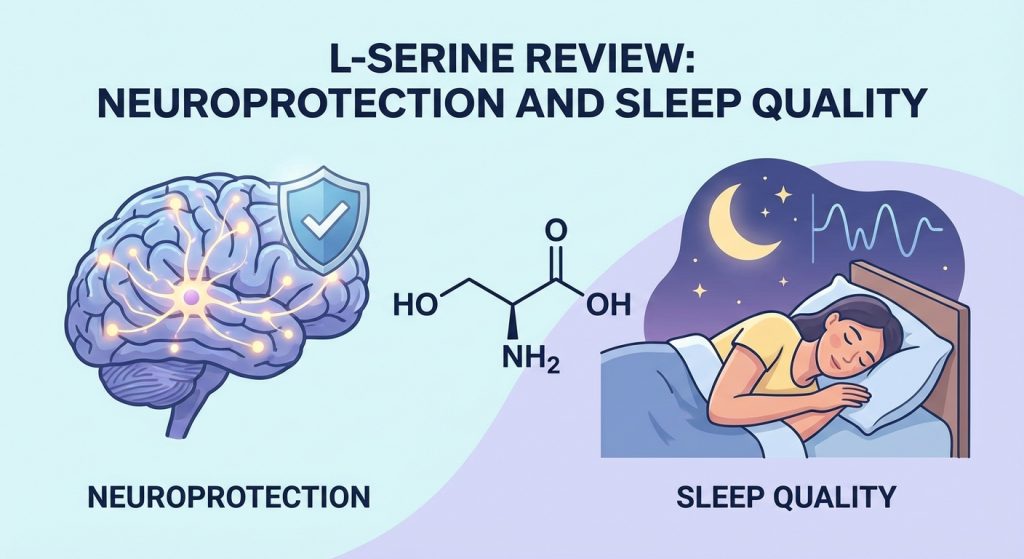
What does serine do for the body?
L-Serine is a precursor. It is the raw material your body uses to synthesize other critical compounds:
- 1. Glycine: As discussed in our L-Glycine Review, this amino acid lowers body temperature for sleep. Serine converts into Glycine.
- 2. D-Serine: A neuromodulator that binds to NMDA receptors in the brain, crucial for synaptic plasticity and memory.
- 3. Phosphatidylserine: A lipid that covers brain cells and helps blunt cortisol.
The Sleep Theory:
By increasing the availability of Glycine and modulating NMDA receptors, L-Serine theoretically calms the firing rate of neurons. If your brain is “overheating” with activity at night, Serine provides the chemical buffer to cool it down.
What does serine do for the brain?
Beyond sleep, it is being researched for neuroprotection. Studies suggest it may help prevent the protein misfolding seen in diseases like ALS and Alzheimer’s.
Reddit & Community Consensus
What do biohackers on r/Nootropics and r/Sleep say?
The Good:
- “Subtle Calm”: Users who are highly sensitive to stimulants often report that Serine provides a very mild, non-sedating sense of calm.
- “Waking Up Clearer”: Similar to Glycine, some users report feeling less groggy in the morning, perhaps due to improved sleep architecture.
The Bad:
- “Weak for Insomnia”: The overwhelming consensus is that L-Serine is not a strong sleep aid. It doesn’t knock you out.
- “Dosage Issues”: Many studies use massive doses (15-30 grams) for ALS, whereas sleep supplements contain only 500mg. Users often feel nothing at standard doses.
Alex’s Personal Review
The following is based on my personal logs.
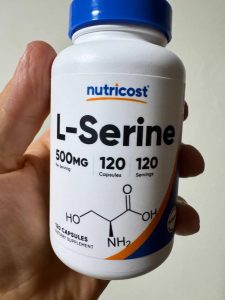
I tested L-Serine (500mg capsules) during a period of mild insomnia. I wanted to see if it could replace my heavier supplements.
My Experience:
I took 500mg to 1000mg about 1 hour before bed for two weeks. I removed my usual Magnesium L-threonate and Liposomal Apigenin to isolate the variable.
The result was negligible. I didn’t feel sleepy. I didn’t feel relaxed. My sleep onset time didn’t change. Unlike Glycine, which at least gave me a thermal effect (cooling), Serine felt biologically inert at this dosage.
My Rating: 3/10
It might be doing wonderful things for my long-term brain health and neuroprotection, but as a tool for fixing “I can’t sleep right now,” it failed. I stopped taking it for sleep purposes.
Where to Buy:
If you want to try it for longevity or cognitive support, NOW Foods or Doctor’s Best offer reliable versions.
Safety & Side Effects
Is serine good for sleep?
It is safe, but arguably not “good” enough to be a primary treatment.
Who should not take serine?
People with kidney disease should consult a doctor before adding high doses of amino acids.
What are the symptoms of serine deficiency?
Deficiency is rare but can manifest as psychomotor retardation and seizures in severe genetic cases.
Can L-serine help with weight loss?
Some limited data suggests it may influence metabolism, but it is not a weight loss drug.
Update for December 2025
Since I first wrote this review, my opinion on L-Serine has shifted from “useless” to “specialized.” New research in 2025 has clarified why my initial 500mg experiment failed and revealed a specific use-case that is blowing up on biohacker forums.
Here is the essential new information for late 2025.
1. The “Creatine Insomnia” Fix
The most practical discovery of 2025 comes from the r/Biohackers and r/Supplements communities.
The Problem: Many users report “Creatine Insomnia”—feeling wired or waking up frequently after taking Creatine Monohydrate, likely due to methylation pathways and SAM-e production.
The Fix: User logs suggest that L-Serine is the specific antidote to this. Because Serine is a methyl donor regulator, it seems to balance out the over-methylation that causes the “wired” feeling.
The Protocol: If you take Creatine and sleep poorly, do not stop the Creatine. Add 2g of L-Serine with dinner.
2. The Dosage Error: 3 Grams or Nothing
My original review rated Serine poorly because I took 500mg. A pivotal 2025 study on circadian phases has proven that dosage was simply too low to reach the brain’s threshold.
The Science: Recent trials show that 3 grams (3,000mg) is the minimum effective dose to influence “Dim Light Melatonin Onset” (DLMO).
The Benefit: At this dosage, Serine doesn’t just “calm” you; it actively prevents your circadian rhythm from drifting later. It acts as a “Circadian Anchor.”
My Correction: If you tried 500mg and felt nothing, you under-dosed. The 3g dose (usually powder form) creates a distinct feeling of “thermal cooling” similar to Glycine.
3. ALS & The “Unfolded Protein” Update
Phase 2 clinical data released in mid-2025 continues to support the “Ogimi Theory”—that Serine protects neurons by preventing proteins from misfolding (a cause of ALS and Alzheimer’s).
The mechanism: L-Serine activates the Unfolded Protein Response (UPR), acting as a “quality control” manager for your neurons.
The takeaway: Even if it doesn’t knock you out like a strong sedative, taking it daily is now considered a “Top Tier” preventative strategy for long-term brain aging by the longevity community.
4. Safety Watch: The “Alzheimer’s Paradox”
A conflict in the medical literature appeared in late 2024. While deficiency is bad, excessively high serum serine levels were correlated with cognitive decline in one specific study.
The Verdict: The biohacker consensus is to avoid “mega-dosing” (15g-30g) unless under doctor supervision for ALS. Stick to the 2g – 4g window for sleep and longevity.
Summary
L-Serine is a fascinating molecule for brain health and longevity, but a weak tool for insomnia.
- Try it if: You are interested in long-term neuroprotection or want to experiment with stacking it alongside Glycine.
- Skip it if: You need immediate relief from sleeplessness. Stick to Melatonin spray, Magnesium, or Apigenin.

By: Alex Warenstein.
Bio: Alex Warenstein is a sleep biohacker and founder of Night Time Comfort. After battling chronic insomnia and circadian disruption, he now helps others optimize their sleep using data-driven protocols. Read full story.
Disclaimer: Alex is not a doctor. This content is for educational purposes only. Always consult a specialist.