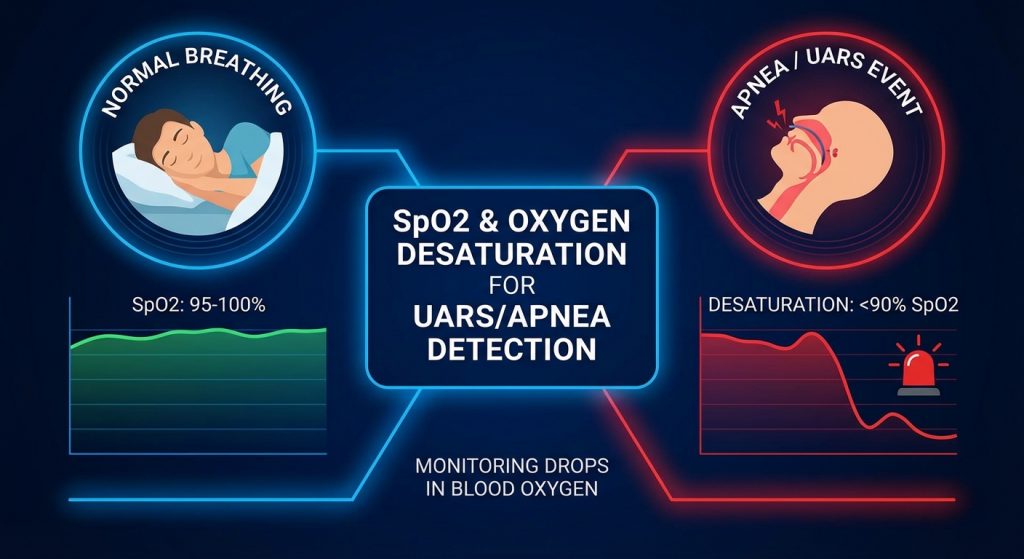
You wake up, check your sleep tracker app, and your heart sinks. The graph shows a red line dipping down to 86%.
Is it a glitch? Did you stop breathing? Or did you just sleep on your hand?
For anyone struggling with unrefreshing sleep, understanding SpO2 levels sleep data is the difference between aimless worrying and actionable diagnostics. However, raw numbers are meaningless without context. In the medical world, a drop in oxygen is only counted as a “respiratory event” if it meets specific mathematical criteria: the 3% vs 4% desaturation rules.
This guide explores the mechanics of nighttime hypoxia, explains why the “4% rule” might be the reason your doctor said you were “fine” even when you feel terrible, and teaches you how to distinguish a sensor error from a genuine airway collapse.
What Is SpO2 and What Is “Normal”?
SpO2 stands for Peripheral Oxygen Saturation. It measures the percentage of hemoglobin in your blood that is carrying oxygen.
Healthy Baseline: For most adults at sea level, normal SpO2 is between 95% and 99%.
The Danger Zone: Consistent levels below 90% are considered hypoxia.
The Fatal Misconception: Many people think, “My average oxygen was 94%, so I’m fine.” Average means nothing in sleep medicine. You can have an average of 95% but still suffer from severe Sleep Apnea if you have frequent, deep oxygen dips that recover quickly.
Why Pharmacy Oximeters Fail
Before we analyze the data, we must address the tool. Many people try to diagnose themselves using cheap ($20-$30) fingertip pulse oximeters bought at a pharmacy.
These are useless for sleep analysis.
- 1. No Recording: They show real-time data but do not record it. You cannot watch your finger while you are asleep.
- 2. No Trends: You need to see the shape of the drop (the waveform) to know if it’s apnea.
- 3. False Comfort: Seeing “98%” when you wake up doesn’t tell you that you dropped to 84% twenty times during the night.
To track oxygen desaturation at home, you need a device that records continuously (at least every 4 seconds), such as the Wellue O2Ring or a medical-grade WatchPAT One (for sleep apnea checkup).
The Core Concept: What is the 4% Drop Rule?
In a sleep lab, technicians score your sleep study to calculate your AHI (Apnea-Hypopnea Index). An “Apnea” is easy to score: you stop breathing completely for 10 seconds.
However, most people suffer from Hypopneas—where the airway is partially collapsed (like sucking a milkshake through a collapsed straw), but not fully blocked. To count as a Hypopnea, the airflow must drop, AND the blood oxygen must drop.
This is where the controversy lies. There are two standards used in medicine:
The 4% Rule (AASM 1B / “Medicare Rule”)
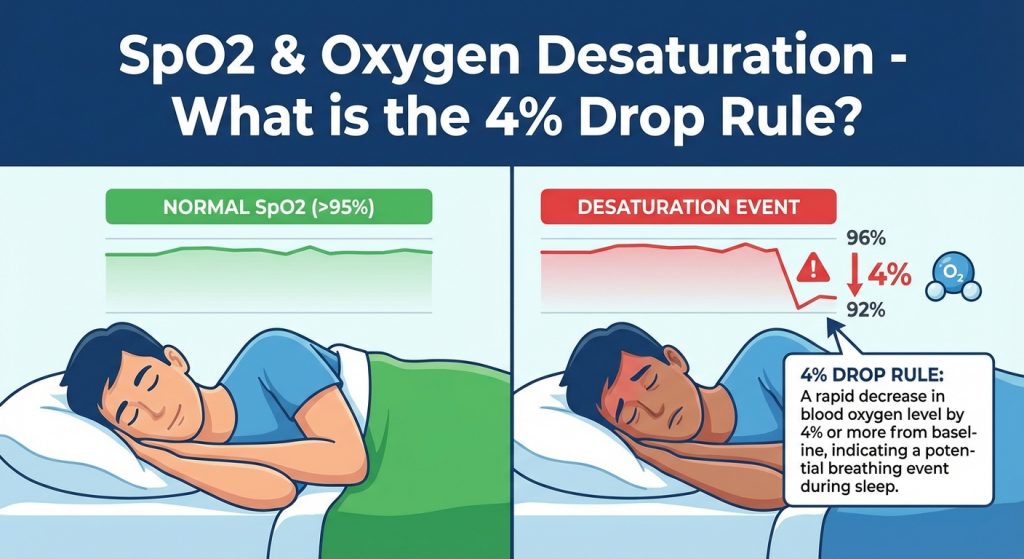
Under this criteria, a breathing event only counts if your oxygen drops by 4% or more from the baseline.
Example: Your oxygen is 96%. You stop breathing for 15 seconds. Your oxygen drops to 93% (a 3% drop).
Verdict: This is NOT counted. According to this rule, you are “healthy.”
Why it exists: It is stricter and often used by insurance companies to limit who qualifies for CPAP coverage.
The 3% Rule (AASM 1A / “Recommended Rule”)
Under this criteria, an event counts if oxygen drops by 3% or more (usually accompanied by a micro-awakening or arousal).
Example: Your oxygen is 96%. You stop breathing. It drops to 93%.
Verdict: This IS counted. You are diagnosed with a respiratory event.
Why This Matters to You
If you feel exhausted but your sleep study came back “negative” or “mild,” ask which rule was used. The 4% rule misses a massive number of patients, particularly those with UARS (Upper Airway Resistance Syndrome) or younger, fit individuals whose bodies are resilient enough to prevent deep oxygen drops despite struggling to breathe.
How to Analyze Your Data: Real Event vs. Sensor Artifact
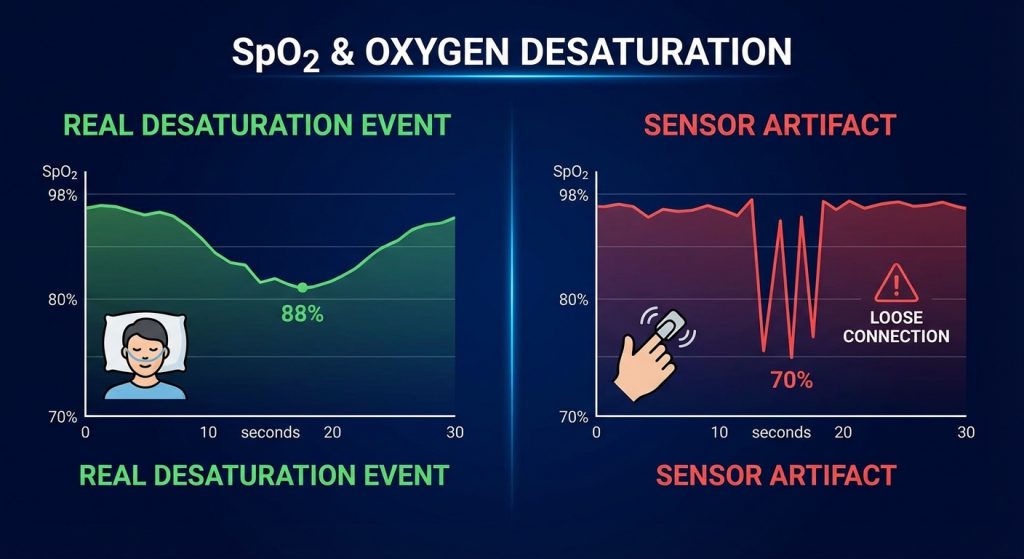
If you are using an O2Ring, you will see dips in the graph. You must learn to separate signal from noise.
- 1. The “Square Wave” (Artifact / Sensor Error)
Sensors use light to read blood flow. If you block the blood flow or the light, the reading fails.
The Shape: The line drops instantly and vertically (e.g., 97% to 80% in 1 second). It stays flat at the bottom for a while. It shoots back up vertically. It looks like a square or a canyon.
The Cause: You slept on your hand (compression), or the device slipped off.
Verdict: Ignore this. This is not nighttime hypoxia. - 2. The “Sawtooth” Pattern (Genuine Apnea/Hypopnea)
This is the classic signature of airway collapse.
The Shape: It looks like a “V” or the teeth of a saw.
The Progression:
1. Gradual Decline: Oxygen drifts down over 10–30 seconds (as you hold your breath).
2. The Nadir: It hits the bottom (e.g., 88%).
3. Sharp Recovery: It shoots back up quickly (within 5–10 seconds). This happens because your brain panicked, spiked your heart rate, and forced you to gasp for air.Confirmation: Look at your Pulse Rate graph at the exact same moment. If the oxygen drop coincides with a sharp heart rate spike, this is almost certainly a respiratory event.
Symptoms of Oxygen Desaturation
What does blood oxygen drops feel like the next day? It is distinct from simple tiredness.
- Morning Headaches: Caused by the dilation of blood vessels in the brain due to high CO2 and low O2.
- Racing Heart: Waking up with a fast pulse (tachycardia) due to the adrenaline dumps required to restart breathing.
- Night Sweats: Often caused by the metabolic stress of fighting for air. Note: This mimics metabolic issues. See our guide on Nocturnal Hypoglycemia to differentiate.
- Gasping/Choking: Waking up suddenly feeling like you were drowning.
The ODI Score: Grading Your Severity
If you use the Wellue O2Ring, the app will provide an ODI (Oxygen Desaturation Index) score. This essentially automates the 4% (or sometimes 3%) rule for you.
- ODI < 5: Normal range. Occasional drops are normal.
- ODI 5 – 15: Mild. (You stop breathing 5 to 15 times every hour).
- ODI 15 – 30: Moderate.
- ODI > 30: Severe. This places immense strain on your heart and cardiovascular system.
Community Insight:
On forums like Reddit (r/SleepApnea), users frequently report that an ODI of even 5-10 can wreck their sleep quality if those drops are causing micro-awakenings. Do not dismiss “mild” numbers if your symptoms are severe.
What To Do Next?
You have tracked your sleep, and you see the “Sawtooth” pattern with an ODI of 15. What now?
- 1. Confirm with the 4% Rule: Look at your data manually. Are the drops at least 4%? If so, you have a very strong case for medical intervention.
- 2. The “80% Solution”: The O2Ring is fantastic for screening. In about 80% of cases, if it shows the V-shaped drops and pulse spikes, you have Apnea or UARS.
Read our full guide: O2Ring Data Analysis: Estimating Your Apnea/UARS Probability. - 3. Get Diagnosed:
If you have access to a doctor, request a Polysomnography.
If wait times are too long (6+ months), look for a WatchPAT One home test. It is a disposable medical-grade device that is more accurate than the ring because it measures peripheral arterial tone (PAT) and uses the 3% rule by default in its detailed reporting. - 4. Lifestyle Factors: While waiting for a doctor, ensure you aren’t making it worse. Alcohol relaxes throat muscles, worsening desaturation.
Check: The Anti-Sleep Diet: 5 Foods That Destroy Sleep Quality.
When to Go to the ER?
Disclaimer: I am not a doctor.
If your resting oxygen while awake is below 92%, seek medical attention.
If your sleep data shows prolonged periods (minutes, not seconds) below 80%, or drops below 70%, this is an urgent cardiovascular risk.
Update for December 2025: The “T90” Metric & The UARS Loophole
Since I first explained the 3% vs 4% rule, medical guidelines have slowly shifted, and the biohacking community has discovered that how deeply you drop matters less than how long you stay there.
Here is the essential new information for late 2025.
1. The Rise of “T90” (Time Below 90%)
In 2025, sleep technicians are placing more emphasis on T90 (percentage of sleep time spent with SpO2 < 90%). Why? You can have a low ODI (few drops), but if you drift down to 88% and stay there for 30 minutes, your hypoxia burden is massive. The Triage: Look at your O2Ring report. If your T90 > 1%, that is clinically significant. If it is >5%, you are accumulating cardiovascular damage regardless of your AHI score.
2. The UARS Loophole: Why 3% Isn’t Enough
For those with UARS, even the 3% rule often fails.
The Reality: UARS patients fight through a narrow airway. Their brain wakes them up (arousal) before oxygen has a chance to drop by 3%.
If your O2Ring shows a stable SpO2 line (no drops) but a chaotic, spiky heart rate, do not assume you are “fine.” This is the classic signature of flow limitation without desaturation. You need a test that scores RERAs (Respiratory Effort-Related Arousals), not just oxygen.
3. Apple Watch “Apnea Notifications” (Series 10+/Ultra 2+)
The FDA clearance of Apple’s sleep apnea feature in late 2024 changed the screening landscape.
The Mechanism: It does not use the 4% rule. It uses accelerometer data (wrist movement) to detect breathing interruptions.
The Advantage: It catches events that don’t cause massive oxygen drops but do cause physical movement.
The Strategy: Use the Apple Watch for “Breathing Disturbances” alerts (sensitivity) and the O2Ring to verify the oxygen impact (severity).
4. AI Analysis of Your CSV
With the rise of advanced LLMs (ChatGPT-5, etc.), you no longer need to guess if a drop is an artifact.
The prompt: Upload your O2Ring CSV file and ask: “Analyze the correlation between heart rate spikes and SpO2 drops. Differentiate between gradual desaturations (apnea) and instantaneous drops (compression artifacts).”
The Benefit: AI is surprisingly good at filtering out the “square wave” hand-sleeping errors that skew your ODI score.
5. High-Altitude Adjustment
More users are tracking sleep while traveling.
The Rule: If you are above 5,000 feet (1,500m), your baseline SpO2 will naturally drop (e.g., to 92-94%).
The Fix: Do not panic if your average is lower in Denver than in Miami. Look for the drops relative to baseline, not the absolute number. A drop from 93% to 89% is just as significant as 97% to 93%.
Summary
Oxygen desaturation is the smoking gun of Sleep Apnea. However, understanding the difference between the 3% and 4% rules explains why so many people fall through the cracks of the medical system.
If your cheap pharmacy oximeter says you are fine, but you feel like a zombie, do not trust it. Get a continuous recorder. Look for the “V” shape. If your oxygen is dipping, your body is suffocating every night—and no amount of melatonin or positive thinking will fix that until the airway is open.
Read Next:
The Sleep Triage Test: Do You Have Insomnia, Apnea, or UARS?
O2Ring Data Analysis: Estimating Your Apnea/UARS Probability

By: Alex Warenstein.
Bio: Alex Warenstein is a sleep biohacker and founder of Night Time Comfort. After battling chronic insomnia and circadian disruption, he now helps others optimize their sleep using data-driven protocols. Read full story.
Disclaimer: Alex is not a doctor. This content is for educational purposes only. Always consult a specialist.