
You lie down in bed, exhausted, ready to sleep. But the moment your body relaxes, a creeping sensation begins deep inside your calves. It isn’t pain, exactly. It feels like carbonated water running through your veins, or an itch you cannot scratch because it is under the skin.
You kick your leg. The feeling stops for five seconds. You stop moving. The feeling returns, louder this time.
This pattern can fit Restless Legs Syndrome (RLS), also called Willis-Ekbom disease, as described by the National Institute of Neurological Disorders and Stroke.
RLS is one of the most maddening sleep disorders because it specifically targets the moment of rest. Estimates vary, but Restless Legs Syndrome affects roughly 5–10% of adults, and it can be confused with insomnia, stress, or plain restlessness—especially when people describe it only as ‘fidgeting’ (MedlinePlus Genetics).
This guide is for general education: it walks you through common symptom patterns (often summarized as URGE), explains why iron status is frequently checked, and offers practical steps that may reduce symptoms and help you prepare what to discuss with a clinician.
The “Itch” Deep Inside: RLS Symptoms vs. Fidgeting
The first step in RLS diagnosis is distinguishing a neurological urge from a behavioral habit.
- Normal Fidgeting
Many people shake their legs during the day or toss and turn at night. This is usually “psychomotor agitation” caused by anxiety, excess caffeine, or high energy.
The Feeling: You move your legs because you feel energetic or anxious.
Control: If someone asks you to stop, you can stop without physical discomfort.
Timing: It happens mostly during the day or when stressed.
Sensation: There is no specific physical sensation in the legs; the urge comes from the mind. - Restless Legs Syndrome (Willis-Ekbom Disease)
RLS is a sensorimotor disorder.
The Feeling: You move your legs because you must. The movement is the only way to relieve a specific, torture-like sensation.
Control: If you try to hold still, the sensation builds in intensity until it becomes unbearable, often leading to an involuntary jerk (PLMD).
Timing: It follows a circadian rhythm. It is significantly worse in the evening and at night.
Sensation: Patients describe it as “creepy-crawly,” “electric shocks,” “soda water in the veins,” “aching,” or “tugging.”
Location: Usually both legs, deep inside the calf or thigh. Occasionally affects the arms.
The Root Cause: The Iron-Dopamine Connection
Why do your legs twitch? For decades, doctors didn’t know. Current clinical guidance highlights iron status as a common, treatable contributor in many cases of RLS—one reason ferritin (and sometimes transferrin saturation) is often part of the evaluation (American Academy of Sleep Medicine).
You might think, “I don’t have a poor diet; I eat meat.” Or, “My doctor said my blood count is normal.”
Here is the nuance: you can have normal hemoglobin (no anemia) and still have low iron stores, reflected by a low ferritin level.
The Ferritin Factor
Ferritin is a protein that stores iron. Your brain needs iron to produce Dopamine, the neurotransmitter that regulates smooth muscle movement.
- The Threshold: A standard lab range for Ferritin might be 30–400 ng/mL. A doctor will look at a level of 35 and say, “You are normal.”
- The RLS Reality: For sleep health, “normal” is not enough.
Many expert resources note that, in people with RLS, clinicians often consider iron repletion when ferritin is below ~75 µg/L (ng/mL) and may aim for higher targets (often >100 µg/L) over time (RLS Foundation). - The Mechanism: When iron stores are low, dopaminergic pathways involved in movement regulation may not function optimally—especially at night—so the urge to move can intensify.
The Home Test: The URGE Criteria
RLS is typically identified from your symptom history (there’s no single definitive home test), but many clinicians look for these same four hallmark features—often remembered as URGE—to judge whether RLS is likely and worth evaluating further.
- 1. U – Urge to Move: You have an overwhelming need to move your legs, usually accompanied by uncomfortable sensations (itchy, crawling, burning).
- 2. R – Rest Worsens It: The symptoms start or get worse when you are inactive (lying down to sleep or sitting in a car/theater).
- 3. G – Getting Up Relieves It: The symptoms are partially or totally relieved by movement (walking, stretching) for as long as the activity continues.
- 4. E – Evening Worsening: The symptoms are worse at night than during the day.
How to test at home:
Wait until 9:00 PM. Lie down on your bed or sit in a recliner. Do not look at your phone. Try to keep your legs perfectly still for 5 minutes.
Result: If the sensations reliably build during rest, improve with movement, and are clearly worse in the evening, that pattern is consistent with RLS and is worth bringing to a clinician.
Triggers: What Makes RLS Worse?
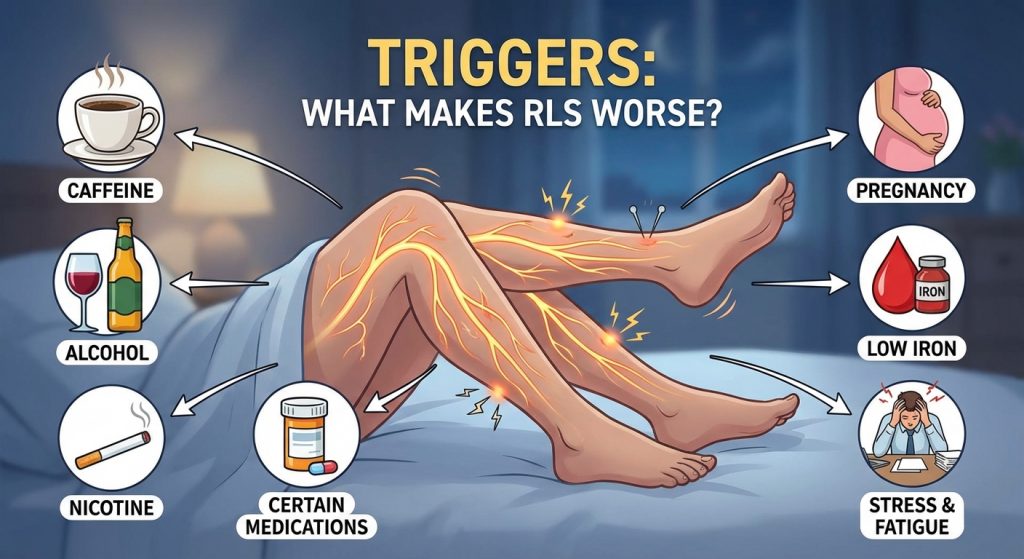
Before you look for a cure, you must stop feeding the fire. RLS is highly sensitive to what you consume.
- 1. The “Benadryl” Trap (Antihistamines)
This is the most common mistake discussed on Reddit RLS forums.The Scenario: You can’t sleep because of your legs, so you take an over-the-counter sleep aid (like Diphenhydramine, Atarax, or Doxylamine).
The Result: Your legs go crazy.
Why: Sedating antihistamines can worsen RLS symptoms in many people—especially “PM” sleep-aid formulas that contain diphenhydramine or doxylamine. Avoid medications containing “PM” (e.g., Tylenol PM) if you have itchy legs at night.
- 2. Antidepressants (SSRIs)
Many antidepressants (like Fluoxetine or Sertraline) increase serotonin but decrease dopamine availability. This can trigger or worsen RLS.Note: Never stop medication without talking to your doctor, but discuss this side effect with them.
- 3. Caffeine and Alcohol
Both substances disrupt dopamine pathways.Alcohol: It may make you feel sleepy at first, but many people notice more fragmented sleep and worse leg symptoms later in the night.
Caffeine: Stimulates the nervous system and depletes magnesium.
Read more: The Anti-Sleep Diet: 5 Foods That Destroy Sleep Quality.
- 4. Sugar and Inflammation
High blood glucose can cause peripheral neuropathy (nerve damage), which mimics or exacerbates RLS.
Natural Treatments & Supplements
If symptoms are mild to moderate, lifestyle changes and addressing contributing factors (like low iron stores) may meaningfully reduce symptoms, and some people can manage without prescription medication.
- 1. Iron Bisglycinate (The Priority)
If your blood test confirms Ferritin < 75 ng/mL, supplementation is the first line of defense. The Form: Use Iron Bisglycinate. It is gentle on the stomach and highly absorbable compared to Ferrous Sulfate. The Co-Factor: Always take iron with Vitamin C (or orange juice) to increase absorption. Warning: Never blindly supplement high-dose iron without a blood test. Iron toxicity (Hemochromatosis) is dangerous. - 2. Magnesium Glycinate
Magnesium helps relax muscles and calm the nervous system.
Why: Magnesium deficiency causes muscle spasms and twitching.
Reddit Consensus: Many users swear by Magnesium Glycinate or topical Magnesium Oil sprayed directly on the calves before bed. - 3. Vitamin D3
There is a correlation between low Vitamin D and RLS severity, likely due to dopamine regulation. Ensure your levels are optimized. - 4. Electrolytes (Potassium)
Sometimes, “restless legs” are actually “cramping legs.” Ensure you are getting enough Potassium (avocados, bananas, or electrolyte powder) to rule out simple muscle cramps.
Physical Hacks & Alternative Therapies
When the sensation strikes at 2 AM, you need immediate relief.
- 1. Compression Socks
Originally for circulation, tight compression socks provide a sensory input that can override the RLS signal.
Why it works: It applies constant pressure to the nerves.
Community Tip: Some users use “sleeves” designed for shin splints. - 2. Weighted Blankets
A heavy blanket (15-20 lbs) provides Deep Pressure Stimulation (DPS).
The Effect: Similar to compression socks, the weight creates a constant sensory input that “quiets” the false nerve firings causing the urge to move. - 3. Percussive Therapy (Massage Guns)
Use a massage gun (like Theragun or generic versions) on the hamstrings and calves for 2 minutes before bed.
The Mechanism: It stimulates blood flow and floods the nerves with vibration sensation, temporarily blocking the RLS “itch.” - 4. The “Bar of Soap” Myth
You will see this everywhere online: “Put a bar of lavender soap under your fitted sheet near your legs.”
The Science: There is almost zero scientific basis for this. It is likely a placebo.
Reddit Verdict: Despite the lack of science, roughly 30% of users in forums claim it works. Since it is cheap and harmless, it is listed here as a folk remedy, but do not rely on it for severe cases.
Periodic Limb Movement Disorder (PLMD)
It is important to distinguish RLS from PLMD, although they often overlap.
RLS: Occurs while you are awake. It keeps you from falling asleep.
PLMD: Occurs while you are asleep. Your legs kick or twitch rhythmically (every 20-40 seconds). You might not know you’re doing it, but your partner certainly does.
Connection: 80% of people with RLS also have PLMD. The treatments (Iron, Magnesium) are generally the same.
When to See a Doctor (Medical Treatments)
If you have optimized your Iron/Ferritin, cut caffeine, and tried magnesium, but you still spend hours pacing the floor at night, you need a neurologist.
Summary: Your RLS Checklist
Restless Legs Syndrome is not “in your head,” and it is not just fidgeting.
It is a neurologic condition that is thought to be linked to iron status and dopamine signaling, as summarized by the NHS.
Your Action Plan:
- 1. The Test: Do the “URGE” check tonight.
- 2. The Lab: Ask your doctor specifically for a Ferritin test. Do not accept “normal” as an answer if it is under 75 ng/mL.
- 3. The Diet: Cut caffeine and alcohol after 2 PM. Avoid “PM” sleep aids (antihistamines).
- 4. The Stack: Consider Magnesium Glycinate and Iron Bisglycinate (if confirmed low).
- 5. The Gear: Try compression socks or a weighted blanket to calm the nerves.
You do not have to dance in your bed every night. By treating the underlying biology, you can quiet the legs and finally get the deep rest you deserve.

By: Alex Warenstein.
Bio: Alex Warenstein is a sleep biohacker and founder of Night Time Comfort. After battling chronic insomnia and circadian disruption, he now helps others optimize their sleep using data-driven protocols. Read full story.
Disclaimer: Alex is not a doctor. This content is for educational purposes only. Always consult a specialist.