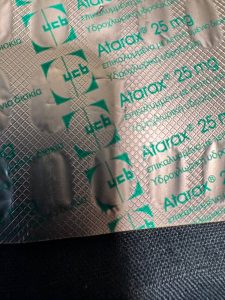
If there is one medication in my biohacking cabinet that I look back on with a mix of deep fondness and slight regret, it is Atarax (Hydroxyzine).
For nine months, this was my “magic bullet.” It was the only thing that could turn off the relentless, racing “monkey mind” that plagues so many of us with insomnia. It didn’t just knock me out; it provided a quality of subjective rest that I have struggled to replicate with gadgets, supplements, or other prescriptions like Trittico (Trazodone).
But this story has a catch. It involves a solid 8.5/10 rating on my personal sleep scale, and the inevitable biological wall known as Hydroxyzine tolerance.
If you are reading this, you are likely staring at a prescription or a box of 25mg tablets, wondering if this old-school antihistamine is the answer to your sleepless nights. Here is everything I learned—not just from living with this medication in my bloodstream, but also from cross-checking mainstream drug references like MedlinePlus.
The Greek Solution: How It Started
My journey with Atarax for sleep didn’t begin in a sterile sleep lab. It began during a trip to Greece. I was going through a particularly rough patch of insomnia – high cortisol, high stress, and that dreadful anxiety about not sleeping.
In Greece, getting Atarax through a local clinic/pharmacy was straightforward, but its prescription/dispensing status varies by country, so don’t assume it’s OTC everywhere. A local doctor suggested I try a low dose—Atarax 25mg—specifically for those nights when my brain refused to shut down.
I was skeptical. I knew it was an antihistamine sleep aid, similar in class to the diphenhydramine found in drugstore sleep aids (which I hate because they make me feel restless). But Atarax is different. It is an H1-receptor antagonist with significant anxiolytic (anxiety-reducing) properties.
My First Night
I took a tiny 25 mg tablet 60 minutes before bed.
Unlike Melatonin, which acts like a gentle whisper suggesting sleep, Atarax felt like a warm, heavy blanket being pulled over my brain. It wasn’t a forced “blackout” like you might get from heavy sedatives. It was a physical and mental deceleration.
My heart rate slowed. The looping thoughts regarding work and health dissolved. I didn’t just fall asleep; I stayed asleep.
For the next nine months, this medication was my safety net. It allowed me to sleep on airplanes (something I historically could never do), saved me before high-stakes presentations, and reset my rhythm when I traveled across time zones.
How Hydroxyzine Actually Works (What We Know)
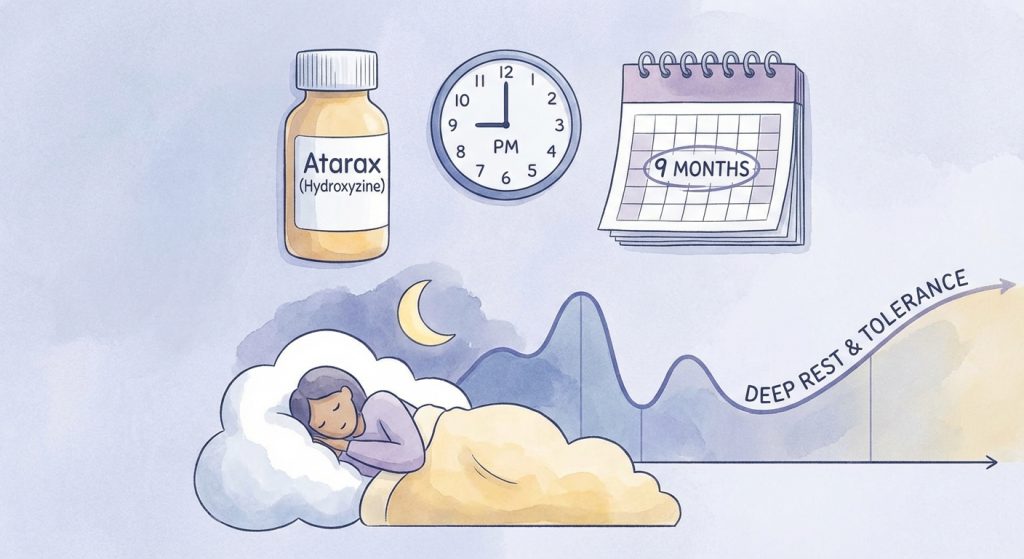
To understand why this works (and why it eventually stops), we have to look at the mechanism. Hydroxyzine is a first-generation antihistamine. It crosses the blood-brain barrier efficiently. Once there, it blocks Histamine H1 receptors.
Histamine isn’t just about allergies; in the brain, histamine is a potent wakefulness neurotransmitter. By blocking it, Atarax induces sedation. But unlike newer antihistamines (like Zyrtec or Claritin) that are designed not to cross into the brain, Atarax goes straight to the central nervous system.
Furthermore, it reduces activity in the subcortical centers of the CNS. This is key for those of us with “Tired but Wired” syndrome or hyperarousal. If your insomnia is driven by anxiety or racing thoughts (the classic “Tired but Wired” pattern), hydroxyzine may reduce anxiety-driven arousal and make sleep onset easier, rather than acting only as a sedative.
Sleep Onset vs. Sleep Maintenance
Based on how it’s typically described in clinical practice (and how it felt for me), hydroxyzine can be very effective for sleep onset, while sleep maintenance is more variable from person to person.
- Sleep Onset (Falling Asleep): Atarax is highly effective here. It typically kicks in within 30 to 60 minutes.
- Sleep Maintenance (Staying Asleep): This is where results are mixed. The half-life is roughly 14-25 hours (varying by age), but the intense sedative effect often wears off after 4-6 hours for some users. However, in my personal case—during those golden 9 months—it provided perfect maintenance. I slept through the night without (!!!) the 4 AM cortisol wake-up.
My Experience: The “Honeymoon” Phase
During the period when Atarax was working for me, I would rate it an 8.5 out of 10.
Why not 10? Because of the morning “fog.” But compared to Trittico (which gave me nightmares and a stuffy nose) or OTC sleep aids (which gave me restless legs), Atarax was superior.
The Subjective Feeling of Rest
The most remarkable thing about Atarax was how I felt after waking up. Despite the initial grogginess (which I’ll discuss below), once the fog lifted, I felt restored.
When I track my sleep with my Apple Watch Ultra 2, some medications show increased sleep duration but poor quality. With Atarax, my subjective feeling was that of deep, healing rest. It felt like my brain had actually shut off for 8 hours, rather than hovering in light sleep.
Some sleep-lab research suggests hydroxyzine can increase total sleep time and reduce wakefulness, but changes in ‘deep sleep’ (NREM3) aren’t consistent across everyone—so I treat wearable trends as interesting signals, not definitive proof.
The Downside: The “Atarax Hangover”
You cannot borrow energy from tomorrow without paying interest. The price of Atarax is the “Hangover.”
It is not a headache-alcohol hangover. It is a cognitive fog.
- The Symptom: Upon waking at 8:00 AM, I would feel like I was moving underwater. My limbs felt heavy. My reaction time was slow. It is what doctors call “residual daytime sedation.”
- The Fix: A strong double espresso. For me, caffeine was the antidote. Once the caffeine hit my system (usually about 30-45 minutes after waking), the fog would burn off completely, and I would function normally for the rest of the day.
However, if you are someone who does not drink coffee or has a slow Caffeine Half-Life metabolism, this morning grogginess might last until noon, which is a major “Con” for this drug.
The Tolerance Trap: Why It Stopped Working
This is the most important part of this article. If you take nothing else away, remember this: Hydroxyzine tolerance is real, and it happens fast.
For the first few months, 25mg was plenty. I took it intermittently—maybe 1 or 2 times a week. This “cycling” helped delay the tolerance.
But eventually, I started taking it more frequently during a stressful period. That was the mistake.
- Month 1-6: 25mg worked like magic.
- Month 7: I noticed I was waking up earlier. The “heavy blanket” feeling was lighter.
- Month 8: I considered increasing the dose to 50mg (a standard adult dose, but higher risk for side effects). I tried it once, but the morning hangover was too severe.
- Month 9: The 25mg dose stopped making me sleepy. It still helped slightly with anxiety, but the hypnotic (sleep-inducing) effect was gone.
My brain had downregulated its H1 receptors. It had adapted. The drug didn’t change; my biology did.
The 2025 Community Consensus on Tolerance
I spent weeks combing through threads on Reddit (r/insomnia, r/Anxiety) and specialized forums like SleepHQ to validate my experience. The pattern is strikingly consistent among users in 2025:
- 1. The “Miracle” Week: Users report the first 3-7 days are incredible.
- 2. The Fade: By week 2 or 3 of daily use, the sedative effect diminishes significantly.
- 3. The “Sugar Pill” Phase: Long-term daily users often report it does nothing for sleep anymore, though it may still blunt anxiety attacks.
The Lesson: Atarax is not a long-term sleep maintenance medication for daily use. It is a “Rescue Tool.” It is for the night before a wedding, the night before a big interview, or the first night in a hotel. If you use it every day, you will lose it.
Safety Profile: Heart Health and The Anticholinergic Burden
In 2025/2026, we are more aware than ever of the long-term risks of medications. While Atarax is generally considered safer than benzodiazepines regarding addiction potential, it carries its own baggage.
1. QT Prolongation (Heart Rhythm)
Regulators have flagged a small but definite QT-prolongation / torsades risk with hydroxyzine—see the European Medicines Agency.
- My Protocol: Since I use an Apple Watch Ultra 2, I occasionally check my ECG. While the Watch cannot perfectly calculate QTc intervals like a 12-lead medical ECG, using third-party apps (like ECG – Corrected QT Interval) allows me to keep a rough eye on my heart rhythm.
- The Reality: For a healthy adult on a low dose, the absolute risk is generally considered low, but it becomes meaningfully higher if you already have QT-risk factors or electrolyte issues, or if you combine it with other QT-prolonging meds (see FDA).
2. Anticholinergic Burden
This is the big warning for 2026. Hydroxyzine is an anticholinergic. It inhibits the neurotransmitter acetylcholine, which is crucial for memory and learning.
- Short term: This causes dry mouth (very common) and constipation.
- Long term: Large observational studies have found an association between higher cumulative exposure to strong anticholinergic medications and higher dementia risk in older adults, which is one reason many clinicians try to keep long-term anticholinergic ‘load’ low (JAMA Internal Medicine).
- Alex’s Take: This is why I am glad I stopped. I need my brain sharp. Using it for 9 months probably didn’t rot my brain, but taking it daily for 10 years? That is a risk I wouldn’t take.
Pros & Cons: The Patient Verdict
Based on my experience and an aggregation of hundreds of Hydroxyzine insomnia reviews from Reddit and sleep forums updated for late 2025:
PROS
- Effective for “Racing Minds”: If anxiety keeps you awake, this is often better than Z-drugs (Ambien).
- Non-Addictive (Physically): You won’t go into dangerous withdrawal if you stop, unlike benzos.
- No “Rebound Insomnia”: When I stopped, my sleep went back to baseline, but it didn’t get worse than before (a common issue with other sleeping pills).
- Access: In many countries (like Greece), it is accessible; elsewhere, it is a very easy prescription to get as it is not a controlled substance.
- Allergy Relief: A nice bonus if you suffer from seasonal allergies—your nose clears up while you sleep.
CONS
- Rapid Tolerance: It stops working for sleep onset if used daily.
- The “Hangover”: Morning grogginess can be brutal and last until noon without caffeine.
- Dry Mouth: Almost guaranteed. You will wake up needing water.
- Weight Gain: Some users report increased appetite (histamine regulation is linked to satiety), though I didn’t experience this personally.
- Heart Risks: QT prolongation warnings require caution.
My Verdict:
Atarax is an excellent “Breaker.” If you’re stuck in a cycle of high anxiety and sleeplessness, short-term or intermittent use can be genuinely helpful for some people, but I wouldn’t frame it as a forever, every-night solution. It breaks the cycle. It reminds your body what it feels like to sleep.
But eventually, you have to do the hard work: fixing your Sleep Hygiene Checklist, optimizing your Magnesium L-Threonate stack, and managing your cortisol.
Today, Atarax sits in my cabinet, expired but respected. It did its job when I needed it most. If your doctor suggests it, don’t be afraid to try it—just respect the tolerance, and don’t expect the magic to last forever if you abuse the frequency.
Summary: Is Atarax Right for You?
I miss the days when Atarax 25mg worked for me. It was a simple, elegant solution to a complex problem. It provided a deep, dark, anxiety-free sleep that helped me recover from years of sleep debt.
However, it is a temporary bridge, not a permanent destination.
If you are looking for a sleep maintenance medication to take every single night for the rest of your life, this is likely not it. The tolerance builds too fast, and the anticholinergic profile makes it less than ideal for long-term brain health.
!!! Disclaimer: I am not a doctor. This article mentions prescription medications. Always consult with your healthcare provider before starting or stopping any medication, especially regarding heart health and interactions.

By: Alex Warenstein.
Bio: Alex Warenstein is a sleep biohacker and founder of Night Time Comfort. After battling chronic insomnia and circadian disruption, he now helps others optimize their sleep using data-driven protocols. Read full story.
Disclaimer: Alex is not a doctor. This content is for educational purposes only. Always consult a specialist.