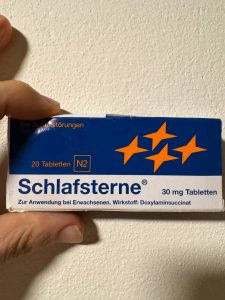
When you have been staring at the ceiling for three hours, and the biohacks, breathing exercises & workouts, and herbal teas have failed, you eventually reach a point of desperation. You need something that simply forces the biological switch from “On” to “Off.” In the world of Over-The-Counter (OTC) sleep aids, there is one compound that earns the nickname “The Sledgehammer.” It is Doxylamine Succinate.
You might know it as Donormil (common in Europe), Unisom SleepTabs (in the US), or Hoggar Night. Regardless of the brand name, the active ingredient is a first-generation antihistamine that possesses a sedative potency significantly higher than its cousin, Diphenhydramine (Benadryl).
This article is a deep dive into Doxylamine. I am a patient who has spent years navigating insomnia, and I treat this medication with a very specific mixture of respect and caution. While my daily stack relies on gentler compounds like Magnesium L-Threonate or Apigenin, Doxylamine sits in my emergency kit for those specific “black days” when sleep seems impossible.
Below, I will break down exactly how it works, the new safety data emerging in 2025 regarding its risks, why the “hangover” is real, and why the internet forums are full of people who both love and fear this little blue pill.
Mechanism of Action: How Doxylamine “Knocks You Out”
To understand why Doxylamine is so effective for sleep onset latency (the time it takes to fall asleep), you have to understand what keeps you awake. One of the primary neurotransmitters responsible for wakefulness and alertness is histamine.
Most people associate histamine with allergies—sneezing, itching, and hives. However, in the brain, histamine acts as a “wake-up” signal. Doxylamine Succinate is a potent H1-receptor antagonist. It crosses the blood-brain barrier efficiently and blocks these histamine receptors. By inhibiting the chemical that keeps you alert, it essentially removes the “brake” on your sleep drive.
But there is a secondary mechanism that makes Doxylamine a double-edged sword: it is a strong anticholinergic agent. It blocks the action of acetylcholine, another neurotransmitter involved in learning, memory, and muscle contraction. This anticholinergic action contributes to the sedation, but it is also responsible for the dry mouth, constipation, and the infamous “brain fog” that can linger well into the next day.
The 2025 Perspective on Anticholinergic Burden
It is impossible to write a responsible review of Doxylamine in 2025 without addressing the “Anticholinergic Burden.” Recent medical literature and updated guidelines (including the AGS Beers Criteria) have become increasingly strict about the use of first-generation antihistamines. The concern isn’t just about feeling groggy; it is about long-term brain health.
Cumulative exposure to strong anticholinergics has been statistically linked to a higher risk of cognitive decline and dementia in older adults. While a single dose to cure a bout of acute insomnia is generally considered safe for a healthy adult, chronic daily use is something the medical community—and the biohacking community—strongly advises against. This is not a “vitamin” you take every night for the rest of your life.
The “Knockout” Effect: Sleep Onset and Maintenance
The primary reason anyone reaches for Donormil or Unisom is speed. According to clinical data and pharmacokinetics, Doxylamine reaches its peak plasma concentration in approximately 2.4 hours, but the sedative onset is often felt much faster, usually within 30 to 60 minutes.
Reducing Sleep Onset Latency
For the “tired but wired” crowd—those of us whose minds race with anxiety the moment the head hits the pillow—Doxylamine acts as a blunt instrument. It introduces a physical heaviness that makes it difficult to maintain racing thoughts.
In a large network meta-analysis published in MedCentral (De Crescenzo et al., updated regarding OTC efficacy), Doxylamine showed a Standardized Mean Difference (SMD) of approximately 0.47 against placebo regarding efficacy. In plain English: it works significantly better than a sugar pill for initiating sleep.
Sleep Maintenance: Staying Asleep
Unlike Melatonin Spray or other fast-acting but short-lived supplements, Doxylamine has a long half-life of about 10 hours. This is crucial for people who suffer from maintenance insomnia (waking up at 3 AM). Because the drug stays in your system through the night, it helps bridge the gap between sleep cycles, potentially reducing the number of nocturnal awakenings.
However, this long half-life is precisely why the “hangover” effect is so prevalent. If you take 25mg at 11:00 PM, a significant amount of the drug is still active in your bloodstream at 7:00 AM when your alarm goes off.
My Personal Experience: The 7/10 Rating
I do not use Doxylamine often. My rating of 7 out of 10 reflects its utility as a rescue medication, not a daily staple.
There have been nights where my standard protocol—sleep hygiene, darkness, and my usual supplements—was simply not enough against a wall of high anxiety (usually work deadlines or family issues). In those moments, when I knew I had to be up in 8 hours and couldn’t afford to lie awake, I took Doxylamine.
The Experience:
It usually takes about 45 minutes for me to feel it. It’s not a gentle drift like I get from Apigenin; it is a heavy, physical sedation. My eyelids get heavy, and my body feels weighted to the mattress.
When It Failed:
I must be honest: there were at least two specific occasions where it did not work. Despite taking the pill, my anxiety was powerful enough to override the sedation. I lay there, physically exhausted and “drugged,” but mentally wide awake. This is a terrible state to be in—trapped in a heavy body with a racing mind. This suggests that while it is a strong sedative, it is not anxiolytic in the same way a benzodiazepine or even Trittico (Trazodone) might be for some. It creates sleepiness, but it doesn’t necessarily turn off the “fight or flight” switch if your cortisol is through the roof.
My Wife’s Experience:
My wife, who does not suffer from chronic sleep issues but occasionally has “bad nights,” has used Doxylamine from my stash three times. For her, it was a 100% success rate. She took it, fell asleep within the hour, and slept through the night without interruption. This highlights how individual the response to histamine blockers can be.
My Protocol:
I never take it more than once a week. Ideally, not even that often. It is strictly for emergencies. If I find myself needing it two nights in a row, I know I need to look at my circadian rhythms, or my stress management, rather than just popping more pills.
The “Hangover” and Side Effects
If you browse the r/insomnia subreddit or SleepHQ reviews, the number one complaint about Doxylamine Succinate is the next-day condition. Users call it the “zombie mode,” “sleep hangover,” or “cement head.”
Because of the 10-hour half-life, the drug is still occupying your H1 receptors the next morning. Symptoms include:
- 1. Grogginess and Inertia: Waking up feels physically difficult. It can take until noon for the brain fog to clear. This is why official guidelines warn against driving or operating machinery early in the morning after taking it.
- 2. Dry Mouth (Xerostomia): The anticholinergic effect dries out mucous membranes. You will likely wake up thirsty.
- 3. Urinary Retention: This is a critical warning for men with prostate issues (BPH). Doxylamine makes it harder to empty the bladder. If you are already taking Pygeum Africanum to stop waking up to pee, taking a drug that causes retention might seem contradictory, but it can actually lead to uncomfortable blockage.
- 4. Constipation: Another classic anticholinergic side effect.
The “Cinema” Effect (Vivid Dreams):
A fascinating and frequently reported side effect on forums is the intensity of dreams. While some studies suggest antihistamines might suppress REM sleep initially, many users report “extremely vivid and incredibly bizarre” dreams. It is not uncommon to read reports of “movies playing in my head” or nightmares that feel disturbingly real. If you are prone to bad dreams, this is a risk factor to consider.
The Tolerance Trap: Why You Can’t Use It Daily
If there is one section of this article you take to heart, let it be this: Tolerance to Doxylamine builds incredibly fast.
This is not a drug where you can take the same dose for a year and get the same result. User reports and clinical pharmacology suggest that sedative tolerance can develop in as little as 3 to 4 days of continuous use.
The Cycle of Failure:
- 1. Day 1: You take 25mg. You are knocked out. You sleep great.
- 2. Day 2: You take 25mg. It works, but maybe you wake up once.
- 3. Day 3: You take 25mg. It takes longer to fall asleep.
- 4. Day 4: You take 25mg. It barely works. You are tempted to take 50mg.
DO NOT chase the dose. Increasing the dosage significantly increases the risk of severe anticholinergic toxicity (hallucinations, heart palpitations, confusion) without guaranteeing sleep.
Furthermore, stopping abruptly after a week of daily use can lead to rebound insomnia—where your sleep is worse than it was before you took the pill. This is why the packaging often says “for occasional sleeplessness.” They mean it.
Community Intel: What the Forums Are Saying in 2025
To ensure this review reflects reality, I have scoured the latest discussions on ApneaBoard, SleepHQ, and relevant subreddits. Here is the consensus from the trenches:
The “Half-Tablet” Strategy:
Many experienced users find that the standard 25mg dose (common in Unisom) is too strong and leads to an unbearable hangover. A very popular strategy is to split the tablet and take only 12.5mg (or even 6.25mg). Users report this often provides enough of a “nudge” to fall asleep without the devastating next-day grogginess.
The Apnea Concern:
On CPAP forums, there is an ongoing debate about using Doxylamine. Some users with Obstructive Sleep Apnea (OSA) worry that the muscle-relaxing properties of the drug (or simply the depth of sedation) might worsen airway collapse. One user on CPAPtalk noted that Doxylamine seemed to “raise my AHI levels” (Apnea-Hypopnea Index). If you are using a ResMed AirSense 11 or similar machine, you should monitor your OSCAR data closely if you introduce a sedative, as it might require a pressure adjustment.
Comparison to Diphenhydramine:
The general consensus on r/insomnia is that Doxylamine is the superior OTC option compared to Diphenhydramine (Benadryl/ZzzQuil). Users consistently rate it as more potent for staying asleep. “Benadryl helps me fall asleep but I wake up in 3 hours; Doxylamine keeps me down,” is a common sentiment.
2025 Safety Updates: What You Need to Know
In 2025, the scrutiny on OTC sleep aids has tightened. The FDA and European agencies haven’t banned these drugs, but the labeling requirements and doctor recommendations have shifted.
- Glaucoma and Breathing: New emphasis is placed on warnings for people with increased intraocular pressure (glaucoma) and chronic breathing issues like emphysema or chronic bronchitis. The drying effect can thicken bronchial secretions, making it harder to clear the lungs.
- The “Full Night” Rule: Labels now explicitly state that you should not take this medication unless you can dedicate 7-8 hours to sleep. Taking it at 4 AM to get “a few more hours” is a recipe for disaster; you will likely be unable to function safely at 8 AM.
- Geriatric Warning: If you are over 65, this medication is likely on the “Avoid” list (Beers Criteria) due to the risk of confusion, falls, and urinary retention.
Pros and Cons Summary
Based on medical data and user reviews, here is the breakdown:
Pros:
- High Potency: Widely considered the strongest sleep aid available without a prescription.
- Availability: Easy to buy in pharmacies (Donormil in EU, Unisom in US) and relatively cheap.
- Maintenance: better than Melatonin or Benadryl for staying asleep through the night.
- Adjustable: Tablets can usually be split to find a minimum effective dose (e.g., 12.5mg).
- Rapid Onset: Usually works within 30-45 minutes.
Cons:
- The Hangover: High probability of next-day grogginess and reduced cognitive performance.
- Rapid Tolerance: Effectiveness drops sharply after 3-4 consecutive days.
- Anticholinergic Side Effects: Dry mouth, constipation, urinary retention are common.
- Cognitive Risk: Long-term use is linked to potential cognitive decline; not for chronic daily use.
- Sleep Architecture: May induce bizarre dreams or nightmares; does not produce “natural” sleep stages.
Comparisons with Other Options
Doxylamine vs. Melatonin Spray:
Melatonin Spray is a chronobiotic—it shifts your body clock. It is subtle and safe for nightly use. Doxylamine is a sedative drug. It is a sledgehammer. Use Melatonin to fix your rhythm; use Doxylamine when you are in crisis.
Doxylamine vs. Prescription Options (Trittico/Atarax):
While Atarax (Hydroxyzine) is also an antihistamine, it is a prescription medication in many countries and has a slightly different receptor profile. Trittico (Trazodone) is an antidepressant used off-label for sleep with a different mechanism (SARI). Generally, doctors prefer Trazodone for long-term management because it lacks the intense anticholinergic burden of Doxylamine. However, for a one-off night without a doctor’s visit, Doxylamine remains the accessible choice.
Summary: The Emergency Brake
Doxylamine Succinate is a tool, not a cure. It does not fix the root cause of your insomnia. It does not lower your cortisol like Phosphatidylserine, nor does it relax your muscles like Magnesium L-Threonate. It simply chemically blocks the signal that keeps you awake.
For me, it sits in the medicine cabinet like a fire extinguisher. I hope I never have to use it. But knowing it is there provides a certain psychological comfort. If you choose to use it, treat it with respect: start with a half dose, ensure you have 8 hours to sleep, and never, ever mix it with alcohol.
If you find yourself needing “The Sledgehammer” more than once or twice a week, it is time to put the pill bottle down and look at the Sleep Triage Test or consult a specialist. Relying on antihistamines for chronic insomnia is a dead-end road that leads to tolerance and frustration. Use it wisely, or not at all.

By: Alex Warenstein.
Bio: Alex Warenstein is a sleep biohacker and founder of Night Time Comfort. After battling chronic insomnia and circadian disruption, he now helps others optimize their sleep using data-driven protocols. Read full story.
Disclaimer: Alex is not a doctor. This content is for educational purposes only. Always consult a specialist.