Most sleep supplements are taken 30 minutes before bed. But sometimes, the best way to fix your night is to fix your day.
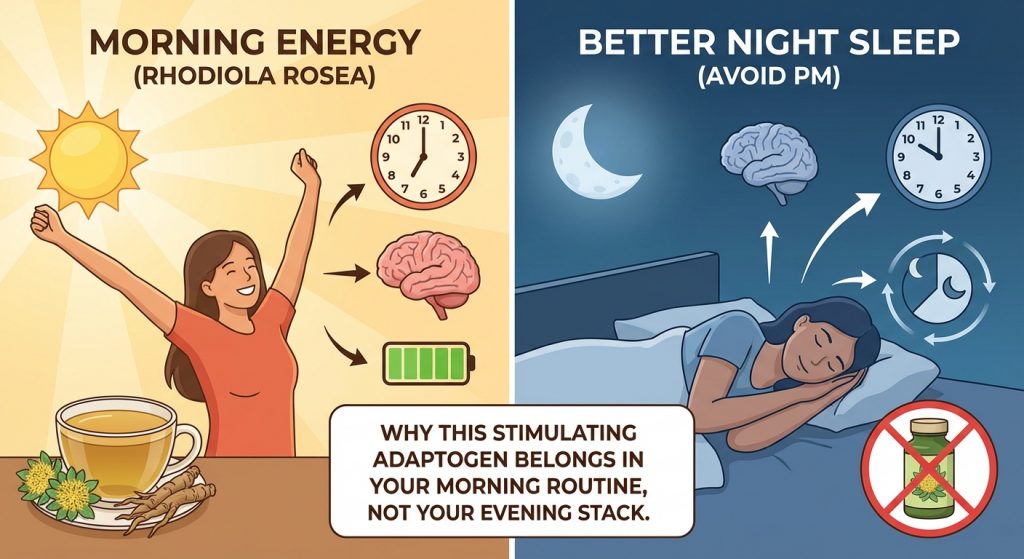
Rhodiola Rosea is not a sedative. It is a stimulating adaptogen. If you take it at 10 PM, you will likely stare at the ceiling for hours.
However, for people who feel run-down from chronic stress, work burnout (the World Health Organization describes burnout as an occupational phenomenon, not a medical diagnosis), or a misaligned sleep schedule, Rhodiola can be a helpful morning tool. By supporting daytime energy and stress tolerance, it may indirectly make it easier for your body to “wind down” at night.
This review summarizes what human research suggests (and what it doesn’t) about rhodiola as a daytime stress/fatigue aid and why that can indirectly support sleep. For a neutral evidence-and-safety snapshot, see the NIH National Center for Complementary and Integrative Health (NCCIH).
What is Rhodiola Rosea?
What does Rhodiola Rosea do for you?
Rhodiola is an herb that grows in the cold, mountainous regions of Europe and Asia. It is classified as an adaptogen, meaning it helps the body resist physical, chemical, and biological stress.
Mechanism of Action:
- 1. Monoamines: Rhodiola may have mild, extract-dependent effects on monoamine signaling (including possible MAO-related activity), which could explain why some people feel a noticeable mood/drive “lift.”
- 2. Cortisol Modulation: Unlike caffeine, which spikes cortisol, Rhodiola balances it. It prevents the crash after stress.
- 3. ATP Production: It supports cellular energy metabolism, reducing physical fatigue.
Is Rhodiola rosea the same as Ashwagandha?
Ashwagandha (including KSM-66) tends to feel more calming for many people and is often taken later in the day, while Rhodiola is typically more activating and is usually better in the morning.
The Sleep Connection: Why Morning Energy Matters
You might wonder, “Why take a stimulant for sleep?”
The answer lies in the Cortisol Rhythm.
- The Problem: Some people with stubborn insomnia feel “tired in the morning, wired at night,” which can happen when your day–night stress rhythm gets messy.
- The Fix: A consistent wake time, morning light, and more daytime activity are the big anchors; a stimulating herb only makes sense if it helps you do those basics.
- The Rhodiola Role: Taken early, Rhodiola may help some people feel more capable during the day—so by nighttime you have more natural “sleep pressure” built up.
Does rhodiola affect cortisol?
Possibly. Rhodiola has been studied for stress response, and some studies report changes in stress markers, but results vary by person, dose, and extract—so track how your own evenings and 3 AM wake-ups respond.
Dosage and Timing: The Critical Window
Should I take rhodiola in the morning or at night?
Morning. Always morning.
Taking it after 2:00 PM risks interfering with sleep onset because of its stimulating nature.
How much to take?
Common label/study doses are roughly 200–600 mg/day; for example, the standardized SHR-5 extract has been studied at 340–680 mg/day (PubMed).
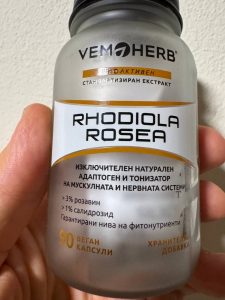
Look for extracts standardized to 3% Rosavins and 1% Salidroside (the active compounds).
Cycling: Many people choose to cycle Rhodiola (mainly to keep the “lift” feeling noticeable), but this is more a user strategy than a proven requirement.
Protocol: 6 weeks on, 2 weeks off. Or 5 days on, 2 days off.
Reddit & Community Consensus
What do users on r/Nootropics and r/Supplements report?
The Good:
- 1. “The Anti-Fatigue King”: Users consistently rate it higher than caffeine for “clean” energy without the jitters.
- 2. “Mood Lift”: Many report a noticeable reduction in “doom and gloom” feelings, likely due to the dopamine/serotonin boost.
- 3. “Focus without Crash”: Unlike high-dose caffeine, there is no crash.
The Bad:
- 1. “Insomnia”: A significant number of users report that they cannot sleep if they take it past noon.
- 2. “Irritability”: Can rhodiola worsen anxiety? For some “wired” individuals, the stimulation can turn into aggression or irritability.
- 3. “Tolerance”: Effects fade if taken every single day for months without a break.
Alex’s Personal Review
The following is based on my personal logs.
I added Rhodiola Rosea (500mg, 3% Rosavins) to my morning stack during a particularly stressful quarter at work. I wasn’t sleeping well because I was carrying work stress home.
My Experience:
I took it with breakfast. Within 45 minutes, I felt a “lift.” It wasn’t a buzz like coffee; it was just a capacity to handle tasks. The “weight” of stress felt lighter.
Crucially, because I was more productive and active during the day, I felt naturally tired by 10:30 PM. It fixed my sleep by fixing my day.
My Rating: 7.5/10
It works. It is potent. I cycle it (3 months on, 1 month off) to keep it effective. It is my go-to for “crunch time.”
Where to Buy:
I use VemoHerb or NOW Foods for products with verified standardization. You can buy them on iHerb.com.
Safety & Side Effects
Who cannot take rhodiola?
- Bipolar Disorder / history of mania: Rhodiola can be too activating for some people, and there are published case reports of rhodiola-associated mania (The Psychiatrist.com).
- SSRI (or other antidepressant/stimulant) users: Interactions are uncommon but worth taking seriously—there are published case reports of serotonergic reactions when Rhodiola is combined with SSRIs (PubMed Central).
What is the downside of rhodiola?
Dry mouth and vivid dreams are common mild side effects.
Update for January 2026
Since September 2025, the newest “sleep-relevant” Rhodiola updates are mostly about how it supports sleep indirectly (through daytime stress/energy) and how to avoid the common sleep mistakes.
- 1. The newest big-picture reviews still frame Rhodiola as a daytime stress/fatigue tool, not a bedtime sleep herb—when sleep improves, it’s usually because people feel less stressed and function better during the day (Annals of Agricultural and Environmental Medicine).
- 2. A late-2025 adaptogens review highlights the same pattern: Rhodiola is discussed most consistently for resilience and performance, while “sleep benefits” show up as secondary outcomes or as part of combination approaches (ScienceDirect).
- 3. More 2025–2026 trials are testing Rhodiola inside “stress + sleep” stacks (e.g., with ashwagandha/L-theanine/apigenin/magnesium forms) instead of pretending it’s a standalone insomnia fix—results are still pending (ClinicalTrials.gov).
- 4. One practical takeaway that keeps showing up in evidence-mapping work: Rhodiola can backfire on sleep if mistimed because it can feel stimulating for some people—so “morning only” remains the safest default (PROSPERO).
- 5. Late-2025 community “sleep hack” pattern: people who say Rhodiola helped their sleep usually mean “my day went smoother, so I slept easier,” and many report that any dose after noon increases insomnia risk (r/cfs).
Summary
Rhodiola Rosea is the daytime guardian of your sleep.
- Use it if: You often wake up exhausted, feel brain fog, or feel “burned out” from stress.
- Avoid it if: You tend to get overly wired/jittery, or you have a history of mania.
- Protocol: 300-500mg with breakfast. Never at night.

By: Alex Warenstein.
Bio: Alex Warenstein is a sleep biohacker and founder of Night Time Comfort. After battling chronic insomnia and circadian disruption, he now helps others optimize their sleep using data-driven protocols. Read full story.
Disclaimer: Alex is not a doctor. This content is for educational purposes only. Always consult a specialist.