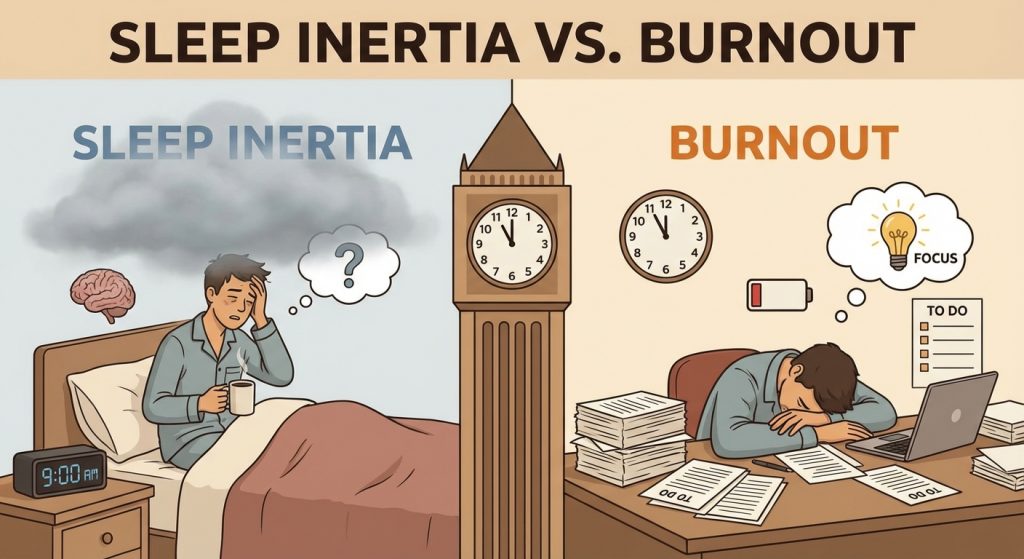
It is 8:30 AM. I am sitting in front of my computer. My eyes are open. My hands are on the keyboard. I have a cup of coffee steaming to my right. But if you asked me to perform a complex task—like analyzing a spreadsheet or writing a coherent email—I would fail. My brain feels like an engine trying to start in sub-zero temperatures. It cranks, it sputters, but it refuses to catch.
For years, I labeled this sensation “laziness.” Later, when the self-criticism became too heavy, I labeled it “burnout.” I assumed that because I hated mornings, I must hate my job, or my life, or that I was simply broken.
I was wrong. While I have certainly experienced stress, what I was fighting every morning wasn’t a psychological rejection of work. It was a physiological state known as Sleep Inertia.
If you are reading this because you consistently feel “drunk” until 11:00 AM, or because your executive dysfunction fatigue makes the first three hours of the day a write-off, you need to understand the difference between a brain that is burned out and a brain that simply hasn’t finished its boot-up sequence.
This is not about “hustle culture” or waking up at 4:00 AM to grind. This is about biology. This is about why you feel like a zombie despite your Apple Watch Ultra 2 telling you that you slept for seven hours. Here is what I learned about clearing the brain fog morning and regaining those lost morning hours.
The Diagnosis: Is It Burnout or Just Inertia?
Before we start buying gadgets or changing routines, we have to distinguish the enemy. Both states feel identical in the moment: a heaviness behind the eyes, an inability to prioritize tasks, and a strong desire to crawl back under the duvet.
What is Sleep Inertia?
Sleep inertia is a transitional state of lowered vigilance, confusion, and poor cognitive performance that occurs immediately after awakening. It is the residue of sleep. Neurophysiologically, your brain stem (arousal) might be active, but your Prefrontal Cortex (logic, planning, executive function) is still partially offline.
Think of it like older computer hardware. You press the power button, the fan spins (you are awake), but the operating system takes 45 minutes to load the icons.
Key Symptoms of Sleep Inertia:
- Timing: It is most severe immediately upon waking and gradually dissipates. By 11:00 AM or noon, you often feel “normal” or even energetic.
- The Weekend Test: If you sleep in on Saturday and wake up naturally (without an alarm) at 9:30 AM, do you feel significantly better? If yes, it’s likely inertia caused by sleep debt or circadian misalignment.
- Reaction: Your reaction time sleep loss is measurable. You drop things. You stumble.
What is Burnout?
According to the World Health Organization (WHO), burnout is an “occupational phenomenon” resulting from chronic workplace stress that has not been successfully managed. It is not just being tired; it is being depleted.
Key Symptoms of Burnout:
- Timing: It does not fade by 11:00 AM. The brain fog morning persists into the afternoon. In fact, the fog might get thicker as you engage with work tasks.
- Emotion: It comes with cynicism, detachment, or a sense of dread specifically related to your obligations.
- The Weekend Test: If you wake up on Saturday and still feel exhausted, cynical, and unable to focus on hobbies you usually enjoy, this is likely burnout or depression, not just a sleep issue.
For me, the realization came when I tracked my mood. Once the clock hit 11:30 AM, my focus sharpened. I could work. I could laugh. I wasn’t burned out; I was suffering from severe, mismanaged sleep inertia compounded by social jetlag symptoms.
The Science: Why Your Brain Won’t Start
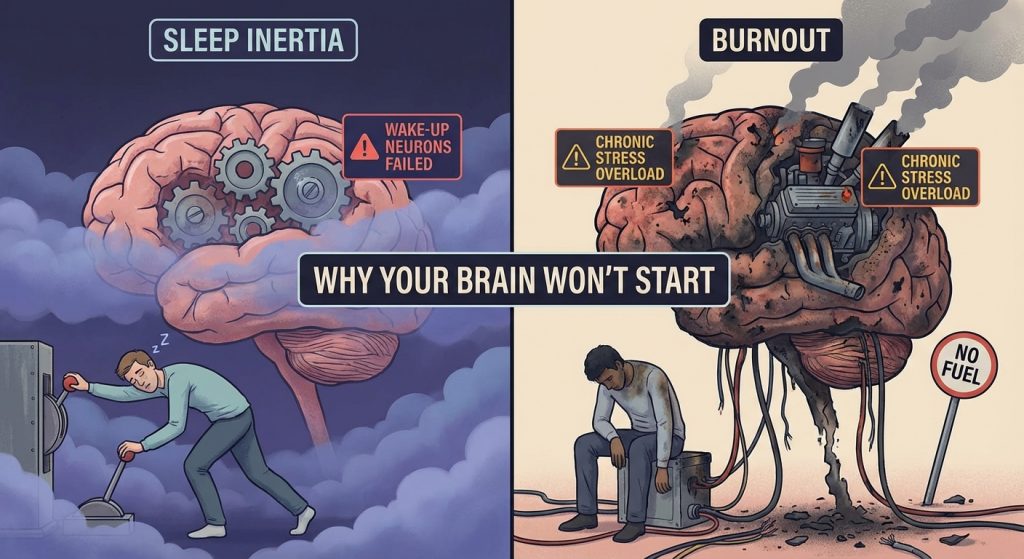
To fix the groggy morning fix, we have to look at what is happening under the hood. Why does sleep deprivation focus hit us so hard in the morning?
1. The Adenosine Hangover
Throughout the day, your brain builds up adenosine, a chemical that creates “sleep pressure.” When you sleep, the glymphatic system (the brain’s sewage system) washes this adenosine away. If you cut your sleep short, or if your sleep architecture is fragmented by issues like UARS (Upper Airway Resistance Syndrome), the wash cycle doesn’t finish. You wake up with residual adenosine. You are chemically still asleep.
2. Waking Up From the Wrong Stage
If you look at a hypnogram (a sleep stage chart), you see cycles of Light, Deep (NREM3), and REM sleep.
- The Ideal Scenario: You wake up from Light Sleep or the end of a REM cycle. Your brain is already near the surface of consciousness.
- The Inertia Scenario: Your alarm screams while you are in NREM3 (Deep Sleep). In this stage, your brain waves are slow (delta waves). Yanking the brain from Delta waves to Beta waves (alertness) instantly is traumatic. This causes the most severe form of inertia, often described as “sleep drunkenness.”
3. Circadian Misalignment
This was my biggest issue. I was forcing myself to wake up at 7:00 AM, but my biological clock (suprachiasmatic nucleus) thought it was 4:00 AM. My body temperature was at its lowest point. My cortisol hadn’t started its morning spike. I was fighting my own biology. This is common if you identify as a “night owl” but work a “morning lark” job.
4. Executive Dysfunction Fatigue
The part of your brain responsible for “getting things done”—the Prefrontal Cortex—is the last region to come online after sleep. When you have high sleep inertia, the connectivity between the cognitive control network and the rest of the brain is disrupted. This is why you can scroll social media (low cognitive load) but can’t draft a strategy document (high cognitive load).
The Protocol: How I Cured My Morning Zombie State
I didn’t fix this overnight. It took months of testing. I stopped looking for a magic pill (though some supplements help) and started treating my morning routine as a physiological resuscitation protocol.
Here is the step-by-step strategy that actually works, based on the latest 2025 research and my own data.
Step 1: The “Dawn Simulation” (Light is the Key)
Light is the primary “Zeitgeber” (time-giver) for the human body. If you wake up in a pitch-black room to a loud alarm, you are guaranteeing failure.
My Setup:
I use a smart light setup that mimics sunrise. However, recently I upgraded to using my Beurer TL45 bright light therapy lamp immediately.
- The Mechanism: Recent 2025 studies on “natural light control” confirm that exposure to gradually increasing light before audible waking significantly improves “awakening quality.” The light penetrates the eyelids, suppressing melatonin and nudging the cortisol awakening response before you even open your eyes.
- Action Step: As soon as my alarm goes off, I turn on the Beurer TL45 (at 10,000 lux) and sit in front of it for 15 minutes while I drink water. This is non-negotiable. This is the morning sunlight protocol that sets my circadian rhythm for the next 24 hours. If you can get outside into real sunlight, do it. But in the dark winters of Europe, the lamp is my savior.
Step 2: Hydration and Temperature Shock
Core body temperature drops to its lowest point around 4:00 AM and needs to rise to trigger alertness. Sleep inertia thrives in a warm, cozy bed.
- The “Cold Engine” Fix: I drink 500ml of water immediately. Then, I go to the bathroom and splash cold water on my face and wrists for 30 seconds.
- Why it works: The thermal shock activates the sympathetic nervous system (mild adrenaline). It forces the heart rate up slightly and signals to the body that the “rest” phase is over. It’s a crude but effective way to shake off the brain fog morning.
Step 3: Movement (The Micro-Workout)
I used to think I needed to do a full gym session to wake up. I was wrong. I just needed to get blood to the brain.
- The 60-Second Rule: Immediately after the cold water splash, I do 60 seconds of vigorous movement. Jumping jacks, air squats, or just running in place.
- The Science: Research shows that a “short burst” of exercise dissipates subjective sleepiness faster than caffeine. It pushes oxygenated blood into the frontal cortex. I am not trying to build muscle here; I am trying to clear the cobwebs.
Step 4: The Caffeine Timing Strategy
This is controversial. For years, I drank coffee the second my eyes opened. The community at The Quantified Scientist and Huberman listeners argue for waiting 90 minutes to avoid the “afternoon crash.”
My Reality:
When sleep inertia is severe, waiting 90 minutes is torture. I adopted a middle ground based on new findings regarding caffeine half-life.
I wait 30 minutes. I let the light and water do the heavy lifting first. Then I consume caffeine.
- Coffee Nap Option: On days where the inertia is crippling (perhaps due to a bad night of maintenance insomnia), I use the “Nappuccino” technique. I drink a double espresso and immediately close my eyes for 20 minutes. The caffeine takes 20 minutes to hit the bloodstream. When I wake up, the adenosine is slightly cleared by the nap, and the caffeine kicks in simultaneously. It is rocket fuel.
Step 5: The Snooze Button (2025 Update)
For years, sleep hygiene purists screamed that the snooze button was the devil. If you hit snooze, you fragment your sleep and make inertia worse.
The New Data:
A massive 2025 analysis of snooze habits (published in Nature) suggests it’s more nuanced. “Light snoozing” (one hit, 5-10 minutes) might actually help dissipate inertia for some chronotypes by allowing a gentler transition from deep sleep to light sleep.
However, “Heavy Snoozing” (30 minutes of drifting in and out) is destructive. It confuses the brain’s sleep-wake flip-flop switch.
My Rule: I allow myself one snooze only if I am feeling physically heavy. But generally, I place my phone across the room. The physical act of standing up to turn it off breaks the paralysis.
Step 6: Consistency (The Boring Truth)
You cannot cure sleep inertia if you have social jetlag. This is the phenomenon where you wake up at 7:00 AM on weekdays and 11:00 AM on weekends. This shifting schedule keeps your brain in a permanent state of lag.
The Fix: I wake up at 8:00 AM every single day. Even Sunday. If I am tired, I take a nap later. But the wake time is the anchor.
The “Tired But Wired” Factor
Sometimes, the morning fog isn’t because you slept too deep, but because your sleep quality was garbage. This brings us to the tired but wired symptoms.
If you are stressed or approaching burnout, your HPA axis (hypothalamic-pituitary-adrenal axis) is dysregulated. You might have high cortisol at night (preventing deep sleep) and low cortisol in the morning (making it impossible to wake up). This “inverted cortisol curve” creates a vicious cycle.
- The Loop: Stress at work -> High evening cortisol -> Fragmented sleep (micro-awakenings) -> Severe morning inertia -> Inability to work -> More stress.
- The Solution: You cannot fix this with coffee. You have to fix the evening routine. I use Apigenin and Magnesium L-Threonate to lower evening excitation. If I don’t calm the “wired” feeling at night, I pay for it with “tired” in the morning.
Medical Rule-Outs: When It’s Not Just Inertia
If you try all the above—light, movement, consistency—and you still feel like you have a concussion every morning, you need to look at pathology.
1. UARS and Apnea
I spent years thinking I was just “not a morning person.” It turned out I had flow limitations in my breathing. Even mild oxygen desaturation or respiratory effort (RERA) pulls you out of deep sleep repeatedly. You wake up exhausted because you just ran a marathon in your sleep fighting for air.
Action: Use a Wellue O2Ring or request a home sleep test. Look at your pulse spikes. If your pulse is spiking all night, your sleep is fragmented.
2. Nocturnal Hypoglycemia
Are you waking up in a sweat? Is the brain fog accompanied by a headache or intense hunger? You might be experiencing a glucose crash at night.
Action: I used a Freestyle Libre 3 to check this. While my glucose was stable, for many, a drop in blood sugar triggers an adrenaline spike at 3 AM, ruining the rest of the night’s sleep quality.
3. Depression
We must be honest. A complete inability to get out of bed, accompanied by a lack of joy, can be a symptom of clinical depression. Sleep inertia is physical; depression is pervasive. If the “fog” is emotional and heavy, please see a specialist.
Supplements for the Morning Fog?
While I focus on removing negative factors, a few supplements have helped my cognitive performance sleep recovery in the mornings.
- Rhodiola Rosea: This is an adaptogen. I take 500mg in the morning on empty stomach. It helps mitigate stress-induced fatigue and seems to clear the fog faster than caffeine alone. It is stimulating, so never take it at night.
- Creatine: Surprisingly, creatine isn’t just for muscles. It is fuel for the brain. Sleep deprivation depletes creatine stores in the brain. Taking 5g daily helps maintain cognitive function even after a bad night.
- L-Tyrosine: A precursor to dopamine. On days where the inertia feels like a lack of motivation, 500mg of L-Tyrosine helps “turn on” the executive function.
Summary: Your Morning Rescue Plan
You are not lazy. You are biologically misaligned. To defeat the sleep inertia cure puzzle, you need to stop treating your body like a machine that should switch on instantly and start treating it like a biological system that needs a boot-up sequence.
The Protocol Checklist:
- 1. Rule out Medical Issues: Ensure you don’t have Apnea, UARS, or nocturnal hypoglycemia using tools like the O2Ring or 24 hour salivary cortisol test.
- 2. Anchor the Wake Time: Pick a time and stick to it, +/- 30 minutes, 7 days a week.
- 3. Blast the Light: 10,000 lux (Beurer TL45) or sunlight immediately upon waking.
- 4. Cold & Move: Cold water on the face, 60 seconds of jumping jacks.
- 5. Delay & Dose Caffeine: Wait 30 minutes, then hydrate and caffeinate.
- 6. Evening Prep: You cannot wake up well if you go to bed “wired.” Manage your sleep hygiene checklist to ensure the sleep you get is restorative.
The hours between 8:00 AM and 11:00 AM are precious. Do not lose them to the fog. Take control of your physiology, and the focus will follow.
Related Articles:
The Sleep Triage Test: Do You Have Insomnia, Apnea, or UARS?

By: Alex Warenstein.
Bio: Alex Warenstein is a sleep biohacker and founder of Night Time Comfort. After battling chronic insomnia and circadian disruption, he now helps others optimize their sleep using data-driven protocols. Read full story.
Disclaimer: Alex is not a doctor. This content is for educational purposes only. Always consult a specialist.